
William Blake’s The Tyger Summary and Analysis
William Blake wrote “The Tyger” in 1794, and it remains one of the most quoted poems in the English language. Readers keep returning to it because it asks a question that never gets old: how can a world contain both innocence and violence, both a lamb and a tiger, if the same creator made them?
This guide breaks the poem down stanza by stanza, explains its symbolism, and places it next to Blake’s other work so you understand not just what the poem says, but why it still matters.
Quick Facts About “The Tyger”
| Detail | Information |
|---|---|
| Poet | William Blake |
| Published | 1794, in Songs of Experience |
| Form | Six quatrains (four-line stanzas) |
| Meter | Trochaic tetrameter |
| Rhyme Scheme | AABB (rhyming couplets) |
| Companion Poem | “The Lamb” (from Songs of Innocence, 1789) |
| Central Theme | The coexistence of good and evil in creation |
Full Summary of “The Tyger”
The poem is a single, sustained question addressed to a tiger burning bright in a dark forest. The speaker doesn’t describe the tiger’s appearance so much as interrogate its origin. He asks what kind of divine being could have designed something so fearsome and so beautiful at once.
Blake structures the entire poem as a string of questions — there isn’t a single declarative answer anywhere in it. The speaker wonders what forge, what hammer, what furnace, and what anvil could have shaped the tiger’s brain. He imagines a blacksmith-like creator working with fire and metal, which was a radical way to picture God in the 1790s. By the end, the speaker asks the poem’s most famous line: did the same hand that made the gentle lamb also make you?
That question never gets answered. Blake leaves the tension open, and that refusal to resolve it is the entire point.
Stanza-by-Stanza Analysis
Stanza 1: The Opening Address
“Tyger Tyger, burning bright, / In the forests of the night”
Blake opens with direct address, speaking to the tiger as though it can hear him. The phrase “burning bright” immediately fuses fire imagery with the animal, setting up the forge metaphor that runs through the whole poem. “Forests of the night” places the tiger in darkness, contrasting its inner fire against its shadowy surroundings — a visual pairing of light and dark that mirrors the poem’s larger theme of good and evil.
Stanza 2: The Forge Imagery Begins
Blake asks what “distant deeps or skies” could have burned the fire in the tiger’s eyes, and what wings or hands dared to seize that fire. This stanza introduces the idea of the creator as a craftsman, someone who physically handles dangerous materials. The word “dare” appears here for the first time and repeats throughout the poem — it suggests that making the tiger required not just skill but courage, even audacity.
Stanza 3: The Physical Creation
Here Blake pictures the tiger’s heart and shoulder being built by hand. He asks what art could twist the sinews of the heart, and once the heart began to beat, what dread hand and what dread feet continued the work. The repetition of “dread” signals that this creative act is frightening, not gentle — very different from how creation is usually described in religious texts.
Stanza 4: The Blacksmith Metaphor
This stanza is the poem’s industrial core. Blake asks about the hammer, the chain, the furnace, and the anvil — tools of a blacksmith, not a gardener or a gentle craftsman. This imagery was striking for its time because it placed God (or whatever force made the tiger) inside a workshop full of fire and metal, closer to industrial labor than to soft, pastoral creation.
Stanza 5: The Turn
“When the stars threw down their spears, / And water’d heaven with their tears”
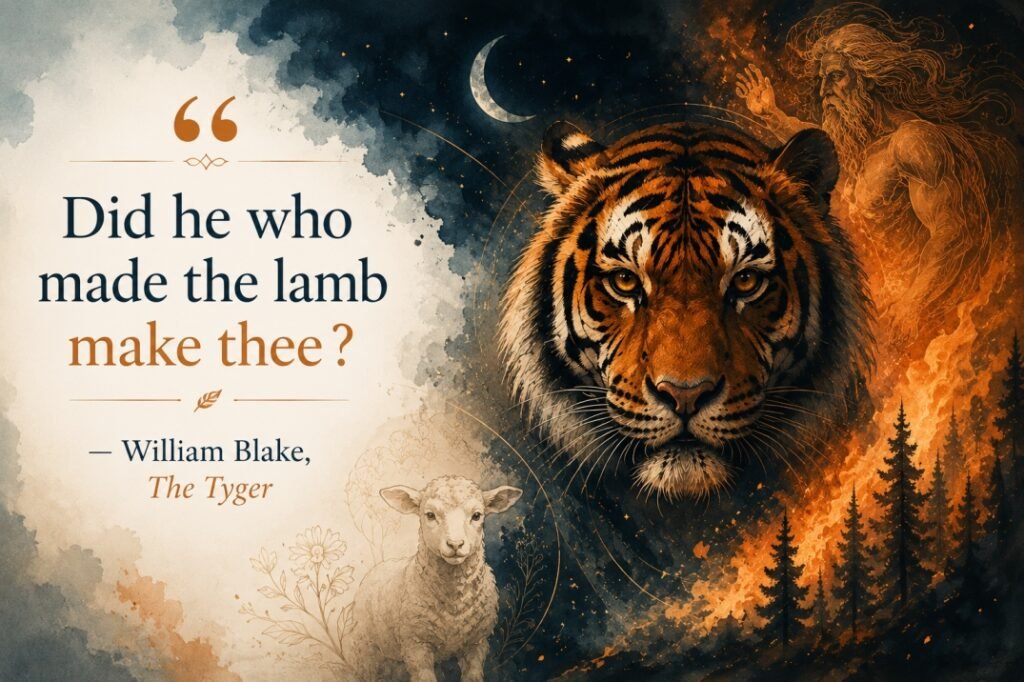
This is the most debated stanza in the poem. Many readers connect it to the fall of the rebel angels in Milton’s Paradise Lost, where the stars (angels) are defeated and weep. Blake then asks the creator directly: did he smile at his work? Did the one who made the lamb also make you? This is the emotional peak of the poem — the direct comparison between the tiger and the lamb, between violence and innocence, arriving from the same source.
Stanza 6: The Return
The final stanza repeats the first almost word for word, except one crucial change. In the opening stanza, Blake asks “What immortal hand or eye / Could frame thy fearful symmetry?” In the final stanza, “Could” becomes “Dare.” That single word swap shifts the tone from wondering whether the creator was capable of this act to wondering whether the creator was bold enough to attempt it at all. It’s a small edit with enormous weight.
Major Themes in “The Tyger”
Creation and Duality
The poem’s central tension is that the same force appears to have created both the tiger’s violence and the lamb’s innocence. Blake never resolves whether this is a contradiction, a mystery, or simply the nature of existence.
The Sublime
“The Tyger” is often cited as a textbook example of the Romantic sublime — beauty that terrifies as much as it delights. The tiger is not a villain in the poem; it’s presented as an object of awe.
Industry and Divinity
By imagining God as a blacksmith working with fire, hammers, and chains, Blake blends the imagery of the Industrial Revolution with religious creation, a combination that would have felt startling to readers in 1794.
Unanswered Questions
Every single stanza in the poem poses a question. Not one is answered directly. This structural choice reflects Blake’s broader belief that experience — the corrupted, complicated adult world — often raises questions that simple faith cannot resolve.
“The Tyger” and “The Lamb”: Innocence vs. Experience
Blake published “The Lamb” in Songs of Innocence (1789) and “The Tyger” in Songs of Experience (1794), five years apart. Together, they form one of the clearest thematic pairings in English poetry.
“The Lamb” asks a gentle child’s question — who made thee? — and answers it simply: the lamb was made by a creator who calls himself a lamb too, a clear reference to Christ. “The Tyger” asks the same fundamental question but never answers it, and the answer it implies is far more unsettling.
Read side by side, the two poems show Blake’s larger project across Songs of Innocence and of Experience: presenting “the two contrary states of the human soul.” Innocence sees a world of gentle, comprehensible order. Experience sees a world where good and evil come from the same unexplainable source.
How “The Tyger” Compares to Blake’s Contemporaries
Blake wrote at the start of the Romantic period, alongside poets like William Wordsworth, Samuel Taylor Coleridge, and later Percy Bysshe Shelley and John Keats. Comparing “The Tyger” to their work shows what made Blake distinct even among Romantics.
Blake vs. Wordsworth: Wordsworth’s nature poetry, such as “Lines Composed a Few Miles Above Tintern Abbey,” treats nature as a source of moral comfort and healing. Blake’s tiger offers no comfort. Nature, for Blake, can be as terrifying as it is beautiful, and he refuses to soften that.
Blake vs. Coleridge: Coleridge’s “The Rime of the Ancient Mariner” also explores guilt, the supernatural, and a universe governed by forces beyond human control. But Coleridge’s poem moves toward moral resolution and redemption. Blake’s poem stays in the question, offering no redemptive close.
Blake vs. Keats: Keats’s odes, particularly “Ode on a Grecian Urn,” share Blake’s interest in art that captures something frozen and eternal. Keats, however, resolves his poem with a philosophical statement (“Beauty is truth, truth beauty”). Blake resolves nothing — his poem ends on a question mark, not a conclusion.
This refusal to resolve tension is part of what makes Blake feel more modern than many of his Romantic peers. He was working alone, largely outside the literary establishment of his day, and his willingness to leave contradictions open rather than smoothing them into a moral is one of his most distinct traits as a poet.
Blake’s Other Major Works Worth Reading
If “The Tyger” is your entry point into Blake, these works build a fuller picture of his poetry:
- “The Lamb” — the direct companion piece from Songs of Innocence
- “The Chimney Sweeper” (both versions, one in Innocence and one in Experience) — Blake’s critique of child labor and religious hypocrisy
- “London” — a darker, more political poem about the suffering Blake witnessed in the city
- “Auguries of Innocence” — famous for its opening lines about seeing “a World in a Grain of Sand”
- “The Marriage of Heaven and Hell” — a prose-poetry work that expands on the same themes of duality found in “The Tyger”
Reading these alongside “The Tyger” shows that Blake wasn’t only interested in tigers and lambs. He was consistently drawn to the gap between how society presents itself and what it actually does to the vulnerable — children, the poor, and, in “The Tyger,” the assumption that creation itself must be gentle.
Frequently Asked Questions
What is the main message of “The Tyger”?
The poem questions whether the same creator who made gentle, innocent beings could also have made something as fierce and dangerous as a tiger, without ever providing a definite answer.
Why did Blake spell it “Tyger” instead of “Tiger”?
The archaic spelling was common in Blake’s era and adds a sense of mystery and otherness to the animal, separating it from an ordinary tiger.
What does the “forge” imagery represent in the poem?
The hammer, chain, furnace, and anvil imagery presents creation as an act of intense, almost violent labor, comparing the divine creator to a blacksmith rather than a gentle craftsman.
Is “The Tyger” a religious poem?
It engages with religious questions about creation and divinity, but it doesn’t offer religious comfort. Instead, it uses religious imagery to voice doubt and awe rather than settled belief.
How does “The Tyger” connect to “The Lamb”?
Both poems ask “who made thee?” “The Lamb” answers with comforting simplicity; “The Tyger” asks the same question about a far more frightening creature and leaves it unresolved.
Final Thoughts
“The Tyger” endures because it doesn’t try to comfort its readers. Blake takes one of the oldest questions in literature — why does the world contain both beauty and terror — and refuses to resolve it, leaving the tiger burning bright in the dark, exactly where he found it. If you have liked The Tyger Summary and Analysis, follow us on our social media channels.
Also read: Jorge Luis Borges Books Ranked