
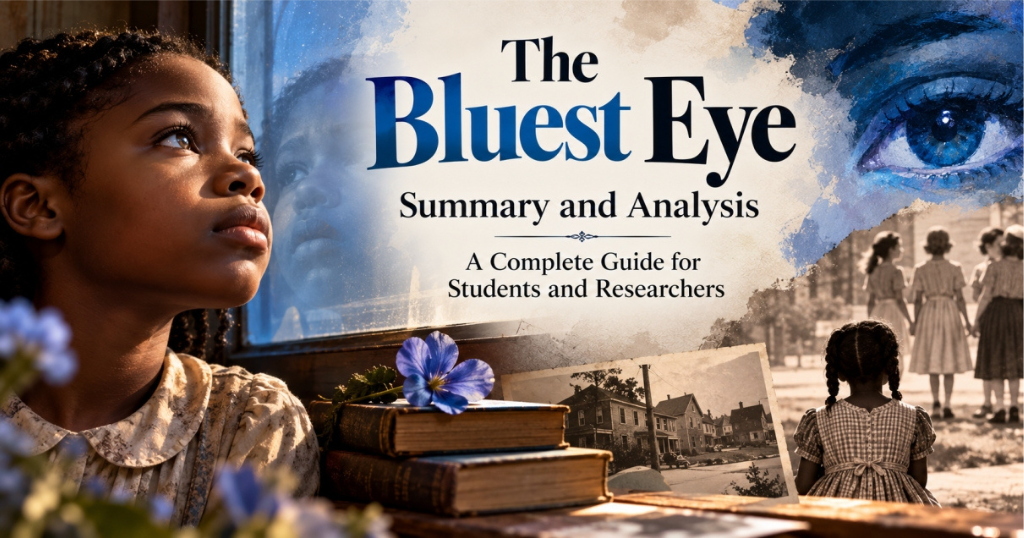
The Bluest Eye (1970) is Toni Morrison’s first novel. It follows Pecola Breedlove, an eleven-year-old Black girl in 1940s Lorain, Ohio, who believes blue eyes would make her beautiful and finally earn her love. The book shows how white beauty standards, poverty and abuse destroy her, and it asks who in the community let that happen.
This guide gives you a full Bluest Eye summary, a character breakdown, the major themes and symbols, and a comparison with other great writers of Morrison’s era.
1. About the Book and Author
Toni Morrison (1931–2019) published The Bluest Eye in 1970, when she was working as an editor. She later won the Pulitzer Prize for Beloved (1988) and the Nobel Prize in Literature (1993). She wrote The Bluest Eye because she wanted to read the story of a Black girl whom American literature had ignored.
Morrison sets the novel in Lorain, Ohio, her hometown, between autumn 1940 and summer 1941. Readers can find the book’s heart in a single idea: a society that worships whiteness teaches a child to hate her own face.
2. The Bluest Eye Summary (Short Version)
Pecola Breedlove lives in a storefront home with her violent father Cholly, her bitter mother Pauline, and her brother Sammy. Everyone calls the family ugly, and Pecola believes them. She prays every night for blue eyes, convinced they would change how the world treats her.
Her father burns down their home, which leaves her briefly staying with the MacTeer family. Claudia and Frieda MacTeer, two sisters, become her friends and later tell her story. Cholly later rapes Pecola, and she becomes pregnant. She visits Soaphead Church, a fraudulent spiritual advisor, who pretends to grant her wish. Pecola then believes she has the bluest eyes in the world. Her mind breaks, and her baby dies soon after birth. The community looks away.
3. The Bluest Eye Summary by Section
Morrison divides the novel into four seasons. Each season shows a different stage of Pecola’s collapse. Short Dick-and-Jane primer passages open the book and break apart as the story darkens.
The Opening: A Primer and a Warning
The novel begins with a version of the old school reading primer. It describes a perfect white family, a neat house and a happy dog. Morrison repeats the passage with the punctuation stripped out, then with the spaces gone. This tells readers that the “ideal family” cannot hold up against the Breedloves’ reality.
Claudia, the adult narrator, then reveals the ending at once. Her opening line is a key piece of the Bluest Eye summary:
“Quiet as it’s kept, there were no marigolds in the fall of 1941.”
The marigold seeds the girls planted never bloomed, just as Pecola’s baby never lived. Morrison names the outcome first and makes the reader ask why it happened.
Autumn
Claudia describes her own childhood. She hates the blue-eyed white dolls adults give her, and she even takes one apart to find what makes it lovable. Her family struggles but protects her. Meanwhile, Pecola arrives to live with the MacTeers after her father puts the family “outdoors,” which in their community means a deep shame.
Pecola drinks milk from a cup decorated with Shirley Temple’s face. She stares at it again and again and drinks great quantities of milk just to hold it. The scene shows how deeply she longs for whiteness.
Winter
We meet Maureen Peal, a light-skinned girl who receives admiration from teachers and classmates. Claudia and Frieda feel both jealous and angry. When a group of boys torments Pecola, Maureen helps at first, then turns cruel and insults her.
Morrison also tells the story of Pecola’s mother, Pauline. Pauline was a girl with a damaged foot who moved north, then fell in love with Hollywood films. The movies taught her that beauty means whiteness, and she judged her own family by that standard. Later, she works as a maid for a wealthy white family and cares for their blonde daughter with more tenderness than she ever shows Pecola.
Spring
Pecola visits the store of Mr. Yacobowski to buy Mary Jane candy, which carries a picture of a smiling blonde girl. The shopkeeper will not even look at her. She feels her own invisibility, and Morrison describes the moment with quiet precision.
Geraldine, a middle-class Black woman who tries to erase every trace of “common” Black life, cares for her cat more than her son Junior. Junior lures Pecola into the house, throws the cat at her, and kills it. Geraldine blames Pecola and calls her a name that cuts deep.
Morrison then tells Cholly’s backstory. His mother left him as a baby, and his great-aunt died not long after. White hunters humiliated him during his first sexual experience as a teenager. The humiliation never left him, and he grew into a man who hates the people who love him. Morrison does not excuse his crime. She wants readers to see how cruelty passes from one generation to the next.
Summer
Cholly assaults Pecola. Morrison handles the scene with restraint and with sorrow, and she gives Pecola’s perspective little space, because the world gave Pecola little space. After her mother refuses to believe her, Pecola seeks help from Soaphead Church. He tells her to feed poisoned meat to a dog. When the dog dies in agony, Pecola believes God has answered her prayer.
By the end, Pecola talks to an imaginary friend who assures her that her eyes are the bluest in the world. Claudia and Frieda understand too late that the whole town used Pecola as a scapegoat. The town felt beautiful, Claudia says, only because it stood beside her ugliness.
4. Main Characters
- Pecola Breedlove: The central figure. She wants love and believes beauty will bring it.
- Claudia MacTeer: The narrator, both as a child and as an adult. She resists white beauty standards but feels guilt about how little she could do.
- Frieda MacTeer: Claudia’s older sister. She is braver and more practical.
- Cholly Breedlove: Pecola’s father. Trauma and shame twist him into an abuser.
- Pauline (Polly) Breedlove: Pecola’s mother. She prefers the fantasy of the white household where she works over her own family.
- Soaphead Church: A false holy man who exploits Pecola’s faith.
- Maureen Peal, Geraldine and Junior: Characters who show how colorism and class prejudice divide the Black community.
5. Themes and Analysis
Internalized Racism and Beauty Standards
The central theme of any good Bluest Eye analysis is how white beauty standards shape Black self-image. Morrison argues that Pecola does not simply feel ugly. Movies, dolls, candy wrappers and school books all teach her that she is. The culture trains her, and the training works.
Community Responsibility
Morrison does not blame one villain. Pauline, Geraldine, Maureen, Soaphead and the townspeople each push Pecola a little further. The “who is to blame?” question stays open, and the reader must answer it.
Family, Love and Violence
The Breedloves show how a lack of love creates more violence. Cholly’s own childhood explains his rage but never excuses it. Morrison separates understanding from forgiveness.
Colorism and Class
Light-skinned characters like Maureen Peal receive better treatment, and middle-class characters like Geraldine look down on poorer Black families. Morrison reveals that pain inside the community can mirror the racism outside it.
Innocence and Its Destruction
Claudia says the seeds of the marigolds would not grow. This image suggests that a poisoned soil, meaning a poisoned society, kills innocent things before they bloom.
6. Symbols and Motifs
- Blue eyes: They represent whiteness, acceptance and the beauty the world rewards.
- Dolls: Claudia’s rage at white dolls shows a child rejecting an ideal she cannot reach.
- Shirley Temple cup and Mary Jane candy: Everyday objects carry the message that white girlhood is the standard of beauty.
- Marigolds: Hope that never blooms.
- Dick-and-Jane primer: The fantasy of the perfect family and the lie behind it.
- Seasons: Morrison uses them in an ironic way, since the story moves toward death rather than renewal.
7. Narrative Style
Morrison uses two narrators. Claudia speaks in the first person, and an omniscient voice reveals the inner lives of characters such as Cholly and Pauline. This structure lets readers see the child’s confusion and the adult world’s cruelty together.
She also breaks the timeline. Backstories interrupt the main plot, and the primer text repeats and degrades. These choices force readers to piece together the tragedy, which mirrors how a community pieces together, and ignores, the signs of Pecola’s suffering.
8. Morrison’s Other Works
The themes in The Bluest Eye return across Morrison’s career:
- Sula (1973): Examines female friendship, and the idea of good and evil within a Black community.
- Song of Solomon (1977): Follows a man’s search for his family history and identity.
- Tar Baby (1981): Looks at class, race and culture through a love story.
- Beloved (1987): Explores the haunting legacy of slavery through the story of Sethe and her daughter.
- Jazz (1992), Paradise (1997), A Mercy (2008): Continue her focus on memory, community and the cost of exclusion.
Readers who finish this Bluest Eye summary often move on to Sula, which shares the same setting of Ohio and revisits the pressures on Black girls and women. You can also read her best quotes to get inspired by her work.
9. Morrison Compared with Other Writers of Her Time
- Ralph Ellison, Invisible Man (1952): Ellison writes about a man whom society refuses to see. Pecola experiences invisibility too, but Morrison centers a young Black girl and shows how gender sharpens the injury.
- Richard Wright, Native Son (1940): Wright shows how racism pushes a young man toward violence. Morrison shifts the lens toward the victims inside the home, and she finds the damage in intimate spaces.
- James Baldwin, Go Tell It on the Mountain (1953): Both writers explore religion, family trauma and the weight of shame. Baldwin focuses on a boy’s spiritual struggle, while Morrison questions whether faith can protect a child at all.
- Zora Neale Hurston, Their Eyes Were Watching God (1937): Hurston celebrates a Black woman’s voice and her search for self. Morrison explores what happens when that search fails.
- Maya Angelou, I Know Why the Caged Bird Sings (1969): Angelou, writing a year before Morrison, also describes childhood trauma and the pain of white beauty ideals. She survives and finds her voice. Pecola does not.
- Alice Walker, The Color Purple (1982): Walker follows a Black woman who heals through love and sisterhood. Morrison gives her readers no such relief.
- William Faulkner: Morrison studied Faulkner at university. Her fragmented timelines and shifting narrators recall his technique, but she uses them to give voice to people he overlooked.
10. Why the Book Is Still Controversial
Schools and libraries have challenged The Bluest Eye many times because of its depiction of sexual abuse and its frank language. Defenders argue that the book treats the abuse with moral seriousness and never celebrates it. Many teachers consider it essential reading, since it speaks honestly about harm that young people may face or witness.
11. Frequently Asked Questions
What is The Bluest Eye about?
It tells the story of Pecola Breedlove, a Black girl who believes blue eyes will make her beautiful and loved. Her community, her family and a racist culture fail her.
What is the main message of The Bluest Eye?
Morrison shows how society’s definition of beauty can wound a child’s sense of self, and how a whole community shares responsibility for that harm.
Who narrates The Bluest Eye?
Claudia MacTeer narrates, and an omniscient voice fills in the stories Claudia could not know.
Why are there no marigolds in the fall of 1941?
The marigolds stand for hope. They fail to grow, just as Pecola’s baby dies, and Claudia reflects on the community’s part in both.
Does Pecola get blue eyes?
No. She only believes she does, after her mind breaks under the pressure of abuse and rejection.
Is The Bluest Eye based on a true story?
It is fiction. Morrison has said it began with a childhood classmate who told her she wanted blue eyes, and the memory stayed with her.
Why is The Bluest Eye banned in some places?
People challenge it for its depiction of rape and incest. Supporters say these scenes serve the book’s moral purpose.
Final Thoughts
This Bluest Eye summary shows why Morrison’s debut still matters. The novel exposes how racism, colorism and neglect work together to break a child, and it asks readers to look at the people who stood by. Read it slowly, and pair it with Sula or Beloved to see how Morrison builds on these ideas.
Also read: 25 Charles Lamb Quotes