
Winter changes how we see the world. Snow hides the land. Days turn short. Nights grow long and silent. Poets have always loved this season. It gives them a language for loss, hope, faith and quiet thought.
This guide brings you the best winter poems ever written. Each entry gives you key lines from the poem. It explains what the poem means and why it still matters. You will also meet the poet, explore their other famous works, and see how they compare with writers of their time.
Students, teachers and poetry lovers can use this list. It works for exam prep, classroom reading, or a quiet evening with a cup of chai.
Quick Answer: What Are the Best Winter Poems of All Time?
The best winter poems of all time are:
- “Stopping by Woods on a Snowy Evening” by Robert Frost
- “The Darkling Thrush” by Thomas Hardy
- “In the Bleak Midwinter” by Christina Rossetti
- “Winter” (“When icicles hang by the wall”) by William Shakespeare
- “The Eve of St. Agnes” by John Keats
- “Frost at Midnight” by Samuel Taylor Coleridge
- “There’s a certain Slant of light” by Emily Dickinson
- “The Snow Man” by Wallace Stevens
- “The Snow-Storm” by Ralph Waldo Emerson
- “Snow-flakes” by Henry Wadsworth Longfellow
- “Snow-Bound” by John Greenleaf Whittier
- “Ring Out, Wild Bells” by Alfred, Lord Tennyson
- “London Snow” by Robert Bridges
- “Dust of Snow” by Robert Frost
- “To a Locomotive in Winter” by Walt Whitman
How We Chose These Poems
We did not pick these poems at random. Our editorial team judged each poem on four points:
- Literary impact: Did the poem shape later poetry?
- Lasting popularity: Do readers, schools and anthologies still use it?
- Depth of meaning: Does winter carry a bigger idea, like death, faith or hope?
- Readability: Can a modern reader enjoy it?
Every poem on this list is in the public domain. We quoted the lines from standard published texts.
1. “Stopping by Woods on a Snowy Evening” by Robert Frost (1923)
Key Lines
Whose woods these are I think I know.
His house is in the village though;
He will not see me stopping here
To watch his woods fill up with snow.My little horse must think it queer
To stop without a farmhouse near
Between the woods and frozen lake
The darkest evening of the year.(Final stanza)
The woods are lovely, dark and deep,
But I have promises to keep,
And miles to go before I sleep,
And miles to go before I sleep.
What the Poem Means
A traveller stops his horse near a snowy forest. He watches the snow fall. The woods pull him in. They feel calm and peaceful. But he has duties waiting. So he moves on.
The poem looks simple. It is not. The dark woods may stand for rest, escape, or even death. The “promises” stand for life’s duties. The repeated last line feels like a sigh. It shows a tired man who still chooses to keep going.
Why It Matters
This is often called the most famous of all the best winter poems. Frost packs a whole life choice into 16 short lines. The rhyme scheme (AABA, BBCB, and so on) links each stanza to the next. It feels like walking through snow, one step at a time.
The poem also has an Indian connection. Jawaharlal Nehru kept its last lines on his desk until his death. They reminded him of his work for the nation.
About the Poet
Robert Frost (1874–1963) was an American poet. He won four Pulitzer Prizes. He wrote about rural New England, farm life and hard choices.
Other famous works: “The Road Not Taken,” “Mending Wall,” “Birches,” “Fire and Ice,” “After Apple-Picking.”
Compared with his peers: T.S. Eliot and Ezra Pound broke old forms. They wrote in fragments. Frost did the opposite. He kept rhyme and meter. He used plain speech. Eliot’s “The Waste Land” feels like a broken city. Frost’s poems feel like a quiet country road. Yet both explore the same modern fear: loneliness.
2. “The Darkling Thrush” by Thomas Hardy (1900)
Key Lines
I leant upon a coppice gate
When Frost was spectre-grey,
And Winter’s dregs made desolate
The weakening eye of day.
The tangled bine-stems scored the sky
Like strings of broken lyres,
And all mankind that haunted nigh
Had sought their household fires.
What the Poem Means
The speaker stands alone on a cold winter evening. The landscape looks dead. Hardy wrote the poem at the end of 1900. So the dying day also stands for the dying century.
Then an old, thin thrush starts to sing. Its song is full of joy. The speaker cannot see any reason for such hope. Still, the bird sings. Maybe it knows something he does not.
Why It Matters
Hardy turns a frozen scene into a question about hope. The poem marks the move from the Victorian age to the modern world. It captures doubt and fear. Yet it ends with a small, stubborn light. That balance makes it one of the best winter poems for deep reading.
About the Poet
Thomas Hardy (1840–1928) was an English novelist and poet. He first became famous for his novels. Later, he gave up fiction and wrote only poetry.
Other famous works: Tess of the d’Urbervilles, Far from the Madding Crowd, Jude the Obscure, “The Convergence of the Twain,” “Neutral Tones.”
Compared with his peers: Matthew Arnold’s “Dover Beach” also mourns lost faith. But Arnold finds comfort in human love. Hardy finds it, faintly, in nature. Tennyson’s poems often move from grief to faith. Hardy rarely reaches faith. He reaches only a hint of hope.
3. “In the Bleak Midwinter” by Christina Rossetti (1872)
Key Lines
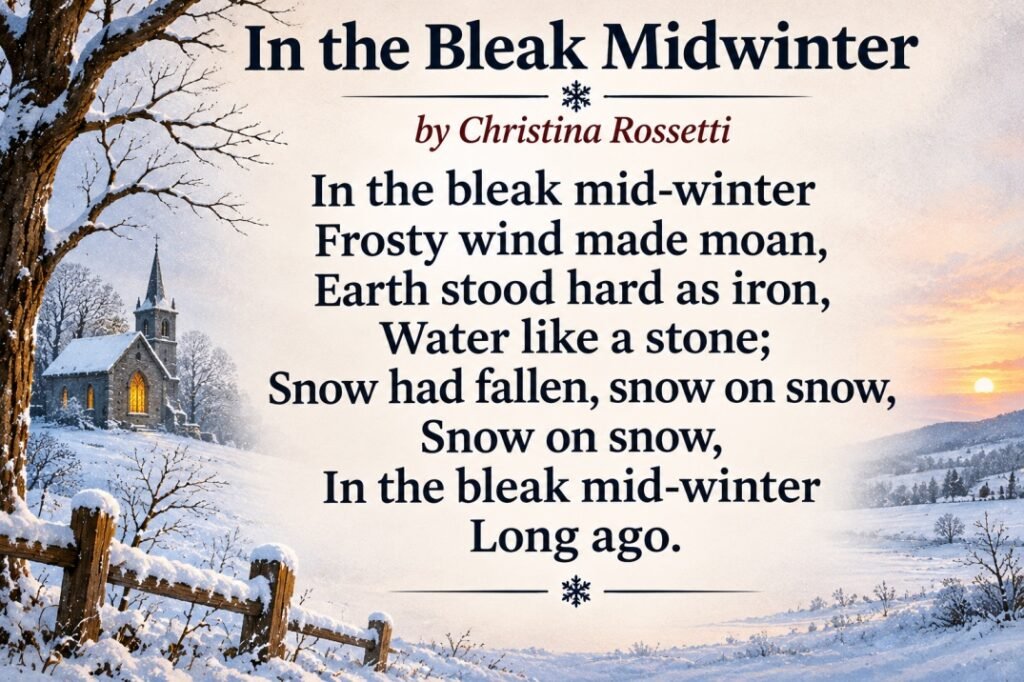
In the bleak mid-winter
Frosty wind made moan,
Earth stood hard as iron,
Water like a stone;
Snow had fallen, snow on snow,
Snow on snow,
In the bleak mid-winter
Long ago.
What the Poem Means
Rossetti imagines the birth of Christ during a harsh winter. The world is frozen and hard. Then she asks a simple question in the final stanza. What can a poor person give to God? Her answer is beautiful. She will give her heart.
Why It Matters
The repetition of “snow on snow” sounds like snow piling up. It is one of the most loved lines in English poetry. Composers Gustav Holst and Harold Darke set the poem to music. Today, choirs sing it every Christmas. Few best winter poems live so fully in both poetry and song.
About the Poet
Christina Rossetti (1830–1894) was an English Victorian poet. Her brother was the painter Dante Gabriel Rossetti. Her faith shaped much of her writing.
Other famous works: “Goblin Market,” “Remember,” “A Birthday,” “Up-Hill,” “Who Has Seen the Wind?”
Compared with her peers: Elizabeth Barrett Browning wrote long, passionate verse. Rossetti wrote short, musical lines. Browning’s Sonnets from the Portuguese celebrate romantic love. Rossetti’s poems often turn toward spiritual love. Both gave women a strong voice in Victorian poetry.
4. “Winter” (“When icicles hang by the wall”) by William Shakespeare (c. 1595)
Key Lines
When icicles hang by the wall,
And Dick the shepherd blows his nail,
And Tom bears logs into the hall,
And milk comes frozen home in pail,
When blood is nipp’d and ways be foul,
Then nightly sings the staring owl,
Tu-whit;
Tu-who, a merry note,
While greasy Joan doth keel the pot.
What the Poem Means
This song closes the play Love’s Labour’s Lost. It paints a busy winter scene. A shepherd blows on his cold fingers. A servant carries logs. Milk freezes in the bucket. A cook stirs the pot. An owl hoots at night.
Why It Matters
Shakespeare does not make winter sad here. He makes it real and earthy. These are ordinary people doing ordinary work. That focus on daily life was fresh for its time. The poem proves that the best winter poems do not need grand ideas. Sharp details can be enough.
About the Poet
William Shakespeare (1564–1616) is the most famous writer in English. He wrote 39 plays, 154 sonnets and several long poems.
Other famous works: Hamlet, Macbeth, King Lear, Romeo and Juliet, Sonnet 18 (“Shall I compare thee to a summer’s day?”). He also wrote another winter song: “Blow, blow, thou winter wind” in As You Like It.
Compared with his peers: Christopher Marlowe wrote bold, thundering lines. Ben Jonson valued classical rules. Shakespeare mixed high poetry with common speech. His winter song shows this gift clearly.
5. “The Eve of St. Agnes” by John Keats (1820)
Key Lines
St. Agnes’ Eve—Ah, bitter chill it was!
The owl, for all his feathers, was a-cold;
The hare limp’d trembling through the frozen grass,
And silent was the flock in woolly fold:
Numb were the Beadsman’s fingers, while he told
His rosary, and while his frosted breath,
Like pious incense from a censer old,
Seem’d taking flight for heaven, without a death,
Past the sweet Virgin’s picture, while his prayer he saith.
What the Poem Means
This long poem tells a love story. Madeline hopes to dream of her future husband on St. Agnes’ Eve. Her lover, Porphyro, sneaks into her castle. The two escape together into a winter storm.
The opening stanza sets the scene. Even the owl feels cold. An old man prays with frozen fingers. His breath rises like incense.
Why It Matters
Keats builds cold through the senses. You can almost feel the chill. The freezing world outside makes the warm love story inside glow brighter. Many critics call this opening the finest description of cold in English. It earns its place among the best winter poems for pure imagery.
About the Poet
John Keats (1795–1821) was an English Romantic poet. He died of tuberculosis at just 25. Yet he left behind some of the greatest poems in the language.
Other famous works: “Ode to a Nightingale,” “Ode on a Grecian Urn,” “To Autumn,” “La Belle Dame sans Merci,” “Bright Star.” He also wrote the short winter lyric “In drear-nighted December.”
Compared with his peers: Wordsworth found meaning in nature and memory. Shelley wrote about revolution and ideals. Byron wrote with wit and drama. Keats focused on beauty and the senses. His images are richer than any other Romantic poet’s.
6. “Frost at Midnight” by Samuel Taylor Coleridge (1798)
Key Lines
The Frost performs its secret ministry,
Unhelped by any wind. The owlet’s cry
Came loud—and hark, again! loud as before.
The inmates of my cottage, all at rest,
Have left me to that solitude, which suits
Abstruser musings: save that at my side
My cradled infant slumbers peacefully.
’Tis calm indeed! so calm, that it disturbs
What the Poem Means
It is a frosty midnight. Everyone sleeps except the poet and his baby son. The silence makes him think. He remembers his lonely childhood in a city school. Then he makes a promise. His son will grow up close to nature. He will learn from clouds, lakes and mountains.
Why It Matters
The phrase “secret ministry” of frost is famous. Frost works silently, like a hidden priest. The poem also started a new style. Critics call it a “conversation poem.” It sounds like a man thinking aloud. This style shaped Wordsworth’s “Tintern Abbey” and much later poetry.
About the Poet
Samuel Taylor Coleridge (1772–1834) was an English Romantic poet and critic. He co-wrote Lyrical Ballads with William Wordsworth in 1798. That book launched the Romantic movement in England.
Other famous works: The Rime of the Ancient Mariner, “Kubla Khan,” “Christabel,” “This Lime-Tree Bower My Prison,” Biographia Literaria.
Compared with his peers: Wordsworth wrote about everyday life in simple words. Coleridge often wrote about the strange and supernatural. “Frost at Midnight” is his gentlest poem. Here, he comes closest to Wordsworth’s style.
7. “There’s a certain Slant of light” by Emily Dickinson (written c. 1861)
Key Lines
There’s a certain Slant of light,
Winter Afternoons –
That oppresses, like the Heft
Of Cathedral Tunes –Heavenly Hurt, it gives us –
We can find no scar,
But internal difference –
Where the Meanings, are –
What the Poem Means
Emily Dickinson describes the pale light of a winter afternoon. It makes her feel heavy and sad. The feeling is like the weight of church music. It leaves no wound on the body. But it changes something inside the soul.
Why It Matters
Many of us know this feeling. Short winter days can bring a low mood. Dickinson named it more than a century before modern science studied it. Her dashes, capital letters and odd rhymes feel strikingly modern. Among the best winter poems, this one speaks most directly to the mind.
About the Poet
Emily Dickinson (1830–1886) was an American poet. She lived a very private life in Amherst, Massachusetts. She wrote nearly 1,800 poems. Only a handful appeared in print during her life.
Other famous works: “Because I could not stop for Death,” “Hope is the thing with feathers,” “I heard a Fly buzz – when I died,” “I’m Nobody! Who are you?”
Compared with her peers: Walt Whitman wrote long, open, loud lines. Dickinson wrote short, tight, quiet ones. Whitman looked outward at America. Dickinson looked inward at the soul. Together, they founded modern American poetry.
8. “The Snow Man” by Wallace Stevens (1921)
Key Lines
One must have a mind of winter
To regard the frost and the boughs
Of the pine-trees crusted with snow;And have been cold a long time
To behold the junipers shagged with ice,
The spruces rough in the distant glitterOf the January sun; and not to think
Of any misery in the sound of the wind,
In the sound of a few leaves,
What the Poem Means
Stevens asks a hard question. Can we see winter as it truly is? Most people feel sad in winter. They add their own emotions to the scene. Stevens says we need “a mind of winter” to see clearly. Only then can we see things without adding our feelings.
Why It Matters
The whole poem is one long sentence. It ends with the famous phrase about “Nothing that is not there and the nothing that is.” Philosophy students still debate it. The poem asks how the mind shapes reality. That makes it one of the most intellectual best winter poems ever written.
About the Poet
Wallace Stevens (1879–1955) was an American modernist poet. He worked as an insurance executive his whole life. He wrote poetry in his spare time.
Other famous works: “Thirteen Ways of Looking at a Blackbird,” “Sunday Morning,” “Anecdote of the Jar,” “The Emperor of Ice-Cream,” Harmonium.
Compared with his peers: William Carlos Williams wanted “no ideas but in things.” Stevens loved ideas and imagination. Frost wrote about country people. Stevens wrote about the mind itself. He is harder to read than Frost, but just as rewarding.
9. “The Snow-Storm” by Ralph Waldo Emerson (1841)
Key Lines
Announced by all the trumpets of the sky,
Arrives the snow, and, driving o’er the fields,
Seems nowhere to alight: the whited air
Hides hills and woods, the river, and the heaven,
And veils the farm-house at the garden’s end.
The sled and traveller stopped, the courier’s feet
Delayed, all friends shut out, the housemates sit
Around the radiant fireplace, enclosed
In a tumultuous privacy of storm.
What the Poem Means
A snowstorm arrives like a royal guest. It covers the fields, the river and the sky. Travel stops. Families gather by the fire. In the second half, Emerson calls the wind an artist. It builds snow sculptures overnight. Human art can only copy what nature makes for free.
Why It Matters
“Tumultuous privacy of storm” is a brilliant phrase. It captures the cosy feeling of being snowed in. The poem also carries Emerson’s big idea: nature is the greatest artist. That idea shaped American thought for generations.
About the Poet
Ralph Waldo Emerson (1803–1882) was an American essayist, lecturer and poet. He led the Transcendentalist movement. He believed in self-reliance and the divine in nature.
Other famous works: “Self-Reliance,” Nature, “The American Scholar,” “Concord Hymn,” “Brahma.” His poem “Brahma” draws directly on the Bhagavad Gita and the Upanishads.
Compared with his peers: Henry David Thoreau, his close friend, lived those ideas at Walden Pond. Emerson explained them in essays. Longfellow wrote poems for the general public. Emerson wrote for thinkers. His influence on Whitman was huge.
10. “Snow-flakes” by Henry Wadsworth Longfellow (1863)
Key Lines
Out of the bosom of the Air,
Out of the cloud-folds of her garments shaken,
Over the woodlands brown and bare,
Over the harvest-fields forsaken,
Silent, and soft, and slow
Descends the snow.Even as our cloudy fancies take
Suddenly shape in some divine expression,
Even as the troubled heart doth make
In the white countenance confession,
The troubled sky reveals
The grief it feels.
What the Poem Means
Longfellow compares falling snow to human feeling. Our sad thoughts slowly take shape. In the same way, the cloudy sky shows its sorrow through snow. Snow becomes the sky’s poem of grief.
Why It Matters
Longfellow wrote this poem soon after a deep personal loss. His wife died in a fire in 1861. Knowing this, the “troubled heart” becomes very real. The line “Silent, and soft, and slow” mimics the falling snow perfectly. It is one of the gentlest best winter poems.
About the Poet
Henry Wadsworth Longfellow (1807–1882) was the most popular American poet of the 19th century. He also taught languages at Harvard.
Other famous works: The Song of Hiawatha, Evangeline, “Paul Revere’s Ride,” “A Psalm of Life,” “The Village Blacksmith.” He also wrote the Christmas poem “Christmas Bells.”
Compared with his peers: Whitman broke rules. Longfellow followed them. Critics later called him old-fashioned. But in his time, he outsold every other poet in America and Britain. Tennyson was his closest match in fame.
11. “Snow-Bound: A Winter Idyl” by John Greenleaf Whittier (1866)
Key Lines
The sun that brief December day
Rose cheerless over hills of gray,
And, darkly circled, gave at noon
A sadder light than waning moon.
Slow tracing down the thickening sky
Its mute and ominous prophecy,
A portent seeming less than threat,
It sank from sight before it set.
What the Poem Means
A great snowstorm traps a farm family for days. They gather around the fire. They tell stories and share memories. Whittier looks back at his own childhood. Most of the people in that circle have since died. The poem becomes a loving tribute to them.
Why It Matters
Snow-Bound made Whittier rich and famous. It came out just after the American Civil War. A tired nation loved its picture of family warmth. The poem shows how winter brings people together. Memory turns cold days into treasured ones.
About the Poet
John Greenleaf Whittier (1807–1892) was an American Quaker poet. He was also a strong campaigner against slavery.
Other famous works: “Barbara Frietchie,” “Maud Muller,” “The Barefoot Boy,” “Ichabod,” “Telling the Bees.”
Compared with his peers: Whittier belonged to the “Fireside Poets” with Longfellow, Bryant, Holmes and Lowell. These poets wrote for families to read aloud at home. Whittier wrote with more moral fire. His anti-slavery poems were braver than most of his peers’ work.
12. “Ring Out, Wild Bells” by Alfred, Lord Tennyson (1850)
Key Lines
Ring out, wild bells, to the wild sky,
The flying cloud, the frosty light:
The year is dying in the night;
Ring out, wild bells, and let him die.Ring out the old, ring in the new,
Ring, happy bells, across the snow:
The year is going, let him go;
Ring out the false, ring in the true.
What the Poem Means
This poem is part of Tennyson’s long elegy In Memoriam A.H.H. He wrote it to mourn his dear friend Arthur Hallam. Here, church bells ring out the old year on a snowy night. The poet asks them to ring out grief, hatred and greed. He wants them to ring in peace, truth and kindness.
Why It Matters
People still read this poem at New Year celebrations around the world. “Ring out the old, ring in the new” has become a common saying. The poem turns private grief into public hope. It shows how the best winter poems can look forward, not just back.
About the Poet
Alfred, Lord Tennyson (1809–1892) was Poet Laureate of Britain for over 40 years. He was the voice of the Victorian age.
Other famous works: “Ulysses,” “The Lady of Shalott,” “The Charge of the Light Brigade,” “Crossing the Bar,” Idylls of the King.
Compared with his peers: Robert Browning wrote dramatic monologues full of strange characters. Tennyson wrote smooth, musical verse. Matthew Arnold worried about lost faith. Tennyson struggled with doubt too, but often found his way back to belief.
13. “London Snow” by Robert Bridges (1890)
Key Lines
When men were all asleep the snow came flying,
In large white flakes falling on the city brown,
Stealthily and perpetually settling and loosely lying,
Hushing the latest traffic of the drowsy town;
Deadening, muffling, stifling its murmurs failing;
Lazily and incessantly floating down and down:
Silently sifting and veiling road, roof and railing;
Hiding difference, making unevenness even,
Into angles and crevices softly drifting and sailing.
What the Poem Means
Snow falls on London overnight. In the morning, the dirty city looks pure and new. Children play and taste the snow. Workers stop and stare at the beauty. Then the daily rush returns, and the magic fades.
Why It Matters
Listen to the sound of these lines. “Silently sifting” and “deadening, muffling, stifling” copy the hush of snow. Bridges was a master of rhythm. The poem shows how snow turns even a crowded city into a place of wonder.
About the Poet
Robert Bridges (1844–1930) was an English poet and doctor. He became Poet Laureate in 1913. He also edited and published the poems of his friend Gerard Manley Hopkins after Hopkins died.
Other famous works: The Testament of Beauty, “Nightingales,” “A Passer-By,” “I Love All Beauteous Things.”
Compared with his peers: Hopkins experimented wildly with rhythm. Bridges experimented too, but gently. Hardy wrote dark poems about fate. Bridges wrote calmer poems about beauty. Without Bridges, the world might never have read Hopkins.
14. “Dust of Snow” by Robert Frost (1923)
Key Lines
The way a crow
Shook down on me
The dust of snow
From a hemlock treeHas given my heart
A change of mood
And saved some part
Of a day I had rued.
What the Poem Means
The speaker is having a bad day. A crow shakes some snow off a tree onto him. This small moment lifts his mood. The rest of his day feels better.
The crow and the hemlock tree usually stand for bad luck and death. Frost flips that idea. Even dark things can bring a moment of joy.
Why It Matters
This poem has just 34 words. Yet it carries a powerful message. Small moments can change how we feel. Indian readers know it well. It appears in the CBSE Class 10 English textbook. That makes it one of the most studied best winter poems in India.
About the Poet
See Robert Frost in entry #1. “Dust of Snow” appeared in the same collection, New Hampshire, which won Frost his first Pulitzer Prize.
Compared with his peers: The Imagist poets, like Ezra Pound and H.D., wrote short poems built on one clear image. “Dust of Snow” works the same way. But Frost adds rhyme and a gentle emotional turn that the Imagists often avoided.
15. “To a Locomotive in Winter” by Walt Whitman (1876)
Key Lines
Thee for my recitative,
Thee in the driving storm even as now, the snow, the winter-day declining,
Thee in thy panoply, thy measur’d dual throbbing and thy beat convulsive,
Thy black cylindric body, golden brass and silvery steel,
Thy ponderous side-bars, parallel and connecting rods, gyrating, shuttling at thy sides,
Thy metrical, now swelling pant and roar, now tapering in the distance,
Thy great protruding head-light fix’d in front,
Thy long, pale, floating vapor-pennants, tinged with delicate purple,
What the Poem Means
Whitman watches a steam train charge through a snowstorm. He praises its power, its noise and its shining parts. The train becomes a symbol of modern America. It is strong, fast and unstoppable.
Why It Matters
Most winter poems look at nature. Whitman looks at a machine. He finds beauty in steel and steam. This was a bold choice in the 1870s. “To a Locomotive in Winter” poem proves that the best winter poems can celebrate energy, not just stillness.
About the Poet
Walt Whitman (1819–1892) was an American poet. He is often called the father of free verse. He revised and expanded one book, Leaves of Grass, for most of his life.
Other famous works: “Song of Myself,” “O Captain! My Captain!,” “When Lilacs Last in the Dooryard Bloom’d,” “Crossing Brooklyn Ferry,” “I Hear America Singing.”
Compared with his peers: Longfellow wrote neat, rhymed verse. Whitman threw out rhyme altogether. Dickinson whispered. Whitman shouted. Emerson called for a new American poet. Whitman answered that call.
Common Themes in the Best Winter Poems
Read these poems together and patterns appear.
Death and endings. Winter closes the year. Frost, Hardy and Tennyson all use it to think about endings.
Hope and renewal. Spring always follows winter. Hardy’s thrush and Tennyson’s bells both point toward a brighter future.
Silence and reflection. Snow quiets the world. Coleridge and Dickinson use that silence to look inward.
Warmth and togetherness. Cold outside makes the fireside special. Whittier, Emerson and Keats all celebrate this contrast.
Faith. Rossetti and Tennyson link winter with Christmas and New Year. The dark season becomes a time of spiritual light.
Frequently Asked Questions (FAQs)
“Stopping by Woods on a Snowy Evening” by Robert Frost is the most famous winter poem. It appeared in 1923. Its closing line, “And miles to go before I sleep,” is one of the most quoted lines in English poetry.
The best winter poems for students are “Dust of Snow” by Robert Frost, “Stopping by Woods on a Snowy Evening” by Robert Frost, and “In the Bleak Midwinter” by Christina Rossetti. They are short, clear and easy to analyse.
“Dust of Snow” by Robert Frost appears in the CBSE Class 10 English textbook, First Flight. It teaches how a small moment can change a person’s mood.
Winter usually symbolises death, endings, loneliness or old age. It can also stand for rest, reflection and the hope of renewal, since spring always follows.
Christina Rossetti wrote “In the Bleak Midwinter” in 1872. Gustav Holst later set it to music, and it became a popular Christmas carol.
The phrase comes from Wallace Stevens’s poem “The Snow Man.” It means seeing the world without adding human emotions to it. Only with “a mind of winter” can we see winter as it truly is.
Samuel Taylor Coleridge wrote “Frost at Midnight.” John Keats wrote “The Eve of St. Agnes” and “In drear-nighted December.” Percy Bysshe Shelley ended “Ode to the West Wind” with the famous line, “If Winter comes, can Spring be far behind?”
Yes. All 15 poems on this list were published before 1929. They are in the public domain in the United States and in most countries.
Conclusion
These best winter poems do more than just describring snow. They help us understand our own lives. Frost teaches us about duty. Hardy shows us hope in dark times. Dickinson names a sadness we all feel. Whitman finds power in the storm.
These poems have lasted for decades, some for centuries. They will keep speaking to readers every winter. So pick one tonight. Read it slowly. Let the season speak to you through the words of a great poet.
Also read: Ficciones Summary and Analysis