
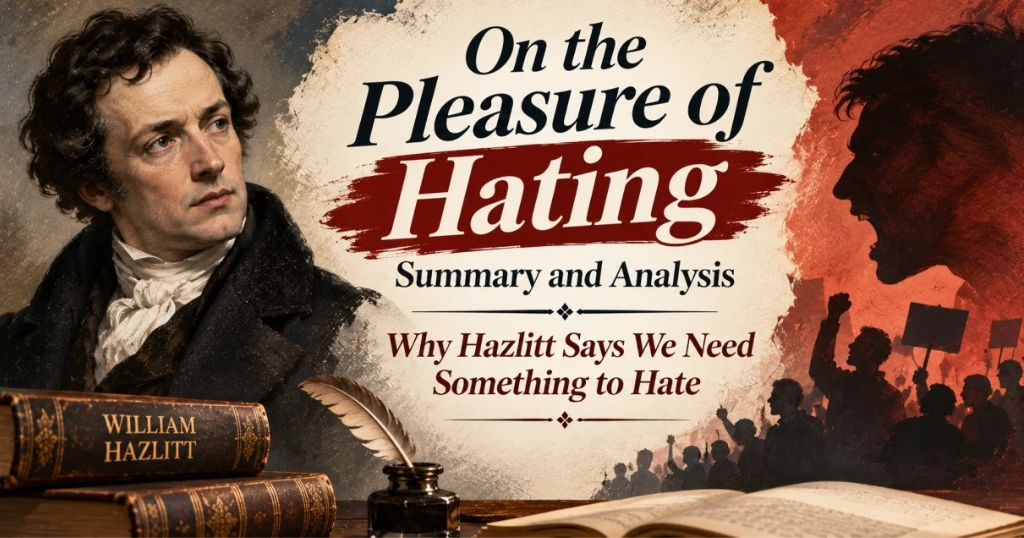
Quick answer: On the Pleasure of Hating is an essay by the English writer William Hazlitt (1778–1830), published in 1826 in his collection The Plain Speaker. Hazlitt argues that hatred is a deep human appetite. It fuels our energy, outlasts love, and sours even our friendships, and he admits that he is no exception.
This on the pleasure of hating summary covers the plot of the argument, the best excerpts, the main themes, and the essay’s place beside Hazlitt’s other works and his famous contemporaries.
Key takeaways
- Author: William Hazlitt, English essayist and critic.
- Published: 1826, in The Plain Speaker.
- Central claim: Without something to hate, human life loses its drive.
- Tone: Honest, ironic, and self-mocking, with a bitter ending.
- Why it matters: It names a feeling most writers avoid admitting.
Who Was William Hazlitt?
Hazlitt was a radical thinker in the age of Wordsworth, Coleridge, and Byron. He wrote about politics, painting, boxing, theatre, and poetry with equal passion. His political views made him many enemies in the Tory press, and those fights shaped the bitter wit of this essay.
Readers still prize his plain, muscular style. He does not hide behind polite theory. He tells you what he feels and dares you to deny it.
On the Pleasure of Hating Summary: What Happens in the Essay?
The essay has no plot, but it follows a clear path. Hazlitt moves from a small domestic scene to a sweeping claim about human nature, and he ends with a confession. This on the pleasure of hating summary breaks that path into five steps.
1. The spider on the floor
Hazlitt opens with a tiny scene:
“There is a spider crawling along the matted floor of the room where I sit”
He does not kill the creature, and he does not like it either. He says plainly:
“I bear the creature no ill-will, but still I hate the very sight of it.”
What it means: Dislike does not need a reason. Hazlitt shows that we can hate something that has done us no harm. The spider sets up the whole essay, because it proves that hatred often comes before logic.
2. Why we need something to hate
Next, Hazlitt widens the lens. He argues that good alone bores us:
“Pure good soon grows insipid, wants variety and spirit.”
He then makes his boldest claim, that without something to hate, we would lose the very spring of thought and action. In his view, enemies, rivals, and causes keep the mind awake. Peace without conflict goes stale.
3. Love fades, hatred lasts
Here the essay turns darker. Hazlitt says every warm feeling wears out with time:
“Love turns, with a little indulgence, to indifference or disgust: hatred alone is immortal.”
He then lists what we turn against:
“We hate old friends: we hate old books: we hate old opinions; and at last we come to hate ourselves.”
What it means: Familiarity breeds contempt. Hazlitt claims that nothing survives our boredom, not even our own character.
4. The thrill of mocking others
Hazlitt now studies a cruel habit that most of us share:
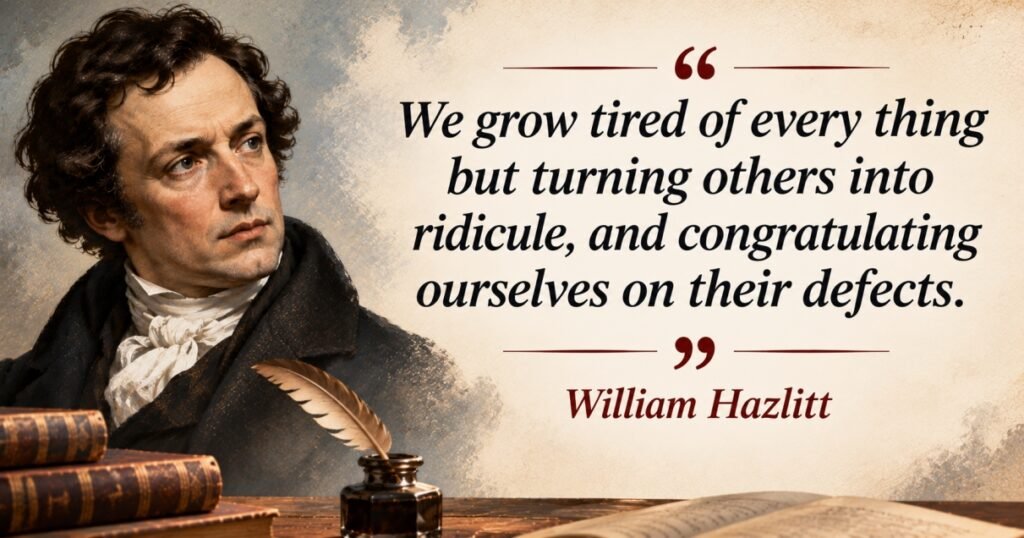
“We grow tired of every thing but turning others into ridicule, and congratulating ourselves on their defects.”
He suggests that we enjoy other people’s flaws because they make us feel better about ourselves. Gossip, satire, and online pile-ons all fit this description, even though Hazlitt wrote two centuries ago.
5. The ugly side of hatred
Hazlitt does not cheer for hatred without limits. He warns about what it does to institutions we call noble:
“The pleasure of hating, like a poisonous mineral, eats into the heart of religion, and turns it to rankling spleen and bigotry; it makes patriotism an excuse for carrying fire, pestilence, and famine into other lands…”
What it means: The same impulse that energizes us can also fuel war, intolerance, and cruelty. Hazlitt sees both sides at once.
The final confession
The essay closes by turning the lens on Hazlitt himself. After a bitter list of the world’s injustices, he asks whether he has reason to hate and despise himself. His answer is the famous last line:
“Indeed I do; and chiefly for not having hated and despised the world enough.”
The twist is clever. Hazlitt does not regret hating. He regrets that he has not hated more.
Analysis: The Main Themes
Theme 1: Hatred as an engine
Hazlitt treats hatred as a force that moves people. Anger gives us purpose, and opposition gives us identity. A modern reader might compare this to rivalry in sport or politics, where a common enemy binds a group together.
Theme 2: The decay of every pleasure
Time erodes friendship, taste, and belief. Hazlitt sees this decay as a law of human nature, not a personal failure. That view makes the essay feel both gloomy and strangely comforting.
Theme 3: Hypocrisy in polite society
Hazlitt mocks people who claim they never hate. He believes that civilization only covers our instincts with a “flimsy veil.” When he describes the joy of reading stories about wild, unrestrained passions, he writes that we throw aside the trammels of civilization, and he quotes King Lear:
“Off, you lendings!”
In that same passage he jokes that these stories contain no “Jeremy Bentham Panopticons,” a jab at the reformer’s ideal of total supervision. Readers escape the rules of a tidy, watched society, and they enjoy the escape.
Theme 4: Self-hatred
The essay’s final turn matters most. Hazlitt admits that the instinct to despise does not stop at the door. He hates his old opinions, his old friends, and finally himself.
A touch of humor
Hazlitt keeps the tone sharp, not preachy. He jokes that even a highwayman who robs you but also curses at you “was no gentleman.” This dry comedy stops the essay from sounding like a sermon.
Style and Technique
- Direct address: Hazlitt speaks as one honest person to another.
- Concrete images: The spider, the poisonous mineral, and the Shakespearean quotation make abstract ideas vivid.
- Lists and rhythm: The chain “old friends… old books… old opinions” builds momentum, then drops into a shocking last clause.
- Irony: He praises hatred while also revealing its harm.
- Literary allusion: He weaves in Shakespeare freely, as many Romantic essayists did.
Does Hazlitt Mean It? A Fair Reading
Some readers take the essay as a plain endorsement of hatred. Others read it as satire. A more careful view sits between the two. Hazlitt describes a real human appetite and refuses to pretend it away. He also shows the damage it causes, so the essay works as both confession and warning.
His wit softens the blow, and his closing lines hint at a personal grudge-weary mood. Elsewhere in the same piece, he even jokes that he must make peace with Charles Lamb:
“I think I must be friends with Lamb again, since he has written that magnanimous Letter to Southey.”
That line shows a man who hates, regrets, and forgives within a single page.
How Hazlitt Compares to His Contemporaries
Charles Lamb: Lamb’s Essays of Elia are warm, gentle, and nostalgic. Hazlitt is blunter and angrier. Where Lamb charms, Hazlitt provokes, yet the two men were close friends, and Hazlitt’s essay even nods to Lamb.
Thomas De Quincey: In Confessions of an English Opium-Eater (1821), De Quincey explores private obsession in ornate, dreamy prose. Hazlitt tackles a similar theme of dark appetite, but he uses short, hard sentences and a conversational voice.
Leigh Hunt: Hunt’s essays favor cheer and good company. Hazlitt balances that mood with a more sceptical view of human motives.
Samuel Taylor Coleridge and William Wordsworth: Hazlitt admired their early poetry and later attacked their shift toward conservatism. That conflict helps explain his sharp view of loyalty, friendship, and changing opinion.
Earlier moralists: Readers who enjoy the French moralist La Rochefoucauld or the essayist Montaigne will see similar ideas about vanity and self-interest. Hazlitt gives them an English, Romantic voice.
Other Works by Hazlitt to Read Next
If this essay interests you, try these in order:
- “The Fight”: A vivid report of a prizefight and a striking example of his energetic prose.
- “On Going a Journey”: A graceful essay on the joy of solitary walking.
- “My First Acquaintance with Poets”: A memory of meeting Coleridge and Wordsworth.
- Table-Talk (1821–22): A collection of essays on art, life, and character.
- Characters of Shakespeare’s Plays (1817): His landmark Shakespeare criticism.
- The Spirit of the Age (1825): Portraits of major figures of his time.
- Liber Amoris (1823): A painful, confessional account of unrequited love.
Hazlitt argues that people need something to hate, because hatred gives life energy, outlasts love, and fills the space left by boredom.
It appeared in 1826 in Hazlitt’s collection The Plain Speaker.
Many readers point to “Love turns, with a little indulgence, to indifference or disgust: hatred alone is immortal.” Others prefer the ending about not hating the world enough.
It is both. Hazlitt writes with real feeling, and he uses irony and humor to deliver hard truths.
The spider shows that we can dislike something harmless. That tiny example proves his larger point about instinctive hatred.
Yes. Online outrage, political rivalry, and gossip all echo Hazlitt’s observations, which helps explain why this on the pleasure of hating summary still draws new readers.
Conclusion
On the Pleasure of Hating remains one of the sharpest short essays in English. Hazlitt tells an uncomfortable truth with wit and courage: we love our enemies more than we admit. Whether you read him for the style, the psychology, or the history, the essay rewards a second look. Use this on the pleasure of hating summary as a guide, then read the full text yourself, because Hazlitt’s own words hit harder than any explanation.
Also read: 15 Best Winter Poems of All Time