

Delight in Disorder Summary in 30 Seconds
Delight in Disorder summary: Robert Herrick’s 1648 poem argues that a slightly untidy outfit attracts the speaker more than a flawless, over-polished one. The speaker lists small flaws in a woman’s clothing: a loose scarf, a stray lace, a flowing cuff, a untied shoe-string. He calls each flaw charming. The final couplet states the idea outright. Carefully arranged “art” bewitches him less than natural, careless grace.
Quick Facts
| Detail | Information |
|---|---|
| Poem | “Delight in Disorder” |
| Poet | Robert Herrick (1591–1674) |
| First published | Hesperides (1648) |
| Form | One 14-line sentence, mostly in rhyming couplets |
| Meter | Iambic tetrameter (four beats per line) |
| Main theme | Natural, careless beauty beats rigid perfection |
| Tone | Playful, flirtatious, admiring |
| Literary movement | Cavalier poetry, “Sons of Ben” |
The Full Poem
Herrick’s poem is in the public domain. Here is the text with modern spelling:
A sweet disorder in the dress
Kindles in clothes a wantonness:
A lawn about the shoulders thrown
Into a fine distraction:
An erring lace, which here and there
Enthralls the crimson stomacher:
A cuff neglectful, and thereby
Ribbands to flow confusedly:
A winning wave, deserving note,
In the tempestuous petticoat:
A careless shoe-string, in whose tie
I see a wild civility:
Do more bewitch me, than when art
Is too precise in every part.
Delight in Disorder Summary: What Happens in the Poem
The poem has no plot and no named characters. Instead, it works like a quick sketch. The speaker watches a woman whose clothes look slightly rumpled, and he enjoys what he sees.
The first couplet sets the thesis: a “sweet disorder” in dress “kindles” a “wantonness.” The next eight lines list small examples, one per couplet. Each begins with “A” or “An” and names one untidy detail. The last couplet delivers the verdict. All these small flaws “bewitch” the speaker more than perfect, over-arranged dress does.
This Delight in Disorder summary shows why the poem is so short and so memorable. Herrick states a single idea, proves it with five snapshots, and closes with a neat conclusion.
Line-by-Line Analysis With Excerpts
Lines 1–2: The Thesis
“A sweet disorder in the dress
Kindles in clothes a wantonness:”
The poem opens with a paradox. “Sweet” normally pairs with pleasant things, and “disorder” normally signals mess. Herrick joins them to show that mess can please. The verb “kindles” adds heat, so the disorder lights a spark of attraction.
“Wantonness” needs a note. In the 17th century, the word meant playfulness and freedom from restraint. It carried a flirtatious edge but not the harsh moral judgment the word carries today.
Lines 3–4: The Loose Scarf
“A lawn about the shoulders thrown
Into a fine distraction:”
A “lawn” is a fine linen scarf. The woman has tossed it over her shoulders without much care. Herrick calls the result a “fine distraction.” That phrase plays on two meanings: the scarf looks delicate (“fine”), and it distracts the viewer’s eye. Notice also that the scarf is “thrown,” so the poem pictures a casual gesture, not a careful one.
Lines 5–6: The Wandering Lace
“An erring lace, which here and there
Enthralls the crimson stomacher:”
The “stomacher” is a decorative panel on the front of a bodice, here in crimson. A lace has slipped out of place and now crosses it. Herrick calls the lace “erring,” from the Latin errare, “to wander.” The lace literally wanders, and the word also hints at a small, forgivable mistake. The verb “enthralls” turns the lace into a captor, so the tiny flaw holds the speaker’s attention captive.
Lines 7–8: The Careless Cuff
“A cuff neglectful, and thereby
Ribbands to flow confusedly:”
The cuff hangs loose, and as a result the ribbons (“ribbands”) flow freely. Herrick connects the two details with “thereby,” which makes the disorder feel like a chain reaction. One loose detail leads to another, and the whole outfit starts to move.
Lines 9–10: The Wave in the Petticoat
“A winning wave, deserving note,
In the tempestuous petticoat:”
Herrick shifts from still images to motion. The petticoat ripples like water and stirs like a storm (“tempestuous”). The word “winning” means charming here, and “deserving note” tells the reader to look closely. This couplet shows how Herrick turns fabric into weather.
Lines 11–12: The Untied Shoe-String
“A careless shoe-string, in whose tie
I see a wild civility:”
This couplet holds the poem’s best phrase. “Wild civility” is an oxymoron: wild suggests untamed nature, while civility suggests polished manners. The phrase sums up the poem’s whole argument. Herrick praises a graceful carelessness that sits between wildness and good manners.
The speaker also appears for the first time here, with the words “I see.” Until now, the poem has described the clothes. From this point on, the poem makes the speaker’s own reaction explicit.
Lines 13–14: The Verdict
“Do more bewitch me, than when art
Is too precise in every part.”
The sentence that began in line 1 finally reaches its main verb: “Do… bewitch.” All the listed details are the subject, and they “bewitch” the speaker. The word “art” here means artifice, or deliberate, calculated polish. The poem says that perfection looks stiff and lifeless, while a touch of disorder looks alive.
Key Vocabulary From the Poem
| Word | Meaning in Herrick’s time |
|---|---|
| Wantonness | Playful freedom, flirtatious looseness |
| Lawn | Fine linen, here a shoulder scarf |
| Erring | Wandering, straying from place |
| Stomacher | Decorative triangular panel on a bodice |
| Ribbands | Ribbons |
| Tempestuous | Stormy, moving in waves |
| Civility | Good manners, refinement |
| Art | Artifice, deliberate polish |
Themes in “Delight in Disorder”
1. Nature Versus Art
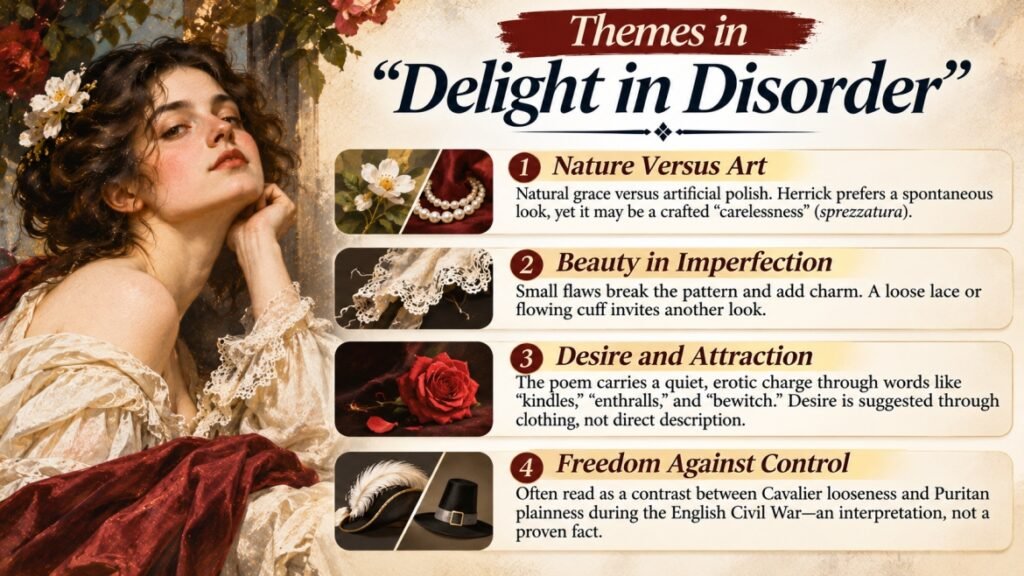
The central theme sets natural grace against artificial polish. Herrick prefers what looks spontaneous. Yet the poem hides a joke: the “natural” look takes effort too. Renaissance readers knew this idea well. Baldassare Castiglione’s The Book of the Courtier (1528) called it sprezzatura, a studied carelessness that makes difficult things look easy. Herrick’s woman may have arranged her disorder with great care.
2. Beauty in Imperfection
Each flaw in the poem gains value because it breaks a pattern. A perfect outfit offers the eye nothing to discover. A loose lace or a flowing cuff invites a second look.
3. Desire and Attraction
The poem simmers with quiet desire. Words such as “kindles,” “enthralls,” and “bewitch” belong to the language of love and magic. Herrick never describes the woman’s body. Instead, he lets her clothes carry all the erotic charge, and the restraint makes the poem more suggestive.
4. Freedom Against Control
Herrick wrote during the English Civil War. Many critics read the poem as a mild political statement: Cavalier looseness and delight against Puritan plainness and control. Treat this as an interpretation, not a proven fact, since Herrick never mentions politics in the poem.
Literary Devices and Form
Oxymoron. “Sweet disorder,” “fine distraction,” and “wild civility” all join opposites. These phrases carry the poem’s argument in miniature.
Personification. Laces “enthrall” and cuffs are “neglectful,” as if the clothes had minds of their own.
Enjambment. Sentences spill over line breaks, for example “thereby / Ribbands to flow confusedly.” The syntax itself flows loosely like the ribbons.
List structure. The poem strings its examples together with colons, so the reader moves from one image to the next at a steady pace.
Sound. Gentle consonants and soft vowels give the poem a light, musical feel. The rhymes (“dress/wantonness,” “tie/civility,” “art/part”) land cleanly.
The Poem’s Clever Irony
Here is the best twist in the poem. Herrick praises disorder in language that is perfectly ordered. The rhymes are tidy, the meter is steady, and the whole poem is one controlled sentence. The form acts out the same lesson as the content: the best art conceals its effort.
Historical Context: Who Was Robert Herrick?
Robert Herrick (1591–1674) grew up in London in a family of goldsmiths and studied at Cambridge. He became a close friend of the playwright and poet Ben Jonson, and he joined the circle of young poets known as the “Sons of Ben.” In 1630, he took a post as vicar of Dean Prior, a country parish in Devon. Parliament’s forces removed him from the position in 1647 during the Civil War. The Crown restored him in 1662.
Herrick published his only collection, Hesperides, in 1648. It contains more than 1,400 poems on love, nature, country festivals, and religion. Many of its best-loved poems are short and polished, like “Delight in Disorder.”
Herrick’s Other Famous Works
Readers who enjoy this poem often move on to these:
- “To the Virgins, to Make Much of Time.” Its opening line, “Gather ye rosebuds while ye may,” became one of English poetry’s most famous calls to seize the day.
- “Upon Julia’s Clothes.” This poem returns to the theme of clothing and desire. It begins “Whenas in silks my Julia goes,” and the speaker admires how her silk seems to flow like liquid.
- “Corinna’s Going A-Maying.” The poem urges a woman to join the May Day festivities before youth fades.
- “To Daffodils.” A gentle meditation on how quickly beauty and life pass.
- “Cherry-Ripe.” A short, playful song about a beloved’s lips.
- His Noble Numbers (1647–48). Herrick’s devotional poems, printed with Hesperides, show his serious religious side.
How Herrick Compares With Other Writers of His Time
Ben Jonson: The Direct Predecessor
Jonson shaped Herrick more than any other poet. Jonson’s song “Still to Be Neat” (from the play Epicoene, 1609) makes almost the same argument:
“Such sweet neglect more taketh me
Than all th’ adulteries of art.”
Both poets prefer natural grace to artificial polish. The difference lies in tone. Jonson sounds sharper and more moral, and he calls cosmetics “adulteries.” Herrick sounds lighter and more sensual, and he dwells on the pleasure of the details. Jonson argues, while Herrick simply delights.
Andrew Marvell: The Seducer With an Argument
Marvell’s “To His Coy Mistress” opens with a clever logical argument:
“Had we but world enough, and time,
This coyness, lady, were no crime.”
Marvell builds a formal case for seduction in three logical steps. Herrick offers no such argument. His speaker simply notices a pretty detail and admires it. Marvell persuades, but Herrick observes.
John Donne: The Metaphysical Contrast
Donne, the leading metaphysical poet, packed his poems with intellectual conceits and abrupt, argumentative openings such as “Busy old fool, unruly Sun.” Herrick avoids that density. He paints with simple, visual language, so a reader needs no footnotes to enjoy a stray ribbon.
Richard Lovelace and Thomas Carew: Fellow Cavaliers
Lovelace and Carew shared Herrick’s Cavalier outlook of wit, elegance, and personal loyalty. Lovelace wrote “To Althea, from Prison,” with its famous line “Stone walls do not a prison make.” His poems tend toward honor and loyalty, and Carew’s lean toward polished courtly love. Herrick stands apart through his domestic detail, his rural settings, and his love of small, physical things.
John Milton: The Puritan Counterweight
Milton, a Puritan sympathizer and later a defender of Cromwell’s government, wrote on grand, serious themes. His epic Paradise Lost (1667) deals with fall and redemption. Herrick’s poetry rarely tries for such scale, and that contrast makes the Cavalier-versus-Puritan reading of “Delight in Disorder” attractive to critics.
Critical Perspectives
Modern readers often raise three questions about the poem.
- Whose gaze is this? The speaker looks at a woman, and she never speaks. Feminist critics note that the poem treats her as an object of display. The poem never tells us whether she planned the disorder or whether her clothes slipped by accident.
- Is the disorder real? The poem hints that the carelessness may be a performance, and that adds a layer of irony.
- Is the poem about more than clothes? Some critics read it as a statement of poetic style. Herrick may say that poetry, too, should look effortless.
Why “Delight in Disorder” Still Matters
The poem’s central idea feels modern. People still admire a “messy bun,” a rumpled shirt, or a casual, undone look, and designers still sell “effortless” style. Herrick spotted that appeal almost four hundred years ago. The poem works as a compact lesson in close reading, too, because it shows how word choice, rhyme, and structure can all serve one idea.
Delight in Disorder Summary: FAQ
What is the main idea of “Delight in Disorder”?
The main idea is that slight, natural disorder in dress attracts the speaker more than perfect, artificial neatness. The poem praises effortless grace over calculated polish.
Who wrote “Delight in Disorder,” and when?
Robert Herrick wrote it, and it appeared in his collection Hesperides in 1648.
What is the theme of “Delight in Disorder”?
The main themes are nature versus art, beauty in imperfection, desire, and freedom versus control. A political reading adds the Cavalier-versus-Puritan contrast.
What does “sweet disorder” mean?
“Sweet disorder” is an oxymoron. It describes small, charming untidiness that adds appeal instead of spoiling an outfit.
What does “wild civility” mean?
“Wild civility” joins wildness and good manners. It describes a graceful carelessness that stays elegant.
What is the form of “Delight in Disorder”?
The poem has 14 lines in iambic tetrameter and reads as one long sentence. Most of its lines rhyme in couplets.
What literary devices does Herrick use in the poem?
He uses oxymoron, personification, enjambment, and a list structure. The tidy rhyme and meter also create an ironic contrast with the messy subject.
How does “Delight in Disorder” compare with Ben Jonson’s “Still to Be Neat”?
Both poems prefer natural grace to artifice. Jonson’s tone is moral and pointed, while Herrick’s tone is sensual and playful.
Is “Delight in Disorder” a Cavalier poem?
Yes. It reflects the Cavalier values of wit, elegance, and pleasure, and Herrick belonged to the “Sons of Ben” circle.
Final Takeaway
This Delight in Disorder summary comes down to one idea: Herrick finds beauty in small flaws. He proves it through five quick images, a few striking oxymorons, and a final verdict that favors natural grace over rigid perfection. The poem’s controlled form adds a witty twist, because Herrick uses perfect order to praise disorder. Read it once for the pleasure of the images, and read it again to notice the craft behind them.
Editorial note: This analysis draws on the primary text of Hesperides (1648), modernized in spelling, and on standard historical and critical reading of the poem. Readers who want to explore further can read Jonson’s Epicoene, Castiglione’s The Book of the Courtier, and Marvell’s collected poems.
Also read: 15 Best Winter Poems of All Time