
Dover Beach Summary in Brief:
Matthew Arnold’s “Dover Beach” (published 1867) shows a speaker who watches a calm sea at night and hears the sound of pebbles dragged by the waves. That sound reminds him of human misery and the retreat of religious faith in the Victorian age. He ends by asking his beloved to stay true to him, because love is the only certainty left in a confusing, violent world.
This Dover Beach summary covers the poem stanza by stanza, with excerpts, and then explains the themes, symbols, literary devices and historical background. It also compares Arnold with Tennyson, Browning, Clough and Hardy.
Quick Facts About “Dover Beach”
| Detail | Information |
|---|---|
| Poet | Matthew Arnold (1822–1888) |
| Written | Probably 1851, around Arnold’s honeymoon |
| Published | 1867, in the collection New Poems |
| Form | Lyric poem with four stanzas and 37 lines |
| Rhyme and meter | Irregular rhyme, with lines of varying length |
| Setting | The Strait of Dover, on the English coast, looking toward France |
| Main themes | Loss of faith, human misery, love as refuge, modern uncertainty |
| Era | Victorian |
Who Was Matthew Arnold?
Matthew Arnold was a Victorian poet, essayist and school inspector. His father, Thomas Arnold, ran Rugby School. Arnold taught at Oxford as Professor of Poetry and later became one of the most influential critics of the nineteenth century.
He wrote poetry that questioned religious certainty, and he wrote essays that questioned Victorian society. Both sides of his work matter for any Dover Beach summary, because the poem blends personal feeling with cultural criticism.
Historical Context: Why Faith Was Retreating
Arnold lived through a period of rapid intellectual change. Charles Lyell’s geology stretched the age of the earth far beyond the biblical timeline. Charles Darwin published On the Origin of Species in 1859. German scholars applied historical methods to the Bible, a movement called “higher criticism.”
Many Victorians felt their old beliefs slipping away with nothing solid to replace them. Arnold gave that feeling its most famous poetic form. You cannot fully understand the Dover Beach summary without this background.
Dover Beach Summary: Stanza-by-Stanza Analysis
Stanza 1: A Calm Night and a Sad Sound
The poem opens with a peaceful scene:
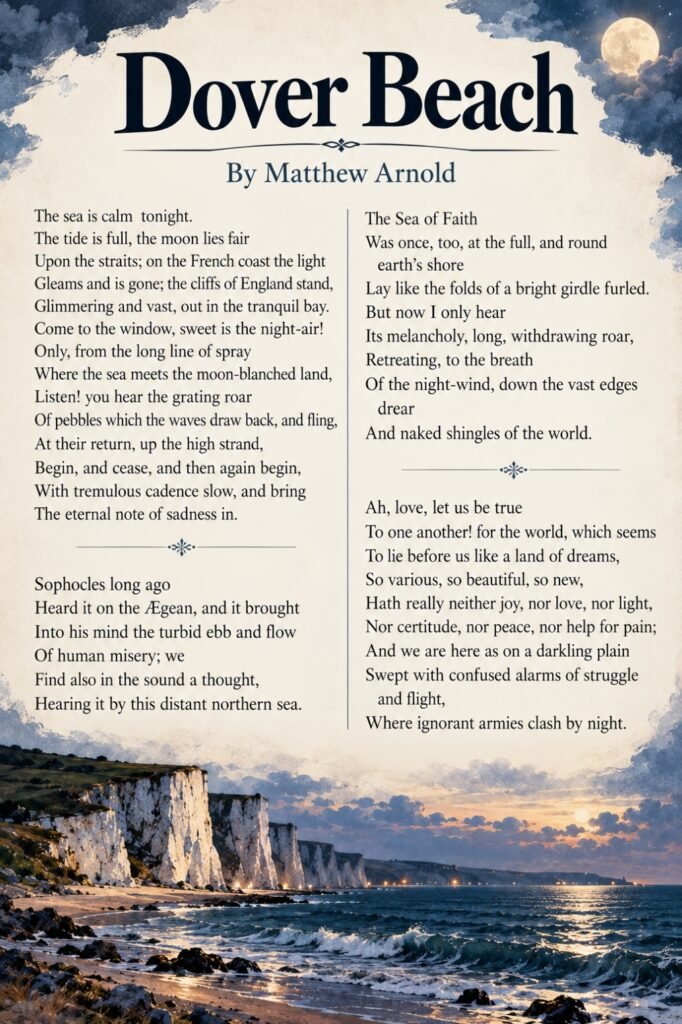
“The sea is calm to-night.
The tide is full, the moon lies fair
Upon the straits;—on the French coast the light
Gleams and is gone; the cliffs of England stand,
Glimmering and vast, out in the tranquil bay.”
The speaker stands at a window and describes the moonlit Channel. He sees the light on the French coast flicker and vanish, while the English cliffs glow in the bay. He invites his companion to share the view:
“Come to the window, sweet is the night-air!”
The mood shifts as soon as he asks her to listen:
“Listen! you hear the grating roar
Of pebbles which the waves draw back, and fling,
At their return, up the high strand,
Begin, and cease, and then again begin,
With tremulous cadence slow, and bring
The eternal note of sadness in.”
What this means: The beauty of the night hides something painful. The waves drag the pebbles down the beach and throw them back up, over and over. Arnold turns this endless motion into a symbol of sorrow that never stops. Words like “grating roar” also make the reader hear the scene. The first stanza of any Dover Beach summary should stress that contrast between calm sight and sad sound.
Stanza 2: Sophocles and the Ebb and Flow of Misery
The second stanza reaches back to ancient Greece:
“Sophocles long ago
Heard it on the Ægæan, and it brought
Into his mind the turbid ebb and flow
Of human misery; we
Find also in the sound a thought,
Hearing it by this distant northern sea.”
What this means: Arnold connects his own night to the Greek playwright Sophocles, who heard the same sound on the Aegean Sea. Sophocles’ plays, including Antigone, explore suffering and fate. By linking himself to Sophocles, Arnold shows that people have always heard sadness in the sea. The line “Ebb and flow of human misery” also turns the tide into a metaphor for the rise and fall of human pain.
Stanza 3: The Sea of Faith Withdraws
The third stanza contains the most famous lines in the poem:
“The Sea of Faith
Was once, too, at the full, and round earth’s shore
Lay like the folds of a bright girdle furled.
But now I only hear
Its melancholy, long, withdrawing roar,
Retreating, to the breath
Of the night-wind, down the vast edges drear
And naked shingles of the world.”
What this means: Here Arnold turns the physical sea into a metaphor. He compares religious faith to a sea that once filled the world like a bright girdle (a belt or sash) wrapped around the earth. Now the tide has gone out. The speaker hears only its “melancholy, long, withdrawing roar” as it leaves behind bare, stony beaches.
This stanza is the heart of the Dover Beach summary. It presents faith as something that once protected and comforted people and now fades away. Arnold does not celebrate this loss, and he does not mock believers. He mourns it.
Stanza 4: Love as the Last Certainty
The final stanza turns from the sea to the speaker’s companion:
“Ah, love, let us be true
To one another! for the world, which seems
To lie before us like a land of dreams,
So various, so beautiful, so new,
Hath really neither joy, nor love, nor light,
Nor certitude, nor peace, nor help for pain;”
The poem ends with a dark image of war:
“And we are here as on a darkling plain
Swept with confused alarms of struggle and flight,
Where ignorant armies clash by night.”
What this means: The speaker admits that the world looks beautiful but offers no real joy, certainty or comfort. Since faith cannot guide people anymore, he proposes personal loyalty and love as the only refuge.
The last image echoes the historian Thucydides, who described a confused night battle during the Athenian attack on Sicily. Soldiers in the dark could not tell friend from enemy. Arnold uses that scene to describe modern life, where people struggle without clear direction or shared beliefs.
Major Themes in “Dover Beach”
1. Loss of Religious Faith
The “Sea of Faith” is the central theme of the poem. Arnold does not argue against religion. He observes that faith has weakened and describes the emotional cost. Any complete Dover Beach summary must lead with this theme.
2. Human Misery
The sound of the waves connects Arnold to Sophocles and to everyone who has suffered. The poem suggests that sadness runs through all of history.
3. Love as Refuge
The poem ends with a plea, not a solution. Love offers comfort, but Arnold never claims it fixes the world. This tension makes the ending moving rather than sentimental.
4. Modern Uncertainty
The “darkling plain” and the “ignorant armies” describe a world without clear values. This is why readers still find the poem relevant in the twenty-first century.
Symbols and Imagery
- The sea: Arnold uses it for both faith and human misery.
- The tide: Its ebb and flow stands for the rise and fall of belief and emotion.
- Pebbles: They stand for people, dragged back and forth by forces they cannot control.
- The moon and the light on the French coast: They suggest hope that appears briefly and then disappears.
- The girdle: It shows how faith once held the world together.
- The darkling plain: It represents a confusing modern world with no clear guide.
Literary Devices in “Dover Beach”
- Metaphor: The Sea of Faith compares belief to a sea.
- Simile: Faith “lay like the folds of a bright girdle furled.”
- Onomatopoeia and sound imagery: Phrases like “grating roar” let the reader hear the beach.
- Allusion: References to Sophocles and Thucydides add historical weight.
- Irregular rhyme and meter: The uneven lines copy the uneven rhythm of the waves.
- Enjambment: Sentences run across line breaks like water rolling up the shore.
- Direct address: The speaker talks to “love,” which makes the poem feel intimate.
- Tone shift: The mood moves from calm, to sad, to despairing, to tender.
Tone and Mood
The tone begins as quiet and observant. It becomes melancholy in the middle stanzas and turns anxious and desperate near the end. The closing plea for love adds a final note of warmth. This shift in tone is a key point in every reliable Dover Beach summary.
Arnold’s Other Works and How They Connect
If you enjoy this poem, these works show the same concerns:
- “Stanzas from the Grande Chartreuse” (1855): Arnold describes himself as “Wandering between two worlds, one dead, / The other powerless to be born.” The line sums up the same loss of certainty that appears in “Dover Beach.”
- “The Scholar-Gipsy” (1853) and “Thyrsis” (1866): These pastoral poems mourn the loss of simplicity and long for a calmer life.
- “Empedocles on Etna” (1852): A philosopher faces doubt and despair.
- “Sohrab and Rustum” (1853): A narrative poem about a father and son who meet in tragic circumstances.
- “The Buried Life“: Arnold explores hidden emotions and the difficulty of true human connection.
- “Culture and Anarchy” (1869): This essay collection argues that culture can guide society when old certainties fail.
- “Literature and Dogma” (1873): Arnold examines the Bible as literature.
- “The Study of Poetry” (1880): He predicts that poetry will take over some of the roles religion once played. That idea explains why “Dover Beach” ends with human bonds instead of divine hope.
Comparing Arnold with Other Victorian Writers
Arnold and Alfred, Lord Tennyson
Tennyson’s In Memoriam A.H.H. (1850) also struggles with faith and doubt after the death of his friend Arthur Hallam. Tennyson writes that “There lives more faith in honest doubt,” and he eventually finds a cautious hope. He also describes nature as “red in tooth and claw,” which shows the same fear of a cold universe that Arnold feels.
Key difference: Tennyson usually ends with tentative trust. Arnold ends with only human love to hold onto.
Arnold and Robert Browning
Browning’s speaker in Pippa Passes declares, “God’s in his heaven— / All’s right with the world!” That line captures a confidence Arnold cannot share. Browning also wrote about doubt in “Bishop Blougram’s Apology,” but his poems usually keep more optimism about life and belief.
Key difference: Browning affirms. Arnold mourns.
Arnold and Arthur Hugh Clough
Clough was Arnold’s close friend, and Arnold wrote “Thyrsis” to mourn him. Clough’s “Say Not the Struggle Nought Availeth” encourages persistence in the face of failure, while his longer poem Dipsychus explores spiritual conflict.
Key difference: Clough urges readers to keep fighting. Arnold sees the struggle as confused and blind.
Arnold and Thomas Hardy
Hardy’s “The Darkling Thrush” (1900) borrows Arnold’s word “darkling” and pictures a bleak world at the end of a century. Hardy’s poem “Hap” also imagines an indifferent universe. Yet Hardy allows a small glimmer of hope in the bird’s song.
Key difference: Hardy’s world seems cold and random. Arnold still holds to love as a refuge.
Comparison Table
| Poet | Poem | View of Faith | Ending |
|---|---|---|---|
| Arnold | “Dover Beach” | Faith is retreating | Love as the only refuge |
| Tennyson | In Memoriam | Doubt mixed with hope | Cautious trust |
| Browning | Pippa Passes | Confident belief | Optimism |
| Clough | “Say Not the Struggle” | Struggle continues | Perseverance |
| Hardy | “The Darkling Thrush” | Faith has faded | A faint hope |
The Poem’s Legacy
“Dover Beach” influenced many later writers. T. S. Eliot’s The Waste Land (1922) pictures a broken civilization in a way that echoes Arnold’s dark plain. Ray Bradbury’s novel Fahrenheit 451 features the poem in a scene where Montag reads it aloud. Ian McEwan’s novel Saturday also gives the poem an important place in its story.
Why This Dover Beach Summary Still Matters
Readers keep returning to “Dover Beach” because it captures a feeling that has not gone away. People today still face rapid change, competing beliefs and a search for meaning. Arnold’s answer is simple and human: hold on to the people you love. A good Dover Beach summary should help readers see that the poem speaks to their own lives as well as to Victorian history.
Frequently Asked Questions About the Dover Beach Summary
What is the summary of Dover Beach?
The Dover Beach summary is simple. A speaker watches the calm sea at night, hears pebbles dragged by the waves, and thinks of human suffering and the retreat of religious faith. He ends by asking his beloved to stay true to him in a confusing world.
What is the main theme of Dover Beach?
The main theme is the loss of religious faith in the Victorian age. Secondary themes include human misery, love as a refuge and the uncertainty of modern life.
What does the Sea of Faith mean in Dover Beach?
The Sea of Faith is a metaphor for religious belief. Arnold says it once covered the earth like a bright girdle, but it now withdraws and leaves the world bare.
Who is the speaker in Dover Beach speaking to?
The speaker addresses his beloved, usually read as a partner or spouse. Many readers connect the poem to Arnold’s honeymoon in 1851, though the poem does not name the listener.
Why is Dover Beach considered a Victorian poem?
It reflects the main Victorian anxieties: scientific discoveries, questions about the Bible and the fear that old beliefs were disappearing. It also uses formal, reflective language typical of the period.
What is the meaning of “ignorant armies clash by night”?
The image describes confused people fighting in the dark without knowing why. Arnold likely draws on Thucydides’ account of a night battle in Sicily. He uses it to show that modern life feels chaotic and lacks clear purpose.
When did Matthew Arnold publish Dover Beach?
Arnold published “Dover Beach” in 1867 in New Poems, although scholars think he wrote it around 1851.
Is Dover Beach a pessimistic poem?
Mostly yes, but not entirely. The poem grieves the loss of faith and describes the world as lacking joy and certainty. The final appeal to love adds a small note of hope.
Conclusion
This Dover Beach summary shows why Arnold’s poem has lasted more than 150 years. It turns a quiet night at the sea into a meditation on faith, suffering and love. You can read it as a Victorian document, as a love poem or as a warning about modern confusion. Each reading rewards the reader.
If you want to go deeper, read “Stanzas from the Grande Chartreuse,” then compare Arnold with Tennyson’s In Memoriam and Hardy’s “The Darkling Thrush.” Then return to “Dover Beach” and listen again to the pebbles on the shore.
Sources and editorial note: This guide draws on the text of “Dover Beach” from Arnold’s New Poems (1867), which is in the public domain, and on standard scholarship about Victorian literature. Readers can verify the poem’s text and background at the Poetry Foundation and the Victorian Web.
Also read: The 12 Best War Poems of All Time