War poetry captures something prose cannot. It compresses chaos into a few tight lines. It turns battlefield noise into silence you can feel. For over a century, poets have used war poems to process violence, grief, and courage.
This guide covers the best war poems of all time. You’ll learn what each poem is about. And you’ll learn why it still matters. You’ll meet the poets behind them. And you’ll see how these writers compare to others of their era.
Let’s start.
1. “In Flanders Fields” by John McCrae
In Flanders fields the poppies blow
Between the crosses, row on row,
That mark our place; and in the sky
The larks, still bravely singing, fly
Scarce heard amid the guns below.
We are the Dead. Short days ago
We lived, felt dawn, saw sunset glow,
Loved and were loved, and now we lie,
In Flanders fields.
Take up our quarrel with the foe:
To you from failing hands we throw
The torch; be yours to hold it high.
If ye break faith with us who die
We shall not sleep, though poppies grow
In Flanders fields.
John McCrae was a Canadian doctor. He served in World War I. And he wrote this poem in 1915. He wrote it after burying a friend near Ypres, Belgium.
The poem describes a battlefield covered in red poppies. The poppies grow between rows of white crosses. The dead speak directly to the living. They ask the living to keep fighting. They ask them not to break faith with the fallen.
Why it matters: This poem changed how the world remembers soldiers. The poppy became the official symbol of war remembrance. Countries across the British Commonwealth still wear poppies every November. Few poems have created a physical, worldwide tradition. This one did.
The poet’s other work: McCrae wrote very little poetry compared to other war poets on this list. He was a physician first. He died of pneumonia in 1918, before the war ended. This poem remains his single lasting legacy.
Comparison: Unlike Wilfred Owen, McCrae doesn’t attack the war. He honors duty and sacrifice instead. This makes his poem more traditional. It sits closer to Rupert Brooke’s patriotic tone than Owen’s bitter realism.
2. “Dulce et Decorum Est” by Wilfred Owen
Bent double, like old beggars under sacks,
Knock-kneed, coughing like hags, we cursed through sludge,
Till on the haunting flares we turned our backs,
And towards our distant rest began to trudge.
Men marched asleep. Many had lost their boots,
But limped on, blood-shod. All went lame; all blind;
Drunk with fatigue; deaf even to the hoots
Of gas-shells dropping softly behind.
Gas! GAS! Quick, boys!—An ecstasy of fumbling
Fitting the clumsy helmets just in time,
But someone still was yelling out and stumbling
And flound’ring like a man in fire or lime.—
Dim through the misty panes and thick green light,
As under a green sea, I saw him drowning.
Wilfred Owen fought in World War I as a British officer. He wrote this poem in 1917, while recovering from shell shock.
The poem follows exhausted soldiers marching away from battle. A gas attack hits. One soldier can’t get his mask on in time. Owen describes the man’s death in brutal, physical detail. He describes choking, drowning-like symptoms, and a face that haunts him afterward. The poem ends by calling patriotic war slogans a lie.
Why it matters: This poem shattered the romantic image of war. Before Owen, poets glorified dying for one’s country. Owen showed the truth instead: gas, blood, and suffering. It remains the most studied anti-war poem in English literature. Schools worldwide still teach it as the definitive statement against war propaganda.
The poet’s other work: Owen also wrote “Anthem for Doomed Youth” (covered below) and “Strange Meeting.” He died one week before the war ended, in 1918. He was only 25.
Comparison: Owen’s mentor was Siegfried Sassoon, also on this list. Sassoon encouraged Owen’s raw, unflinching style. Compared to Rupert Brooke’s gentle patriotism, Owen’s work feels like a punch to the gut. Critics often call Owen the greatest war poet in the English language and this one of the best war poems of all time.
3. “The Charge of the Light Brigade” by Alfred, Lord Tennyson
I
Half a league, half a league,
Half a league onward,
All in the valley of Death
Rode the six hundred.
“Forward, the Light Brigade!
Charge for the guns!” he said.
Into the valley of Death
Rode the six hundred.
II
“Forward, the Light Brigade!”
Was there a man dismayed?
Not though the soldier knew
Someone had blundered.
Theirs not to make reply,
And theirs not to reason why,
Theirs but to do and die.
Into the valley of Death
Rode the six hundred.
Tennyson wrote this poem in 1854. He was Britain’s Poet Laureate at the time. He based it on a real military disaster during the Crimean War.
The poem describes 600 British cavalry soldiers riding into a valley. Enemy cannons fire from three sides. The soldiers know the order is a mistake. They charge anyway. Tennyson repeats the phrase “into the valley of death” to build dread. The rhythm mimics galloping horses.
Why it matters: This poem turned a military blunder into a symbol of duty and courage. It’s one of the most quoted poems in English. Politicians, coaches, and writers still reference it when discussing loyalty under impossible odds. It proved that poetry could shape public memory of a historical event.
The poet’s other work: Tennyson wrote “In Memoriam A.H.H.” and “Ulysses.” He remains one of the most celebrated Victorian poets in history.
Comparison: Tennyson wrote decades before Owen and Sassoon. His tone celebrates obedience and honor. He doesn’t question the war’s leadership directly, even though the poem describes a fatal mistake. This makes him closer to the patriotic tradition that Owen later rejected. Many people consider this as one of the best war poems of all time.
4. “The Soldier” by Rupert Brooke
If I should die, think only this of me:
That there’s some corner of a foreign field
That is for ever England. There shall be
In that rich earth a richer dust concealed;
A dust whom England bore, shaped, made aware,
Gave, once, her flowers to love, her ways to roam;
A body of England’s, breathing English air,
Washed by the rivers, blest by suns of home.
And think, this heart, all evil shed away,
A pulse in the eternal mind, no less
Gives somewhere back the thoughts by England given;
Her sights and sounds; dreams happy as her day;
And laughter, learnt of friends; and gentleness,
In hearts at peace, under an English heaven.
Rupert Brooke wrote this poem in 1914, at the start of World War I. He died the following year from an infection, before seeing major combat.
The poem imagines the speaker’s death in a foreign land. He says that patch of earth becomes forever England because an English body lies there. The tone is calm, almost comforting. There’s no blood, no gas, no fear.
Why it matters: This poem represents the idealism that existed before the war’s horrors became known. It shows how soldiers and civilians viewed the war in its earliest days. Reading it alongside Owen’s work shows readers exactly how the war changed public feeling within just a few years.
The poet’s other work: Brooke wrote a series of five sonnets called “1914.” “The Soldier” is the last and most famous of the set.
Comparison: Brooke and Owen wrote about the same war. Their tones couldn’t be more different. Brooke represents innocence. Owen represents disillusionment. Teaching them together shows students how quickly war poetry evolved between 1914 and 1917.
5. “Anthem for Doomed Youth” by Wilfred Owen
What passing-bells for these who die as cattle?
— Only the monstrous anger of the guns.
Only the stuttering rifles’ rapid rattle
Can patter out their hasty orisons.
No mockeries now for them; no prayers nor bells;
Nor any voice of mourning save the choirs,—
The shrill, demented choirs of wailing shells;
And bugles calling for them from sad shires.
What candles may be held to speed them all?
Not in the hands of boys, but in their eyes
Shall shine the holy glimmers of goodbyes.
The pallor of girls’ brows shall be their pall;
Their flowers the tenderness of patient minds,
And each slow dusk a drawing-down of blinds.
Owen wrote this poem in 1917, with edits suggested by Sassoon. It asks a haunting question: what funeral rites do dying soldiers actually get?
Anthem for Doomed Youth answers its own question. Soldiers get no church bells. They get gunfire instead. And they get no choir. They get screaming shells instead. Owen replaces every traditional funeral image with a battlefield equivalent.
Why it matters: This poem exposes the gap between how society honors death and how soldiers actually die. It’s built like a sonnet, a form usually used for love poetry. Owen twists that gentle form into something devastating. This contrast is why literature teachers use it to explain poetic irony.
The poet’s other work: See “Dulce et Decorum Est” above. Owen’s entire body of work centers on exposing war’s true cost.
Comparison: This poem pairs naturally with McCrae’s “In Flanders Fields.” Both discuss how the dead should be remembered. McCrae offers comfort. Owen offers anger. Together, they show two completely different responses to mass death.
6. “Suicide in the Trenches” by Siegfried Sassoon
I knew a simple soldier boy
Who grinned at life in empty joy,
Slept soundly through the lonesome dark,
And whistled early with the lark.
In winter trenches, cowed and glum,
With crumps and lice and lack of rum,
He put a bullet through his brain.
No one spoke of him again.
You smug-faced crowds with kindling eye
Who cheer when soldier lads march by,
Sneak home and pray you’ll never know
The hell where youth and laughter go.
Sassoon served as a British officer in World War I. He won medals for bravery, then turned against the war publicly. He wrote this poem in 1917.
The poem describes a young soldier who was cheerful before the war. Trench life destroys him. He dies by suicide. The final lines attack civilians who cheer soldiers marching to war without understanding what awaits them.
Why it matters: This poem tackles a topic many still avoid: military mental health and suicide. Sassoon wrote it decades before terms like PTSD existed. It remains disturbingly relevant today, as veteran mental health stays a major public issue.
The poet’s other work: Sassoon wrote “Glory of Women” and a memoir trilogy about his war experience, starting with “Memoirs of a Fox-Hunting Man.”
Comparison: Sassoon mentored Owen and pushed him toward brutal honesty. Sassoon’s anger targets civilians directly. Owen’s anger targets war propaganda more broadly. Both poets served together and influenced each other’s style enormously.
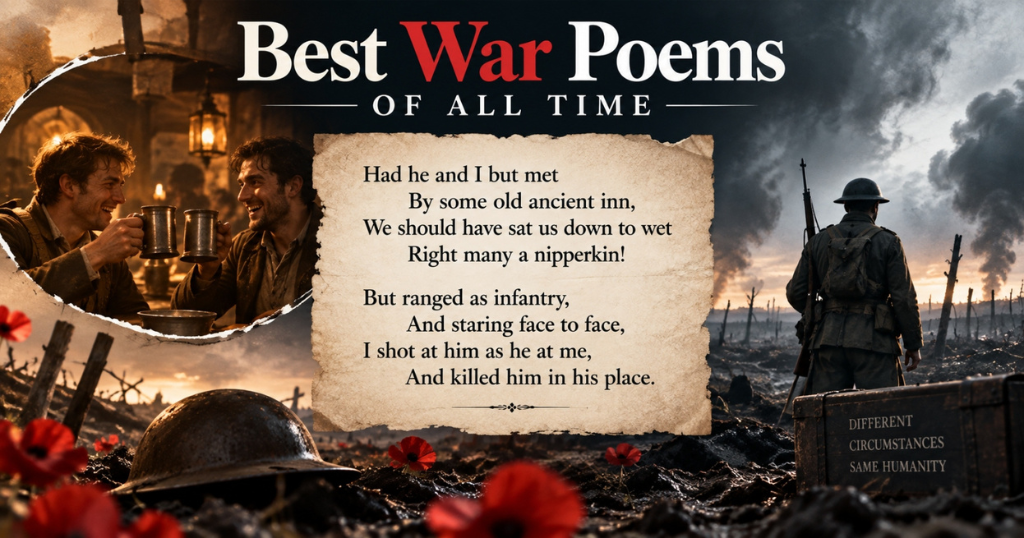
7. “The Man He Killed” by Thomas Hardy
“Had he and I but met
By some old ancient inn,
We should have sat us down to wet
Right many a nipperkin!
“But ranged as infantry,
And staring face to face,
I shot at him as he at me,
And killed him in his place.
Thomas Hardy wrote this poem in 1902, following the Boer War. Hardy is better known as a novelist, but his poetry carries real weight.
The poem uses a conversational voice. A soldier explains that he shot a man in battle. He admits that if they’d met in a pub instead, they’d have shared drinks like friends. He killed him only because war made him “his foe.”
Why it matters: This poem shows how war turns strangers into enemies for no personal reason. It uses plain, working-class language instead of formal poetic style. This makes it feel honest and immediate. It’s often used to teach irony and the absurdity of war.
The poet’s other work: Hardy wrote novels like “Tess of the d’Urbervilles” and “Far from the Madding Crowd.” He only turned fully to poetry later in life.
Comparison: Hardy predates Owen and Sassoon by over a decade. His conversational tone influenced how later war poets wrote about ordinary soldiers, rather than generals and heroes. Many people think this is one of the best war poems of all time.
8. “Naming of Parts” by Henry Reed
Today we have naming of parts. Yesterday,
We had daily cleaning. And tomorrow morning,
We shall have what to do after firing. But today,
Today we have naming of parts. Japonica
Glistens like coral in all of the neighboring gardens,
And today we have naming of parts.
This is the lower sling swivel. And this
Is the upper sling swivel, whose use you will see,
When you are given your slings. And this is the piling swivel,
Which in your case you have not got. The branches
Hold in the gardens their silent, eloquent gestures,
Which in our case we have not got.
Henry Reed wrote this poem during World War II, in 1942. He served in the British Army.
The poem splits into two voices. One voice is a drill instructor teaching soldiers how to name rifle parts. The other voice is a young soldier’s mind, wandering to nature and spring blossoms outside the window. The two voices interrupt each other throughout.
Why it matters: This poem shows how military training strips away individual thought. It contrasts mechanical violence with natural beauty. The structure itself, split between two competing voices, mirrors the soldier’s internal conflict. It’s a favorite in poetry courses because of its clever technical structure.
The poet’s other work: Reed wrote this as part of a larger sequence called “Lessons of the War.” It remains his most famous piece.
Comparison: Reed’s dry, ironic humor differs from Owen’s raw despair. Reed uses satire. Owen uses horror. Both approaches attack the dehumanizing effect of military life, just through different tones.
9. “The Death of the Ball Turret Gunner” by Randall Jarrell
From my mother’s sleep I fell into the State,
And I hunched in its belly till my wet fur froze.
Six miles from earth, loosed from its dream of life,
I woke to black flak and the nightmare fighters.
When I died they washed me out of the turret with a hose.
Randall Jarrell served in the US Army Air Forces during World War II. He wrote this poem in 1945. It’s only five lines long, making it one of the shortest famous war poems ever written.
The poem describes a gunner curled inside a cramped turret beneath a bomber plane. He describes his own death in cold, mechanical terms. The final line describes his body being washed out of the turret with a hose.
Why it matters: This poem proves that length doesn’t determine impact. In just five lines, Jarrell captures the horror of industrial warfare. Soldiers become machine parts, disposed of like waste. It’s one of the most anthologized poems about World War II specifically.
The poet’s other work: Jarrell wrote “Losses” and “Eighth Air Force,” both dealing with his wartime experience as ground crew.
Comparison: Jarrell wrote about mechanized, aerial warfare. Owen and Sassoon wrote about trench warfare decades earlier. Comparing them shows how war poetry adapted as war technology changed.
10. “Facing It” by Yusef Komunyakaa
My black face fades,
hiding inside the black granite.
I said I wouldn’t
dammit: No tears.
I’m stone. I’m flesh.
My clouded reflection eyes me
like a bird of prey, the profile of night
slanted against morning. I turn
this way—the stone lets me go.
I turn that way—I’m inside
the Vietnam Veterans Memorial
again, depending on the light
to make a difference.
Yusef Komunyakaa served in the Vietnam War as a journalist. He wrote this poem in 1988, years after the war ended.
The poem describes a veteran standing at the Vietnam Veterans Memorial in Washington, D.C. He sees his own reflection in the polished black stone. His face blends with the names of the dead. He sees a white woman’s reflection, too, trying to erase a name with her hand, but it stays.
Why it matters: This poem deals with memory, trauma, and how America processed the Vietnam War decades later. It’s one of the few widely taught poems written by a Black Vietnam veteran. It brings a modern, personal, and racially aware lens to war poetry.
The poet’s other work: Komunyakaa wrote “Dien Cai Dau,” an entire poetry collection about Vietnam. He won the Pulitzer Prize for Poetry in 1994.
Comparison: Unlike the WWI poets above, Komunyakaa writes from decades of distance. His poem deals with memory and monuments, not battlefield action. This makes it a powerful modern companion to Owen and Sassoon’s immediate wartime writing.
11. “MCMXIV” by Philip Larkin
Those long uneven lines
Standing as patiently
As if they were stretched outside
The Oval or Villa Park,
The crowns of hats, the sun
On moustached archaic faces
Grinning as if it were all
An August Bank Holiday lark;
And the shut shops, the bleached
Established names on the sunblinds,
The farthings and sovereigns,
And dark-clothed children at play
Called after kings and queens,
The tin advertisements
For cocoa and twist, and the pubs
Wide open all day;
Philip Larkin wrote this poem in 1964, exactly 50 years after World War I began. The title is 1914 in Roman numerals.
The poem describes long lines of men waiting to enlist in 1914. It describes a peaceful, innocent England, with fields, pubs, and children playing. Larkin never mentions death directly. He simply says that innocence “never would” return.
Why it matters: This poem looks backward, unlike most poems on this list. It mourns a world that no longer exists, not just the soldiers who died. And it shows how war doesn’t just kill people. It kills entire ways of life.
The poet’s other work: Larkin wrote “This Be The Verse” and “The Whitsun Weddings.” He’s considered one of England’s greatest 20th-century poets.
Comparison: Larkin never fought in a war himself. Yet his poem carries as much emotional weight as Owen’s or Sassoon’s firsthand accounts. This proves that war poetry doesn’t require direct combat experience, just deep empathy and craft. A lot of critics say this is one of the best war poems of all time.
12. “War Is Kind” by Stephen Crane
Do not weep, maiden, for war is kind.
Because your lover threw wild hands toward the sky
And the affrighted steed ran on alone,
Do not weep.
War is kind.
Hoarse, booming drums of the regiment,
Little souls who thirst for fight,
These men were born to drill and die.
The unexplained glory flies above them,
Great is the battle-god, great, and his kingdom—
A field where a thousand corpses lie.
Stephen Crane wrote this poem in 1899, before World War I. He’s better known for his novel “The Red Badge of Courage.”
The poem repeats the phrase “war is kind” throughout, but Crane means the opposite. He describes a husband dying in battle, a horse running without its rider, and children who will grow up without a father. Each image contradicts the ironic title.
Why it matters: This poem uses irony as its main weapon, decades before Owen and Sassoon perfected the same technique. It proves that skepticism toward war existed in American poetry even before World War I made it common in British poetry.
The poet’s other work: Crane wrote “The Red Badge of Courage,” a Civil War novel praised for its realistic depiction of combat, despite Crane never having fought himself.
Comparison: Crane predates every British poet on this list except Hardy. His bitter irony toward patriotic language directly foreshadows what Owen and Sassoon would write nearly 20 years later.
Why These War Poems Still Matter Today
War poetry does something history books can’t. It puts you inside one person’s mind during humanity’s worst moments. These 12 poems span over 130 years of conflict: the Crimean War, the Boer War, both World Wars, and Vietnam.
Together, they trace a clear pattern. Early poems honor duty and sacrifice. Later poems expose horror and trauma. Modern poems deal with memory and healing. Reading them in order shows how society’s relationship with war has changed.
Every poem here remains relevant. Soldiers still fight. Families still grieve. Countries still debate when war is justified. These poems give readers language for feelings that are hard to express any other way. Share these best war poems of all time with your friends.
Frequently Asked Questions
What is the most famous war poem of all time?
“In Flanders Fields” by John McCrae is likely the most widely recognized, largely because of the poppy tradition it inspired.
Who is considered the greatest war poet?
Wilfred Owen holds this title for most literary scholars, due to his raw honesty and technical skill.
What makes a poem a “war poem”?
A war poem directly addresses combat, its aftermath, or its emotional and social impact, often written by someone who experienced war firsthand or close to it.
Also read: 12 Best Poems for Funerals