
John Donne wrote “The Ecstasy” (also spelled “The Extasie”) sometime in the 1590s, though it wasn’t published until 1633, two years after his death. The poem asks whether love can live purely in the soul, or whether it needs the body too. Donne answers with one of the boldest arguments in English love poetry.
This guide gives you the full summary first, then breaks down six different angles of analysis: theme, argument, imagery, structure, tone, and critical interpretation. Each section points to the exact stanza so you can follow along in the original text.
Quick Facts
| Detail | Information |
|---|---|
| Poet | John Donne |
| Written | Likely 1590s |
| Published | 1633 (posthumously, in Songs and Sonnets) |
| Form | 19 stanzas, four lines each (quatrains) |
| Rhyme scheme | ABAB |
| Genre | Metaphysical love poetry |
| Central idea | The union of body and soul in love |
Step 1: The Full Summary
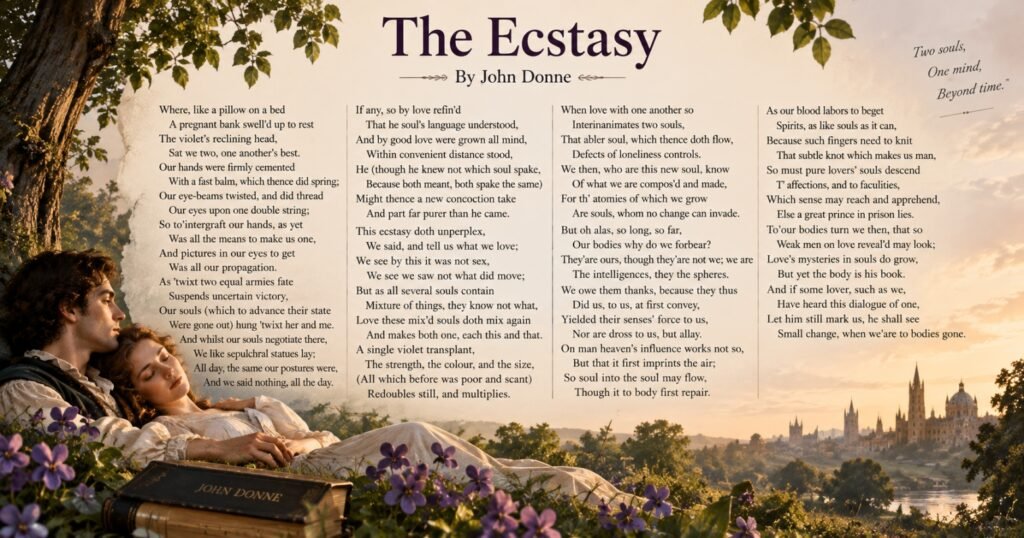
Two lovers lie on a riverbank, holding hands, staring into each other’s eyes (stanzas 1–3). Donne describes their clasped hands as sealed together by a kind of natural glue, and their locked gazes as threading an invisible cord between them. Their bodies stay completely still throughout the entire poem — this stillness matters, because everything that happens next happens somewhere else.
While the bodies rest, the lovers’ souls slip out and meet in the space between them (stanzas 4–8). Donne pictures this meeting as a negotiation: two separate souls hover like an army standing between the two people, then merge into one larger, unified soul — something bigger and better than either person alone.
This merged soul then makes a discovery: it can’t fully explain what love actually is (stanzas 9–12). Neither lover’s individual mind was enough on its own; only the combination reveals anything close to the truth. But even this combined understanding hits a wall — pure soul-knowledge alone isn’t complete.
The poem then pivots into its central argument (stanzas 13–16): souls need bodies to act in the world, the same way a prince needs subjects to carry out his will, or the way medieval astronomers believed planetary spheres needed guiding intelligences to move them. Bodies aren’t lesser than souls — they’re the necessary means through which souls express love.
The final stanzas resolve the tension (stanzas 17–19). The souls must return to their bodies for their love to become real and active, not just an abstract meeting of minds. Donne closes by suggesting that anyone who watched this whole “dialogue of one” would learn more about love by seeing the lovers return to their bodies than by studying pure soul-union alone.
Step 2: Analyzing the Central Argument
Read the poem as a piece of reasoning, not just a description of feeling. Donne structures it like a logical proof: premise, complication, resolution.
- Premise (stanzas 1–8): Souls can unite independently of bodies.
- Complication (stanzas 9–12): This soul-union alone can’t fully explain or complete love.
- Resolution (stanzas 13–19): Bodies are required as the interpreter and instrument of soul-love.
This structure is what separates Donne from earlier love poets. He doesn’t just express longing — he builds a case, stanza by stanza, the way a philosopher or lawyer would. Notice how stanza 13 introduces the prince-and-subjects comparison almost like an attorney introducing evidence, shifting the poem from meditation into argument.
Step 3: Analyzing the Major Themes
Three themes run through the poem:
Body and soul unity. The poem’s core claim is that love isn’t purely spiritual or purely physical — it requires both. Donne treats the body not as a distraction from love but as its essential vehicle.
Love as a merging of identity. The imagery in the middle stanzas (the two souls becoming one “abler soul”) suggests love dissolves individual identity into something shared. This idea recurs across Donne’s work — see “The Good-Morrow” for a similar concept of two people creating one shared world.
Knowledge through union. Donne frames physical and spiritual intimacy as a form of understanding, not just pleasure or sentiment. The lovers “know” more together than either knew alone — a theme that echoes his religious poetry, where union with God is also framed as a form of knowledge.
Step 4: Analyzing the Central Conceit
Metaphysical poetry runs on the “conceit” — an extended, surprising comparison stretched to a logical extreme. Donne builds two major conceits here:
The political conceit (around stanza 13): The soul-body relationship gets compared to a prince and his subjects. A prince’s authority means nothing without subjects to execute his commands; likewise, a soul’s love means nothing without a body to express it.
The astronomical conceit (also stanza 13): Donne draws on the medieval belief that heavenly spheres needed guiding “intelligences” to move them. The soul, he argues, is like that intelligence — powerful but static without a physical sphere to animate.
Both conceits work the same way: they take an abstract emotional claim and dress it in the language of political theory and science, making the argument feel rigorous rather than sentimental. This technique is the single biggest reason critics label Donne a “metaphysical” poet.
Step 5: Analyzing Structure and Form
The poem’s 19 quatrains, rhymed ABAB, give it a steady, almost meditative rhythm — fitting for two people lying motionless for the entire poem. But look closer at how the content changes even while the form stays constant.
The early stanzas move slowly, layering image after image of stillness (the fixed eyes, the clasped hands, the “sepulchral” bodies). The middle stanzas quicken into abstraction as the souls negotiate their merger. The final third turns argumentative and almost legal in tone, as Donne builds his case for the body’s necessity.
This matters because form typically imitates meaning in Donne’s work: the unchanging quatrain structure represents the lovers’ unmoving bodies, while the shifting tone within that structure represents the restless activity happening in their souls.
Step 6: Analyzing Tone and Voice
The poem’s tone shifts from contemplative to persuasive. In the opening stanzas, the speaker sounds like an observer, almost detached, describing a scene from outside it. By the middle stanzas, the voice becomes more intimate and philosophical, working through an idea in real time.
By the final third, the tone turns openly persuasive; the speaker seems to be building an argument aimed at his beloved (and at the reader) rather than just meditating privately. This shift is why many critics read the poem as part seduction — the persuasive tone in the closing stanzas does real rhetorical work, not just philosophical explanation.
Step 7: Weighing the Critical Interpretations
Scholars split into three main camps on how to read the poem:
- The sincere metaphysical reading: Donne genuinely believes body and soul are equal partners in love, and the poem is a serious philosophical statement about human intimacy.
- The seduction reading: The elaborate argument is really a sophisticated way for the speaker to talk his partner into physical intimacy — a technique similar to Marvell’s “To His Coy Mistress.”
- The Neoplatonic critique reading: Donne is directly answering the Neoplatonic love poetry of his era, which idealized purely spiritual love, and correcting it with a more grounded, embodied view.
Most modern critics blend the first two readings — the poem works as both genuine philosophy and clever persuasion, since for Donne, intellectual argument and romantic seduction were rarely separate impulses.
How “The Ecstasy” Connects to Donne’s Other Work
- “The Flea“ — Uses a lighter, more comic conceit for a similar seduction argument, comparing a flea bite to physical union.
- “A Valediction: Forbidding Mourning” — Takes almost the opposite position, arguing that separated lovers’ souls stay connected without needing physical closeness, using the famous compass metaphor.
- “The Good-Morrow” — Explores how love creates one shared, complete world for two people, echoing the “one soul” imagery here.
- Holy Sonnets — Later in life, Donne applies this same intense, argumentative style to his relationship with God, showing his metaphysical method outlasted his secular love poetry.
Donne vs. His Contemporaries
| Poet | Approach to Love | Contrast with Donne |
|---|---|---|
| George Herbert | Devotional, humble, focused on God’s love | Favors plain-spoken sincerity over Donne’s argumentative complexity |
| Andrew Marvell | Witty, persuasive, often urgent (“To His Coy Mistress”) | Shares Donne’s seduction-through-logic technique, but with less philosophical weight |
| William Shakespeare | Emotional, musical, focused on beauty and time | Rarely uses scientific or political conceits the way Donne does |
| Edmund Spenser | Idealized, allegorical, Neoplatonic | Represents the idealized-love tradition Donne seems to push back against |
Samuel Johnson later criticized poets like Donne for yoking together wildly different ideas by force — political theory, astronomy, and romance in a single poem. That same quality is exactly what makes “The Ecstasy” stand out from more conventional love poetry of its time.
Frequently Asked Questions
What is “The Ecstasy” about?
It’s about whether love needs to exist in the body as well as the soul. Two lovers experience a soul-union while lying motionless, then conclude that real love requires the body too.
What does “ecstasy” mean in the title?
It comes from the Greek word for “standing outside oneself.” In the poem, it describes the lovers’ souls leaving their bodies to merge together.
Is “The Ecstasy” a seduction poem?
Many critics think so. The philosophical argument doubles as a persuasive case for physical intimacy, similar to Marvell’s “To His Coy Mistress.”
What are the main conceits in the poem?
Donne compares the soul-body relationship to a prince and his subjects, and to medieval astronomical “spheres” and their guiding intelligences.
When was the poem written and published?
Likely written in the 1590s, published posthumously in 1633 in Donne’s Songs and Sonnets.
Also read: 12 Best Poems for Funerals