
In this article we will understand The Scholar-Gipsy by Matthew Arnold summary and analysis in easy way.
Quick Facts About “The Scholar-Gipsy”
| Detail | Information |
|---|---|
| Poet | Matthew Arnold |
| Published | 1853 |
| Form | Pastoral elegy |
| Stanza structure | 10-line stanzas, rhyme scheme ABABCCDDEE |
| Source material | Joseph Glanvill’s The Vanity of Dogmatizing (1661) |
| Setting | The countryside near Oxford, particularly the Cumnor Hills |
| Companion poem | “Thyrsis” (1866), written as a sequel-elegy |
Introduction
Matthew Arnold wrote “The Scholar-Gipsy” in 1853, and it remains one of the most studied poems of the Victorian era. On the surface, it tells a simple story: a poor Oxford student abandons his studies, joins a band of Romani travelers, and disappears from ordinary society forever. Underneath that story, though, Arnold is doing something much larger. He’s using this legend to diagnose what he saw as the central sickness of his own century — a restless, fragmented, “divided” way of living that never lets a person settle into purpose or peace.
This guide breaks down the poem’s story, structure, symbols, and themes, and places it alongside Arnold’s other major works and the writing of his contemporaries.
Where the Story Comes From
Arnold didn’t invent the scholar-gipsy. He borrowed the tale directly from The Vanity of Dogmatizing, a 1661 book by the philosopher and clergyman Joseph Glanvill. Glanvill’s original account describes a bright but financially struggling Oxford student who, unable to secure academic advancement, leaves university life behind to travel with a group of Romani people. Once he gains their trust, they teach him elements of their traditional knowledge and their own methods of understanding the world. Years later, two of his old Oxford classmates run into him on a country road. He tells them that the travelers have taught him forms of insight ordinary scholarship never could, and that he intends to master this knowledge fully before sharing it with the world.
Arnold keeps this framework almost entirely intact, then builds an entire meditation on modern existence around it.
Summary of the Poem
The poem opens with the speaker — closely identified with Arnold himself — sitting alone in a hillside field above Oxford, looking out over the university spires in the distance. He tells a shepherd he’ll stay there until evening, reading and thinking. Beside him lies Glanvill’s old book, and he decides to reread the familiar story of the scholar-gipsy once more.
He then retells the legend: the poor scholar, tired of waiting for advancement that never comes, walks away from his studies one summer morning to join the Romani community and learn their ways. Later, when former classmates encounter him, he explains that his new companions possess a kind of concentrated, imaginative understanding — one that requires patience and the right conditions to fully develop.
From here, the poem shifts. The speaker imagines catching glimpses of this same wanderer across the centuries. For example, near a mill, by a stream, in an orchard at dusk. As though he never aged and never truly disappeared. The speaker insists the scholar-gipsy cannot have died in any ordinary sense. Because he stepped outside the exhausting cycle of ambition, disappointment, and fatigue that wears down everyone else. Modern people, the speaker argues, live scattered, half-finished lives, chasing many goals at once and completing none of them. The scholar-gipsy, by contrast, held onto a single, undivided hope.
The poem closes with an extended comparison. The scholar-gipsy is like a Tyrian trader who, seeing Greek merchants moving in to compete, sails away to untouched shores rather than adapt to the changing marketplace. The image reinforces the poem’s final message — some forms of purity survive only by refusing to engage with a corrupting, competitive modern world.
Structure and Form
Arnold builds the poem from twenty-five ten-line stanzas. Each of them following the same rhyme scheme (ABABCCDDEE) and mixing iambic pentameter with a shorter sixth line. This regularity gives the poem a slow, meditative rhythm that suits its reflective, elegiac mood. The steady form also creates a quiet tension with the poem’s subject matter. It includes a strict, ordered structure describing a man who has escaped all structure.
The poem belongs to the pastoral elegy tradition. A form that mourns a loss (here, the loss of wholeness and certainty in modern life) using the language and imagery of idealized rural nature. Arnold was drawing on a lineage that runs through Theocritus, Virgil, Milton’s “Lycidas,” and Shelley’s “Adonais.”
Major Themes
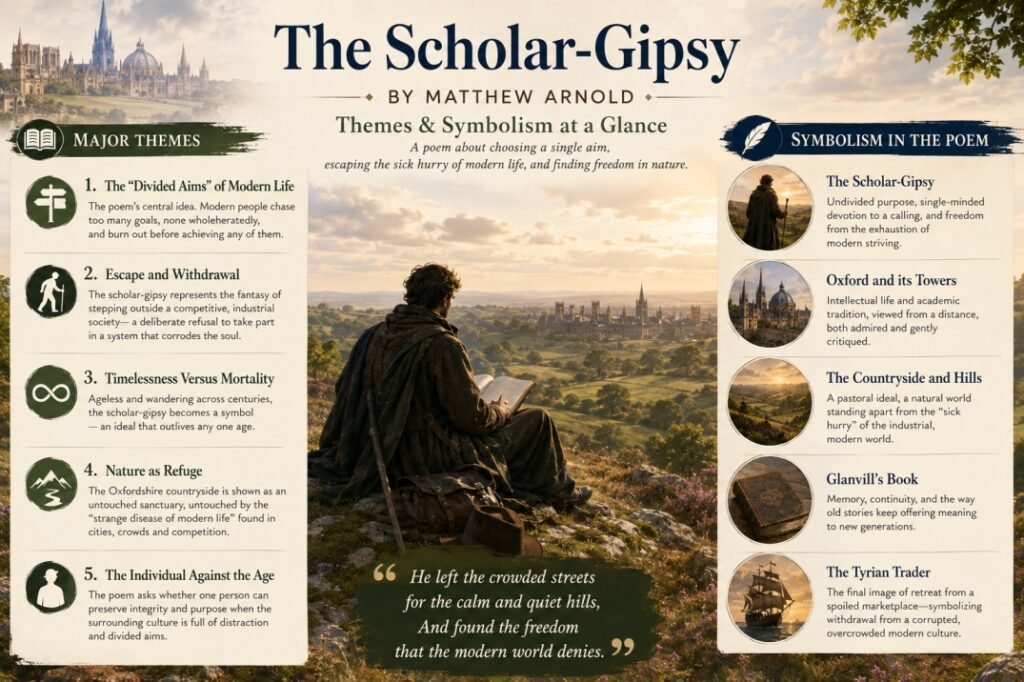
1. The “Divided Aims” of Modern Life
This is the poem’s central idea. Arnold believed his contemporaries suffered from what he elsewhere called a sick hurry and divided aims. They chase too many goals, none of them wholeheartedly, and burning out before achieving any of them.
2. Escape and Withdrawal
The scholar-gipsy represents the fantasy of stepping entirely outside a competitive, industrializing society. His retreat isn’t laziness. It’s a deliberate refusal to participate in a system Arnold viewed as corrosive to the human spirit.
3. Timelessness Versus Mortality
By imagining the scholar-gipsy as ageless, wandering the same hills across centuries, Arnold turns him into a symbol rather than a historical figure. An idea that can outlive any single era.
4. Nature as Refuge
The Oxfordshire countryside functions as an untouched space, standing apart from the “strange disease of modern life” that Arnold locates specifically in cities, crowds, and competition.
5. The Individual Against the Age
Like much of Arnold’s work, the poem asks whether one person can preserve integrity and purpose. Along with the surrounding culture fragments into distraction.
Symbolism in the Poem
- The Scholar-Gipsy himself — undivided purpose, single-minded devotion to a calling, and freedom from the exhaustion of modern striving.
- Oxford and its towers — intellectual life and academic tradition, viewed from a distance, both admired and gently critiqued.
- The countryside and hills — a pastoral ideal, insulated from the “sick hurry” of the industrial world.
- Glanvill’s book — memory, continuity, and the way old stories keep offering meaning to new generations.
- The Tyrian trader — the closing image of retreat from a spoiled marketplace, standing in for withdrawal from a corrupted, overcrowded modern culture.
“The Scholar-Gipsy” and Arnold’s Other Major Works
Arnold’s poetry and prose consistently return to the same worry: that modern life fractures the self. Reading “The Scholar-Gipsy” alongside his other works sharpens that pattern. This will increase your understanding of The Scholar-Gipsy by Matthew Arnold summary and analysis.
- “Dover Beach” (1867) — Arnold’s most famous poem shares the same undercurrent of loss, describing a world where the “sea of faith” has withdrawn, leaving only uncertainty. Where “The Scholar-Gipsy” offers an escape route, “Dover Beach” offers none — only the comfort of human companionship against a confusing world.
- “Thyrsis” (1866) — Written as a direct companion piece, this elegy mourns Arnold’s friend and fellow poet Arthur Hugh Clough, using the same Cumnor countryside and even referencing the scholar-gipsy again as a symbol of steady purpose.
- “Empedocles on Etna” (1852) — This poem explores a philosopher paralyzed by doubt and intellectual exhaustion, a darker counterpart to the scholar-gipsy’s escape into certainty.
- “Sohrab and Rustum” (1853) — Shows Arnold’s skill with classical narrative form and epic-style storytelling, published the same year as “The Scholar-Gipsy.”
- Culture and Anarchy (1869) — In this prose work, Arnold develops his critique of Victorian materialism and “doing as one likes,” the same social sickness he diagnoses poetically years earlier.
Together, these works form a consistent argument: Arnold saw his century as spiritually and intellectually adrift, and he kept testing different literary forms — elegy, dramatic monologue, lyric, criticism — to explore what a person could hold onto in response.
How Arnold Compares to Other Victorian and Romantic Poets
Arnold vs. Alfred Tennyson
Tennyson’s “In Memoriam A.H.H.” wrestles with religious doubt after personal loss but ultimately moves toward reconciliation and faith. Arnold offers no such resolution. “The Scholar-Gipsy” ends not with comfort but with retreat — the wanderer sails away rather than making peace with the modern world. Tennyson mourns and heals; Arnold mourns and withdraws.
Arnold vs. William Wordsworth
Both poets treat nature as a moral and spiritual teacher, but their relationship to it differs. Wordsworth’s nature actively restores and instructs the soul. Arnold’s countryside is more passive — a beautiful backdrop that highlights what modern life has lost rather than a force that actively repairs it. Arnold admired Wordsworth deeply. He even edited a major selection of his poems, but his own outlook is far less consoled by nature’s presence.
Arnold vs. John Keats
Keats’s odes chase intense, sensory beauty and try to hold a perfect moment still, as in “Ode on a Grecian Urn.” Arnold’s poem shares that longing for something permanent and untouched by time, but it’s driven by a specifically Victorian anxiety — industrial pressure, professional competition, and intellectual overload — that Keats’s Romantic generation hadn’t yet fully confronted.
Arnold vs. Robert Browning
Browning’s dramatic monologues dive into fractured, often unreliable psychology, letting flawed speakers reveal themselves gradually. Arnold’s speaker in “The Scholar-Gipsy,” by contrast, is calm, controlled, and consistent throughout — closer to a philosophical essayist thinking aloud than a dramatized character.
This poem sits at a genuine turning point. It carries Romantic reverence for nature and solitary genius. But, reshapes it through a distinctly Victorian sense of crisis, doubt, and social fatigue.
Why “The Scholar-Gipsy” Still Matters
Arnold wrote about “sick hurry” and “divided aims” in 1853. They describe a culture accelerating faster than the human spirit could adjust to. That diagnosis reads as remarkably current in an age of information overload, career switching, and constant digital distraction. The poem’s core question — how does a person hold onto a single, undivided purpose in a fragmented world — hasn’t gone out of date; if anything, it has grown more relevant.
Frequently Asked Questions
What is “The Scholar-Gipsy” about?
It’s a Victorian pastoral elegy about a 17th-century Oxford student who abandons academic life to live among Romani travelers. Arnold uses this legend to reflect on the restlessness, distraction, and lack of purpose he saw in modern life.
Who wrote “The Scholar-Gipsy” and when?
Matthew Arnold wrote it, and it was published in 1853.
What is the source of the scholar-gipsy legend?
Arnold based the poem on an anecdote in Joseph Glanvill’s 1661 book The Vanity of Dogmatizing.
What form does the poem use?
Twenty-five ten-line stanzas in a fixed ABABCCDDEE rhyme scheme, written mostly in iambic pentameter.
Is “The Scholar-Gipsy” connected to any other Arnold poem?
Yes. “Thyrsis” (1866), an elegy for Arnold’s friend Arthur Hugh Clough, revisits the same setting and references the scholar-gipsy directly.
What is the poem’s main theme?
The tension between the modern world’s fragmented, exhausting pursuit of many goals and the scholar-gipsy’s undivided, patient devotion to a single purpose.
Also read: The Flea by John Donne Summary and Analysis