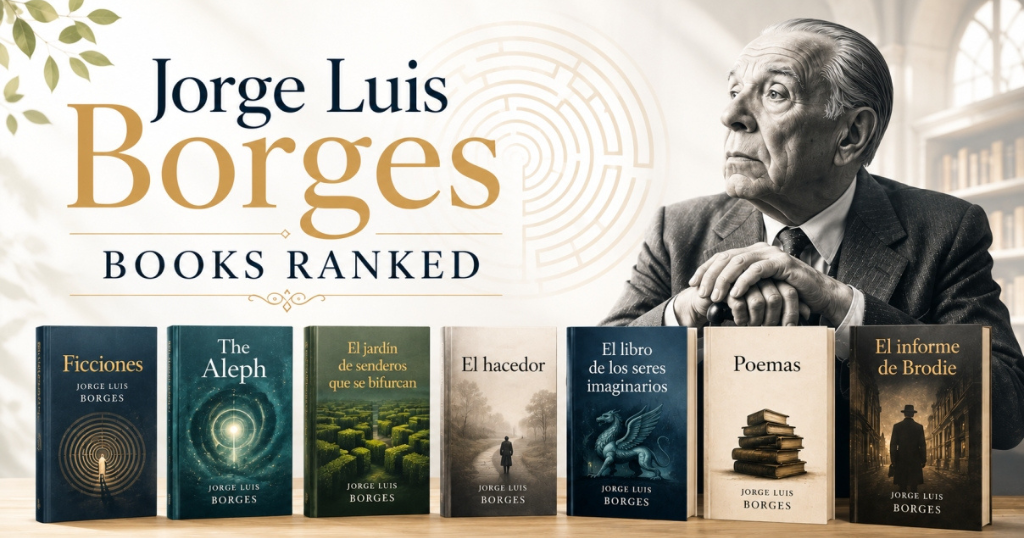
How This Ranking Works
I pulled the average Goodreads rating and total rating count for every major Borges collection currently listed on Goodreads (data current as of July 2026), then cross-checked reader reviews to explain why each book lands where it does. This isn’t a guess-based list — every number below comes directly from Goodreads’ public rating data. Where two editions of the same content exist (say, the Spanish “El Aleph” versus the English “The Aleph and Other Stories”), I’ve grouped them and noted the split so you know exactly which edition to buy.
Borges never wrote a traditional novel. He built his reputation entirely on short stories, essays, and poems, usually assembled into slim collections of 15,000 to 30,000 words. That makes ranking his books a bit different from ranking, say, Gabriel García Márquez’s novels — you’re really ranking curated bundles of the same core body of work, repackaged by different publishers and translators over seven decades. Keep that in mind as you read.

Quick Answer: The Top 5 Borges Books
- Collected Fictions — 4.56 ★
- Labyrinths — 4.44 ★
- Ficciones — 4.39 ★
- Other Inquisitions — 4.36 ★
- The Aleph and Other Stories — 4.32 ★
Now let’s break down all twelve major titles in detail.
1. Collected Fictions — 4.56 ★ (26,000+ ratings)
Translator: Andrew Hurley | Published (English): 1998
This ranks first for a simple reason: it contains everything. Andrew Hurley translated all of Borges’s short fiction into a single volume, covering nine collections — A Universal History of Iniquity, Fictions, Artifices, The Aleph, The Maker, In Praise of Darkness, Brodie’s Report, The Book of Sand, and Shakespeare’s Memory — roughly 103 stories in total.
Why it ranks so high: Readers treat this as the definitive Borges purchase. You get a single, consistent translation voice instead of juggling five different translators across five different books, and Hurley’s prose keeps Borges’s precision without flattening his strangeness. Reviewers frequently call this the volume they return to again and again over decades.
Why it isn’t a “10”: A handful of readers find Hurley’s translation choices less lyrical than earlier ones (particularly compared to the Irby/Yates Labyrinths team). Purists who first met Borges in an older translation sometimes prefer that original voice, even if Hurley is more complete.
Best for: Readers who want one authoritative book and don’t mind the density of having every story in one place.
2. Labyrinths — 4.44 ★ (34,000+ ratings)
Translators: James E. Irby and Donald A. Yates | Published: 1962
Labyrinths introduced English-language readers to Borges and remains the classic entry point. It bundles his most anthologized stories — “Tlön, Uqbar, Orbis Tertius,” “The Garden of Forking Paths,” and “The Library of Babel” — alongside essays and parables, with a preface by André Maurois of the Académie française.
Why it ranks high: This edition won a spot among the London Society of Authors’ fifty outstanding translations of the past fifty years. It also mixes genres deliberately — fiction, essay, and parable sit side by side — which gives new readers a fuller picture of how Borges actually thought, not just how he told stories.
Why it isn’t first: Some later critics, including translator Alastair Reid, have argued the 1950s-era translations in this volume read as “uneven” compared to more recent, more meticulous versions. It’s a landmark, but not the most polished text available today.
Best for: First-time Borges readers who want the canonical university-syllabus entry point.
3. Ficciones — 4.39 ★ (82,000+ ratings — the most-reviewed Borges book on Goodreads)
Published (Spanish): 1944
This is Borges’s signature work and the book most people mean when they say “read Borges.” Split into two parts — El jardín de senderos que se bifurcan (“The Garden of Forking Paths”) and Artificios — it contains sixteen stories, including “Tlön, Uqbar, Orbis Tertius,” “Pierre Menard, Author of the Quixote,” and “The Library of Babel,” which one reviewer calls the book’s central and most important theme: the universe imagined as an infinite library.
Why it ranks high: Ficciones has by far the largest number of Goodreads ratings of any Borges title, which tells you something on its own — it’s the default recommendation, the one professors assign, the one that shows up on “books to read before you die” lists.
Why it isn’t higher: Reviews split sharply here. Some readers call individual stories, like “Pierre Menard,” unconvincing or hard to connect with emotionally. Others describe the book as intellectually dazzling but “distant and cerebral” — you admire it more than you feel it. That tension between admiration and emotional distance shows up constantly in reader reviews of this specific collection.
Best for: Anyone building a serious literature habit — this is the one to read if you only ever read one Borges book.
4. Other Inquisitions (Otras inquisiciones) — 4.36 ★ (1,844 ratings)
Published: 1952
Borges’s essay collection, gathering his literary criticism and philosophical speculation rather than fiction. It covers everything from Dante to Pascal to Kafka.
Why it ranks well: Among readers who specifically seek out Borges’s non-fiction, this collection earns consistent praise for showing the analytical engine behind his stories — the same obsessions with infinity, mirrors, and paradox, argued directly instead of dramatized.
Why it sits mid-table overall: With under 2,000 ratings, it has a small, self-selecting audience of essay readers rather than the broad fiction crowd that drives Borges’s bigger numbers. It rewards readers who already love the fiction and want the theory behind it — it’s not a good starting point.
Best for: Readers who’ve finished Ficciones and The Aleph and want to understand Borges’s mind, not just his stories.
5. The Aleph and Other Stories — 4.32 ★ (51,000+ ratings)
Published (Spanish): 1949 | Published (English translation): 1970
The title story is widely considered, alongside “The South” from Ficciones, Borges’s single best piece of short fiction — a narrator discovers a point in space that contains every other point in the universe, simultaneously and without distortion. The collection also includes “Emma Zunz,” “The Immortal,” and “The Zahir.”
Why it ranks well: Reviewers repeatedly single out the title story’s closing paragraph as one of the most quoted passages in all of Borges — the narrator’s meditation on memory fading “under the tragic erosion of the years.” This collection also directly inserts a fictionalized version of Borges himself into the narrative, a technique reviewers note few authors attempt.
Why it’s not top 3: Compared to Ficciones, this collection is viewed as slightly less consistent story-to-story — the highs (the title story, “Emma Zunz”) are extremely high, but a few entries feel like minor works riding alongside the masterpieces.
Best for: Readers who want Borges’s single most famous story without committing to the full Collected Fictions.
6. Doctor Brodie’s Report (El informe de Brodie) — 4.34 ★ (6,750+ ratings)
Published: 1970
A later-career collection where Borges deliberately writes in a plainer, more conventional narrative style, influenced by his admiration for Kipling.
Why it ranks decently: Longtime readers appreciate seeing Borges strip away his usual erudition and footnote-heavy games to write closer to traditional gaucho and adventure fiction. It shows range.
Why it ranks lower overall: New readers expecting the labyrinths-and-mirrors Borges of Ficciones sometimes find this collection anticlimactic — it deliberately avoids the tricks that made him famous, which reads as a letdown if you don’t already know that’s the point.
Best for: Established Borges readers exploring his stylistic evolution, not newcomers.
7. The Book of Sand — 4.30 ★ (2,659 ratings, English edition)
Published (Spanish): 1975 | Published (English): 1977
One of Borges’s final major collections, written after blindness had fully set in and he was dictating his work aloud. The title story concerns a book with infinite pages.
Why it ranks well: Reviewers consistently point to the title story as a late-career return to peak form — proof Borges hadn’t lost his gift for a single, perfect metaphysical premise even in his seventies.
Why it’s mid-table: It’s a shorter, later collection with a smaller review base, so it doesn’t have the cultural weight or reading-list ubiquity of his 1940s peak work.
Best for: Readers tracking Borges’s late style and his lifelong obsession with infinity.
8. The Maker (El Hacedor / Dreamtigers) — 4.16 ★ (5,315 ratings)
Published: 1960
A hybrid collection of very short prose pieces, parables, and poems, written as Borges’s eyesight was failing and his public fame was growing — a combination he directly addresses in the book’s content.
Why it ranks in the middle: Fans of Borges’s more experimental, fragmentary side rate this highly for its introspection; it’s the book where Borges writes most directly about identity, aging, and losing his sight.
Why it doesn’t rank higher: It’s the least narrative of his major collections. Readers coming from Ficciones looking for plot-driven stories sometimes find these vignettes too brief or abstract to land emotionally.
Best for: Readers interested in Borges the person, not just Borges the puzzle-maker.
9. The Book of Imaginary Beings — 4.05 ★ (9,979 ratings)
Published (expanded edition): 1957 (as Manual de zoología fantástica)
A genre outlier: an encyclopedia of mythological and invented creatures, from the Basilisk to Borges’s own inventions, co-written with Margarita Guerrero.
Why it ranks respectably: It’s beloved as a browsing book — readers dip in and out rather than reading cover to cover, and it’s often recommended to fantasy and mythology fans who might not otherwise pick up Borges.
Why it ranks lower than his fiction: It’s reference material, not narrative, so it lacks the emotional and philosophical payoff that drives high ratings on his story collections. It’s a supplement to Borges’s world, not a core text.
Best for: Mythology enthusiasts and readers who want Borges in small, illustrated doses.
10. The Book of Sand and Shakespeare’s Memory (combined English edition) — 4.09 ★ (17,000+ ratings)
Published: 1975 / 1983, combined English edition 1998
This edition bundles Borges’s last two original story collections together, including “Shakespeare’s Memory,” about a man who inherits Shakespeare’s memories.
Why it ranks decently: As a two-for-one late-career bundle, it’s a practical way to read Borges’s final published fiction without hunting down two separate out-of-print books.
Why it ranks lower: Reviewers generally treat late Borges as a footnote to his 1940s peak — thoughtful and often moving, but rarely matching the density of ideas in Ficciones or The Aleph.
Best for: Completists finishing off Borges’s fiction bibliography.
11. Shakespeare’s Memory (standalone) — 4.09 ★ (1,378 ratings)
Published: 1983
Borges’s final collection, published just three years before his death.
Why it ranks here: Small, specific audience; mostly read by readers who already own everything else and want the last original pieces Borges wrote.
Best for: Completists only — most readers get this content via the combined edition above.
12. A Universal History of Iniquity — 3.90 ★ (12,295 ratings)
Published: 1935
Borges’s first book of fiction — technically not fiction in his later style at all, but a collection of stylized, semi-fictionalized biographies of real criminals, pirates, and con artists.
Why it ranks last: Reader reviews consistently frame this as historically interesting rather than genuinely great. It’s Borges before he found his signature style — before labyrinths, infinite libraries, and metaphysical puzzles became his subject. As an experiment in tone and voice, it’s valuable; as a reading experience, most reviewers rate it well below his mature work.
Best for: Literary historians and Borges completists who want to see where he started.
Full Ranking Table
| Rank | Book | Goodreads Rating | Ratings Count | Published |
|---|---|---|---|---|
| 1 | Collected Fictions | 4.56 | 26,049 | 1998 |
| 2 | Labyrinths | 4.44 | 34,299 | 1962 |
| 3 | Ficciones | 4.39 | 82,015 | 1944 |
| 4 | Other Inquisitions | 4.36 | 1,844 | 1952 |
| 5 | The Aleph and Other Stories | 4.32 | 51,101 | 1949/1970 |
| 6 | Doctor Brodie’s Report | 4.34 | 6,752 | 1970 |
| 7 | The Book of Sand | 4.30 | 2,659 | 1975/1977 |
| 8 | The Maker | 4.16 | 5,315 | 1960 |
| 9 | The Book of Imaginary Beings | 4.05 | 9,979 | 1957 |
| 10 | Book of Sand and Shakespeare’s Memory | 4.09 | 17,025 | 1998 |
| 11 | Shakespeare’s Memory | 4.09 | 1,378 | 1983 |
| 12 | A Universal History of Iniquity | 3.90 | 12,295 | 1935 |
About Jorge Luis Borges: Biography, Style, and Legacy
Full name: Jorge Francisco Isidoro Luis Borges Acevedo
Born: August 24, 1899, Buenos Aires, Argentina
Died: June 14, 1986, Geneva, Switzerland
Borges grew up bilingual — his grandmother was English, and he read Cervantes in English translation before he read him in Spanish. His family moved to Switzerland in 1914, where he studied at the Collège de Genève and encountered French and German literature firsthand. He traveled widely across Europe, including Spain, before returning to Argentina in 1921 and beginning to publish poetry and essays in surrealist literary journals.
Career and public life: Borges worked for years as a municipal librarian in Buenos Aires — a detail that shaped his fiction more than almost anything else in his biography. His obsession with infinite libraries, card catalogs, and archives comes directly from decades spent shelving books. In 1955, after the fall of the Perón government (which had sidelined him for his opposition politics), Borges was appointed director of Argentina’s National Public Library and professor of English Literature at the University of Buenos Aires — a role he held despite having gone almost completely blind by that point, a condition that ran in his family and had claimed his father’s sight before him.
Writing style: Borges wrote almost exclusively in short forms — stories rarely longer than twenty pages, essays, and poems. He never completed a novel. His prose is precise, formal, and dense with erudition, frequently blending real historical and literary figures with invented ones so seamlessly that readers often can’t tell fact from fabrication without checking. His recurring obsessions include infinity, labyrinths, mirrors, dreams, doubles, and the idea that the universe itself might be a kind of library or book.
Famous works
His most influential stories include “Tlön, Uqbar, Orbis Tertius,” “The Library of Babel,” “The Garden of Forking Paths,” “Pierre Menard, Author of the Quixote,” “Funes the Memorious,” and “The Aleph.” His best-known collections, Ficciones and El Aleph, both published in the 1940s, are considered foundational texts of twentieth-century Latin American literature.
Records and honors: Borges shared the International Publishers’ Prize (the Prix Formentor) with Samuel Beckett in 1961, the award that first brought him major recognition in the English-speaking world and led directly to the publication of Labyrinths. He never won the Nobel Prize in Literature, a fact widely regarded by critics as one of the award’s most notable omissions — he’s frequently cited as the most influential Nobel-eligible writer never to receive it. He’s credited, more than any other single writer, with shaping the magical realism movement that later produced Gabriel García Márquez and Julio Cortázar, despite writing in a very different, more cerebral register himself.
Frequently Asked Questions
What is Jorge Luis Borges’s best book?
By Goodreads rating, Collected Fictions ranks highest at 4.56 stars, since it contains his complete short fiction in one authoritative translation. By reputation and reading-list ubiquity, Ficciones remains the single most recommended entry point.
What order should I read Borges in?
Start with Ficciones or Labyrinths for the classic stories, move to The Aleph and Other Stories next, then read Collected Fictions if you want everything in one volume. Save Other Inquisitions and A Universal History of Iniquity for later, once you’re already invested.
Did Borges write any novels?
No. Borges never wrote a full-length novel. He worked exclusively in short stories, essays, and poetry, and often said he found the novel form unnecessarily padded.
Why didn’t Borges win the Nobel Prize?
No official reason was ever given, since the Nobel committee doesn’t explain individual decisions, but his political associations in Argentina during the 1970s are widely believed to have counted against him. Critics still consider it one of the Nobel’s most glaring omissions.
Is Ficciones the same book as The Aleph?
No — they’re separate collections, though they’re often published together in single-volume editions. Ficciones (1944) and El Aleph (1949) are Borges’s two most celebrated books and are frequently sold bundled, which sometimes causes confusion in listings.
Also read: 6 Most Famous Authors of Argentina