
Christopher Marlowe wrote Doctor Faustus in the final years of the sixteenth century, and audiences still feel its pull four hundred years later. A brilliant scholar sells his soul for twenty-four years of unlimited power. He gets everything he asks for. He loses everything that matters. That single trade sits at the heart of one of English literature’s most enduring tragedies.
This guide breaks down the play act by act, unpacks its major themes, and places it beside the work of Marlowe’s contemporaries so you understand exactly why Doctor Faustus still commands a place in every serious study of Renaissance drama.
Quick Facts About Doctor Faustus
| Detail | Information |
|---|---|
| Author | Christopher Marlowe |
| Written | Between 1588 and 1592 |
| First Published | 1604 (A-text), 1616 (B-text, expanded) |
| Genre | Elizabethan tragedy |
| Source Material | The German Faustbuch (1587) |
| Form | Blank verse with prose comic scenes |
| Structure | Five acts |
| Central Theme | The price of unchecked ambition |
Who Was Christopher Marlowe?
Marlowe was born in 1564, the same year as Shakespeare, and he burst onto the London stage while still in his twenties. He studied at Cambridge, wrote in a bold, muscular blank verse that later poets openly borrowed, and lived a short, controversial life that ended in a tavern stabbing in 1593 at just twenty-nine. In that brief span, he produced Tamburlaine, The Jew of Malta, Edward II, and Doctor Faustus — plays that reshaped what English tragedy could sound like before Shakespeare ever wrote Hamlet.
Doctor Faustus Summary by Act
Prologue
The Chorus opens the play and tells us plainly what we’re about to watch: a gifted man will rise through scholarship, grow proud, and fall through forbidden knowledge. Marlowe compares Faustus to Icarus, the boy who flew too close to the sun. That comparison tells you the ending before the story even starts.
Act 1: The Bargain Begins
We meet Doctor Faustus in his study, restless and dissatisfied. He has mastered logic, medicine, law, and theology, and none of it satisfies him anymore. He dismisses each field in turn and lands on necromancy — magic that promises “a world of profit and delight.”
Two fellow scholars, Valdes and Cornelius, teach him the dark arts, and Faustus conjures a spirit that same night. Mephistopheles appears, and Faustus immediately tries to strike a deal for his service. Mephistopheles warns him plainly about the horror of damnation and even admits his own suffering as a fallen angel. Faustus hears the warning and pushes forward anyway, sending Mephistopheles back to Lucifer with his terms.
Meanwhile, a comic subplot begins: Faustus’s servant Wagner mimics his master’s dabbling in magic with the clown Robin, a small mirror of the temptation playing out at a lower social level.
Act 2: The Contract Is Signed
Faustus wavers before committing. A Good Angel and a Bad Angel appear at his side — one urging repentance, the other urging him toward the bargain — and this becomes a recurring pattern throughout the play, representing the war inside Faustus’s own conscience.
He signs the contract in his own blood, offering his soul in exchange for twenty-four years of Mephistopheles’s service. Even as the blood congeals on the page, a small but chilling stage detail, he presses on. The moment he finishes signing, the words “Homo, fuge” (“Man, flee”) appear on his arm — one more warning he ignores.
Faustus immediately asks for a wife, and immediately settles for lesser pleasures instead, since Mephistopheles refuses and offers him courtesans in her place. He then questions Mephistopheles about astronomy and the nature of hell, but grows frustrated with the vague answers. Lucifer himself appears with a parade of the Seven Deadly Sins to distract Faustus from any thought of repentance, and it works.
Act 3: Power Wasted on Small Ends
This is where the play’s structure gets debated among critics. Faustus, granted virtually limitless power, uses it for surprisingly small ends. He travels to Rome and plays invisible pranks on the Pope during a papal banquet, snatching food and boxing his ears. Rather than commanding kingdoms, he spends his power on mischief.
Many readers find this section frustrating on first read, but it’s actually one of Marlowe’s sharpest ironies. A man who bargained away eternity uses his power for parlor tricks. Greatness slips through his fingers because he never really knew what to do with it.
Act 4: Entertaining Courts
Faustus’s exploits continue at the court of the German Emperor, where he conjures a vision of Alexander the Great to entertain the royal audience. He then tricks a horse-dealer who tries to cheat him, and grows a pair of horns on a knight who mocks him at court.
These episodes reinforce the same irony from Act 3: a man capable of commanding devils spends his gifts on parlor tricks and petty revenge. Time is quietly running out, though Faustus barely seems to notice it slipping away.
Act 5: The Final Hour
As the twenty-four years run out, Faustus asks Mephistopheles to conjure Helen of Troy, and he delivers the play’s most famous line at the sight of her: “Was this the face that launched a thousand ships?” This moment shows a man reaching for beauty and pleasure to numb the terror of what’s coming, rather than seeking the repentance that might still save him.
An Old Man appears and urges Faustus toward genuine repentance, offering one last chance at mercy. Faustus nearly breaks down, but Mephistopheles threatens him, and Faustus recommits himself to Lucifer instead, even asking for Helen as his lover to seal his resolve.
The last scene is the play’s most devastating. Faustus has one hour left before the devils come to claim him, and he knows it exactly. He begs time to slow down. He cries out for Christ’s mercy and, in the same breath, for the earth to swallow him or the stars to pull him into open air — anything to escape damnation. The clock strikes twelve. Devils drag him off. Scholars find only his torn limbs the next morning.
Epilogue
The Chorus returns and delivers the moral directly: Faustus’s fall should teach the wise “only to wonder at unlawful things,” since forbidden knowledge tempts even the strongest minds to ruin.
Doctor Faustus Analysis
Theme 1: Ambition Without Limits
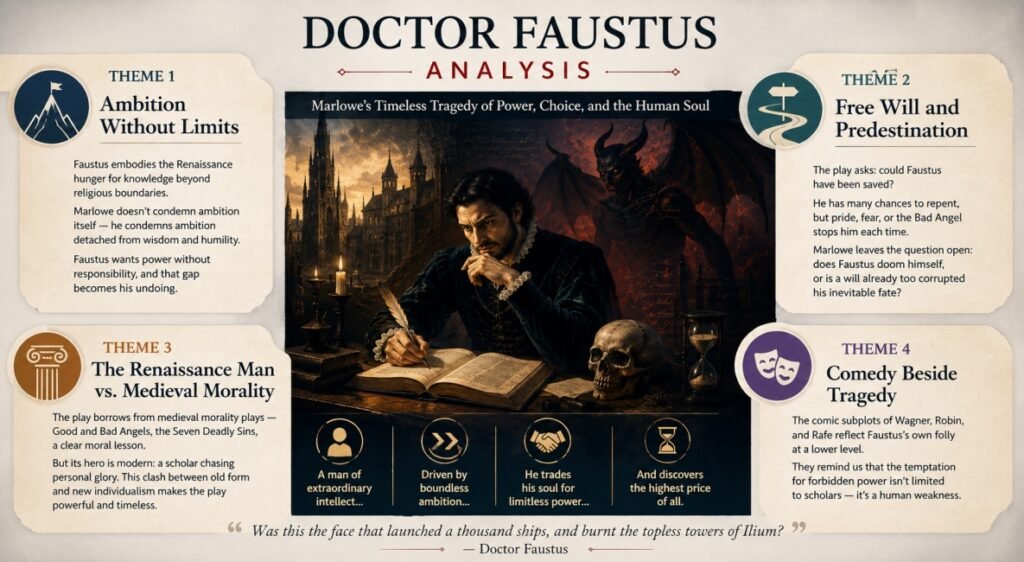
Faustus is a Renaissance figure through and through. He represents the era’s hunger for knowledge beyond traditional religious boundaries. Marlowe doesn’t condemn ambition itself — he condemns ambition detached from wisdom and humility. Faustus wants power without responsibility, and that gap becomes his undoing.
Theme 2: Free Will and Predestination
The play repeatedly asks whether Faustus could have been saved. He has multiple chances to repent, and each time something — pride, fear, or the Bad Angel’s whisper — stops him. Marlowe leaves the question open: does Faustus doom himself through his own choices, or does a will already too corrupted trap him? This tension mirrors real theological debates of Marlowe’s era, particularly the Calvinist doctrine of predestination that was reshaping English religious thought.
Theme 3: The Renaissance Man vs. Medieval Morality
Doctor Faustus sits at a fascinating hinge point in literary history. Structurally, it borrows from medieval morality plays — the Good and Bad Angels, the Seven Deadly Sins parade, the clear moral lesson. But its hero is unmistakably modern: an individual scholar chasing personal glory rather than a symbolic Everyman. That collision between old dramatic form and new Renaissance individualism makes the play feel unsettled and compelling even now.
Theme 4: Comedy Beside Tragedy
The comic subplots involving Wagner and the clowns Robin and Rafe often get skipped in summaries, but they matter. They mirror Faustus’s own folly at a lower social register, showing that his temptation toward forbidden power isn’t unique to great scholars — it’s a distinctly human weakness.
Doctor Faustus and Marlowe’s Other Works
Marlowe returned to the theme of overreaching ambition throughout his short career, and reading Doctor Faustus alongside his other plays sharpens the picture considerably.
- Tamburlaine the Great — Marlowe’s earlier hero conquers nations through sheer will and dies unrepentant and undefeated. Faustus, by contrast, conquers nothing but suffers total spiritual defeat. Read together, the two plays feel like Marlowe testing the same question — what happens when ambition has no ceiling — from opposite angles.
- The Jew of Malta — Barabas, like Faustus, makes calculated bargains that spiral out of control, though Marlowe treats his fall with a darker, almost satirical humor.
- Edward II — Here ambition is political rather than magical, but the same pattern holds: a man clings to power past the point of wisdom and pays for it in blood.
Taken together, these plays form something like a personal obsession for Marlowe: gifted, willful men who cannot recognize the limits of their own reach until it’s too late.
Marlowe Compared to His Contemporaries
Marlowe vs. Shakespeare
Shakespeare’s tragic heroes — Hamlet, Macbeth, Lear — tend to wrestle with an inner world of doubt, memory, and shifting motive. Marlowe’s Faustus is more direct: his conflict plays out almost entirely between temptation and conscience, staged externally through the Good and Bad Angels rather than through private soliloquy alone. Shakespeare gives us psychological complexity; Marlowe gives us moral urgency. Both approaches were groundbreaking, but Marlowe got there first, and Shakespeare’s early tragedies clearly absorbed Marlowe’s blank verse and his taste for towering, driven protagonists.
Marlowe vs. Ben Jonson
Jonson favored satire grounded in recognizable social types — con men, fools, city merchants. Marlowe reached instead for myth, magic, and cosmic stakes. Where Jonson mocks human folly from ground level, Marlowe stages it against heaven and hell themselves.
Marlowe vs. Thomas Kyd
Kyd’s The Spanish Tragedy helped establish the revenge tragedy genre with its ghosts, madness, and bloody spectacle. Marlowe borrows some of that same theatrical intensity but redirects it inward, toward a single soul’s private negotiation with damnation rather than a public cycle of revenge.
Why Doctor Faustus Still Matters Today
Every era rewrites the Faust legend for its own anxieties. Goethe reimagined it as a story of redemption through striving. Modern culture keeps returning to the Faustian bargain, too — anyone who’s used the phrase “sold his soul” for fame, money, or power is echoing Marlowe’s language, whether they know it or not. Marlowe’s version stays disturbing precisely because it refuses easy comfort. Faustus wants forgiveness in his final hour. He doesn’t get it. That’s the line the play forces every reader to sit with.
Frequently Asked Questions
What is Doctor Faustus about in simple terms?
A brilliant scholar named Faustus grows bored with ordinary knowledge, sells his soul to the devil for twenty-four years of magical power, wastes that power on tricks and entertainment, and is dragged to hell when his time runs out.
Who wrote Doctor Faustus?
Christopher Marlowe, an English playwright and a contemporary of Shakespeare, wrote the play sometime between 1588 and 1592.
What happens in each act of Doctor Faustus?
Act 1 sets up Faustus’s dissatisfaction with scholarship and his first summoning of Mephistopheles. Act 2 covers the blood contract and his early questions about hell. Act 3 shows him wasting his power on pranks in Rome. Act 4 continues his exploits at the German Emperor’s court. Act 5 brings the vision of Helen of Troy, the Old Man’s warning, and Faustus’s final, terrifying hour before damnation.
What is the main theme of Doctor Faustus?
The central theme is the danger of unchecked ambition — the idea that reaching for forbidden knowledge and power without wisdom or humility leads to self-destruction.
How does Doctor Faustus end?
Faustus spends his final hour begging for mercy and dreading damnation at the same time. At midnight, devils drag him away, and scholars discover his torn body the next morning.
Is Doctor Faustus a tragedy?
Yes. It follows classical tragic structure: a gifted protagonist with a fatal flaw — in this case, pride and unchecked ambition — brings about his own downfall.
What’s the difference between the A-text and B-text of Doctor Faustus?
The A-text, published in 1604, is shorter and considered closer to Marlowe’s original. The B-text, published in 1616, is longer and includes additional comic and spectacle scenes likely added by other writers after Marlowe’s death.
Also read: 7 Famous Writers of the Renaissance