Introduction
The Renaissance was not just a revival of art and architecture. It was a revolution of the written word.
Between the 14th and 17th centuries, a group of extraordinary writers shook the foundations of medieval thinking. They questioned authority, celebrated human potential, and wrote in ways that still move readers today. If you want to understand why modern literature exists the way it does, you need to know these seven names.
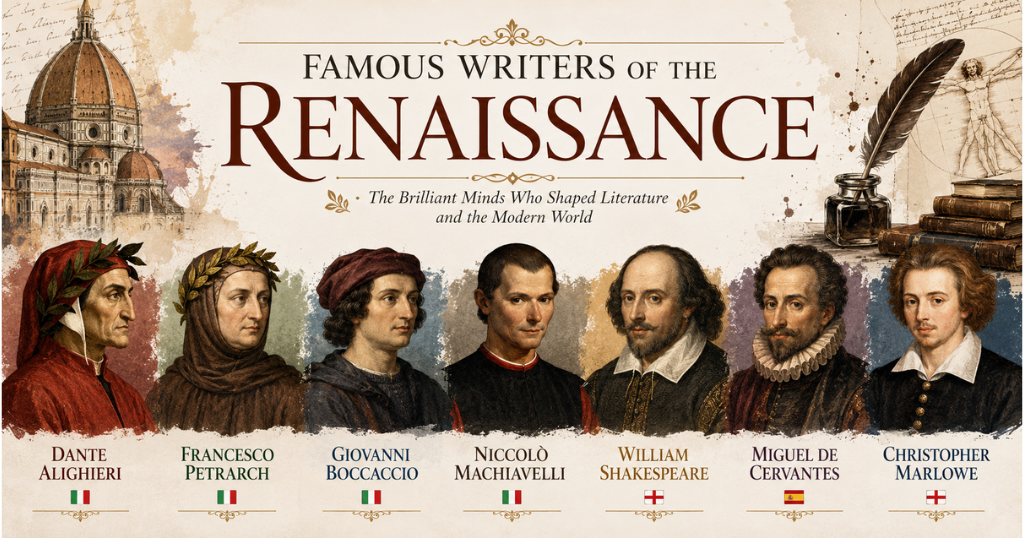
Here are the 7 famous writers of the Renaissance who permanently changed the course of human expression.
1. Dante Alighieri (1265–1321) — The Father of the Italian Language
Most historians place Dante at the very beginning of the Renaissance literary tradition. He wrote The Divine Comedy — a three-part epic journey through Hell, Purgatory, and Heaven — in the Tuscan vernacular rather than Latin. That single decision democratized literature.
Before Dante, serious writing happened in Latin, a language only the educated elite could read. By choosing the language ordinary people actually spoke, Dante made literature accessible to everyone.
Why he matters: The Divine Comedy remains one of the most studied literary works in the world. His influence on Chaucer, Milton, T.S. Eliot, and countless others is direct and documented.
Must-read work: The Divine Comedy (especially Inferno)

2. Francesco Petrarch (1304–1374) — The First Modern Man
Scholars often call Petrarch the “Father of Humanism,” and the title fits perfectly. He rejected the medieval obsession with the afterlife and turned his attention to the beauty of earthly human experience.
His Canzoniere — a collection of 366 poems dedicated to a woman named Laura — invented the Petrarchan sonnet form. This 14-line structure became the blueprint that Shakespeare, Spenser, and Sidney all borrowed and refined.
Petrarch also wrote extensively in Latin, producing works of history, philosophy, and biography. He dug up forgotten classical texts and pushed scholars to look backward at ancient Rome and Greece to move forward.
Why he matters: He redefined what poetry could express. Love, longing, inner conflict — Petrarch turned private emotion into universal literature.
Must-read work: Canzoniere
3. Giovanni Boccaccio (1313–1375) — The Storyteller Who Shocked Europe
Boccaccio wrote The Decameron in the shadow of the Black Death. Ten young people flee plague-ridden Florence and pass the time by telling each other 100 stories over ten days. The result is one of the most vibrant, scandalous, and human collections of fiction ever written.
The Decameron featured merchants, priests, lovers, tricksters, and noblewomen — all portrayed with psychological depth and dark humor. It treated sexuality, class, and religion with a frankness that medieval literature simply refused to touch.
Why he matters: Boccaccio essentially invented the prose novella. Chaucer’s Canterbury Tales owes a clear debt to The Decameron, and so does the entire tradition of short fiction.
Must-read work: The Decameron
4. Niccolò Machiavelli (1469–1527) — The Man Who Told the Truth About Power
Machiavelli wrote The Prince as a practical manual for rulers. He did not moralize. And he did not idealize. He simply observed how power actually works and wrote it down with brutal honesty.
His core argument was uncomfortable: a ruler who wants to keep power must sometimes choose effectiveness over morality. This idea horrified many readers of his time. It also described political reality with stunning accuracy.
Beyond The Prince, Machiavelli wrote plays, histories, and political philosophy. His comedy Mandragola is still performed today and stands among the finest Italian plays of the Renaissance.
Why he matters: Modern political science, strategic thinking, and leadership theory all trace lines back to Machiavelli. Every conversation about power, ends, and means carries his fingerprints.
Must-read work: The Prince
5. William Shakespeare (1564–1616) — The Writer Who Defined the English Language
No list of famous Renaissance writers is complete without Shakespeare. He wrote 37 plays and 154 sonnets, and he did something no other writer has matched — he shaped the English language itself.
Scholars credit Shakespeare with introducing over 1,700 words into English, including “bedroom,” “lonely,” “generous,” and “obscene.” His plays explored revenge, jealousy, ambition, love, and grief with a complexity that feels entirely modern.
He worked across every genre — tragedy (Hamlet, Macbeth, Othello), comedy (A Midsummer Night’s Dream, Twelfth Night), and history (Henry V, Richard III). Each genre he touched, he elevated.
Why he matters: Shakespeare is not just a Renaissance writer. He is the standard against which all English literature gets measured.
Must-read works: Hamlet, Macbeth, The Sonnets
6. Miguel de Cervantes (1547–1616) — The Father of the Modern Novel
Cervantes published Don Quixote in two parts, in 1605 and 1615. Most literary scholars consider it the first modern novel ever written.
The story follows an aging Spanish nobleman who reads so many chivalric romances that he loses his grip on reality and sets off as a knight-errant with his peasant companion Sancho Panza. What begins as a parody of medieval romance becomes something far deeper — a meditation on idealism, delusion, friendship, and what it means to be human.
Cervantes invented techniques that novelists still use today: unreliable narrators, stories within stories, characters who are aware they exist in a book, and the tension between how people see themselves versus how the world sees them.
Why he matters: Every novelist who came after Cervantes — Flaubert, Dostoevsky, Kafka, García Márquez — owes him a debt. Don Quixote is the most widely translated book in the world after the Bible.
Must-read work: Don Quixote
7. Christopher Marlowe (1564–1593) — The Genius Who Came Before Shakespeare
Christopher Marlowe died at 29, yet he transformed English drama before Shakespeare had written his greatest works. He popularized blank verse — unrhymed iambic pentameter — as the dominant form for English theatre. Shakespeare absorbed this technique and built an empire on it.
Marlowe’s Doctor Faustus introduced the archetype of the brilliant man who sells his soul for forbidden knowledge. His Tamburlaine brought the ambition of conquest to the English stage with a power audiences had never experienced before.
Some scholars even argue — controversially — that Marlowe co-authored certain Shakespeare plays. Whether or not that is true, his influence on the Elizabethan stage is beyond question.
Why he matters: Without Marlowe, English theatre takes a very different shape. He is the direct bridge between medieval mystery plays and the golden age of Elizabethan drama.
Must-read work: Doctor Faustus
What Made Renaissance Writers Different?
These seven writers shared certain qualities that set them apart from their medieval predecessors:
- They focused on the human being. Renaissance writers placed individual experience, emotion, and reason at the center of their work — not divine authority.
- They experimented with form. The sonnet, the novel, blank verse, the political treatise — all either originated or matured in this period.
- They wrote for wider audiences. Many chose vernacular languages over Latin, which expanded readership dramatically.
- They challenged existing power. Whether Machiavelli questioning political morality or Cervantes mocking chivalric romance, these writers pushed against the comfortable assumptions of their time.
Final Thoughts
The Renaissance produced writers who refused to accept the limitations of their age. Dante gave ordinary people a literature they could read. Petrarch gave poetry an emotional vocabulary. Boccaccio made storytelling human and funny and dark. Machiavelli told hard truths about power. Shakespeare reinvented the English language. Cervantes created the novel as we know it. Marlowe lit the fuse of Elizabethan theatre.
Together, these 7 famous writers of the Renaissance built the foundation of modern literature. Every book you have ever loved connects back to what they started.
Also read: 25 Best Bhagavad Gita Quotes in English