Introduction
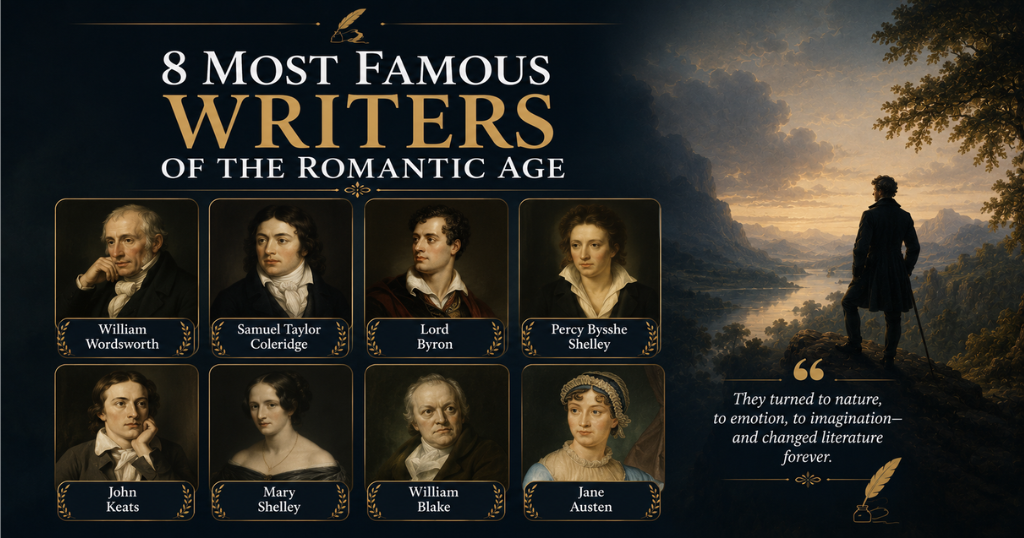
The Romantic Age produced some of the most passionate, rebellious, and imaginative writers the world has ever seen. Spanning roughly from the 1780s to the 1850s, this literary movement pushed back hard against the cold logic of the Enlightenment. Its writers celebrated nature, individual emotion, creative freedom, and the mysterious power of the human imagination.
If you want to understand Western literature at its most electric, you need to know the writers of the Romantic Age. This list covers the eight most influential among them — what made them remarkable, what they wrote, and why readers still return to their work today.
1. William Wordsworth (1770–1850)
William Wordsworth is, for many scholars, the father of English Romantic poetry. He believed that ordinary life and natural landscapes could carry the deepest truths a poet could express.
In 1798, Wordsworth co-published Lyrical Ballads with Samuel Taylor Coleridge. That slim volume effectively launched the Romantic Age in England. His preface to the second edition became a kind of manifesto — he argued that poetry should use “the real language of men” rather than the ornate, artificial diction that dominated 18th-century verse.
His masterpiece, The Prelude, is a long autobiographical poem about the growth of a poet’s mind. He spent over 50 years revising it, and it stands today as one of the greatest works in the English language.
Why he still matters: Wordsworth taught readers that a walk through the countryside, or a childhood memory by a river, could be as worthy of serious poetry as any epic battle or royal drama. He democratised literature’s subject matter permanently.
2. Samuel Taylor Coleridge (1772–1834)
Where Wordsworth grounded Romantic poetry in the natural world, Coleridge pulled it toward the supernatural and the psychologically strange. He was Wordsworth’s closest collaborator and his most brilliant intellectual foil. He was one of the most influential writers of Romantic Age.
His two greatest poems — The Rime of the Ancient Mariner and Kubla Khan — are unlike almost anything written before them. The Ancient Mariner follows a sailor cursed for killing an albatross, weaving guilt, isolation, and redemption into a haunting maritime ballad. Kubla Khan, famously left unfinished, came to Coleridge in an opium-induced dream and remains one of the most studied fragments in English poetry.
Coleridge also wrote Biographia Literaria, a landmark work of literary criticism that shaped how later generations thought about imagination and poetic theory.
Why he still matters: Coleridge explored the darker corners of the human mind — guilt, addiction, the unconscious — decades before psychology existed as a formal discipline. His influence runs through Gothic literature, fantasy writing, and even modern horror.
3. Lord Byron (1788–1824)
No writer embodied the Romantic spirit more theatrically than George Gordon Byron, better known as Lord Byron. He was scandalous, brilliant, politically radical, and impossibly glamorous. He became so famous that the term “Byronic hero” — a brooding, rebellious, morally complex protagonist — entered the literary vocabulary permanently.
His narrative poem Childe Harold’s Pilgrimage made him an overnight celebrity in 1812. His satirical epic Don Juan, left unfinished at his death, is widely considered his masterpiece — sharp, funny, subversive, and technically astonishing.
Byron did not just write about rebellion. He lived it. He died in 1824 fighting for Greek independence, which cemented his legend across Europe.
Why he still matters: Byron invented the template for the romantic anti-hero. You can trace a direct line from his Byronic hero to characters in Gothic fiction, Victorian novels, and modern cinema. His political passion also reminds us that Romantic writers saw poetry as a tool for social change.
4. Percy Bysshe Shelley (1792–1822)
Percy Shelley was arguably the most radical political thinker among the major Romantic poets. He was an atheist, a pacifist, and a fierce critic of tyranny and organised religion at a time when those positions could ruin a man’s career — or worse.
His poem Ozymandias is one of the most quoted poems in the English language — a tight 14-line meditation on how power crumbles and time defeats all human arrogance. His longer works, including Prometheus Unbound and Adonais (his elegy for Keats), display a visionary ambition that few poets have matched.
Shelley drowned in a storm off the Italian coast at just 29 years old, leaving behind a body of work that felt impossibly large for such a short life.
Why he still matters: Shelley’s belief that poets are “the unacknowledged legislators of the world” still resonates. His political poems speak directly to modern struggles against authoritarianism and inequality. Ozymandias alone has never gone out of print or out of relevance.
5. John Keats (1795–1821)
Keats died of tuberculosis at 25, yet he produced a collection of odes that most poets would be proud to call a life’s work. Ode to a Nightingale, Ode on a Grecian Urn, To Autumn, and Ode on Melancholy are among the most perfectly crafted poems in any language.
Keats introduced the concept of “negative capability” — the ability to remain comfortable in uncertainty and doubt without reaching for irritable facts or reason. He believed great poetry required a poet to dissolve the ego and inhabit experience fully.
His letters are almost as celebrated as his poems. They give us a rare, intimate view into how a great mind thought about art, love, mortality, and beauty.
Why he still matters: Keats showed that sensory richness and emotional depth are not weaknesses in literature — they are its greatest strengths. His influence on later poets, from Tennyson to Wilfred Owen to modern lyric poets, is enormous. He also gave the literary world the concept of “negative capability,” which writers and thinkers still invoke today.
6. Mary Shelley (1797–1851)
Mary Shelley belongs on any serious list of Romantic Age writers, and not simply because she was Percy Shelley’s wife. She wrote Frankenstein; or, The Modern Prometheus at 18 years old, publishing it in 1818. That novel did not just tell a story — it invented an entire genre.
Frankenstein is a Romantic text in the deepest sense. It asks what happens when human ambition overrides moral responsibility. It explores creation, isolation, the hunger for belonging, and the dangerous pride of those who play God. Victor Frankenstein is a Romantic hero gone wrong — brilliant, passionate, and ultimately destructive.
Mary Shelley also wrote The Last Man (1826), a post-apocalyptic novel that anticipates science fiction by decades, and produced significant biographical and critical work on her husband and his contemporaries.
Why she still matters: Mary Shelley created science fiction as a literary form. Her questions about technology, ethics, and what it means to be human have grown more urgent with every decade. Frankenstein is now studied in literature, philosophy, science, and bioethics courses worldwide.
7. William Blake (1757–1827)
William Blake sits slightly apart from the other Romantic writers — he was older, stranger, and more visionary than almost anyone around him. He was a poet, painter, and printmaker who produced his own illustrated books by hand. He rejected the rationalism of the Enlightenment with a fury that bordered on the prophetic.
His two great collections — Songs of Innocence (1789) and Songs of Experience (1794) — present contrasting views of the human condition. Together they explore innocence versus corruption, freedom versus oppression, and spiritual vision versus mechanical thinking. Poems like The Tyger and London pack astonishing intellectual and emotional weight into very few lines.
Blake spent much of his life in obscurity, dismissed as eccentric or mentally unwell. Later generations recognised him as a visionary who was simply too original for his own time.
Why he still matters: Blake’s critique of industrial society, religious hypocrisy, and the oppression of the poor sounds as current as any 21st-century protest poem. His visual-verbal artworks also make him a unique figure in world culture — a one-man multimedia artist two centuries before the term existed.
8. Jane Austen (1775–1817)
Jane Austen may surprise readers on a list of Romantic Age writers, since she is rarely grouped with the Romantic poets. But she wrote and published entirely within the Romantic period, and her novels respond to its ideas in complex and often ironic ways.
While the male Romantic poets celebrated passion and imagination above reason, Austen brought sharp irony, social precision, and psychological realism to the novel. Pride and Prejudice, Sense and Sensibility, Emma, and Persuasion are masterworks of narrative craft. They dissect manners, money, marriage, and gender with a wit that has never dated.
Austen offers a crucial counter-perspective within the Romantic Age. She understood emotion deeply but insisted that reason and self-awareness must accompany feeling. That tension drives all six of her completed novels.
Why she still matters: Austen is one of the most adapted, analysed, and beloved writers in English literature. Her novels launched the modern psychological novel and remain the standard by which character-driven fiction is judged. She also documented the lives of women in the Romantic Age with an honesty that male contemporaries rarely attempted.
What Defined the Writers of the Romantic Age?
These eight writers shared certain core commitments, even when their individual styles differed dramatically:
- Emotion over reason — They trusted feeling and intuition as paths to truth, not distractions from it.
- Nature as a spiritual force — For most of them, the natural world was alive with meaning, not merely a backdrop.
- Individualism — They celebrated the unique perspective of the individual imagination over social convention.
- Rebellion — Whether political (Byron, Shelley), spiritual (Blake), or social (Austen), all of them pushed against the dominant order.
- The power of the past — They looked to medieval history, mythology, and folklore for inspiration, reacting against the modernity of the Industrial Revolution.
Frequently Asked Questions
Who are the most famous writers of the Romantic Age?
The most famous include William Wordsworth, Samuel Taylor Coleridge, Lord Byron, Percy Bysshe Shelley, John Keats, Mary Shelley, William Blake, and Jane Austen.
When was the Romantic Age in literature?
The Romantic Age in English literature ran roughly from 1785 to 1850, though dates vary by country and tradition. In Britain, many scholars mark its start with the publication of Lyrical Ballads in 1798.
What did Romantic Age writers believe in?
They believed in the power of individual emotion, the spiritual value of nature, the freedom of the imagination, and the importance of creative originality. Most also rejected the cold rationalism of the Enlightenment that preceded them.
Is Jane Austen a Romantic writer?
Yes. Although she differs in style and tone from the Romantic poets, Austen lived and wrote entirely within the Romantic period. Her novels engage with Romantic themes — emotion, individualism, and the tension between feeling and reason — from a distinctive, often ironic angle.
What is the difference between Romantic Age poetry and prose?
Romantic poetry (Wordsworth, Keats, Shelley) tended to emphasise lyrical expression, nature, and emotion. Romantic prose (Mary Shelley, Austen) explored psychology, society, and moral questions through narrative. Both forms shared the era’s central focus on individual experience and imagination.
Conclusion
The writers of the Romantic Age gave literature its emotional vocabulary. They insisted that what a person feels, imagines, and intuits is not less important than what they can prove or measure. That was a revolutionary claim in their time, and it still challenges us today.
From Wordsworth’s quiet riverbanks to Blake’s burning tigers, from Keats’s nightingales to Shelley’s crumbling empires — these writers reached for something permanent beneath the surface of ordinary experience. They mostly found it. That is why we keep reading them, two centuries later.