The Renaissance was one of the most electrifying periods in human history. From the workshops of Florence to the courts of Rome, artists, thinkers, and rulers reshaped the world between the 14th and 17th centuries. Whether you want to understand the politics behind the Medici family, walk through Michelangelo’s mind, or lose yourself in a richly imagined historical novel — the right book can transport you directly into that world.
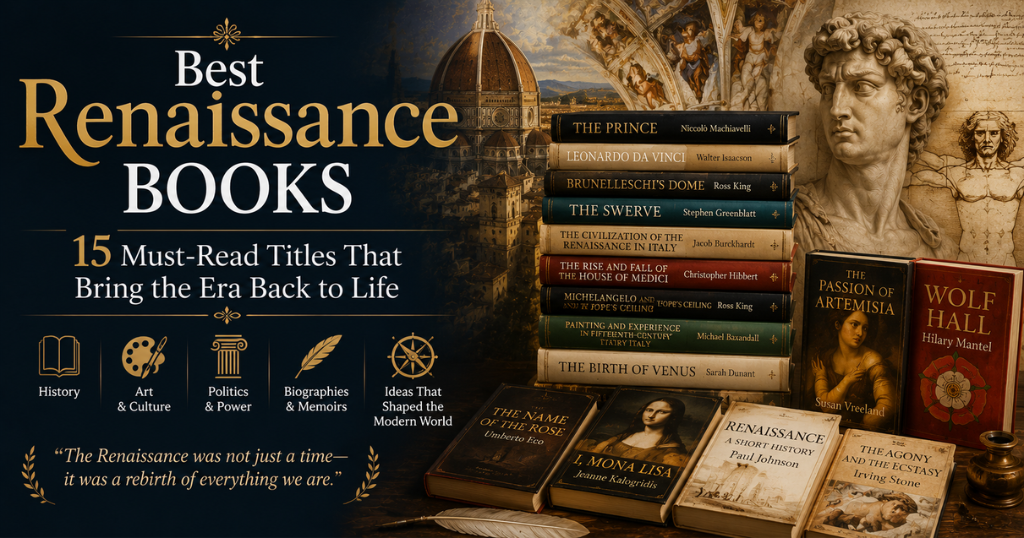
This list covers the best Renaissance books across every category: nonfiction history, biography, primary sources, and historical fiction. Whether you are a student, a history enthusiast, or simply a curious reader, you will find exactly what you need here.
What Makes a Renaissance Book Worth Reading?
A great Renaissance book does more than list dates and names. It pulls you into the texture of the era — the smell of fresh paint on a chapel ceiling, the tension of a political assassination, the thrill of a new idea challenging centuries of orthodoxy. The books on this list do exactly that. They are well-researched, compellingly written, and illuminate the Renaissance from angles you may never have considered.
The Best Renaissance Books (Nonfiction)
1. The Prince by Niccolò Machiavelli (1532)
No list of Renaissance books is complete without The Prince. Machiavelli wrote this short political treatise in the early 16th century, and it remains one of the most influential — and controversial — works in the history of political thought. He separates the lofty ideals of morality from the hard realities of governing, arguing that a ruler must be willing to act ruthlessly when the situation demands it. His ideas still spark debate in boardrooms, classrooms, and governments today. If you read only one Renaissance primary source, make it this one.

2. Leonardo da Vinci by Walter Isaacson (2017)
Walter Isaacson — the biographer behind books on Steve Jobs and Albert Einstein — turns his lens on history’s greatest Renaissance man. Drawing on Leonardo’s personal notebooks, Isaacson builds a vivid portrait of a relentlessly curious genius who refused to separate art from science. This book captures how Leonardo’s insatiable need to understand everything — from the flow of water to the anatomy of the human eye — made him unlike anyone before or since. Microsoft CEO Satya Nadella publicly praised this biography, and it is easy to see why.
3. Brunelleschi’s Dome by Ross King (2000)
This book tells the story of how Filippo Brunelleschi engineered the impossible: a dome for Florence’s Cathedral that would weigh an estimated seventy million pounds. No one had attempted anything like it in over a thousand years. King reconstructs the drama of its construction — the rivalries, the plagues, the political feuds — and shows how one man’s stubbornness and genius changed architecture forever. It reads like a thriller and teaches you more about Renaissance Florence than most history textbooks do.
4. The Swerve: How the World Became Modern by Stephen Greenblatt (2011)
Winner of the Pulitzer Prize, The Swerve follows a Renaissance book hunter named Poggio Bracciolini who discovered a lost ancient manuscript — Lucretius’s On the Nature of Things — in a German monastery in 1417. That single discovery helped ignite the intellectual revolution we now call the Renaissance. The Boston Globe called it “an intellectually invigorating, nonfiction version of a Dan Brown-like mystery-in-the-archives thriller.” Greenblatt makes the history of ideas feel urgent and alive.
5. The Civilization of the Renaissance in Italy by Jacob Burckhardt (1860)
This is the book that largely invented the modern concept of the Renaissance. Swiss art historian Jacob Burckhardt argued that 14th-century Italy witnessed the birth of the modern individual — a radically new idea at the time. Scholars have challenged and refined his thesis for over 150 years, but this remains essential reading for anyone who wants to understand how historians think about this period. It is dense but rewarding.
6. The Rise and Fall of the House of Medici by Christopher Hibbert (1974)
The Medici family bankrolled the Renaissance. Without their money and ambition, Florence might never have become the artistic capital of the world. Hibbert’s biography of this extraordinary dynasty is thoroughly researched and dramatically told — tense in exactly the right places. It covers banking, art patronage, assassination, and papal politics across several generations, and it makes an iron-clad case that understanding the Medici means understanding the Renaissance itself.
7. Michelangelo and the Pope’s Ceiling by Ross King (2003)
Ross King returns with another masterpiece of narrative history. This book reconstructs the four years Michelangelo spent lying on his back, painting the Sistine Chapel ceiling between 1508 and 1512. The conflict between the artist and Pope Julius II, the physical agony of the work, the staggering creative ambition — King brings all of it to life with meticulous research and compelling prose. You will never look at the Sistine Chapel the same way again.
8. Painting and Experience in Fifteenth-Century Italy by Michael Baxandall (1972)
This is the academic title on the list, but it earns its place because it genuinely changed how scholars — and passionate general readers — think about Renaissance art. Baxandall argues that to understand a painting, you must excavate the entire world that surrounds it: the commercial relationships, the humanist ideas, the patronage systems, the original location of the work. Professor Jerry Brotton of Queen Mary University of London calls it one of the most important Renaissance books ever written.
The Best Renaissance Historical Fiction
9. The Birth of Venus by Sarah Dunant (2003)
Set in Renaissance Florence, this novel follows Alessandra Cecchi — a young woman drawn to art and forbidden love — as she navigates the turbulence of Savonarola’s rise and the city’s political upheaval. Dunant captures the vibrancy and danger of 15th-century Florence with gorgeous detail. She handles the themes of female autonomy, religious extremism, and artistic passion with real sophistication. This book consistently tops reader polls as one of the best Renaissance novels ever written.
10. The Passion of Artemisia by Susan Vreeland (2002)
Artemisia Gentileschi was one of the most talented painters of the early 17th century — and one of the most remarkable women of any era. This novel follows her from a traumatic trial in Rome to the studios of Florence and beyond, showing how she defied every expectation society placed on her to become a celebrated artist. Vreeland writes with deep knowledge of the period and real empathy for her subject. Art lovers will find this book impossible to put down.
11. Wolf Hall by Hilary Mantel (2009)
Technically set in the Tudor court of Henry VIII rather than Renaissance Italy, Wolf Hall belongs on this list because it captures the Renaissance moment in England — where new humanist ideas collided with the old world of religious authority. Mantel’s portrait of Thomas Cromwell is one of the finest pieces of historical fiction ever written in the English language. It won the Booker Prize and launched one of the most celebrated trilogies in modern fiction.
12. The Name of the Rose by Umberto Eco (1980)
Eco’s labyrinthine mystery novel takes place in a 14th-century Italian monastery — right at the dawn of the Renaissance. A Franciscan friar investigates a series of murders that centre on a forbidden book. The novel explores the battle between Church authority and free intellectual inquiry — the exact tension that would eventually give birth to the Renaissance itself. Eco was a medieval scholar, and his erudition fills every page without ever becoming dry.
13. I, Mona Lisa by Jeanne Kalogridis (2006)
This novel reimagines the life of Lisa Gherardini, the woman most scholars believe sat for Leonardo da Vinci’s most famous painting. Kalogridis sets the story against the backdrop of the Pazzi Conspiracy — one of the most dramatic assassination attempts of the Renaissance era. It is a novel of art, ambition, betrayal, and survival, told from a female perspective that brings a fresh angle to a story most readers think they already know.
Best Renaissance Books for Beginners
14. Renaissance: A Short History by Paul Johnson (2000)
If you are new to the period and want a lively, accessible overview before diving into deeper reading, Paul Johnson’s compact history is the perfect starting point. Johnson covers art, literature, science, and politics across two centuries in under 200 pages, writing with the energy and clarity of a gifted journalist. Critics have called it one of the best short introductions to the Renaissance available in print.
15. The Agony and the Ecstasy by Irving Stone (1961)
This biographical novel about Michelangelo remains one of the most beloved gateways into the Renaissance for general readers. Stone spent years researching Michelangelo’s life and letters before writing this fictionalized account of the artist’s struggles with the Church, his patrons, and his own relentless perfectionism. It is not strictly academic — it is a novel — but it captures the emotional reality of what it meant to be a Renaissance genius better than many nonfiction books do.
How to Choose the Right Renaissance Book for You
Not every reader wants the same thing. Here is a quick guide:
- You want to understand Renaissance politics → Start with The Prince by Machiavelli, then move to The Rise and Fall of the House of Medici by Hibbert.
- You love biography → Read Leonardo da Vinci by Isaacson first, then Michelangelo and the Pope’s Ceiling by Ross King.
- You prefer historical fiction → Begin with The Birth of Venus by Sarah Dunant or Wolf Hall by Hilary Mantel.
- You are a complete beginner → Pick up Renaissance: A Short History by Paul Johnson, then Brunelleschi’s Dome by Ross King.
- You want academic depth → Go straight to Burckhardt’s Civilization of the Renaissance in Italy and Baxandall’s Painting and Experience in Fifteenth-Century Italy.
Why the Renaissance Still Matters
The Renaissance was not just a period of beautiful paintings and bold architecture. It was the moment when humanity decided that the individual human mind — curious, critical, creative — deserved to be trusted. That idea changed science, art, politics, and philosophy in ways we still live with today. The books on this list help you trace those changes back to their source.
Reading about the Renaissance is not an exercise in nostalgia. It is a way of understanding how the modern world came to be — and who built it.
Final Thoughts
The best Renaissance books share one quality: they make you feel the stakes. These were not quiet times. People risked their reputations, their freedom, and often their lives to paint a ceiling, write a political treatise, or revive a lost manuscript. The books on this list honour that drama. Pick one that suits your interests, and you will quickly discover that the Renaissance is not history you study — it is history you experience.
Also read: 12 Elements of the Renaissance Period