
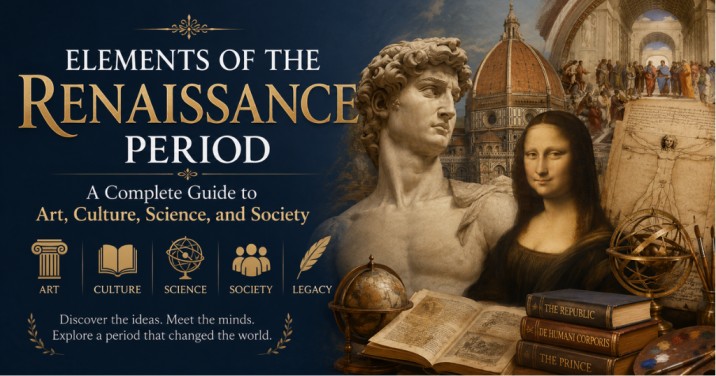
Introduction: What Made the Renaissance So Revolutionary?
Between the 14th and 17th centuries, Europe underwent one of the most profound transformations in human history. The Renaissance — a French word meaning “rebirth” — began in Italy and spread across the continent, touching every dimension of life: art, literature, science, philosophy, religion, and politics.
But what exactly were the core elements that made this period distinct? What gave the Renaissance its identity and its lasting power?
This guide breaks down every major element of the Renaissance period clearly and thoroughly — whether you’re a student, a researcher, or simply someone fascinated by one of history’s most extraordinary eras.
1. Humanism: The Philosophical Foundation
The single most important intellectual element of the Renaissance was humanism — a philosophical movement that placed human beings, not God or the Church, at the centre of inquiry and value.
Renaissance thinkers turned to the ancient Greeks and Romans for inspiration. They studied classical texts, revived Latin literature, and argued that humans possessed dignity, reason, and the capacity for self-improvement.
Humanists like Petrarch, Erasmus, and Pico della Mirandola championed the idea that education, especially in grammar, rhetoric, history, poetry, and moral philosophy, shaped well-rounded citizens capable of civic virtue and personal excellence.
This was a radical departure from medieval thinking, which focused primarily on salvation and the afterlife. The Renaissance humanist asked: What can a human being achieve in this life?
2. A Revolution in Art: Realism, Perspective, and Beauty
Renaissance art broke dramatically from the flat, symbolic style of medieval painting. Artists developed techniques that made paintings feel like windows into the real world.
Linear Perspective
Leon Battista Alberti and Filippo Brunelleschi developed the mathematical system of linear perspective, which allowed painters to depict three-dimensional space on a two-dimensional surface. For the first time, viewers could sense depth, distance, and spatial relationships in a painting.
Chiaroscuro
Leonardo da Vinci perfected chiaroscuro — the use of light and shadow to create volume and three-dimensionality in figures. His paintings felt alive because the light behaved as it does in the real world.
Naturalism
Renaissance artists studied the human body with scientific rigour. Michelangelo dissected cadavers to understand anatomy. The result was art that portrayed the human form with unprecedented accuracy — muscles, bones, posture, and emotion all rendered truthfully.
Notable Artists and Works
- Leonardo da Vinci — The Last Supper, Mona Lisa
- Michelangelo — The Sistine Chapel Ceiling, David
- Raphael — The School of Athens
- Botticelli — The Birth of Venus
These works didn’t just decorate walls. They expressed ideas — about beauty, divinity, human potential, and the harmony of the universe.
3. Architecture: Order, Symmetry, and Classical Revival
Renaissance architects rejected the tall, ornate Gothic style and returned to the classical ideals of ancient Rome and Greece.
Key Architectural Principles
- Symmetry and proportion — buildings were designed around mathematical ratios inspired by the human body
- Use of columns, arches, and domes — reviving Greco-Roman forms
- Emphasis on harmony — every element of a building related mathematically to the others
Filippo Brunelleschi’s dome for the Florence Cathedral remains one of the greatest engineering achievements in history. Andrea Palladio’s architectural treatise I Quattro Libri dell’Architettura (The Four Books of Architecture) became a foundational text that influenced buildings across Europe and the Americas for centuries.
4. Literature and the Written Word
The Renaissance transformed literature in two major ways: it revived the classics and created new masterpieces in vernacular languages.
Classical Revival
Scholars translated and published ancient Greek and Roman texts. Works by Plato, Cicero, Virgil, and Aristotle circulated widely and shaped Renaissance thought profoundly.
Vernacular Literature
Writers began producing great works in their native languages rather than Latin alone. This democratised literature and gave rise to national literary traditions.
Major literary works of the Renaissance include:
- Dante Alighieri’s Divine Comedy (though slightly pre-Renaissance, it inspired the movement)
- Francesco Petrarch’s sonnets — the father of Renaissance humanism and lyric poetry
- Giovanni Boccaccio’s Decameron — a collection of vivid human stories
- Niccolò Machiavelli’s The Prince — a brutally realistic guide to political power
- William Shakespeare’s plays — the pinnacle of Renaissance drama and language
- Miguel de Cervantes’s Don Quixote — considered the world’s first modern novel
Each of these works reflected Renaissance values: human complexity, wit, moral ambiguity, and a fascination with individual character.
5. The Scientific Revolution: Observation Over Authority
Perhaps the Renaissance’s most lasting legacy was the birth of modern science. Renaissance thinkers rejected the idea that ancient authorities like Aristotle or the Church held all the answers. Instead, they insisted on observation, experimentation, and evidence.
Key Scientific Advances
- Nicolaus Copernicus proposed a heliocentric model of the solar system, removing the Earth from the centre of the universe
- Galileo Galilei used the telescope to observe the moons of Jupiter and support the Copernican model
- Andreas Vesalius revolutionised anatomy by conducting actual dissections and correcting centuries of error in medical knowledge
- Leonardo da Vinci filled thousands of notebook pages with observations about anatomy, geology, hydrodynamics, and engineering
The scientific method — observe, hypothesise, test, conclude — took shape during this period. It changed humanity’s relationship with knowledge permanently.
6. The Printing Press: Knowledge at Scale
Johann Gutenberg’s invention of the movable-type printing press around 1440 was one of the most consequential technological developments in history.
Before the printing press, books were hand-copied by monks. They were rare, expensive, and accessible only to the elite clergy and aristocracy. The printing press changed everything:
- Books became affordable
- Ideas spread across Europe within years rather than generations
- Literacy increased dramatically
- The Protestant Reformation became possible because Martin Luther’s ideas could be printed and distributed rapidly
The printing press was the internet of its day. It democratised knowledge and accelerated every other element of the Renaissance.
7. Religion: Reform and Challenge to the Church
The Renaissance did not destroy religion. Most Renaissance thinkers remained deeply Christian. However, the Renaissance spirit of questioning and individual interpretation created pressure on the institutional Church.
This pressure eventually led to the Protestant Reformation, led by figures like Martin Luther, John Calvin, and Ulrich Zwingli. The Reformation challenged papal authority, the sale of indulgences, and the Church’s monopoly on scripture interpretation.
Within the Catholic tradition, the Counter-Reformation responded by reforming abuses and reaffirming doctrine through the Council of Trent.
The Renaissance thus reshaped the religious landscape of Europe, producing the diverse Christian traditions — Catholic, Lutheran, Reformed, Anglican — that persist to this day.
8. Political Thought: The Modern State Emerges
The Renaissance produced some of the most influential political theory in Western history.
Niccolò Machiavelli, writing in early 16th-century Florence, broke from the medieval tradition of linking politics to Christian virtue. In The Prince, he argued that rulers must be pragmatic — sometimes deceptive, sometimes forceful — to maintain power and stability. This realist approach to politics laid the groundwork for modern political science.
Renaissance political thinkers also explored the idea of the republic — a system where power derives from citizens rather than God-appointed monarchs. The experience of city-states like Florence, Venice, and Genoa gave thinkers real models of republican governance to analyse.
9. The Renaissance Individual: The “Universal Man”
The Renaissance celebrated the idea of the uomo universale — the universal man — who excelled across multiple domains. Leonardo da Vinci embodied this ideal: he was a painter, sculptor, architect, scientist, mathematician, engineer, inventor, botanist, and musician.
This concept encouraged educated Renaissance men to develop broad competence. It valued curiosity, versatility, and self-cultivation. The humanist education system — studying the arts, sciences, rhetoric, and history together — was designed to produce exactly this kind of person.
Baldassare Castiglione’s The Book of the Courtier (1528) described the ideal Renaissance gentleman in detail: physically graceful, intellectually sharp, musically accomplished, politically astute, and socially elegant.
10. Trade, Wealth, and the Italian City-States
No account of the Renaissance is complete without understanding its economic foundation. The Renaissance began in Italy because Italy — particularly Florence, Venice, Milan, and Genoa — was the commercial heart of Europe.
Wealthy merchant families, above all the Medici of Florence, bankrolled the Renaissance. They commissioned art, sponsored scholars, built libraries, and turned their cities into cultural capitals.
The Medici family alone commissioned works from Botticelli, Leonardo da Vinci, and Michelangelo. Without patronage, there would have been no Renaissance. Wealth created the conditions for cultural flowering.
11. Women in the Renaissance
The Renaissance celebrated human potential — but that celebration had sharp limits when it came to women. Most women were excluded from formal education, professional guilds, and political life.
Yet some remarkable women did leave their mark:
- Isabella d’Este, Marchioness of Mantua, was one of the most powerful patrons of Renaissance art
- Vittoria Colonna was a celebrated poet and close friend of Michelangelo
- Sofonisba Anguissola became the first internationally recognised female painter, eventually appointed court painter to the King of Spain
- Christine de Pizan had already, in the early 15th century, written powerfully in defence of women’s intellectual capacity
The Renaissance thus presents a paradox: a movement celebrating human dignity that left half of humanity largely in the shadows.
12. Music: Polyphony and the Rise of Secular Song
Renaissance music moved away from the monophonic chant of the medieval Church toward polyphony — the weaving together of multiple independent melodic lines.
Composers like Josquin des Prez, Giovanni Pierluigi da Palestrina, and Orlando di Lasso created elaborate choral works of extraordinary beauty. Meanwhile, secular music — madrigals, lute songs, dance music — became fashionable among the educated classes.
The Renaissance also saw the invention and refinement of many instruments still used today, including early versions of the violin family, the lute, and keyboard instruments.

The Spread of the Renaissance Beyond Italy
The Renaissance began in Italy but spread across Europe, adapting to local conditions in each region.
- Northern Renaissance: In Germany, the Netherlands, and England, Renaissance ideas merged with a strong interest in religious reform and scholarly biblical study. Erasmus of Rotterdam exemplified the Northern Renaissance with his witty, learned, reformist writing.
- French Renaissance: France absorbed Italian artistic and intellectual influences through military campaigns in Italy. Francis I invited Leonardo da Vinci to his court.
- English Renaissance: The reign of Elizabeth I saw an explosion of literature and theatre. Shakespeare, Marlowe, Spencer, and Sidney transformed the English language.
- Spanish Renaissance: Spain produced Cervantes and El Greco, blending Italian influence with distinctly Iberian sensibility.
Why the Renaissance Still Matters
The elements of the Renaissance period — humanism, artistic realism, scientific enquiry, religious reform, political realism, the printing press, and the celebration of individual potential — did not disappear when the period ended. They became the foundations of the modern world.
The scientific method that Galileo practised still drives research today. The political realism that Machiavelli articulated still shapes international relations. The architectural principles that Brunelleschi developed still appear in buildings worldwide. The literary tradition that Petrarch launched still flows through contemporary poetry.
Understanding the Renaissance means understanding how the modern world came to be.
Frequently Asked Questions
What are the five elements of the Renaissance? The five core elements are: humanism, artistic realism (including perspective and anatomy), the scientific revolution, classical revival in literature and architecture, and religious reform through the Reformation.
What was the most important element of the Renaissance? Most historians point to humanism as the foundational element, since it underpinned changes in art, science, politics, and religion alike.
Where did the Renaissance begin? The Renaissance began in Florence, Italy, in the 14th century, largely driven by the wealth of merchant families like the Medici and the proximity to ancient Roman ruins and texts.
When did the Renaissance end? The Renaissance is generally considered to have ended around 1600 in most of Europe, though exact dates vary by country and field.
What was the role of the printing press in the Renaissance? The printing press made books affordable and ideas portable, accelerating the spread of humanist, scientific, and religious reform ideas across Europe.
Conclusion
The Renaissance was not a single idea or a single moment. It was the convergence of multiple powerful forces — intellectual, artistic, economic, technological, and religious — into a sustained transformation of European civilisation.
Its elements speak directly to enduring human questions: How do we understand the world? What does beauty mean? How should we be governed? What is a human being capable of?
The Renaissance answered those questions in ways that still resonate — and that is precisely why, five centuries later, it continues to fascinate us.
Also read: Modernism and Post-Modernism: Know the Difference in Easy Way