
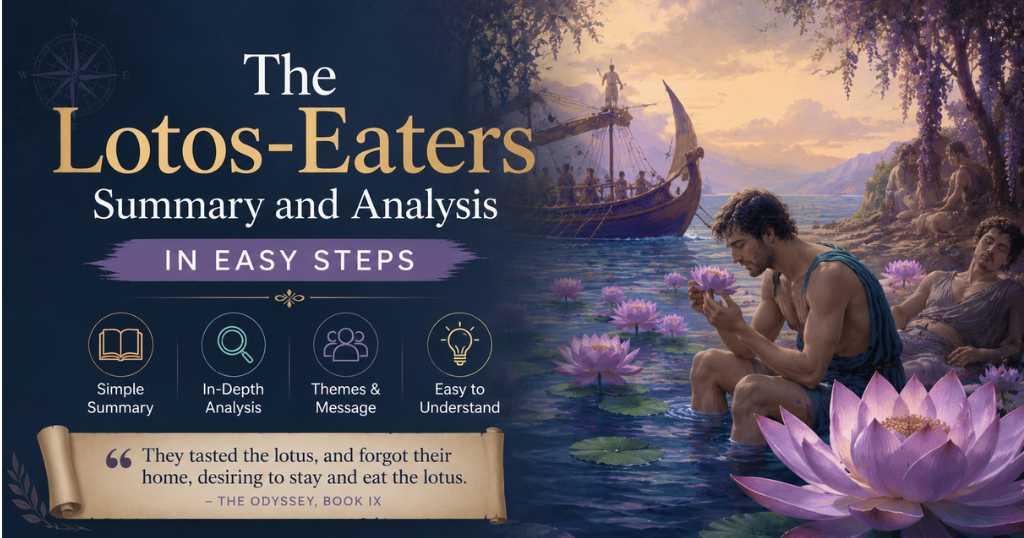
Introduction: Why “The Lotos-Eaters” Still Matters
Alfred Lord Tennyson wrote “The Lotos-Eaters” in 1832, but its central question feels strikingly modern: What if you simply stopped? Stopped striving, stopped suffering, stopped trying?
Tennyson borrowed his premise from Homer’s Odyssey, where Odysseus and his crew land on an island of lotus-eaters. But he transformed that brief episode into something far richer — a hypnotic meditation on escapism, duty, nature, and the human longing for rest.
If you want to understand this poem fully — its story, its deeper meanings, its structure, and why it continues to fascinate readers — this guide covers everything you need.
Quick Background: Tennyson and the Poem’s Origins
Tennyson published “The Lotos-Eaters” in his 1832 collection. He revised it significantly for the 1842 edition, adding depth to the “Choric Song” section.
The poem draws directly from Book IX of Homer’s Odyssey. After the fall of Troy, Odysseus and his men sail toward home. A storm blows them off course, and they land on the island of the lotus-eaters — a people who live on a flower that makes those who eat it forget everything, including the desire to return home.
Tennyson expands this moment into a full dramatic poem. He gives the sailors a voice. He lets them argue their case. And in doing so, he raises questions that Homer never asked.
Full Summary of “The Lotos-Eaters”
The Opening Stanzas: Arrival on the Island
The poem opens with Odysseus and his sailors arriving at a strange, dreamlike land. Tennyson immediately sets a languid, slow-moving tone. Everything on the island seems to droop and drift:
The sailors see a land where it always seems afternoon.
The light is soft. The waterfalls move slowly. The very air feels heavy with sleep. Three island inhabitants approach the sailors and offer them the lotos flower.
The sailors eat it — and everything changes.
The Transformation
Once the sailors eat the lotos, they no longer want to leave. They sit on the shore and feel a deep, overwhelming desire to stay forever. And they do not feel panic or confusion. They feel peace — a peace so total that it frightens them a little, even as they surrender to it.
The Choric Song: The Heart of the Poem
The bulk of the poem consists of the “Choric Song” — eight stanzas in which the sailors collectively argue why they should not return home. This is where Tennyson’s genius truly shows.
The sailors make several distinct arguments:
Argument 1: Life is suffering, and they have suffered enough. They remind themselves of the years of war at Troy, the endless sea voyages, the storms, and the losses. They ask — why must men always toil?
Argument 2: Nature itself rests, so why shouldn’t they? They observe the natural world around them. The streams flow without effort. The flowers bloom without struggle. Even the gods rest in their divine happiness. Why must humans alone suffer constant labor?
Argument 3: Their families have moved on without them. They imagine their wives and children at home. But instead of longing, they feel detachment. Their sons have grown. Their wives have aged. The world has continued without them. What, really, are they returning to?
Argument 4: Death is coming anyway. The sailors confront mortality directly. They know they will die eventually. So why exhaust themselves chasing a life that will end regardless? Better to rest now, in beauty, than to struggle toward a grave.
Argument 5: The lotos island offers a gentle eternity. They envision spending their existence in a half-dream — watching, drifting, existing peacefully until they fade away like music.
The poem ends without resolution. Odysseus does not drag them back to the ships. The sailors simply declare that they will stay, recline, and watch the world from their island paradise.
Detailed Analysis of “The Lotos-Eaters”
1. The Theme of Escapism
Escapism sits at the very heart of this poem. The sailors do not want adventure. They want relief.
Tennyson wrote this poem during the early Victorian era — a period when society placed enormous pressure on individuals to work, achieve, and progress. The Industrial Revolution was transforming England. The idea of rest, or doing nothing, carried moral stigma.
The sailors’ desire to escape, then, reads as a quiet rebellion against that culture of relentless productivity. Tennyson does not entirely condemn them. He gives them eloquent, moving arguments. He makes their case sympathetically. The reader genuinely feels the appeal of the lotos island.
This ambiguity is intentional. Tennyson does not want you to judge the sailors easily.
2. The Theme of Duty vs. Desire
Running directly against escapism is the theme of duty. The sailors know they should go home. They have families. They have obligations. Odysseus is supposed to be a king.
But they choose desire over duty. They choose what they want over what they should do.
Tennyson frames this tension carefully. He never lets duty win cleanly in the poem. The sailors acknowledge their responsibilities and then consciously set them aside. This makes the poem morally complex rather than simply cautionary.
3. Nature as Seduction
Tennyson uses nature imagery with extraordinary skill throughout the poem. The island does not tempt the sailors with wealth or power. It tempts them with beauty and stillness.
The waterfalls, the drooping flowers, the slow streams, the amber light — all of it creates a world that feels both gorgeous and faintly ominous. Nature here is seductive rather than wholesome. It pulls the sailors toward passivity, toward forgetting, toward a beautiful kind of death.
This contrasts sharply with the Romantic tradition of nature as energizing and morally uplifting. In Tennyson’s poem, nature lulls rather than inspires.
4. The Theme of Mortality
The sailors spend considerable time thinking about death. But they do not fear it. Instead, they use it as a justification for rest.
Their logic runs like this: we will all die, so why suffer needlessly in the meantime? Why not spend whatever time remains in peace?
This is philosophically interesting because it echoes certain strands of Epicurean philosophy — the idea that the goal of life is the reduction of suffering and the pursuit of tranquility. Tennyson almost certainly knew this tradition, and he gives the sailors its most poetic expression.
5. The Psychological Reading
Many modern readers interpret the poem psychologically. The lotos island represents depression, dissociation, or emotional exhaustion. The sailors have simply been through too much. They have lost the will to continue.
Read this way, the poem becomes deeply compassionate rather than morally troubling. It captures something real about human psychology — the way prolonged suffering can erode a person’s motivation to engage with life at all.
Tennyson himself suffered significant personal losses and struggled with grief and doubt throughout his life. Critics often read his poetry, including “The Lotos-Eaters,” as a working-through of those internal battles.

Structure and Form: How Tennyson Builds the Dream
The Spenserian Stanza
Tennyson opens the poem using the Spenserian stanza — a nine-line stanza with a specific rhyme scheme (ABABBCBCC) that Edmund Spenser used in The Faerie Queene. This choice is deliberate. The Spenserian stanza carries associations of medieval romance, of long dreaming narratives, of a world slightly removed from reality.
By choosing this form, Tennyson signals from the very first line that this poem inhabits a dreamlike, legendary space.
The Choric Song
The “Choric Song” shifts the form significantly. It uses varying line lengths, different rhyme schemes, and a more musical, incantatory rhythm. The word “choric” evokes the Greek chorus — a collective voice that comments on dramatic action.
By giving the sailors a choric voice, Tennyson removes individual identity. These are not specific men with names and histories. They become a unified, almost mythic voice — the voice of human exhaustion itself.
Rhythm and Sound
Tennyson crafts the sound of the poem to feel like the lotos effect. The lines move slowly. The vowels are long and soft. The rhythm droops and elongates. Reading the poem aloud, you can feel yourself slowing down.
This is one of Tennyson’s most remarkable technical achievements. The poem performs its own subject matter. It makes the reader feel what the sailors feel.
Key Symbols in “The Lotos-Eaters”
The Lotos Flower: The central symbol, representing escapism, forgetfulness, and the seductive pull of inaction. Eating the lotos means giving up memory, ambition, and identity.
The Island: A liminal space — between life and death, between duty and desire, between the human world and something else entirely. It exists outside normal time and consequence.
The Afternoon Light: Tennyson famously describes a land “in which it seemed always afternoon.” Afternoon suggests that time has stopped before reaching evening — life paused before its natural conclusion.
The Waterfall: Tennyson describes the waterfall as moving “like a downward smoke” — barely seeming to fall at all. This image captures the poem’s atmosphere of suspended time and slowed reality perfectly.
The Gods: The sailors imagine the gods resting in divine indifference, feasting on ambrosia while humans suffer below. This vision justifies their own desire for rest — even the immortals do not toil endlessly.
“The Lotos-Eaters” in Its Historical Context
The Victorian Anxiety About Rest
Victorian England valorized work. The Protestant work ethic permeated culture, politics, and morality. Idleness was considered a vice — even a sin. Against this backdrop, Tennyson’s poem made a radical gesture by treating rest sympathetically.
Colonialism and the “Exotic” Other
Some contemporary scholars read the poem through a postcolonial lens. The island inhabitants who offer the lotos flower are depicted as languid and passive — a portrayal that draws on Victorian stereotypes of non-European peoples. Tennyson was not consciously promoting colonial ideology, but the poem reflects assumptions that were common in his cultural moment.
Tennyson’s Personal Context
When Tennyson wrote this poem, he had recently lost his closest friend, Arthur Hallam, to sudden death. Grief shapes the poem in ways Tennyson may not have fully intended. The sailors’ desire to stop, to rest, to forget — reads partly as the voice of a young man shattered by loss.
How “The Lotos-Eaters” Compares to Homer’s Original
In Homer’s Odyssey, the lotus-eater episode lasts barely a page. Odysseus forces his men back to the ships. He shows no sympathy and wastes no time. The episode illustrates a danger to be overcome, nothing more.
Tennyson transforms this entirely. He gives the sailors interiority. Also, he lets them speak at length. He makes their arguments good. Where Homer’s Odysseus represents the triumph of duty and homecoming, Tennyson’s poem questions whether that triumph was worth it.
This transformation reflects Tennyson’s own deepest concerns — and the concerns of his age. Homer wrote for a world that celebrated heroic action. Tennyson wrote for a world beginning to wonder whether heroic action always led somewhere worthwhile.
Common Exam Questions and Answers
Q: What is the main theme of “The Lotos-Eaters”? The main theme is the tension between escapism and duty — the human desire to rest and forget versus the obligation to engage with life and its responsibilities.
Q: What does the lotos symbolize? The lotos symbolizes forgetfulness, escapism, and the seductive appeal of abandoning one’s responsibilities and ambitions.
Q: What is the significance of the Choric Song? The Choric Song gives the sailors a unified, collective voice. It transforms individual men into a chorus representing universal human exhaustion and the desire for peace.
Q: How does Tennyson use sound in the poem? Tennyson uses slow rhythms, long vowels, and soft sounds to create a dreamlike effect that mirrors the sailors’ lotos-induced state. The poem sounds like what it describes.
Q: Is Tennyson sympathetic to the sailors? Yes — notably so. He gives them eloquent, emotionally resonant arguments. He does not simply condemn them, which makes the poem morally complex and enduringly powerful.
Conclusion: What “The Lotos-Eaters” Teaches Us
“The Lotos-Eaters” endures because it asks a question that never goes out of date: How much suffering must a person endure before rest becomes justified?
Tennyson does not answer that question. He sits with it, turns it over, makes it beautiful, and hands it back to the reader. That is what great poetry does.
The sailors on the lotos island are not simply lazy men avoiding their responsibilities. They are exhausted human beings who have reached a limit. Tennyson honors that exhaustion — and in doing so, he honors something real in all of us.
Whether you read this poem as a cautionary tale about escapism, a meditation on mortality, or a compassionate portrait of emotional collapse — it rewards careful reading every time.
Also read: Alexander Pope Famous Works