

A funeral needs the right words. Poetry gives comfort when speeches fail. It says what grief cannot always say out loud.
This guide brings you 12 poems for funerals. Four are original poems, written fresh for this list. Eight are classics from history’s greatest poets. Each one fits a different kind of loss.
Read them. Compare them. Pick the one that speaks for you.
How We Chose These Poems
We selected poems based on three things. First, emotional resonance across generations. Second, historical significance in funeral and memorial traditions. Third, adaptability — these poems work in religious and secular services alike.
Editorial note: Classic poems below are identified with a brief quoted line plus a full plain-language walkthrough of their content. For the complete verbatim text, please use a licensed poetry collection, the poet’s official archive, or a public-domain repository like the Poetry Foundation.
Part 1: 4 Original Funeral Poems
These four poems are written fresh for this guide. Use them freely at any memorial.
1. “The Room You Left”
You left the room, but not the house.
Your coat still hangs beside the door.
The kettle knows your morning sound.
The garden waits for you once more.
We will not rush to change a thing.
We’ll let your presence fill the air.
For love like yours does not depart —
It settles into every chair.
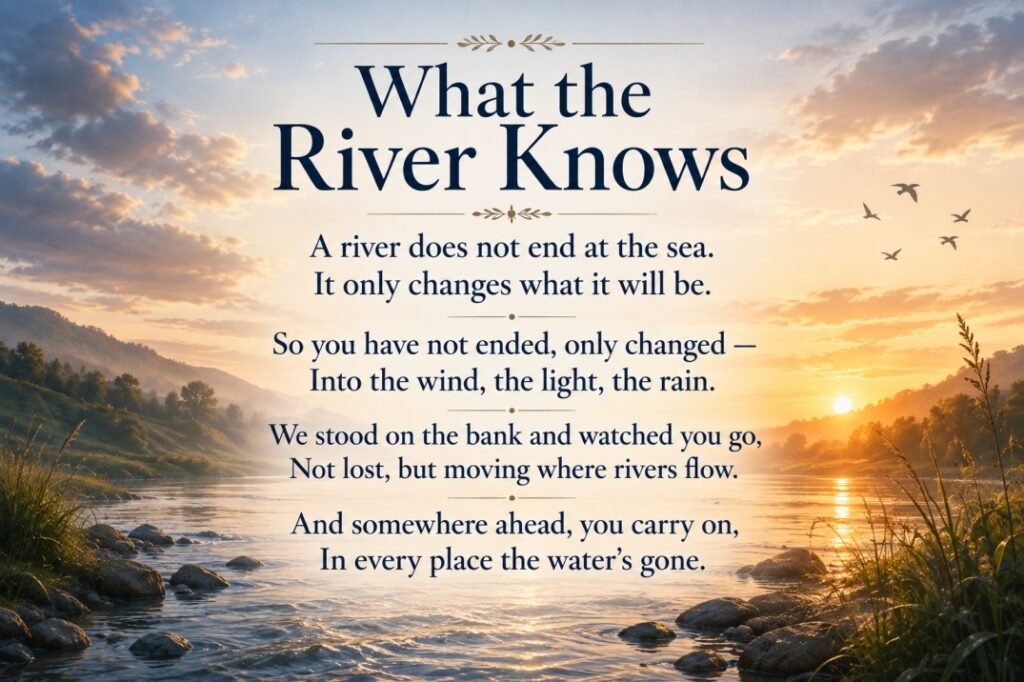
2. “What the River Knows”
A river does not end at the sea.
It only changes what it will be.
So you have not ended, only changed —
Into the wind, the light, the rain.
We stood on the bank and watched you go,
Not lost, but moving where rivers flow.
And somewhere ahead, you carry on,
In every place the water’s gone.
3. “A Short Goodbye”
I will not write a long goodbye.
You never liked long speeches, either.
So here it is, plain and true:
Thank you. I loved you. I still do.
Go gently now. Rest well tonight.
We’ll carry what you gave to light.
And when we laugh, you’ll laugh there too —
That part of you was never through.
4. “For Someone Who Gave Quietly”
Some people shine. You simply gave.
No stage, no praise, no need to save
A single moment for yourself —
You built a life for everyone else.
So let this be your final gift:
That we go on, a little lifted,
Carrying the quiet weight
Of everything you gave, too late
for us to thank you as we should.
So we say it now, as best we could:
You mattered more than words can show.
Rest now. We’ll carry what you sowed.
Part 2: 8 Classic Funeral Poems by Legendary Poets
5. “Do Not Stand at My Grave and Weep” — Mary Elizabeth Frye
Opening line: “I am a thousand winds that blow.”
What the poem says: The speaker addresses a mourner directly, telling them not to stand at the grave and cry. Across twelve short lines, the speaker claims to be everywhere in nature instead — the wind, sunlight on ripe grain, gentle autumn rain, the quiet lift of birds in circling flight at dawn, and the soft star that shows itself at night. The poem closes by repeating its opening instruction: don’t stand at the grave and weep, because there’s nothing there to mourn.
About the poem: Frye wrote this in 1932, on a torn paper bag, comforting a grieving friend. It never appeared in a formal collection during her lifetime, yet it became one of the most recited funeral poems in the English-speaking world.
About the poet: Frye published almost nothing else. This single poem defined her legacy. Unlike career poets, she wrote from raw personal experience, not literary ambition — which may explain why the poem feels so direct and unguarded.
Why it works for funerals: It rejects the grave as a place of sorrow and relocates the deceased into nature. Families often choose it when they want comfort over mourning.
6. “Crossing the Bar” — Alfred, Lord Tennyson
Opening line: “Sunset and evening star.”
What the poem says: The poem opens at dusk, with the speaker hoping for “one clear call” as he sets out to sea. Across four stanzas, Tennyson builds an extended metaphor: crossing the sandbar at a harbor’s mouth stands in for crossing from life into death. He hopes the “moaning of the bar” — the sound of grief — stays quiet, because the tide is simply carrying him home. The poem ends with the hope of meeting his “Pilot” face to face once he has crossed.
About the poem: Tennyson wrote this in 1889, three years before his death, and asked that it be placed last in every collection of his work.
About the poet: Tennyson served as Britain’s Poet Laureate for over 40 years. Compared to Robert Browning’s dramatic monologues, Tennyson’s verse stays measured and musical. Compared to Matthew Arnold’s melancholy, this poem’s tone is calm, even hopeful.
Why it works for funerals: It frames death as a sea voyage, not an ending. Naval and military funerals often use it for that exact reason.
7. “Because I Could Not Stop for Death” — Emily Dickinson
Opening line: “Because I could not stop for Death.”
What the poem says: Death arrives as a courteous carriage driver, and the speaker climbs in without fear. The carriage passes ordinary scenes of life — children at recess, fields of grain, the setting sun — moving slowly, unhurried. Eventually they stop at a house that turns out to be a grave, described only as a low mound in the ground. The final stanza reveals centuries have passed, yet they feel shorter than that first day the speaker realized the horses were headed toward eternity.
About the poem: Published posthumously in 1890, the poem treats death as gentle and patient rather than violent.
About the poet: Dickinson wrote nearly 1,800 poems but published fewer than a dozen while alive, living a reclusive life in Amherst, Massachusetts. Unlike her contemporary Walt Whitman’s sprawling, public-facing verse, Dickinson wrote in tight, private stanzas that feel almost like a diary entry.
Why it works for funerals: It removes fear from death. The unhurried carriage ride suggests death is patient, not violent.
8. “Remember” — Christina Rossetti
Opening line: “Remember me when I am gone away.”
What the poem says: This sonnet asks a loved one to remember the speaker after death — to hold onto the memory of their hand, of plans they made together. Partway through, the poem turns: the speaker says if remembering brings only sadness, it’s better to forget and smile than to remember and grieve. The final lines release the mourner from guilt entirely, preferring their happiness over being remembered at all.
About the poem: Written in 1862, few funeral poems balance memory and release as gracefully as this one does.
About the poet: Rossetti was central to the Pre-Raphaelite literary circle alongside her brother, Dante Gabriel Rossetti. Where Dante’s work leaned visual and sensuous, Christina’s poetry stayed spiritual and restrained, often returning to themes of mortality, faith, and quiet endurance.
Why it works for funerals: It gives mourners permission to heal. Families use it when they want to honor grief without prolonging it.
9. “Death Is Nothing At All” — Henry Scott-Holland
Opening line: “Death is nothing at all.”
What the poem says: The speaker insists that dying changes nothing essential between two people. He describes simply slipping into “the next room,” still himself, still reachable. Then he asks to be called by his old, familiar name, spoken without solemnity, laughed about the way they always laughed together. He insists that life retains all its old meaning, that nothing has been lost, only put out of sight for a little while.
About the poem: Delivered as part of a 1910 sermon at St. Paul’s Cathedral, following the death of King Edward VII, this text was never meant as standalone verse — it grew into a funeral favorite on its own.
About the poet: Scott-Holland was a Church of England canon and theology professor, not a professional poet. His words carry a pastoral, conversational tone, closer to a letter than to formal verse.
Why it works for funerals: It insists nothing has really changed between the living and the dead. Many choose it for a lighter, more conversational memorial tone.
10. “Funeral Blues” — W.H. Auden
Opening line: “Stop all the clocks, cut off the telephone.”
What the poem says: The poem opens with a string of impossible demands — silence every phone, muffle every drum, stop every clock — as the speaker tries to make the outside world register a private catastrophe. It escalates into public spectacle: planes writing “He Is Dead” across the sky, doves in mourning crepe, traffic police in black cotton gloves. The final stanza collapses into personal devastation, naming the dead man as the speaker’s every direction and every hour of the week, before declaring that nothing — not stars, moon, sun, ocean, or forest — matters anymore.
About the poem: Auden wrote this in 1936, originally as satire for a play, later revising it into sincere elegy. It reached global audiences after being read aloud in Four Weddings and a Funeral (1994).
About the poet: Auden remains one of the 20th century’s most influential English-language poets. Compared to T.S. Eliot, whose modernism fractured form, Auden mostly kept form intact while still breaking hearts with it.
Why it works for funerals: It captures the shock and disorientation of sudden loss, more than a long illness.
Note: This poem remains under active copyright. Please source the full text through an authorized publisher, such as Auden’s collected works from Faber & Faber.
11. “A Psalm of Life” — Henry Wadsworth Longfellow
Opening line: “Tell me not, in mournful numbers.”
What the poem says: Longfellow opens by rejecting the idea that life is “an empty dream.” Across nine stanzas, he insists life is real, action matters, and the soul does not simply return to dust. He urges readers not to trust the future or dwell on the past, but to act in the present. The poem closes with its most famous image: great lives leave “footprints on the sands of time,” which can guide someone else struggling through their own difficult passage.
About the poem: Written in 1838, it directly challenges fatalism, urging readers to build and leave something behind.
About the poet: Longfellow was 19th-century America’s most popular poet, admired alongside Whitman and Poe. Unlike Poe’s gothic darkness, Longfellow wrote with moral clarity and optimism, and his poems were memorized in schools for generations.
Why it works for funerals: It celebrates a life well-lived. Families use it for someone remembered for ambition, work, or legacy.
12. “The Dash” — Linda Ellis
Opening line: “I read of a man who stood to speak.”
What the poem says: The poem describes a eulogy at a funeral, where a speaker points to the years carved on a headstone — birth and death — and notes that what matters is the small dash between them. Ellis argues that the dash represents everything a person actually did, felt, and gave during their time alive. The poem then turns outward, urging the reader to reconsider how they spend their own “dash” — with more love, less anger, more patience with others — since none of us know how much time remains on our own stone.
About the poem: Written in 1996, this modern poem shifted the focus of funeral readings toward how someone lived, not just when they were born and died.
About the poet: Ellis is a contemporary American poet and speaker. Her work sits apart from classical funeral poetry, reading more like direct address, built for public recitation rather than private reading.
Why it works for funerals: It turns the eulogy’s focus toward how someone lived. It fits secular, life-celebration-style memorials well.
Note: This poem remains under active copyright. Please source the full text through the poet’s official website, lindaellis.net.
How to Choose the Right Poem for a Funeral
- Sudden or tragic loss: “Funeral Blues” or “A Short Goodbye”
- Long illness or expected loss: “Crossing the Bar” or “Remember”
- A parent or grandparent: “The Room You Left” or “A Psalm of Life”
- A quiet, humble person: “For Someone Who Gave Quietly” or “The Dash”
- A spiritual or church service: “Death Is Nothing At All”
- A secular or non-religious service: “Because I Could Not Stop for Death” or “What the River Knows”
Frequently Asked Questions
What is the most popular poem read at funerals?
“Do Not Stand at My Grave and Weep” by Mary Elizabeth Frye ranks among the most requested funeral poems worldwide, alongside Tennyson’s “Crossing the Bar.”
Can I read a copyrighted poem at a funeral?
Yes. Reading a poem aloud at a private memorial service is generally accepted practice. Reproducing it in printed programs or online without permission may require checking the poem’s copyright status first.
Are short poems better for funerals than long ones?
Short poems often work better for live readings. They hold emotional weight without losing the audience partway through.
Can I use one of the four original poems in this guide for free?
Yes. The four original poems above are free to read, print, or share at any memorial service.
What poem should I choose if I don’t know where to start?
Start with “Do Not Stand at My Grave and Weep” or “A Short Goodbye.” Both are short, accessible, and fit almost any service.
Also read: The Scholar-Gipsy by Matthew Arnold: Full Summary