
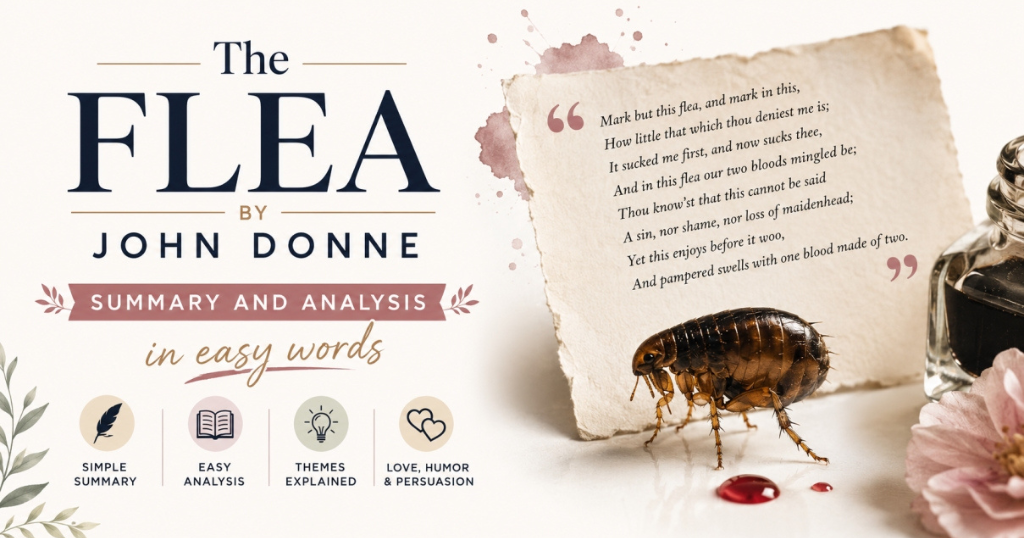
“The Flea” is one of John Donne‘s most famous metaphysical poems, first published posthumously in 1633 in his collection Songs and Sonnets. The poem uses a flea that has bitten both the speaker and his beloved as an elaborate, witty argument for seduction. It’s a masterclass in the metaphysical conceit — an extended, surprising metaphor that yokes together wildly different ideas — and remains a staple of English literature syllabi for its blend of intellectual cleverness and physical desire.
Below, you’ll find the full text of the poem, a stanza-by-stanza summary, a detailed analysis of its themes and technique, and comparisons to Donne’s other work and his contemporaries.
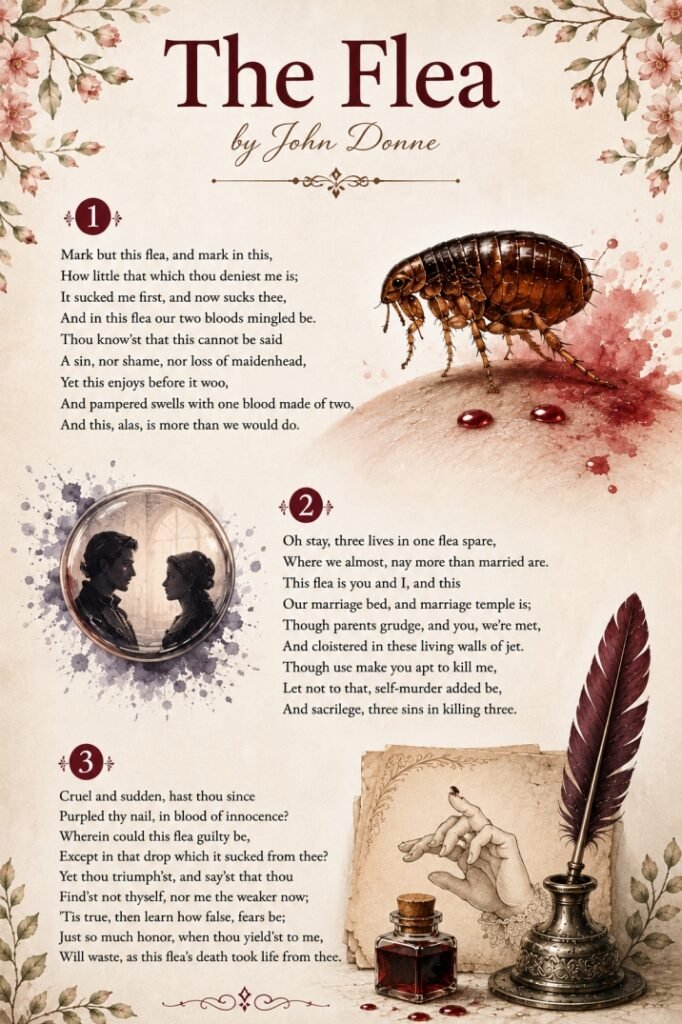
Summary, Stanza by Stanza
Stanza 1: The Proposition
The speaker points to a flea that has bitten both him and the woman he’s addressing, and argues that inside the flea, their blood has already “mingled.” If their blood can mix inside an insect without shame or sin, he reasons, why should she withhold something as small as sex from him? He frames the flea as having already enjoyed more intimacy with her than he has.
Stanza 2: The Escalation
As she reaches to kill the flea, he stops her. He now claims the flea contains three lives — his, hers, and its own — and calls it their “marriage bed” and “marriage temple.” Killing the flea, he argues, would be a triple sin: murder, suicide (since his blood is in it too), and sacrilege (since it’s now a sacred marriage space).
Stanza 3: The Reversal
She kills the flea anyway, brushing off his argument with a triumphant flick of her nail. The speaker doesn’t miss a beat — he pivots the same logic against itself. If killing the flea caused no real harm to either of them, he says, then giving in to him and losing her “honor” will cost her just as little. The poem ends on this clever, if manipulative, twist.
Analysis
The Central Conceit
The poem’s power lies in its metaphysical conceit: an argument built on a comparison so unlikely it forces the reader to follow the logic rather than dismiss it outright. Comparing a flea bite to sex, marriage, and religious sacrament is absurd on its face — but Donne commits to the logic so fully, and with such formal control, that the poem becomes a genuine display of wit. This technique, taking a trivial or grotesque object and building a serious argument around it, is Donne’s signature move and one of the defining features of metaphysical poetry more broadly.
Structure and Form
The poem consists of three nine-line stanzas, each following a tight rhyme scheme (AABBCCDDD) and a mix of iambic tetrameter and pentameter, with the closing triplet in each stanza giving it a punchy, aphoristic finish. This structure mirrors the poem’s argument: each stanza builds on the last, and the final rhymed triplet lands the persuasive point like the punchline of a debate.
Seduction as Argument
“The Flea” belongs to the carpe diem tradition of seduction poetry, but it inverts the usual approach. Where poems like Andrew Marvell’s “To His Coy Mistress” argue urgency (“we have little time, so let’s act now”), Donne’s speaker argues triviality (“this act means nothing, so why refuse?”). It’s a legalistic, almost courtroom-style seduction — the speaker behaves like a lawyer building a case, not a lover pleading from the heart. That coolness and cleverness, rather than raw emotion, is exactly what marks it as metaphysical rather than purely romantic verse.
The Woman’s Silence and Agency
Notably, the woman never speaks. We only know her actions and reactions through the speaker’s descriptions: she “grudges,” she kills the flea, she “triumphs.” Some modern readings note that her decisive action, killing the flea despite his elaborate argument, gives her the last physical word in the poem even though the speaker gets the last verbal one. This tension between his rhetorical persistence and her practical defiance adds a layer of irony: his argument technically “loses” the flea but he still tries to repurpose the loss.
Sex, Sin, and Religious Imagery
Donne, who later became an Anglican priest and Dean of St Paul’s Cathedral, frequently blended the sacred and the sexual in his poetry — a hallmark also visible in his Holy Sonnets. In “The Flea,” marriage, sacrilege, and murder are all invoked to describe something as small as an insect bite, which is part satire, part genuine theological wit. The poem plays with the idea that sin is often more about social convention than actual moral weight, a recurring skepticism in Donne’s secular love poetry.
Comparison with Donne’s Other Works
- “The Sun Rising” — Like “The Flea,” this poem uses an audacious argument (telling the sun it’s less important than the lovers’ bed) built on hyperbole and wit rather than sentiment.
- “A Valediction: Forbidding Mourning” — Here Donne uses a different conceit (a drawing compass) to argue for the durability of love during separation, showing his range: the same technique used for seduction in “The Flea” is used for tenderness and reassurance elsewhere.
- Holy Sonnets (e.g., “Batter my heart, three-personed God”) — These later religious poems show the same intensity of argument and paradox, proving that Donne’s rhetorical style carried seamlessly from erotic to devotional subjects.
Together, these poems show Donne’s consistent method: take one small, concrete object or image and build an entire argument, often startling or paradoxical, around it.
Donne in Context: Comparison with Contemporaries
| Poet | Style | Contrast with Donne |
|---|---|---|
| Andrew Marvell | Also metaphysical; “To His Coy Mistress” uses urgency, not triviality, as its seduction strategy | Marvell leans on the shortness of life; Donne leans on clever logic |
| Edmund Spenser | Idealized, musical, allegorical (The Faerie Queene, Amoretti) | Spenser’s love poetry is reverent and formal; Donne’s is argumentative and physical |
| William Shakespeare | Sonnets blend emotional sincerity with wordplay | Shakespeare’s conceits (e.g., comparing a lover to a summer’s day) are gentler; Donne’s are deliberately jarring and intellectual |
| George Herbert | Metaphysical, but devotional and humble in tone | Herbert shares Donne’s conceit-driven style but applies it almost exclusively to faith rather than desire |
Donne stands out among his peers for his combination of colloquial, conversational speech patterns with dense intellectual argument — a style later dubbed “metaphysical” by Samuel Johnson, who found the yoking together of unlike ideas both admirable and, at times, excessive.
Themes at a Glance
- Wit over sentiment — persuasion through logic, not emotion
- The triviality of sin — social convention versus real morality
- Physical intimacy and its meaning — what actually constitutes loss of “honor”
- Power and resistance — his rhetorical control versus her physical action
- Sacred and profane blending — marriage and murder invoked over an insect
Frequently Asked Questions
What is the main message of “The Flea” by John Donne?
The poem argues that a physical union as small as a flea bite mixing two people’s blood is no different, morally, from sex — so the woman’s refusal is framed as an inconsistency the speaker tries to exploit through clever argument.
What type of poem is “The Flea”?
It is a metaphysical seduction poem structured in three nine-line stanzas, built around a single extended conceit (the flea) common to Donne’s style.
Why does the woman kill the flea in the poem?
She kills it to reject the speaker’s argument and reclaim control of the situation, showing that his elaborate logic hasn’t actually persuaded her.
What literary device dominates “The Flea”?
The metaphysical conceit — an extended, unconventional metaphor — is the poem’s defining device, alongside hyperbole and legalistic argumentation.
When was “The Flea” written and published?
Donne likely wrote it in the 1590s or early 1600s; it was published posthumously in 1633 as part of Songs and Sonnets.
Also read: Doctor Faustus Summary and Analysis