Introduction
The Bhagavad Gita is not just a religious text. It is a timeless guide to life. Written over 5,000 years ago, this sacred conversation between Lord Krishna and the warrior Arjuna on the battlefield of Kurukshetra carries wisdom that cuts through every era, every culture, and every human struggle.
People across the world — from students and entrepreneurs to soldiers and philosophers — have drawn strength from its verses. Mahatma Gandhi called it his “spiritual dictionary.” Albert Einstein, Nikola Tesla, and Oppenheimer all referenced it. The reason is simple: the Gita speaks directly to the human condition.
In this blog, you will find the 25 most impacting Bhagavad Gita quotes, what they truly mean, and how they can reshape the way you think, act, and live. You will also find a curated list of the best books to help you go deeper into its teachings.
Let’s begin.
25 Most Impacting Bhagavad Gita Quotes
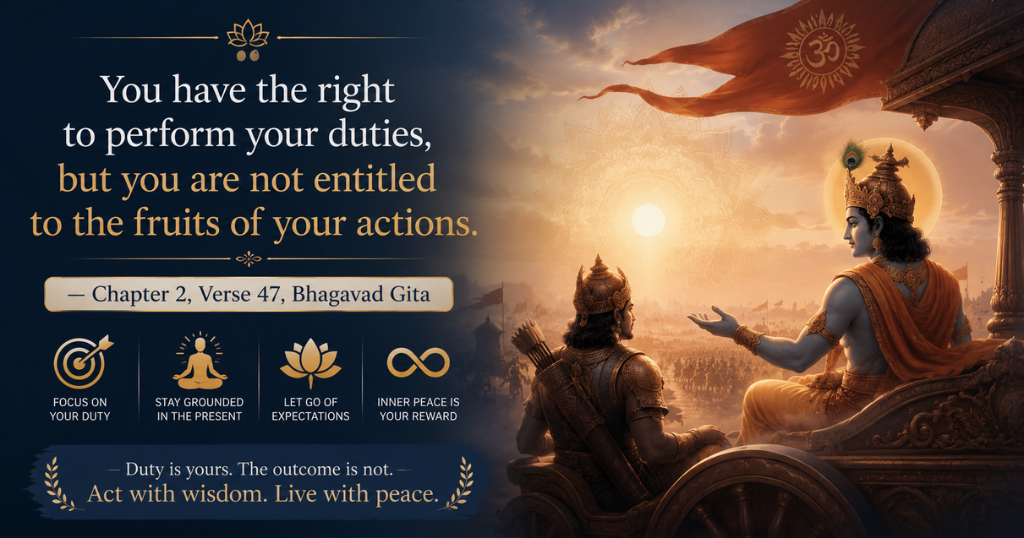
1. “You have the right to perform your duties, but you are not entitled to the fruits of your actions.” — Chapter 2, Verse 47
This is perhaps the most quoted verse in the entire Gita. Krishna tells Arjuna — and all of us — to focus entirely on our effort, not our outcome. When you stop chasing results and start mastering your process, anxiety disappears and performance improves. This single idea can transform how you work, study, and live.
2. “The soul is neither born, nor does it ever die.” — Chapter 2, Verse 20
Fear of death drives much of human suffering. Krishna dissolves that fear by explaining the eternal nature of the soul. The body changes, ages, and perishes — but the self within remains untouched. Once you truly absorb this truth, you stop clinging to the temporary and start living from a deeper place.
3. “Change is the law of the universe. What you think of as death is indeed life.” — Chapter 2, Verse 22
Nothing in life stays the same. Every ending is a beginning. Every loss creates space for something new. Instead of resisting change, the Gita teaches you to flow with it. This quote reframes every setback as a transition, not a termination.
4. “Man is made by his belief. As he believes, so he is.” — Chapter 17, Verse 3
Your identity is built on what you believe about yourself and the world. Weak beliefs produce weak actions. Strong, clear beliefs produce powerful results. The Gita understood the psychology of belief long before modern science did. Audit your beliefs, and you audit your destiny.
5. “The mind is everything. What you think, you become.” — Chapter 6, Verse 5
The mind is your greatest ally — and your greatest enemy. Krishna explains that a disciplined mind lifts you up, while an undisciplined mind pulls you down. Your thoughts shape your actions, and your actions shape your life. Train the mind, and everything else follows.
6. “It is better to live your own destiny imperfectly than to live an imitation of someone else’s life with perfection.” — Chapter 3, Verse 35
This verse strikes at one of the deepest human anxieties — comparison. The world constantly pushes you to copy someone else’s path. The Gita says: resist that urge. Walk your own path, imperfect as it may be. Authenticity always beats imitation.
7. “Let a man lift himself by his own self alone; let him not lower himself, for this self alone is the friend of oneself, and this self alone is the enemy of oneself.” — Chapter 6, Verse 5
No one is coming to save you. No one can do the inner work for you. The Gita places the responsibility of growth squarely on your own shoulders. Your mind, when disciplined, becomes your greatest supporter. When left wild, it becomes your worst opponent.
8. “The power of God is with you at all times — through the activities of mind, senses, breathing, and emotions — and is constantly doing all the work using you as a mere instrument.” — Chapter 13, Verse 14
This quote awakens a sense of humility and surrender. When you accept that a greater intelligence works through you, ego softens. You stop forcing outcomes and start trusting the process. This is not passivity — it is conscious participation with something larger than yourself.
9. “Perform all thy actions with mind concentrated on the Divine, renouncing attachment and looking upon success and failure with an equal eye — spirituality implies equanimity.” — Chapter 2, Verse 48
Equanimity is the Gita’s answer to emotional chaos. Success should not inflate you. Failure should not crush you. When you develop a steady inner state, you become unshakeable. That stability is not weakness — it is the highest form of mental strength.
10. “Fear not what is not real, never was and never will be. What is real, always was and cannot be destroyed.” — Chapter 2, Verse 16
Most of what you fear never happens. And even what does happen cannot destroy your essential self. This verse is a direct antidote to anxiety. Read it when fear grips you. It cuts through illusion and brings you back to what is real and permanent.
11. “When meditation is mastered, the mind is unwavering like the flame of a lamp in a windless place.” — Chapter 6, Verse 19
Scattered attention is one of the great problems of modern life. The Gita offers meditation not as a luxury, but as a necessity. A still mind sees clearly, decides wisely, and acts powerfully. Build a meditation practice, and you build everything else on a rock-solid foundation.
12. “Hell has three gates: lust, anger, and greed.” — Chapter 16, Verse 21

The Gita is remarkably practical here. It does not just describe a spiritual ideal — it names the exact forces that drag human beings downward. Unchecked desire, uncontrolled anger, and bottomless greed destroy relationships, health, and purpose. Recognize these gates. Do not walk through them.
13. “The wise grieve neither for the living nor for the dead.” — Chapter 2, Verse 11
Grief is natural, but prolonged suffering over what cannot be changed wastes the life you still have. Wisdom, according to the Gita, means understanding what is permanent and what is not. When you truly understand the nature of life and death, your grief transforms into acceptance — and then into peace.
14. “A gift is pure when it is given from the heart to the right person at the right time and at the right place, and when we expect nothing in return.” — Chapter 17, Verse 20
Giving without expectation is one of the rarest and most powerful human acts. The Gita describes this as the highest form of charity. In a world built on transaction, this kind of pure giving builds genuine connection, inner abundance, and lasting joy.
15. “One who sees inaction in action and action in inaction — that person is wise among humans.” — Chapter 4, Verse 18

This is one of the Gita’s deeper paradoxes. True action sometimes means stillness — choosing not to react, not to speak, not to force. And apparent stillness can be the most powerful action. The master of this principle acts with precision and stops wasting energy on reactive, ego-driven behavior.
16. “Through selfless service, you will always be fruitful and find the fulfillment of your desires.” — Chapter 3, Verse 10
Service without ego is one of the Gita’s core teachings. When you contribute to something beyond yourself — your family, your community, your mission — you stop feeling empty. Meaning fills the space that selfish pursuit never could. Serve well, and life rewards you in ways you did not expect.
17. “Neither in this world nor elsewhere is there any happiness in store for him who always doubts.” — Chapter 4, Verse 40
Doubt is the enemy of all achievement. A little healthy skepticism is wisdom, but chronic self-doubt paralyzes action and destroys opportunity. The Gita is direct: choose conviction. Act on your best understanding, and adjust as you go. Doubt nothing as completely as you doubt yourself.
18. “With a drop of my energy I enter the earth and support all beings. I become the moon and thereby nourish all plants.” — Chapter 15, Verse 13
This verse reminds you of the interconnectedness of all life. You are not separate from the world around you. What you do to others, you do to yourself. What you do to the earth, returns to you. This awareness — that you are part of an infinite web — is the beginning of real responsibility.
19. “Sever the ignorant doubt in your heart with the sword of self-knowledge.” — Chapter 4, Verse 42
Self-knowledge is not navel-gazing. It is the most practical skill you can develop. When you know your values, your patterns, your strengths, and your blind spots, you make better decisions. The Gita calls ignorance — not evil — the root cause of suffering. Cut ignorance with knowledge.
20. “The key to happiness is the reduction of desires.” — Chapter 2, Verse 71
Modern culture teaches you to multiply desires. The Gita teaches the opposite. Every desire unsatisfied creates suffering. Not because desire is wrong, but because endlessly chasing objects outside yourself leaves your inner world hollow. Simplify what you want, and watch how quickly contentment arrives.
21. “Those who eat too much or eat too little, who sleep too much or sleep too little, will not succeed in meditation.” — Chapter 6, Verse 16
Balance is not a modern wellness trend — it is ancient wisdom. The Gita teaches moderation in eating, sleeping, working, and resting as the foundation for any kind of spiritual or practical progress. Extremes destroy clarity. Balance builds it.
22. “He who has let go of hatred, who treats all beings with kindness and compassion, who is always serene — that person is dear to me.” — Chapter 12, Verse 13–14
This is the Gita’s portrait of the ideal human being. Not a warrior, not a scholar — but someone who has released hatred and cultivated genuine compassion. In a time of division and anger, these words are revolutionary. Kindness is not softness. It is the highest form of strength.
23. “The soul who is not motivated by fear, who is not disturbed even by the three-fold miseries, who is not elated when there is happiness, and who is free from attachment, fear, and anger, is called a sage of steady mind.” — Chapter 2, Verse 56
Steady-mindedness is the Gita’s highest psychological ideal. Not numbness — but deep stability. Life will bring pain and pleasure, loss and gain. The person who remains rooted through all of it does not just survive — they thrive with a quiet, unmovable power.
24. “You came empty-handed, and you will leave empty-handed.” — Chapter 2, Verse 15 (contextual paraphrase)
Nothing you own truly belongs to you. You arrived with nothing and will depart the same way. The Gita does not say this to depress you — it says this to free you. When you stop gripping what was never really yours, you live more fully in what you actually have: this moment.
25. “Whatever happened, happened for the good. Whatever is happening, is happening for the good. And whatever will happen, will also happen for the good.” — Chapter 2, paraphrase from contextual teachings
This is one of the most beloved summaries of the Gita’s teaching on acceptance and divine order. It does not ask you to ignore pain. It asks you to trust that behind every event — loss, failure, confusion — something larger is at work. This shift in perspective turns every wound into a lesson and every obstacle into a stepping stone.
Best Books to Read on the Bhagavad Gita
Reading the Gita’s verses is powerful. Reading them with guidance is transformative. These books will help you understand the text at a deeper level and apply its teachings to your everyday life.
1. The Bhagavad Gita — Translated by Eknath Easwaran Easwaran’s translation is clear, accessible, and deeply insightful. It includes a long introduction and chapter-by-chapter commentary that makes the Gita approachable for first-time readers and rewarding for those who return to it again and again.
2. Bhagavad Gita As It Is — A.C. Bhaktivedanta Swami Prabhupada This is one of the most widely distributed versions of the Gita in the world. Prabhupada offers both translation and extensive purports (explanations) from the Vaishnava devotional perspective. It is thorough, faithful, and philosophically rich.
3. The Living Gita — Sri Swami Satchidananda Satchidananda’s version makes the Gita feel alive and immediately relevant. He draws connections between ancient wisdom and modern life with warmth and clarity. Ideal for those who want practical spiritual guidance.
4. Essence of the Bhagavad Gita — Swami Kriyananda Kriyananda presents the Gita through the lens of Paramhansa Yogananda’s teachings. This version focuses on the inner, meditative aspects of the text and is especially powerful for those drawn to the yoga tradition.
5. The Bhagavad Gita — Translated by Barbara Stoler Miller Miller’s scholarly translation is precise and poetic. It respects the literary beauty of the original Sanskrit while making it readable for a modern audience. A great choice for those who want both accuracy and elegance.
6. Gita for Children — Roopa Pai This book does not dumb down the Gita — it brings it to life for younger readers with clarity and imagination. Even adults who are new to the Gita will find Roopa Pai’s style refreshing and easy to follow.
How to Apply Bhagavad Gita Wisdom in Daily Life
Reading the Gita is one thing. Living it is another. Here are a few ways to bring its wisdom into your actual day.
Start with action, not results. Before any task — a meeting, a workout, a conversation — remind yourself why you are doing it. Focus entirely on the doing. Release your grip on the outcome.
Practice daily stillness. Even five minutes of sitting quietly, watching your breath, trains the “unwavering flame” that Krishna describes. Begin small. The habit compounds.
Notice the three gates. When lust, anger, or greed rises in you, pause. Name it. You do not have to act from it. The gap between impulse and action is where wisdom lives.
Choose one verse a week. Write it on a card. Place it where you will see it. Let it work on you slowly over seven days. The Gita rewards slow reading and deep reflection.
Serve without scorekeeping. Look for one act of service today that you perform without expectation of recognition or reward. Notice how differently it feels from transactional giving.
Why the Bhagavad Gita Still Matters
We live in an age of information overload, comparison culture, and constant distraction. The exact problems the Gita addresses — attachment, fear, ego, doubt, and purposelessness — are louder today than they have ever been.
The Gita does not offer an escape from life’s difficulties. It offers a way to stand in the middle of them without being destroyed. It teaches you to act well, think clearly, love deeply, and surrender wisely.
That is not ancient philosophy. That is the manual for a meaningful life.
Final Thoughts
These 25 quotes from the Bhagavad Gita are not decorations to post on Instagram. They are tools — sharp, precise, and immensely powerful when you actually use them.
Pick the one that resonated most with you today. Carry it with you. Return to it when you feel lost, angry, afraid, or purposeless. Let it do its work.
The Gita has been changing people for thousands of years. It is ready to change you too.
“When you move amidst the world of sense, free from attachment and aversion alike, there comes the peace in which all sorrows end, and you live in the wisdom of the Self.” — Bhagavad Gita, Chapter 2, Verse 64–65
Also read: Famous Shlokas from The Bhagavad Gita