It is important for today’s literature students to understand The Countess Cathleen Summary and Analysis in detail.
In the landscape of Irish literature, few works capture the haunting intersection of folklore, faith, and national identity like William Butler Yeats’s “The Countess Cathleen.” First performed in 1899, this verse play was at the heart of the Irish Literary Revival and remains a cornerstone for students and researchers of Modernist drama.
Whether you are preparing for a high-stakes literature exam, an academic interview, or conducting deep-dive research into Celtic Twilight, this comprehensive guide will transform you into an expert on the text.
The Ultimate Guide: “The Countess Cathleen” Summary and Analysis
About the Author: The Visionary W.B. Yeats
William Butler Yeats (1865–1939) was not just a poet; he was a cultural architect. Along with Lady Gregory, he founded the Abbey Theatre to give Ireland a voice during its struggle for independence. “The Countess Cathleen” was dedicated to his muse, Maud Gonne, and it reflects his lifelong obsession with the “sacrifice” required for a noble cause.

Step 1: The Wholesome Summary (The Core Narrative)
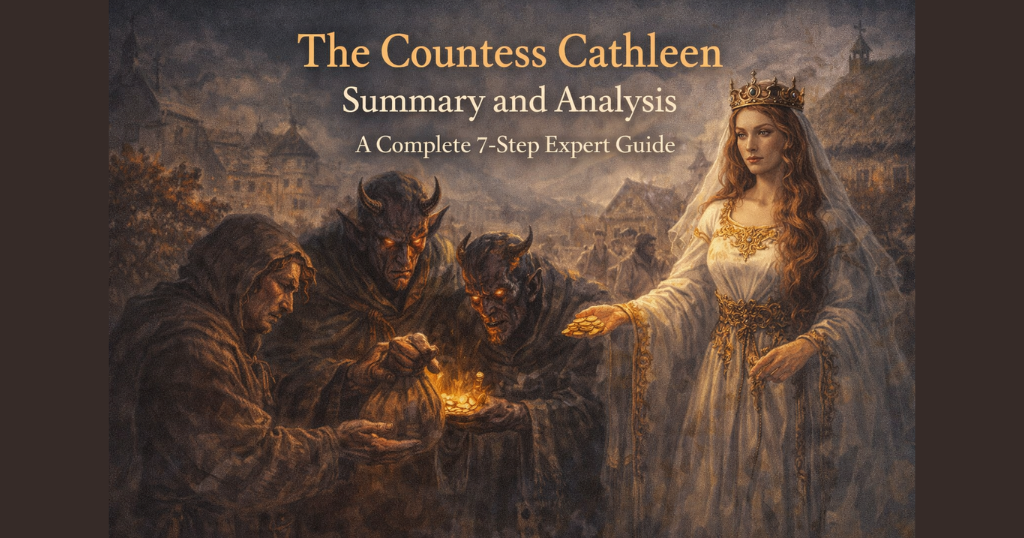
The play is set in a mythical, famine-stricken Ireland. The air is thick with desperation. Two Demon Merchants disguised as traders arrive in the countryside. Their objective? To buy the souls of the starving peasantry in exchange for gold and food.
The Conflict: The Countess Cathleen, a wealthy and pious noblewoman, is heartbroken by the suffering of her people. She exhausts her fortune trying to buy food to save them. However, the Demon Merchants use supernatural trickery to delay her ships and steal her gold.
The Ultimate Sacrifice: When the peasants begin selling their souls to survive, Cathleen realizes her money is not enough. In a supreme act of altruism, she strikes a deal with the Demons: she sells her own soul for 500,000 crowns to feed the poor and buy back the souls they had already sold.
The Resolution: Cathleen dies of a broken heart shortly after the deal. However, as the Demons come to claim her, the sky opens. An Angel appears, declaring that Cathleen is saved. Because her motive was pure love and sacrifice, her “crime” of selling her soul is forgiven by God.
Step 2: Character Analysis (The Expert’s View)
To ace an interview or exam, you must understand the characters as symbols:
- Countess Cathleen: She represents the “Ideal Ireland”—noble, maternal, and self-sacrificing. She is a Christ-like figure who takes the sins (and debts) of her people upon herself.
- Aleel: He is a poet and Cathleen’s lover. He represents the world of Art and Romance. He begs Cathleen to flee the famine and live in the world of dreams, but she chooses the world of duty. Aleel is often seen as a stand-in for Yeats himself.
- The Demon Merchants: They represent the “Materialistic World.” They are the vultures of capitalism and spiritual corruption, exploiting the poor when they are at their weakest.
- Oona: Cathleen’s foster mother, representing tradition and the earthly ties that bind us to the physical world.
Step 3: Analyzing the Famine (Historical vs. Symbolic)
While the play was written decades after the Great Irish Famine (1845-1852), the memory of that trauma is the play’s engine.
- Literary Factor: Yeats uses the famine not just as a historical event, but as a spiritual test. It asks the question: What is the price of a human soul when the body is dying?
- Research Note: Contrast this with Liam O’Flaherty’s Famine. While O’Flaherty is realistic, Yeats is Symbolic.
Step 4: The Controversy (Why the Church Hated It)
When the play premiered, it caused a riot. Devout Catholics accused Yeats of blasphemy. They couldn’t accept the idea that an Irishwoman would sell her soul, or that God would save someone who made a pact with the Devil.
- Exam Tip: Mention that this controversy highlights the tension between Irish Nationalism and Catholic Orthodoxy at the turn of the century.
Step 5: Literary Techniques and Style
Yeats wrote this in Blank Verse (unrhymed iambic pentameter).
- Celtic Twilight Imagery: The play is filled with “pale” colors, “mist,” and “shadows.” This creates an ethereal, dream-like atmosphere.
- The Supernatural: Unlike the gritty realism of later Irish plays, Yeats uses folklore to explain human psychology. The Demons are the “dark thoughts” that emerge during starvation.
Step 6: Themes of Sacrifice and Duty
The central theme is the “Noble Sacrifice.” Cathleen’s choice is a “Sublime Sin.” She does something “wrong” (sells her soul) for a “right” reason (saves a nation).
Compare and Contrast: You can contrast this with Christopher Marlowe’s Doctor Faustus. Faustus sells his soul for power and knowledge (Selfish), while Cathleen sells hers for mercy (Selfless).
Step 7: Key Quotes and Explanations
- “The years like great black oxen tread the world / And God the herdsman goads them on behind.” * Meaning: This symbolizes the relentless and crushing nature of time and destiny. It shows the peasants’ feeling of helplessness.
- “The soul is a lone thing… but the body is of the crowd.”
- Meaning: This highlights the conflict between individual salvation and social responsibility.
Frequently Asked Questions (FAQs)
What is the main theme of The Countess Cathleen? The primary theme is self-sacrifice. It explores the idea that true nobility is found in giving up one’s spiritual or physical well-being for the survival of the community.
Is The Countess Cathleen a true story? It is based on an Irish folk tale that Yeats found in a collection of French stories. While it isn’t “true” in a historical sense, it reflects the “emotional truth” of the Irish Famine experience.
Why is Aleel important to the play? Aleel represents the Poet’s voice. He offers Cathleen a path of beauty and escape, but her rejection of him shows that social duty often triumphs over personal happiness in Yeats’s early work.
How did the audience react to the first performance? The audience, particularly Catholic students, rioted and hissed. They found the idea of an Irishwoman selling her soul to be an insult to the national character and religious faith.
Also read: 20 Best The Art of War Book Quotes to Win Strategically in Life