Queen Victoria ruled Britain from 1837 to 1901. In those 64 years, the country built railways, expanded an empire, argued over Darwin and watched factories transform its cities. Literature captured every bit of that upheaval.
The Victorian era writers and poets gave us Oliver Twist, Jane Eyre, Sherlock Holmes, Dracula and Alice in Wonderland. Their poems still appear in school syllabi across India, the UK and the US. Students preparing for CBSE, ICSE, UGC-NET and university English exams meet these names again and again.
This guide covers the 25 most influential Victorian era writers and poets. For each one, you will find a famous excerpt, a plain-English explanation, their other major works and a comparison with a contemporary.
Quick Answer: Who Were the Most Important Victorian Era Writers and Poets?
The most important Victorian era writers and poets include Charles Dickens, Charlotte Brontë, Emily Brontë, George Eliot and Thomas Hardy among novelists, and Alfred Lord Tennyson, Robert Browning, Elizabeth Barrett Browning, Matthew Arnold and Christina Rossetti among poets. Other key figures include Oscar Wilde, Lewis Carroll, Robert Louis Stevenson, Bram Stoker and Rudyard Kipling.
Why 25? No official count exists. Literary historians name hundreds of Victorian authors. We selected these 25 because they appear most often in university syllabi, major anthologies and critical histories of the period, and because their work still shapes modern literature.
Table of Contents
- What Defines Victorian Literature?
- Quick-Reference Table: All 25 Victorian Era Writers and Poets
- The 10 Great Victorian Poets
- The 12 Great Victorian Novelists
- 3 Victorian Writers Who Created New Genres
- Head-to-Head Comparisons
- Common Themes Across Victorian Writing
- Frequently Asked Questions
- How We Chose This List
1. What Defines Victorian Literature?
Victorian literature sits between the Romantic Age (roughly 1798–1837) and Modernism (roughly 1901–1939). The Romantics celebrated nature, emotion and the individual imagination. Victorian authors kept some of that feeling but turned their eyes toward society.
Five forces shaped the period:
- The Industrial Revolution crowded workers into smoky cities and created stark divides between rich and poor.
- Darwin’s On the Origin of Species (1859) shook religious certainty and sparked a crisis of faith.
- The British Empire reached its peak, and writers both celebrated and questioned it.
- The rise of the middle class created a huge reading public hungry for novels.
- Serial publication let readers buy novels in monthly instalments, which made authors like Dickens household names.
Key features of Victorian writing include realism, moral seriousness, long multi-plot novels, social criticism, the dramatic monologue in poetry and a constant tension between faith and doubt.
2. Quick-Reference Table: All 25 Victorian Era Writers and Poets
| # | Writer | Lived | Best Known For | Category |
|---|---|---|---|---|
| 1 | Alfred, Lord Tennyson | 1809–1892 | In Memoriam, “Ulysses” | Poet |
| 2 | Robert Browning | 1812–1889 | “My Last Duchess” | Poet |
| 3 | Elizabeth Barrett Browning | 1806–1861 | Sonnets from the Portuguese | Poet |
| 4 | Matthew Arnold | 1822–1888 | “Dover Beach” | Poet & critic |
| 5 | Christina Rossetti | 1830–1894 | “Goblin Market” | Poet |
| 6 | Dante Gabriel Rossetti | 1828–1882 | “The Blessed Damozel” | Poet & painter |
| 7 | Gerard Manley Hopkins | 1844–1889 | “God’s Grandeur” | Poet |
| 8 | Algernon Charles Swinburne | 1837–1909 | Poems and Ballads | Poet |
| 9 | Rudyard Kipling | 1865–1936 | “If—”, The Jungle Book | Poet & novelist |
| 10 | A. E. Housman | 1859–1936 | A Shropshire Lad | Poet |
| 11 | Charles Dickens | 1812–1870 | Great Expectations | Novelist |
| 12 | Charlotte Brontë | 1816–1855 | Jane Eyre | Novelist |
| 13 | Emily Brontë | 1818–1848 | Wuthering Heights | Novelist & poet |
| 14 | Anne Brontë | 1820–1849 | The Tenant of Wildfell Hall | Novelist |
| 15 | George Eliot | 1819–1880 | Middlemarch | Novelist |
| 16 | William Makepeace Thackeray | 1811–1863 | Vanity Fair | Novelist |
| 17 | Elizabeth Gaskell | 1810–1865 | North and South | Novelist |
| 18 | Anthony Trollope | 1815–1882 | Barchester Towers | Novelist |
| 19 | Thomas Hardy | 1840–1928 | Tess of the d’Urbervilles | Novelist & poet |
| 20 | Wilkie Collins | 1824–1889 | The Moonstone | Novelist |
| 21 | Robert Louis Stevenson | 1850–1894 | Dr Jekyll and Mr Hyde | Novelist |
| 22 | Bram Stoker | 1847–1912 | Dracula | Novelist |
| 23 | Lewis Carroll | 1832–1898 | Alice’s Adventures in Wonderland | Children’s writer |
| 24 | Oscar Wilde | 1854–1900 | The Importance of Being Earnest | Playwright & novelist |
| 25 | Arthur Conan Doyle | 1859–1930 | Sherlock Holmes stories | Detective fiction |
3. The 10 Great Victorian Poets
1. Alfred, Lord Tennyson (1809–1892)
Tennyson served as Poet Laureate for 42 years, longer than anyone before or since. No poet captured the Victorian mood more completely.
Famous excerpt from “Ulysses” (1842):
To strive, to seek, to find, and not to yield.
What it means: An ageing Ulysses refuses to retire quietly. He wants one last voyage. The line sums up the Victorian belief in effort, duty and endless self-improvement.
Excerpt from In Memoriam A.H.H. (1850):
’Tis better to have loved and lost
Than never to have loved at all.
Tennyson wrote In Memoriam over 17 years after his close friend Arthur Hallam died suddenly. The poem wrestles with grief, science and faith. It also contains the famous phrase “Nature, red in tooth and claw,” written nearly a decade before Darwin published his theory.
Other major works: “The Lady of Shalott,” Idylls of the King, “The Charge of the Light Brigade,” “Crossing the Bar,” Maud
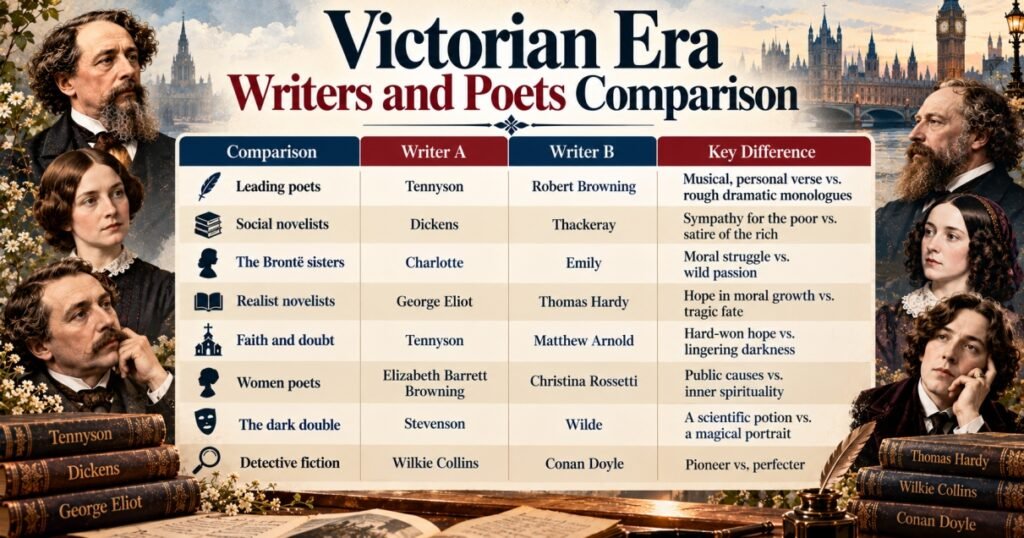
Compared with Robert Browning: Tennyson wrote musical, polished verse that soothed readers. Browning wrote rough, conversational poems that made readers work. Victorians admired Tennyson first; modern critics often prefer Browning’s psychological depth.
2. Robert Browning (1812–1889)
Browning perfected the dramatic monologue, a poem spoken by a character who reveals more than they intend.
Famous excerpt from “My Last Duchess” (1842):
That’s my last Duchess painted on the wall,
Looking as if she were alive.
What it means: A duke shows a visitor a portrait of his late wife. As he talks, we slowly realise he had her killed because she smiled too freely at others. Browning never states the crime outright. Readers piece it together from the duke’s own chilling words.
Excerpt from “Andrea del Sarto” (1855):
Ah, but a man’s reach should exceed his grasp,
Or what’s a heaven for?
This line has become one of the most quoted statements about ambition in English.
Other major works: “Porphyria’s Lover,” Men and Women, The Ring and the Book, “Fra Lippo Lippi,” “The Pied Piper of Hamelin”
Compared with Tennyson: Both poets explored doubt and ambition. Tennyson spoke in his own grieving voice; Browning hid behind masks of murderers, painters and monks.
3. Elizabeth Barrett Browning (1806–1861)
Before she married Robert Browning, Elizabeth Barrett was the more famous poet of the two. Critics seriously considered her for Poet Laureate in 1850.
Famous excerpt from Sonnets from the Portuguese, Sonnet 43 (1850):
How do I love thee? Let me count the ways.
I love thee to the depth and breadth and height
My soul can reach…
What it means: The speaker tries to measure love and finds it boundless. She wrote this sequence during her secret courtship with Robert, and it remains one of the most recited love poems in the world.
Other major works: Aurora Leigh (a verse novel about a woman writer), “The Cry of the Children” (a protest against child labour), Casa Guidi Windows
Compared with Christina Rossetti: Both women wrote about love and faith. Barrett Browning tackled public causes like slavery and child labour. Rossetti turned inward, toward renunciation and spiritual longing.
4. Matthew Arnold (1822–1888)
Arnold worked as a school inspector for 35 years and wrote poetry and criticism on the side. His poems voice the Victorian crisis of faith more clearly than any others.
Famous excerpt from “Dover Beach” (1867):
Ah, love, let us be true
To one another! for the world, which seems
To lie before us like a land of dreams,
So various, so beautiful, so new,
Hath really neither joy, nor love, nor light,
Nor certitude, nor peace, nor help for pain;
What it means: Standing by the sea at night, the speaker hears religious faith retreating like an ebbing tide. With God gone, only human love remains as a source of meaning. Earlier in the poem, Arnold describes “The Sea of Faith” that “Was once, too, at the full.”
Other major works: “The Scholar-Gipsy,” “Thyrsis,” “Shakespeare,” Culture and Anarchy (prose), Essays in Criticism (prose)
Compared with Tennyson: Tennyson’s In Memoriam ends in hard-won hope. Arnold’s “Dover Beach” ends in darkness, with “ignorant armies” clashing by night.
5. Christina Rossetti (1830–1894)
Christina Rossetti wrote everything from children’s rhymes to devotional verse. Her Christmas carol “In the Bleak Midwinter” is still sung in churches worldwide.
Famous excerpt from “Goblin Market” (1862):
Morning and evening
Maids heard the goblins cry:
“Come buy our orchard fruits,
Come buy, come buy:
What it means: Two sisters, Laura and Lizzie, hear goblin merchants selling magical fruit. Laura tastes it and begins to waste away. Lizzie saves her through courage and sisterly love. Critics read the poem as a tale about temptation, addiction, consumerism and female solidarity.
Excerpt from “Remember” (1862):
Remember me when I am gone away,
Gone far away into the silent land;
Other major works: “Up-Hill,” “A Birthday,” “In the Bleak Midwinter,” Sing-Song (children’s poems)
Compared with her brother Dante Gabriel: Both belonged to the Pre-Raphaelite circle. Dante Gabriel wrote sensuous, lavish verse. Christina wrote simple, restrained lines with deep spiritual tension underneath.
6. Dante Gabriel Rossetti (1828–1882)
Rossetti co-founded the Pre-Raphaelite Brotherhood in 1848, a group of painters and poets who rejected academic art in favour of rich colour and medieval subjects.
Famous excerpt from “The Blessed Damozel” (1850):
The blessed damozel leaned out
From the gold bar of Heaven;
What it means: A young woman in heaven leans over its golden rail and longs for her lover still on earth. The poem blends spiritual and physical desire, a mix that shocked some readers.
Other major works: The House of Life (sonnet sequence), “Sudden Light,” “Jenny,” Ballads and Sonnets
Compared with Swinburne: Both men pushed Victorian poetry toward sensuality. Rossetti kept a dreamy, painterly quality; Swinburne went further into open rebellion.
7. Gerard Manley Hopkins (1844–1889)
Hopkins became a Jesuit priest and published almost nothing in his lifetime. His friend Robert Bridges released his poems in 1918, and they instantly influenced modern poets.
Famous excerpt from “God’s Grandeur” (written 1877):
The world is charged with the grandeur of God.
It will flame out, like shining from shook foil;
What it means: God’s presence fills nature like electricity. It flashes out suddenly, the way crumpled foil glitters when shaken. Hopkins invented “sprung rhythm,” a metre based on stressed syllables that makes his lines feel energetic and packed.
Excerpt from “Pied Beauty”:
Glory be to God for dappled things
Other major works: “The Windhover,” “The Wreck of the Deutschland,” “Spring and Fall,” “Binsey Poplars”
Compared with Tennyson: Both saw God in nature. Tennyson’s verse flows smoothly; Hopkins’s lines crackle and collide. Hopkins feels like a modern poet trapped in the Victorian age.
8. Algernon Charles Swinburne (1837–1909)
Swinburne scandalised Victorian England. His 1866 collection Poems and Ballads openly celebrated pagan themes and desire, and reviewers attacked it fiercely.
Famous excerpt from “The Garden of Proserpine” (1866):
That even the weariest river
Winds somewhere safe to sea.
What it means: The speaker finds comfort in the idea that all life, however tired, eventually ends in rest. The musical, hypnotic rhythm became Swinburne’s trademark.
Other major works: Atalanta in Calydon, Songs before Sunrise, “Hymn to Proserpine”
Compared with Arnold: Both poets questioned Christianity. Arnold mourned the loss of faith; Swinburne seemed to celebrate it.
9. Rudyard Kipling (1865–1936)
Kipling was born in Bombay (now Mumbai) and spent his early years in India. In 1907, he became the first English-language writer to win the Nobel Prize in Literature.
Famous excerpt from “If—” (written 1895, published 1910):
If you can keep your head when all about you
Are losing theirs and blaming it on you,
What it means: A father advises his son on how to become a mature, self-controlled man. The poem lists qualities such as patience, humility and resilience. Readers frequently vote it Britain’s favourite poem.
Other major works: The Jungle Book, Kim, Just So Stories, “Gunga Din,” Plain Tales from the Hills
A note for Indian readers: Kipling’s love for India’s landscapes shines through Kim and The Jungle Book. However, poems such as “The White Man’s Burden” openly support British imperialism, and critics rightly challenge those views today.
Compared with Tennyson: Both wrote about empire and duty. Tennyson celebrated it from London; Kipling wrote from inside colonial India, with far more detail about ordinary soldiers and local life.
10. A. E. Housman (1859–1936)
Housman was a strict classical scholar at Cambridge. Yet his slim volume A Shropshire Lad (1896) became one of the best-selling poetry books of its time.
Famous excerpt from “Loveliest of Trees” (1896):
Loveliest of trees, the cherry now
Is hung with bloom along the bough,
What it means: A 20-year-old speaker calculates that even 70 years of life give him only 50 more springs. He decides to enjoy the cherry blossoms now. The poem captures how fleeting youth and beauty are.
Other major works: “To an Athlete Dying Young,” “When I Was One-and-Twenty,” Last Poems
Compared with Hardy: Both wrote short, plain poems full of pessimism about fate. Housman’s verse sounds like folk songs; Hardy’s carries a heavier, more philosophical weight.
4. The 12 Great Victorian Novelists
11. Charles Dickens (1812–1870)
Dickens is the most famous name among all Victorian era writers and poets. As a 12-year-old, he worked in a boot-blacking factory while his father sat in debtors’ prison. That trauma fuelled his lifelong fight against poverty and injustice.
Famous excerpt from A Tale of Two Cities (1859):
It was the best of times, it was the worst of times, it was the age of wisdom, it was the age of foolishness…
What it means: Dickens opens his novel about the French Revolution with a string of contradictions. The age held both hope and despair, wealth and misery. Readers today still apply these lines to their own times.
Excerpt from Oliver Twist (1838):
“Please, sir, I want some more.”
A starving orphan asks for a second bowl of gruel in a workhouse. That single request exposed the cruelty of Britain’s Poor Law system.
Other major works: Great Expectations, David Copperfield, Bleak House, A Christmas Carol, Hard Times, Little Dorrit
Compared with Thackeray: Dickens sided with the poor and built memorable, almost cartoonish characters. Thackeray mocked the upper and middle classes with cooler, more ironic realism.
12. Charlotte Brontë (1816–1855)
Charlotte Brontë published under the male pen name “Currer Bell” because publishers took women less seriously. Her novel Jane Eyre became an instant bestseller in 1847.
Famous excerpt from Jane Eyre (1847):
I am no bird; and no net ensnares me: I am a free human being with an independent will.
What it means: Jane, a poor governess, declares her equality to Mr Rochester, her wealthy employer. In an age that expected women to obey, this declaration felt revolutionary. Many critics call Jane Eyre an early feminist novel.
The novel also contains one of literature’s most famous closing chapters, which begins: “Reader, I married him.”
Other major works: Villette, Shirley, The Professor
Compared with Emily Brontë: Charlotte focused on a woman’s inner moral struggle. Emily wrote about wild, almost supernatural passion that breaks every social rule.
13. Emily Brontë (1818–1848)
Emily Brontë wrote just one novel before dying of tuberculosis at 30. That novel, Wuthering Heights, is now among the most studied books in English.
Famous excerpt from Wuthering Heights (1847):
Whatever our souls are made of, his and mine are the same.
What it means: Catherine Earnshaw explains her bond with Heathcliff. She feels that he is part of her very being. Their destructive love spans two generations and the bleak Yorkshire moors.
Emily also wrote powerful poetry. Her poem “No coward soul is mine” shows fierce spiritual independence.
Other major works: Poems by Currer, Ellis, and Acton Bell (with her sisters), “No coward soul is mine,” “Remembrance”
Compared with George Eliot: Eliot built calm, detailed portraits of ordinary communities. Emily Brontë created a storm of obsession, revenge and ghostly encounters.
14. Anne Brontë (1820–1849)
Anne, the youngest Brontë sister, often stands in her sisters’ shadow. Yet her second novel tackled marital abuse and alcoholism with startling honesty.
Famous excerpt from the preface to The Tenant of Wildfell Hall (2nd edition, 1848):
I wished to tell the truth, for truth always conveys its own moral to those who are able to receive it.
What it means: Critics had attacked the novel as coarse. Anne replied that she painted vice realistically so readers could recognise and avoid it. Her heroine, Helen Graham, leaves an abusive husband and slams her bedroom door against him, a scene many critics now call one of the most radical moments in Victorian fiction.
Other major works: Agnes Grey, poems published under the name “Acton Bell”
Compared with Charlotte: Charlotte romanticised Mr Rochester’s flaws. Anne showed exactly where such flaws lead, with no romantic gloss.
15. George Eliot (1819–1880)
George Eliot was the pen name of Mary Ann Evans. Many critics consider her Middlemarch the greatest novel in the English language.
Famous excerpt from Middlemarch (1871–72), final lines:
…for the growing good of the world is partly dependent on unhistoric acts; and that things are not so ill with you and me as they might have been, is half owing to the number who lived faithfully a hidden life, and rest in unvisited tombs.
What it means: The heroine, Dorothea Brooke, never achieves fame. Eliot argues that quiet, ordinary goodness still changes the world. This idea makes her one of the most humane voices of the era.
Other major works: The Mill on the Floss, Silas Marner, Adam Bede, Daniel Deronda
Compared with Dickens: Dickens dramatised society through vivid caricatures. Eliot analysed it through deep psychological portraits. Virginia Woolf famously praised Middlemarch as one of the few English novels written for grown-up people.
16. William Makepeace Thackeray (1811–1863)
Thackeray was born in Calcutta (now Kolkata), another Indian connection among the Victorian era writers and poets. He rivalled Dickens in popularity during the 1840s and 1850s.
Famous excerpt from Vanity Fair (1847–48):
Which of us is happy in this world? Which of us has his desire? or, having it, is satisfied?
What it means: Thackeray subtitled his book “A Novel without a Hero.” He follows the clever, social-climbing Becky Sharp through a world of greed and snobbery. These closing lines suggest that worldly success never truly satisfies.
Other major works: The History of Henry Esmond, Pendennis, The Luck of Barry Lyndon, The Newcomes
Compared with Trollope: Both satirised respectable society. Thackeray’s tone was sharper and more cynical; Trollope’s was gentler and more forgiving.
17. Elizabeth Gaskell (1810–1865)
Gaskell lived in Manchester, the heart of industrial England. She wrote about factory workers with more first-hand knowledge than most of her peers.
Famous excerpt from Cranford (1853), opening line:
In the first place, Cranford is in possession of the Amazons; all the holders of houses above a certain rent are women.
What it means: Gaskell humorously describes a small town run almost entirely by genteel single women and widows. The book gently mocks their strict social rules while celebrating their kindness.
Other major works: North and South, Mary Barton, Wives and Daughters, The Life of Charlotte Brontë
Compared with Dickens: Dickens published Gaskell’s work in his magazine Household Words. Both wrote “condition of England” novels about industrial poverty. Gaskell gave a more balanced view of both mill owners and workers.
18. Anthony Trollope (1815–1882)
Trollope wrote 47 novels while working full time at the Post Office. He even helped introduce the iconic red pillar box to Britain.
Famous excerpt from An Autobiography (1883):
A small daily task, if it be really daily, will beat the labours of a spasmodic Hercules.
What it means: Trollope wrote a fixed number of words every morning before work. This line explains his secret: steady discipline beats bursts of inspiration. Writers still quote it as productivity advice.
Other major works: The Warden, Barchester Towers, The Way We Live Now, the Palliser novels, the Chronicles of Barsetshire
Compared with George Eliot: Both wrote detailed portraits of provincial life. Eliot dug into philosophy and psychology; Trollope focused on politics, money and everyday social comedy.
19. Thomas Hardy (1840–1928)
Hardy bridged the Victorian and modern ages. He wrote novels until 1895, then switched entirely to poetry after critics attacked Jude the Obscure.
Famous excerpt from Tess of the d’Urbervilles (1891):
“Justice” was done, and the President of the Immortals, in Æschylean phrase, had ended his sport with Tess.
What it means: Tess, an innocent country girl, suffers betrayal after betrayal and finally faces execution. Hardy suggests that cruel cosmic forces toy with human lives. His bitter quotation marks around “Justice” attack Victorian morality.
Excerpt from “The Darkling Thrush” (dated 31 December 1900):
An aged thrush, frail, gaunt, and small,
In blast-beruffled plume,
On the last day of the 19th century, a frail bird sings joyfully in a bleak landscape. Hardy wonders whether the bird knows of some hope he cannot see.
Other major works: Far from the Madding Crowd, The Mayor of Casterbridge, Jude the Obscure, The Return of the Native, Wessex Poems
Compared with George Eliot: Both wrote about rural England. Eliot believed in moral growth and human sympathy; Hardy saw people crushed by fate and chance.
20. Wilkie Collins (1824–1889)
Collins was Dickens’s close friend and collaborator. He pioneered the “sensation novel,” a gripping blend of mystery, crime and secrets.
Famous excerpt from The Woman in White (1859–60), opening line:
This is the story of what a Woman’s patience can endure, and what a Man’s resolution can achieve.
What it means: Collins tells the story through multiple narrators, like witnesses in a courtroom. Readers piece together a plot involving stolen identity and a mysterious woman dressed in white.
Other major works: The Moonstone (which T. S. Eliot called the first and best of modern English detective novels), Armadale, No Name
Compared with Conan Doyle: Collins laid the groundwork for detective fiction with Sergeant Cuff in The Moonstone. Conan Doyle later perfected the genius detective in Sherlock Holmes.
21. Robert Louis Stevenson (1850–1894)
Stevenson, a Scot, wrote adventure stories and psychological horror with equal skill. He spent his final years in Samoa.
Famous excerpt from Strange Case of Dr Jekyll and Mr Hyde (1886):
…man is not truly one, but truly two.
What it means: Dr Jekyll realises that every person carries both good and evil. His potion splits him into the respectable doctor and the violent Mr Hyde. The phrase “Jekyll and Hyde” now describes anyone with a split personality.
Other major works: Treasure Island, Kidnapped, A Child’s Garden of Verses, The Master of Ballantrae
Compared with Oscar Wilde: Both explored the hidden, darker self. Stevenson used a chemical potion; Wilde used a magical portrait in The Picture of Dorian Gray.
22. Bram Stoker (1847–1912)
Stoker managed London’s Lyceum Theatre for 27 years. In his spare time, he created the most famous vampire in history.
Famous excerpt from Dracula (1897):
Welcome to my house! Enter freely and of your own will!
What it means: Count Dracula greets the young lawyer Jonathan Harker at his Transylvanian castle. The polite welcome hides deadly intent. Stoker tells the story through diaries, letters and newspaper clippings, which makes the horror feel real.
Other major works: The Jewel of Seven Stars, The Lair of the White Worm, Dracula’s Guest (short stories)
Compared with Stevenson: Both tapped into late-Victorian fears about science, sexuality and moral decay. Stevenson set his horror in London’s foggy streets; Stoker brought an ancient foreign evil into modern England.
5. Three Victorian Writers Who Created New Genres
23. Lewis Carroll (1832–1898)
Lewis Carroll was the pen name of Charles Lutwidge Dodgson, an Oxford mathematics lecturer. He invented the Alice stories for a young girl named Alice Liddell.
Famous excerpt from Alice’s Adventures in Wonderland (1865):
“Curiouser and curiouser!” cried Alice
Excerpt from “Jabberwocky” in Through the Looking-Glass (1871):
’Twas brillig, and the slithy toves
Did gyre and gimble in the wabe;
What it means: Carroll played with logic and language for pure delight. Most of the words in “Jabberwocky” are invented, yet readers still sense a story. Words like “chortle” and “galumph,” both coined in this poem, have entered the dictionary.
Other major works: Through the Looking-Glass, The Hunting of the Snark, Sylvie and Bruno
Compared with Kipling: Both shaped children’s literature forever. Carroll wrote nonsense and fantasy; Kipling wrote animal fables with clear moral lessons.
24. Oscar Wilde (1854–1900)
Wilde was the wittiest voice of the late Victorian period and the leader of the Aesthetic Movement, which championed “art for art’s sake.”
Famous excerpt from The Importance of Being Earnest (1895):
The truth is rarely pure and never simple.
Excerpt from the preface to The Picture of Dorian Gray (1891):
There is no such thing as a moral or an immoral book. Books are well written, or badly written. That is all.
What it means: Wilde rejected the Victorian idea that literature must teach moral lessons. He believed art should simply be beautiful. His plays mock high society through sparkling wordplay.
After his imprisonment, Wilde wrote The Ballad of Reading Gaol, which contains the haunting line: “Yet each man kills the thing he loves.”
Other major works: The Picture of Dorian Gray, Lady Windermere’s Fan, An Ideal Husband, The Happy Prince and Other Tales, De Profundis
Compared with Swinburne: Both challenged Victorian morality. Swinburne rebelled through sensuous poetry; Wilde rebelled through comedy and epigrams.
25. Arthur Conan Doyle (1859–1930)
Conan Doyle trained as a doctor. He based Sherlock Holmes partly on his medical professor, Joseph Bell, who could diagnose patients through tiny observations.
Famous excerpt from The Sign of Four (1890):
How often have I said to you that when you have eliminated the impossible, whatever remains, however improbable, must be the truth?
What it means: Holmes explains his method of deduction to Dr Watson. This principle turned detective fiction into a logic puzzle that readers could try to solve alongside the hero.
Other major works: A Study in Scarlet, The Hound of the Baskervilles, The Adventures of Sherlock Holmes, The Lost World
Compared with Wilkie Collins: Collins introduced the detective novel. Conan Doyle made the detective a global icon, inspiring every crime writer from Agatha Christie to the makers of today’s TV thrillers.
6. Head-to-Head Comparisons
Victorian vs. Romantic Writers
Romantic poets like Wordsworth, Keats and Shelley celebrated nature and personal emotion. Victorian era writers and poets kept that emotional depth but added social conscience, religious doubt and scientific awareness. Where Wordsworth found God in a field of daffodils, Arnold heard faith retreating on a dark beach.
7. Common Themes Across Victorian Writing
- Class and poverty — Dickens, Gaskell and Hardy exposed the suffering of the working poor.
- Faith and doubt — Tennyson, Arnold and Hopkins wrestled with religion after Darwin.
- The “Woman Question” — The Brontës, Eliot and Barrett Browning challenged women’s limited roles.
- Duty and self-improvement — Tennyson’s “Ulysses” and Kipling’s “If—” celebrated perseverance.
- The double self — Stevenson, Wilde and Stoker explored hidden desires beneath respectable surfaces.
- Empire — Kipling and Tennyson celebrated it; later critics exposed its injustices.
- Industrialisation — Novels like Hard Times and North and South questioned the cost of progress.
8. Frequently Asked Questions
Who are the most famous Victorian era writers and poets?
The most famous Victorian era writers and poets are Charles Dickens, Charlotte Brontë, Emily Brontë, George Eliot, Thomas Hardy, Alfred Lord Tennyson, Robert Browning, Elizabeth Barrett Browning, Oscar Wilde and Lewis Carroll.
What years does the Victorian era cover?
The Victorian era covers Queen Victoria’s reign, from 20 June 1837 to 22 January 1901.
Who was the greatest Victorian poet?
Most critics name Alfred, Lord Tennyson as the greatest Victorian poet. He served as Poet Laureate from 1850 to 1892. Robert Browning ranks as his closest rival.
Who was the greatest Victorian novelist?
Charles Dickens was the most popular Victorian novelist. Many critics, however, consider George Eliot’s Middlemarch the finest novel of the period.
Which female writers were prominent in the Victorian era?
Charlotte, Emily and Anne Brontë, George Eliot, Elizabeth Gaskell, Elizabeth Barrett Browning and Christina Rossetti led the way. Several of them published under male pen names to gain fair treatment.
What are the main features of Victorian literature?
Victorian literature features realism, social criticism, moral seriousness, long serialised novels, the dramatic monologue in poetry and a tension between faith and scientific doubt.
What is a dramatic monologue?
A dramatic monologue is a poem spoken by a single character to a silent listener. The speaker reveals their personality, often unintentionally. Robert Browning’s “My Last Duchess” is the most famous example.
Which Victorian writers had links to India?
Rudyard Kipling was born in Bombay, and William Makepeace Thackeray was born in Calcutta. Kipling set Kim and The Jungle Book in India.
How is Victorian literature different from Romantic literature?
Romantic literature focused on nature, imagination and the individual. Victorian literature turned toward society, morality, industrial change and religious doubt.
9. How We Chose This List
We selected these 25 Victorian era writers and poets using four criteria:
- Academic presence: How often the author appears in university syllabi and competitive English exams such as UGC-NET.
- Anthology coverage: Inclusion in standard references such as The Norton Anthology of English Literature.
- Lasting influence: Whether the author shaped later literature, genres or language.
- Enduring readership: Whether readers still buy, adapt and quote their work today.
All excerpts come directly from the original texts, which are in the public domain.
Conclusion
The Victorian era writers and poets lived through a century of dizzying change. They wrote about factories and faith, love and loss, empire and identity. Dickens gave a voice to the poor. The Brontës gave a voice to women. Tennyson and Arnold gave a voice to doubt. Carroll, Stevenson, Stoker and Conan Doyle invented genres we still devour today.
Read one excerpt from this list each day, and within a month you will understand why these 25 Victorian era writers and poets still shape how the world reads, writes and thinks.