
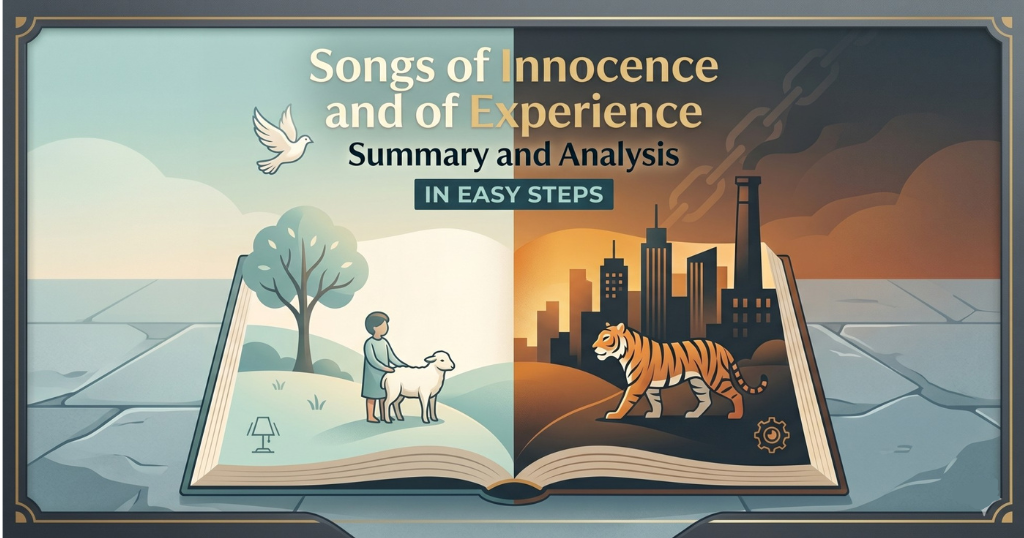
William Blake’s Songs of Innocence and of Experience stands as one of the most profound and enduring works in English literary history. Published in two parts — Songs of Innocence in 1789 and the combined edition in 1794 — this illustrated poetry collection explores the dual nature of the human soul. Blake uses the voices of children, shepherds, chimney sweeps, and angels to challenge society, religion, and the loss of purity that comes with adulthood.
This guide gives you a complete summary, poem-by-poem analysis, thematic breakdown, and symbolic interpretation of the entire collection. Whether you are a student, a literature enthusiast, or preparing for an exam, this is the only resource you need.
Background and Context: Who Was William Blake?
William Blake (1757–1827) was an English poet, painter, and printmaker. He belongs to the Romantic movement, which valued imagination, emotion, and nature over reason and industrial progress. Blake was deeply spiritual but fiercely critical of organized religion. He believed that the Church, the monarchy, and industrialization had robbed human beings — especially children — of their natural joy and freedom.
Songs of Innocence and of Experience reflects this belief directly. Blake subtitles the collection “Shewing the Two Contrary States of the Human Soul.” This subtitle is the key to understanding everything in the book. The two states — innocence and experience — are not simply stages of life. They represent two ways of seeing the world: one open, trusting, and joyful; the other worn down by suffering, authority, and disillusionment.
Blake wrote and illustrated the poems himself using a method he called “illuminated printing,” where text and images merged to create a unified artistic experience.
Songs of Innocence: Overview and Summary
The Songs of Innocence presents a world seen through the eyes of children and those who care for them. The tone is gentle, musical, and full of warmth. However, Blake is not naive. Even within innocence, he plants quiet hints of danger and inequality.
Introduction (Songs of Innocence)
The collection opens with a piper walking through a valley who meets a child on a cloud. The child asks the piper to play a song about a lamb, then sing it, then write it down. This poem establishes the entire collection’s tone — joyful creativity born from pure inspiration. The child represents the divine muse, and the piper is Blake himself, writing poems that bring happiness to every child.
The Shepherd
A shepherd watches over his flock with love and vigilance. The sheep are safe and at peace. This poem sets up the central metaphor of the protective, benevolent shepherd — a figure Blake associates with Christ. In the world of innocence, those in authority are kind and trustworthy.
The Echoing Green
Children play joyfully on a village green as old men watch fondly. Evening comes, and the children go home. This poem captures the beauty of childhood freedom, but the coming of evening hints at the inevitable end of innocence. The green “echoes” with laughter, but that laughter must fade.
The Lamb
One of the most famous poems in the collection. A child asks a lamb who made it, then answers: the same one who made me — Jesus Christ. Both the child and the lamb share qualities of meekness, gentleness, and purity. The Lamb is a symbol of Christ’s innocence, and the poem presents the world of innocence as one in which creator, creation, and child exist in perfect harmony.
The Little Black Boy
A Black child in Africa tells a white child that although his skin is dark, his soul is as bright as any. His mother teaches him that the body is only a cloud that shields us from God’s love, and one day all souls will stand equal before God. This poem carries deep emotional weight. Blake expresses empathy and challenges racial hierarchy, though he does so through a theology that asks the oppressed to endure suffering patiently — a tension many modern readers find worth examining.
The Blossom
A brief, joyful poem where a sparrow and a robin find shelter in a blossom. It celebrates energy, life, and the happiness of small living things.
The Chimney Sweeper (Innocence)
A young boy whose mother has died and whose father has sold him into chimney sweeping tells his story. He comforts a fellow sweep named Tom Dacre, who dreams of being freed by an angel. The angel tells the boys that if they do their duty, they will have God as their father. The poem ends with Tom waking and going cheerfully to work.
This is one of Blake’s most powerful critiques. On the surface, it reads as comforting. Beneath the surface, Blake reveals how religion is used to keep the poor obedient and grateful for their suffering. These children face exploitation and danger, yet they are told their reward will come in heaven.
The Night
Angels watch over sleeping animals and children through the night. Even lions are calmed by the angels’ presence. The poem creates a picture of divine protection over the innocent and vulnerable.
Spring
A short, musical poem celebrating the arrival of spring. Birds sing, lambs play, and a child joins in the joy of new life. It captures the energy and sensory delight of innocence.
Nurse’s Song (Innocence)
A nurse hears children playing at dusk. They beg her to let them play longer, and she agrees. The hills echo with their laughter. This poem contrasts beautifully with its counterpart in Experience, where the same scene becomes bitter and regret-filled.
Infant Joy
A two-day-old baby says it has no name and feels nothing but joy. The speaker names it “Joy.” The poem celebrates the pure, unnamed happiness of new life — existence before the world has imposed identity, expectation, or sorrow.
A Dream
The speaker dreams of an emmet (ant) lost and crying for her children. A glow-worm and a beetle guide her home. This gentle poem shows how even in distress, the innocent world offers compassion and community.
On Another’s Sorrow
Can a father ignore a child’s grief? Can God ignore human suffering? Blake answers: absolutely not. God himself became a child to share in human pain. This poem affirms divine empathy and concludes the Songs of Innocence with a note of comfort.
Songs of Experience: Overview and Summary
Where Songs of Innocence shows the world as it could be, Songs of Experience shows it as it is. The tone becomes darker, angrier, and more ironic. The same symbols — lambs, children, shepherds — reappear, but they now exist in a world of cruelty, repression, and lost hope.
Introduction (Songs of Experience)
Blake calls out to the “Earth” to rise and break free from the chains that bind it. A “Holy Word” (representing authoritarian religion or God as a tyrant) has imprisoned the Earth beneath a covering of jealousy and possessiveness. This poem opens Experience with a challenge to oppressive authority.
Earth’s Answer
Earth responds to the call, but with despair. It describes itself as chained, cold, and imprisoned by a “Starry Jealousy” — a jealous God who controls desire and denies freedom. Earth longs for liberation but sees no hope. This poem directly critiques religious systems that suppress human joy.
The Clod and the Pebble
A clod of clay sings that true love gives everything and asks for nothing in return. A pebble disagrees: love seeks its own pleasure and makes others suffer. The clod represents innocent, selfless love. The pebble represents the selfish, possessive love that experience teaches. Both versions exist in the world, and Blake refuses to choose between them — he simply presents the contradiction.
Holy Thursday (Experience)
In the Innocence version, Holy Thursday shows charity children singing in church. Here, Blake exposes the same scene as a scandal. Children starve in a rich and fertile land. If England is prosperous, why do children go hungry? Blake tears away the comfortable story of charity and reveals it as a cover for social failure. “Is that trembling cry a song?” he asks. The answer is clearly: no.
The Little Girl Lost / The Little Girl Found
A young girl named Lyca falls asleep in the desert and is found by a lion who carries her gently to his cave. Her parents search for her and eventually follow the lion without fear. These two narrative poems are unusual in the collection. They suggest that the dangerous world of experience can, paradoxically, offer its own form of safety. Some scholars read Lyca as a symbol of the soul moving from innocence to a deeper, spiritual freedom.
The Chimney Sweeper (Experience)
A child chimney sweeper stands in the snow on a cold morning. When asked why he is alone, he says his parents have gone to church to praise God and the King. The final stanza is devastating: those who make a child’s misery into a duty to heaven make a heaven of our misery. Where the Innocence version offered false consolation, the Experience version names the lie directly.
Nurse’s Song (Experience)
The nurse hears children playing and feels bitterness. She sees her own youth wasted. “Your spring and your day are fled away,” she tells the children. Unlike the gentle nurse of Innocence, this nurse has been hollowed out by experience. She can no longer share in joy.
The Sick Rose
One of Blake’s most analyzed poems. A rose is being destroyed by an invisible worm that has found its dark, secret bed. The worm represents hidden corruption, repressed desire, or a love that has been made secretive and poisonous by social prohibition. The rose is beautiful, but doomed. This poem captures the way experience turns natural joy into something diseased.
The Fly
A speaker brushes away a fly and wonders: am I any different? We both live, think, drink, and die. If I am like a fly, then death is simply the end of thought. The poem meditates on mortality and the arbitrary nature of life with surprising lightness.
The Angel
A dreaming maiden is protected by an angel, but she hides her desires behind a defensive “shield.” When she wakes and grows old, both her youthful weapons and her angel are gone. The poem critiques the way repression — especially of female desire — leaves a person empty and undefended.
The Tyger
The most famous poem in the entire collection. The speaker asks a tiger: what immortal hand or eye could have made your terrifying symmetry? Could the same God who made the gentle lamb also forge such a fearful creature?
Blake never answers the question. The Tyger represents raw energy, destruction, and the sublime terror of existence. Together, “The Tyger” and “The Lamb” form the moral and aesthetic center of the entire collection. Innocence asks who made the lamb. Experience asks who made the tiger. The same creator made both — and that is the great, unresolved tension at the heart of Blake’s vision.
My Pretty Rose Tree / Ah! Sun-Flower / The Lily
This trio of short poems explores love and desire. The speaker in My Pretty Rose Tree rejects a beautiful flower to stay faithful to his rose tree, but the rose responds with jealousy and thorns. Ah! Sun-Flower describes a flower that yearns for the place where the sun rises — a symbol of spiritual longing. The Lily praises the lily for offering love without defense or shame. Together, these poems argue that possessive love destroys, while open love heals.
The Garden of Love
The speaker returns to the Garden of Love from childhood, but now a chapel stands where he used to play. The gates are shut with “Thou shalt not” written above them. Priests walk through the garden, binding joy and desire with briars. This poem is a direct attack on the Church’s role in suppressing human happiness and natural love.
The Little Vagabond
A poor boy says he would rather spend time at the alehouse than in the cold church. The alehouse is warm and welcoming; the church only makes people miserable. He imagines a kinder God who would be pleased by happiness rather than suffering. Blake uses the child’s voice to expose the cruelty of a religion that offers cold comfort to the poor.
London
One of Blake’s greatest poems and a masterpiece of social criticism. The speaker walks through London’s streets and hears in every voice, every face, marks of weakness and marks of woe. Chimney sweepers’ cries appall the church. Soldiers’ sighs run in blood down palace walls. Midnight streets echo with the curses of young prostitutes who spread disease to newborns.
Every institution — Church, State, Marriage — participates in the oppression of the poor. London is not just a city. It is a system of chains, and those chains are “mind-forged” — created and maintained not just by rulers, but by the minds of those who accept them.
The Human Abstract
In Innocence, Blake wrote “The Divine Image,” celebrating the divine virtues of mercy, pity, peace, and love. In Experience, he shows how these virtues become distorted. Mercy exists only because there is poverty. Pity exists because we make each other unhappy. Cruelty constructs a tree of deceit and mystery — a false religion that traps the human soul. The “Gods of the Earth” live inside the human brain, not in any heaven.
Infant Sorrow
Where “Infant Joy” celebrated new life, “Infant Sorrow” presents a baby born into a dangerous world. The infant struggles against its father’s hands and its swaddling bands. It sulks on its mother’s breast. The world of experience greets new life not with joy but with constraint.
A Poison Tree
One of the most psychologically acute poems in the collection. The speaker is angry at a friend and tells him so; the anger ends. But he is angry at a foe and says nothing. He nurtures the anger secretly, waters it with tears, and baits it with false smiles. His enemy steals into the garden, eats the “apple” grown from this hidden wrath, and dies. The speaker is glad.
This poem exposes how repressed anger becomes a weapon. It works on multiple levels: personal psychology, religious prohibition, and the way systems of power cultivate resentment to destroy others.
A Little Boy Lost / A Little Girl Lost
In A Little Boy Lost, a child questions a priest’s demand for blind love, and the priest responds by burning him alive in a public ceremony, while his parents weep and the crowd watches silently. In A Little Girl Lost (placed in some editions under Innocence), a girl and a boy meet secretly to love each other until her father’s face — pale and cold — shuts down their joy.
Both poems attack religious and paternal authority that crushes natural feeling.
To Tirzah
Tirzah is a biblical figure representing the material world. The speaker rejects the body that binds the soul to mortality and limitation. This poem marks a turn toward Blake’s later prophetic works, where he develops elaborate mythologies about the spiritual forces that entrap humanity.
A Voice of the Ancient Bard
The collection closes with an invitation. The Ancient Bard calls out to youth to leave the night of doubt and superstition behind and step into the light of a new dawn. It is a note of hope — not naive innocence, but a hard-won vision of liberation.
Major Themes in Songs of Innocence and of Experience
1. Innocence vs. Experience
This is the central opposition of the collection. Innocence represents openness, trust, joy, and spiritual wholeness. Experience represents suffering, repression, social injustice, and spiritual loss. Blake does not simply celebrate innocence or condemn experience. He shows that both states exist simultaneously in the world, and that true wisdom — what he calls “organized innocence” — requires passing through experience without losing the capacity for joy.
2. Critique of Organized Religion
Blake was deeply spiritual but deeply hostile to the institutional Church. Throughout Experience, he shows how religion is used to keep the poor obedient, suppress desire, and justify social inequality. Priests bind joy with briars. Churches ignore starving children. Holy days are covers for exploitation.
3. The Oppression of Children
Children appear on nearly every page of this collection. Many of them — chimney sweepers, beggar children, orphans — represent the victims of an industrial, capitalist society that treats human beings as resources. Blake was writing during the Industrial Revolution, and he watched as children as young as four were sent into chimneys or factories. His outrage is quiet but devastating.
4. Repression of Desire
The poems of Experience repeatedly show how natural desire — for love, joy, pleasure — is made shameful or dangerous by social and religious prohibition. The result is not virtue but disease: poisoned roses, sick loves, wasted youth. Blake believed that energy and desire were divine, and their suppression was a form of spiritual murder.
5. Imagination and Vision
Blake believed that poetic imagination was the highest human faculty — more reliable than reason, more truthful than empirical observation. The piper and the bard who introduce each half of the collection represent the visionary artist who can see through the surface of the world to its spiritual truth.
6. Social Inequality and Class
London, Holy Thursday (Experience), and The Chimney Sweeper (Experience) make Blake’s social politics clear. He was horrified by the gap between the wealthy and the destitute in English society, and he refused to dress that horror in comfortable language.
Key Symbols and Their Meanings
The Lamb — Innocence, Christ, purity, and vulnerability.
The Tyger — Raw energy, experience, creative and destructive power, the terrifying sublime.
The Chimney Sweeper — The exploitation of children; the use of religion to enforce compliance among the oppressed.
The Garden — The natural, Edenic state of humanity, destroyed by prohibition and religious authority.
The Rose — Natural beauty and desire, corrupted by secrecy and possession.
The Shepherd — Benevolent authority; in Innocence, a figure of protection; in Experience, potentially absent or false.
Gold / Dark — Light in these poems often represents false authority or the blinding brightness of oppressive power; darkness represents both suffering and hidden truth.

Songs of Innocence and of Experience: Poetic Style and Structure
Blake’s poems in Innocence tend to use short, musical lines, simple AABB or ABAB rhyme schemes, and a sing-song quality that mimics nursery rhymes. This is deliberate — Blake wants the innocent voice to sound like a child’s, full of natural music.
In Experience, the rhymes become tighter and more ironic. The simple forms are now weapons. A poem that sounds like a lullaby is actually exposing exploitation. Blake’s genius lies in this gap between form and content: the sweetness of the language makes the bitterness of the message hit harder.
He also uses repetition strategically. Returning the same characters, settings, and images across both collections forces readers to compare the two states directly, almost like a split-screen view of the human condition.
Why Songs of Innocence and of Experience Still Matters
Blake wrote this collection over two hundred years ago, yet it speaks directly to debates that are very much alive today: children’s rights, religious authority, economic inequality, racial injustice, the suppression of desire, and the power of imagination to challenge oppression.
The Tyger and The Lamb together ask one of the oldest and most difficult questions in philosophy: how can the same universe produce both suffering and beauty, both violence and tenderness? Blake does not answer this question. He holds it open, and in doing so, he invites every reader to wrestle with it for themselves.
His work also pioneered a mode of social criticism that did not rely on polemic or argument, but on image, symbol, and voice. He let children speak. Blake let the Earth cry out. He made the reader feel the weight of injustice through art rather than argument — and that is why his work endures.
Quick-Reference Summary Table
| Poem | Collection | Key Theme |
|---|---|---|
| The Lamb | Innocence | Purity, Christ, divine creation |
| The Tyger | Experience | Power, fear, divine mystery |
| Holy Thursday | Both | Charity as cover for oppression |
| The Chimney Sweeper | Both | Child exploitation, false religion |
| London | Experience | Urban suffering, institutional oppression |
| Nurse’s Song | Both | Lost childhood, regret |
| The Garden of Love | Experience | Religious repression of desire |
| A Poison Tree | Experience | Repressed anger, psychological corruption |
| Infant Joy / Sorrow | Both | Contrasting views of new life |
| The Sick Rose | Experience | Corrupted love and desire |
Frequently Asked Questions
What is the main message of Songs of Innocence and of Experience? Blake argues that human beings exist in two contrary states: innocence, which is joyful and open, and experience, which is marked by suffering and repression. True wisdom lies in holding both states in tension without surrendering either.
What does the Tyger symbolize in Blake’s poem? The Tyger symbolizes raw creative and destructive energy — the dark, fearsome side of existence that the same divine force produced alongside the gentle lamb. It represents the terrifying sublime and forces readers to question the nature of God and creation.
How are “The Lamb” and “The Tyger” related? They are companion poems. The Lamb represents innocence, gentleness, and Christ. The Tyger represents experience, power, and ferocious energy. Together, they ask: can a benevolent God have created both?
What social issues does Blake criticize in this collection? Blake criticizes child labor, poverty, religious hypocrisy, racial inequality, the suppression of sexual desire, and the complicity of Church and State in maintaining social injustice.
What does “contrary states of the human soul” mean? It means that innocence and experience are not sequential stages — one does not simply replace the other. They are opposing but equally real ways of encountering the world, and a fully human life requires acknowledging both.
Conclusion
William Blake’s Songs of Innocence and of Experience is far more than a children’s book or a collection of pretty verses. It is a sustained, fearless critique of everything Blake believed was wrong with his world — and ours. He gave voice to children who had no voice. Blake named the cruelty that society called charity. He asked questions about God, power, and desire that no one else dared to ask in such plain and beautiful language.
To read this collection carefully is to come away changed: more alert to the gap between what institutions say they offer and what they actually deliver, more sensitive to the cost that “experience” extracts from the human spirit, and more committed to the idea that imagination — the capacity to see the world as it could be — is not a luxury but a necessity.
Blake called it “the two contrary states of the human soul.” What he was really describing is the whole of human life. Because of his contributions he became one of the most famous writers of the Romantic Age.
Also read: The Bell Jar Summary and Analysis