

Human civilization is like a massive jigsaw puzzle — thousands of years, countless cultures, and endless stories, all fitting together to explain who we are today. But how can a single reader grasp this vast complexity? The answer lies in a handful of extraordinary books. These works, written by historians, anthropologists, scientists, and philosophers, don’t just narrate history — they decode the forces that shaped humanity. These Books That Teach Everything About Human Civilization in an unforgettable way.
If you’ve ever wanted to understand how we went from hunting mammoths to building megacities, these seven books are a treasure chest. Each one shines a light on a different piece of the human journey, and together they offer something close to a panoramic view of civilization itself.
1. Sapiens: A Brief History of Humankind by Yuval Noah Harari
Harari’s Sapiens is like standing on a high mountain and looking down at the entire sweep of human history in one breathtaking view. From the moment Homo sapiens evolved in Africa to the digital age, Harari explains how we went from small tribes to a global civilization.
- Core idea: Humans dominate not because we are the strongest, but because of our ability to believe in shared myths — religion, money, nations.
- Memorable comparison: Just as bees cooperate because of instinct, humans cooperate because of stories. The difference? Our “stories” (like democracy or capitalism) exist only because we collectively agree they do.
This book is a fantastic starting point because it helps readers see history not as random events, but as a continuous narrative shaped by imagination, belief, and cooperation.
2. Guns, Germs, and Steel by Jared Diamond
Where Harari zooms out, Diamond dives into the details of why certain civilizations thrived while others collapsed. His famous question was: Why did Europeans conquer the Americas and not the other way around?
- Core idea: Geography and resources shaped the fate of civilizations more than intelligence or willpower. Those with access to domesticable animals, fertile crops, and favorable climates advanced faster.
- Contrast: Imagine two families: one lives near a river with fertile soil, while the other lives in the desert. Even if both families are equally hardworking, the river family will likely thrive more quickly. Diamond applies this logic to entire civilizations.
The book teaches us that human progress is often less about genius individuals and more about environmental luck. It’s humbling, and it reminds us how much our surroundings shape our destiny.
3. The Story of Civilization by Will and Ariel Durant
If Harari and Diamond give us sweeping arguments, the Durants give us the details — all the details. This 11-volume series (yes, eleven!) is like the encyclopedia of human achievement. From ancient Egypt to the Enlightenment, the Durants explore philosophy, politics, art, science, and religion.
- Core idea: Civilization is the interplay between cultural creativity and societal stability. Too much chaos, and civilizations collapse; too much rigidity, and they stagnate.
- Comparison: Think of civilization like a dance. Progress happens when there is both structure (the rhythm) and freedom (the movement). The Durants show how each civilization struggled to balance the two.
You don’t have to read all eleven volumes. Even dipping into a single one — like The Story of Philosophy — gives you a rich, textured understanding of how ideas and cultures shape each other over time.
4. Collapse: How Societies Choose to Fail or Succeed by Jared Diamond
If Guns, Germs, and Steel explains why civilizations rise, Collapse explains why they fall. Diamond compares societies from Easter Island to the Maya and even modern Rwanda, asking why some societies destroyed themselves while others adapted and endured.
- Core idea: Environmental misuse, poor political decisions, and failure to adapt often doom civilizations.
- Memorable example: Easter Island, once forested and fertile, was destroyed by overexploitation of resources. The inhabitants cut down their trees for statues — a powerful metaphor for shortsightedness.
This book feels eerily relevant today. When we see global warming, deforestation, and overconsumption, we realize our modern world may be walking the same path as past civilizations. It’s both a warning and a guide.
5. The History of the Ancient World by Susan Wise Bauer
Bauer’s work is like a grand, narrative-driven documentary in book form. Unlike Diamond’s scientific approach, Bauer tells history through stories — of kings, queens, wars, and ordinary people.
- Core idea: Human civilization is best understood as a tapestry of stories, each thread representing a people or culture.
- Comparison: If Diamond is like a scientist explaining patterns, Bauer is like a storyteller sitting by a fire, making history vivid and memorable.
Her strength is accessibility. Readers who find massive academic tomes intimidating will appreciate how Bauer weaves facts into a compelling narrative. It reminds us that history is not only about causes and theories, but also about people — ambitious, flawed, and very human.
6. The Lessons of History by Will and Ariel Durant
While The Story of Civilization is vast, The Lessons of History is its concentrated essence. In less than 150 pages, the Durants distill decades of research into timeless insights.
- Core idea: Despite different cultures and ages, civilizations repeat similar patterns of growth, conflict, and decline.
- Contrast: Think of civilizations like waves in the ocean. Each wave rises, peaks, and crashes, but the ocean — humanity itself — continues.
What makes this book unforgettable is its reflection on human nature. Are humans naturally violent or cooperative? Is progress permanent or fragile? The Durants explore these eternal questions, helping us not only understand the past but also reflect on the future.
7. A Short History of Nearly Everything by Bill Bryson
Finally, we end not with history in the traditional sense, but with science. Bryson takes us back to the very origins of the universe, explaining physics, chemistry, biology, and geology in ways that even non-scientists can enjoy.
- Core idea: To understand civilization, you need to understand the planet and universe that made civilization possible.
- Memorable comparison: Bryson explains the Big Bang as if the universe went from nothing to everything in the time it takes to clap your hands. This simple analogy makes cosmic events relatable.
While the book isn’t about kings or empires, it reminds us that human civilization is just one chapter in a much larger cosmic story. It’s like zooming out even further than Harari — from human history to universal history.
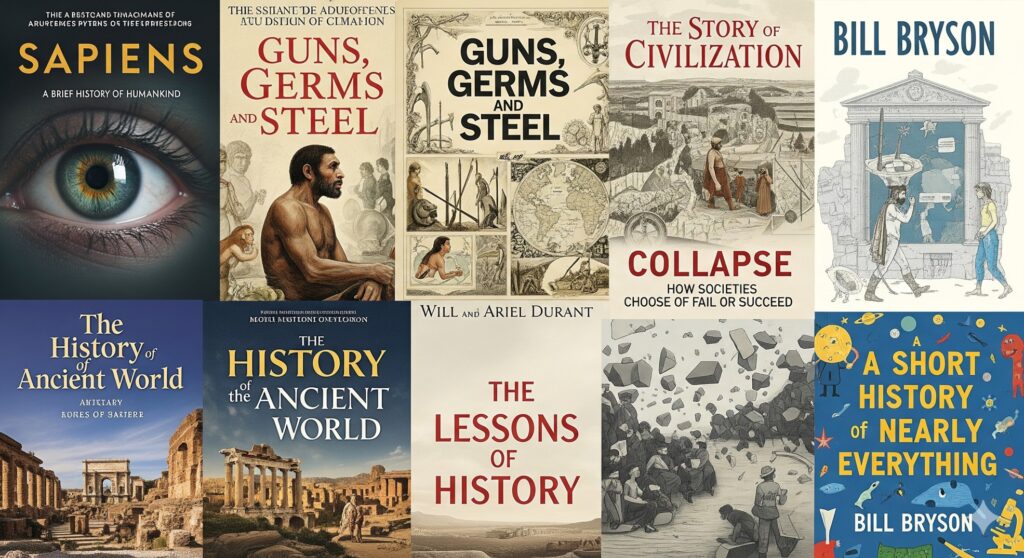
Why These Seven Books Together Matter
Each of these books is powerful on its own, but together they form a kind of “syllabus of civilization.”
- Harari shows us the big picture of human cooperation.
- Diamond explains both success (Guns, Germs, and Steel) and failure (Collapse).
- The Durants give us the texture and philosophy of culture.
- Bauer tells the story of people in a way we can feel.
- Bryson reminds us that it all started with atoms, stars, and the Earth itself.
Think of them as a team: Harari is the visionary, Diamond the analyst, the Durants the philosophers, Bauer the storyteller, and Bryson the scientist. Together, they give us not just history, but perspective — a way to understand how civilizations rise, fall, and continue. These Books That Teach Everything About Human Civilization will make a master in the history of society.
Final Thoughts
Understanding human civilization isn’t just about memorizing dates and names. It’s about seeing patterns, learning lessons, and recognizing that we are both heirs of the past and creators of the future. These seven books won’t literally teach everything, but they will give you something even better: the tools to think about civilization in a deep, reflective way.
After reading them, history stops being just “what happened” and becomes “why we are the way we are.” You’ll start seeing echoes of the past in today’s news, today’s politics, and even in your daily life. That’s the true reward of studying civilization — realizing that the story of humanity is, in many ways, the story of us.
Also read: How John Donne is a Metaphysical Poet: A Wholesome Exploration
If you are looking for a fresh book to read, you can take a look at A Man With A White Shadow by Vikram Suryawanshi.