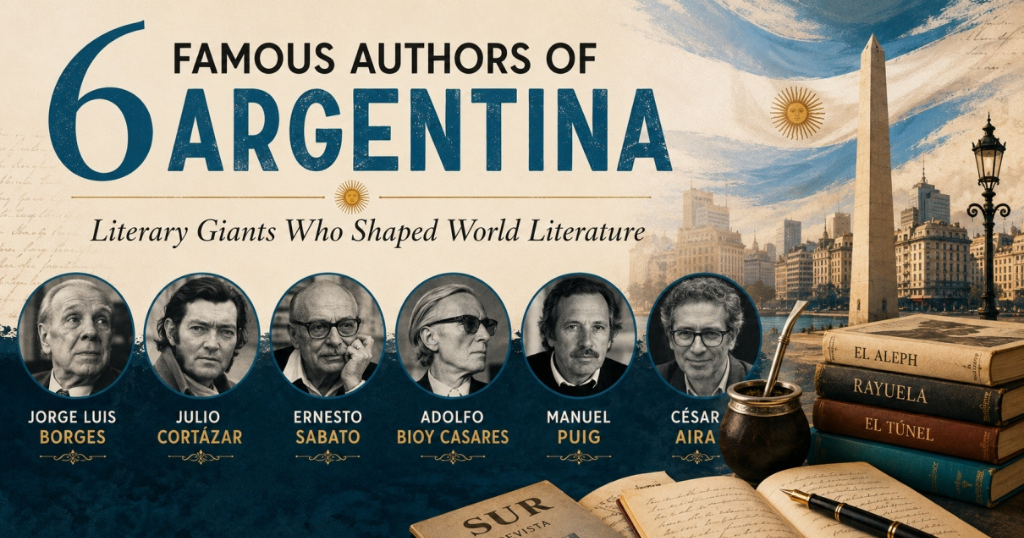
Argentina has produced some of the most influential writers in world literature. From Jorge Luis Borges’s labyrinthine short stories to Julio Cortázar’s genre-bending novels, Argentine authors have redefined how readers experience fiction. This guide covers six famous authors of Argentina, their distinct writing styles, landmark works, and the records and honors that cemented their global reputations.
Quick Reference: Famous Argentine Authors at a Glance
| Author | Lifespan | Signature Work | Literary Style |
|---|---|---|---|
| Jorge Luis Borges | 1899–1986 | Ficciones | Magical realism, philosophical fiction |
| Julio Cortázar | 1914–1984 | Hopscotch (Rayuela) | Experimental, non-linear narrative |
| Ernesto Sabato | 1911–2011 | The Tunnel | Existentialist, psychological fiction |
| Adolfo Bioy Casares | 1914–1999 | The Invention of Morel | Speculative fiction, fantasy |
| Manuel Puig | 1932–1990 | Kiss of the Spider Woman | Pop culture-infused narrative, dialogue-driven |
| César Aira | 1949–present | Ghosts | Improvisational, avant-garde |
1. Jorge Luis Borges
Biography
Jorge Luis Borges was born on August 24, 1899, in Buenos Aires. He grew up in a bilingual household and learned English before Spanish, thanks to his father’s extensive library. Borges moved to Switzerland with his family in 1914 and later lived in Spain, where he joined the avant-garde Ultraist movement. He returned to Buenos Aires in 1921 and began publishing poetry, essays, and short stories. A hereditary condition gradually left him completely blind by the 1950s, yet he continued producing work by dictation. Borges served as director of the Argentine National Library from 1955 to 1973 and taught English literature at the University of Buenos Aires. He died on June 14, 1986, in Geneva.
Writing Style
Borges wrote dense, philosophical short stories that explore infinity, labyrinths, mirrors, dreams, and alternate realities. He rarely wrote novels, favoring instead compact stories that blend essay, fiction, and literary criticism. Critics credit him with laying the groundwork for magical realism, a style that later writers like Gabriel García Márquez expanded into full novels.

Famous Works
- Ficciones (1944) — short story collection, his best-known book
- The Aleph (El Aleph, 1949) — short story collection
- A Universal History of Infamy (1935) — early short fiction
- Labyrinths (1962) — English-language anthology of stories and essays
- The Book of Sand (1975) — later short story collection
- “Tlön, Uqbar, Orbis Tertius” — individual story on invented worlds
- “The Garden of Forking Paths” — individual story on branching time
Records and Recognition
Despite being nominated for the Nobel Prize in Literature for more than 30 years, Borges never won it, a fact many critics attribute to his political views. He did share the inaugural Formentor Prize with Samuel Beckett in 1961, an award that brought him international fame practically overnight. He also received honorary doctorates from Oxford, Cambridge, and Columbia.
2. Julio Cortázar
Biography
Julio Cortázar was born in 1914 in Brussels to Argentine parents and grew up in Buenos Aires. He worked as a teacher and translator before relocating to Paris in 1951, where he spent most of his adult life. Cortázar became deeply involved in leftist politics and supported the Cuban Revolution and Sandinista movement in Nicaragua. He died in Paris in 1984.
Writing Style
Cortázar broke conventional narrative structure. He experimented with fragmented timelines, multiple narrators, and reader participation, treating fiction as an interactive puzzle rather than a linear story.
Famous Works
- Hopscotch / Rayuela (1963) — his most famous novel, readable in two sequences
- Bestiario (1951) — short story collection
- Final del juego (1956) — short story collection
- Blow-Up and Other Stories (1967 English compilation) — includes “Las babas del diablo,” adapted into the film Blow-Up
- 62: A Model Kit (1968) — experimental novel
- A Manual for Manuel (1973) — political novel
Records and Recognition
Hopscotch is frequently cited as one of the first major “reader’s choice” novels in world literature, since it offers two distinct reading paths through the same text. The novel influenced the Latin American Boom and remains a staple of postmodern literature courses worldwide.
3. Ernesto Sabato
Biography
Ernesto Sabato was born in 1911 in Rojas, Argentina. He trained as a physicist and earned a doctorate before abandoning science for literature in the early 1940s. Sabato later chaired CONADEP, the Argentine commission that investigated forced disappearances during the country’s military dictatorship, and authored its landmark report, Nunca Más. He died in 2011 at age 99.
Writing Style
Sabato wrote psychologically intense, existentialist fiction. His narrators often struggle with obsession, isolation, and moral crisis, reflecting influences from Dostoevsky and Sartre.
Famous Works
- The Tunnel (El túnel, 1948) — debut novel, his most translated work
- On Heroes and Tombs (Sobre héroes y tumbas, 1961) — his major multi-layered novel
- Abaddón el exterminador (1974) — final novel, closes his fictional trilogy
- Nunca Más (1984) — nonfiction report on Argentina’s forced disappearances
Records and Recognition
Sabato received the Cervantes Prize in 1984, one of the highest honors in Spanish-language literature. His work leading Nunca Más also gave him a lasting role in Argentina’s human rights history, separate from his literary career.
4. Adolfo Bioy Casares
Biography
Adolfo Bioy Casares was born in Buenos Aires in 1914 into a wealthy family. He became a close friend and frequent literary collaborator of Jorge Luis Borges, and the two co-wrote detective fiction under shared pseudonyms. He married fellow writer Silvina Ocampo. Bioy Casares died in 1999.
Writing Style
Bioy Casares wrote speculative and fantastical fiction with tight, controlled plotting. Unlike Borges’s essayistic tendencies, his stories favor clear, suspenseful narratives grounded in a single striking premise.
Famous Works
- The Invention of Morel (1940) — his most acclaimed novel
- Plan for Escape (Plan de evasión, 1945) — speculative fiction novel
- A Diary of the War of the Pig (Diario de la guerra del cerdo, 1969) — dystopian novel
- Six Problems for Don Isidro Parodi (1942) — co-written with Borges under a shared pseudonym
- Asleep in the Sun (Dormir al sol, 1973) — surreal novel
Records and Recognition
The Invention of Morel influenced later works exploring virtual and simulated worlds, and many scholars consider it an early conceptual ancestor of ideas later popularized in science fiction film and television. Bioy Casares received Spain’s Cervantes Prize in 1990.
5. Manuel Puig
Biography
Manuel Puig was born in 1932 in General Villegas, a small town in the Argentine pampas. He studied film in Rome before turning to fiction. Puig lived much of his life abroad, in New York, Rio de Janeiro, and Mexico, partly due to censorship of his work under Argentina’s military government. He died in 1990.
Writing Style
Puig incorporated popular culture, particularly Hollywood cinema, into literary fiction. He relied heavily on dialogue, interior monologue, and pop-culture references rather than traditional descriptive narration.
Famous Works
- Betrayed by Rita Hayworth (1968) — debut novel
- Heartbreak Tango (Boquitas pintadas, 1969) — serialized-style novel
- Kiss of the Spider Woman (1976) — his most famous work, adapted into an Oscar-winning film and a Broadway musical
- Pubis Angelical (1979) — novel blending fantasy and politics
- Eternal Curse on the Reader of These Pages (1980) — later novel
Records and Recognition
The film adaptation of Kiss of the Spider Woman won William Hurt the Academy Award for Best Actor in 1986, bringing Puig’s work to a global mainstream audience beyond literary circles.
6. César Aira
Biography
César Aira was born in 1949 in Coronel Pringles, Argentina, and has lived most of his life in Buenos Aires. He remains active today, teaches translation, and is known for an unusually prolific writing schedule. Aira is one of the few authors on this list still living and publishing new work.
Writing Style
Aira practices what he calls “constant flight forward,” writing without revision and letting each new page take the plot in an unplanned direction. His novels are typically short, surreal, and unpredictable, often blending genres like horror, romance, and science fiction within a single short book.
Famous Works
- Ghosts (Los fantasmas, 1990) — short surreal novel
- The Hare (La liebre, 1991) — early full-length novel
- How I Became a Nun (Cómo me hice monja, 1993) — semi-autobiographical novel
- The Literary Conference (El congreso de literatura, 1997) — science-fiction-tinged novella
- An Episode in the Life of a Landscape Painter (2000) — historical novella
- Varamo (2002) — one of his widely translated later works
Records and Recognition
Aira’s extraordinarily large body of published work, over 100 novellas, is considered unusual even among prolific novelists, and he has become a frequent name in Nobel Prize speculation in recent years, though he has not won the award.
Frequently Asked Questions
Who is considered the greatest Argentine author?
Jorge Luis Borges is widely regarded as Argentina’s greatest and most internationally influential author, credited with shaping magical realism and postmodern fiction worldwide.
Which Argentine author won the Nobel Prize in Literature?
No Argentine author has won the Nobel Prize in Literature. Borges was nominated repeatedly for over three decades but never received it.
What is the most famous Argentine novel?
Rayuela (Hopscotch) by Julio Cortázar and Ficciones by Jorge Luis Borges are the two most internationally recognized works of Argentine literature.
Are any famous Argentine authors still alive and writing today?
Yes. César Aira, born in 1949, remains an active and highly prolific novelist, publishing multiple books per year.
What themes define Argentine literature?
Argentine literature often explores identity, memory, political upheaval, urban life in Buenos Aires, and philosophical questions about reality and perception.
Also read: Francis Bacon’s Writing Style