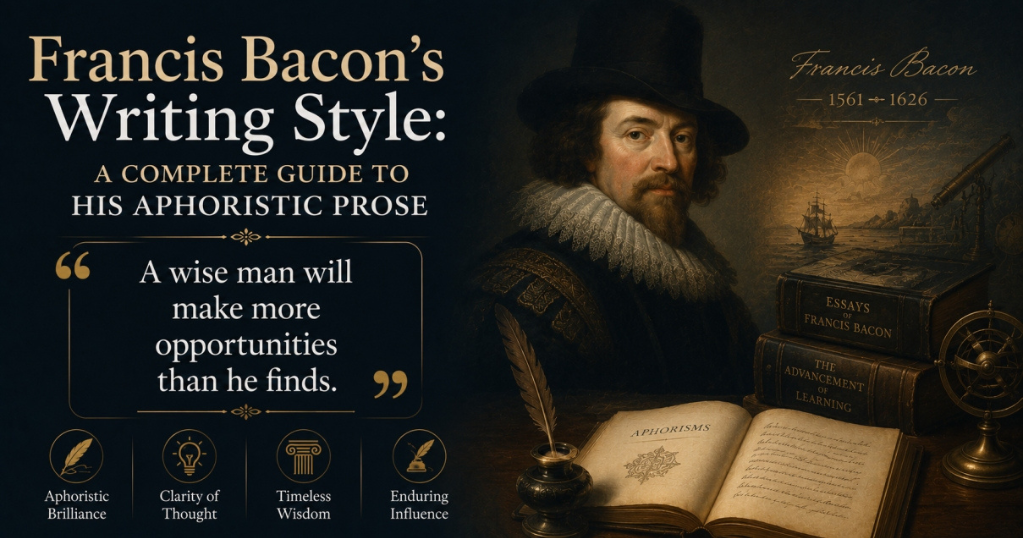
Francis Bacon shaped English prose more than almost any writer of his era. He didn’t write like the playwrights and poets around him. He wrote like a lawyer building a case, a scientist testing a hypothesis, and a philosopher distilling wisdom into single lines you could carry in your pocket. If you’ve ever read a Bacon essay and felt like you just absorbed ten ideas in two paragraphs, that’s not an accident — it’s his signature style at work.
This guide breaks down exactly what makes Francis Bacon’s writing distinct, why it still influences essayists today, and how you can recognize it in his most famous works.
Who Was Francis Bacon?
Francis Bacon (1561–1626) was an English philosopher, statesman, and essayist, widely regarded as the father of the scientific method and modern empiricism. He served as Lord Chancellor under King James I, but his lasting legacy comes from his writing — particularly his Essays, first published in 1597 and expanded through later editions.
Best Francis Bacon Quote on knowledge
Bacon didn’t just write about ideas. He wrote about how to think, how to govern, how to study, and how to live — all in a style that became a model for English nonfiction.
The Defining Features of Bacon’s Writing Style
1. Aphoristic and Compressed
Bacon’s sentences pack maximum meaning into minimum words. He rarely explains an idea across several paragraphs when one tight, quotable line will do. This aphoristic quality is probably the single most recognizable trait of his prose — short, self-contained statements that feel like proverbs or maxims rather than ordinary sentences.
Take his opening line from “Of Studies“: “Studies serve for delight, for ornament, and for ability.” Three functions, nine words, zero fat.
2. Plain Style Over Ornamentation
Unlike many Elizabethan writers who favored elaborate, decorative language, Bacon championed what’s often called the “plain style.” He distrusted flowery rhetoric because he believed it obscured truth rather than revealing it. His goal was clarity, not beauty for its own sake — though his prose ends up beautiful anyway, simply because precision has its own elegance.
3. Logical, Argumentative Structure
Bacon trained as a lawyer, and it shows. His essays move like arguments: he states a position, examines it from multiple angles, weighs counterpoints, and arrives at a balanced judgment. He rarely indulges in pure narrative or personal anecdote. Instead, he reasons his way through a topic the way a barrister builds a case before a judge.
4. Latinate Vocabulary and Syntax
Bacon wrote in an era when Latin was still the language of scholarship, and his English prose reflects that education. He frequently uses Latin-derived words and balanced, parallel sentence structures borrowed from classical rhetoric. This gives his writing a formal, weighty quality without making it inaccessible.
5. Essayistic Tone — Practical, Not Personal
Bacon’s essays are often described as the first true essays in English in the modern, practical sense. Unlike Montaigne, whose essays (which directly influenced Bacon) were personal and exploratory, Bacon’s tone stays objective and instructional. He writes less like someone thinking aloud and more like an advisor handing you a manual for navigating life — topics like ambition, friendship, truth, and death are treated almost like case studies.
6. Use of Antithesis and Parallelism
Bacon frequently balances opposing ideas within the same sentence, a rhetorical device called antithesis. This creates rhythm and reinforces his points through contrast. You’ll notice pairs and triads throughout his essays — ideas set against each other to sharpen meaning.
Examples From Bacon’s Essays
A few lines that showcase these traits in action:
From “Of Truth”: “A mixture of a lie doth ever add pleasure.” Short, declarative, slightly provocative — built to be remembered.
From “Of Marriage and Single Life”: “He that hath wife and children hath given hostages to fortune.” A single metaphor doing the work of an entire paragraph.
From “Of Revenge”: “Revenge is a kind of wild justice.” Six words, and the entire moral tension of the essay is already on the table.
Notice the pattern — Bacon rarely needs more than a sentence or two to land an idea that other writers might spend a page developing.
Why Bacon’s Style Still Matters
Bacon’s influence runs through centuries of English prose. His aphoristic compression shows up in modern self-help writing and business advice. His plain-style clarity influenced scientific and journalistic writing, where precision matters more than ornamentation. And his structured, argumentative essay form became a template that’s still taught in schools today.
Writers from Samuel Johnson to modern essayists owe something to Bacon’s approach: say what you mean, say it precisely, and don’t waste the reader’s time getting there.
Frequently Asked Questions
What is Francis Bacon’s writing style called? Bacon’s style is generally described as aphoristic and “plain style” — concise, logical, and free of excessive ornamentation, in contrast to the more elaborate prose common in his era.
What makes Bacon’s essays different from Montaigne’s? Montaigne wrote personal, exploratory essays that wandered through his own thoughts. Bacon wrote practical, structured essays that read more like reasoned arguments or advice, with less personal reflection.
Why are Bacon’s sentences so short and quotable? Bacon deliberately compressed his ideas into aphorisms — brief, memorable statements — because he believed concise language communicated truth more effectively than long-winded explanation.
What subjects did Bacon write about in his essays? His essays cover a wide range of practical and philosophical topics, including truth, death, marriage, ambition, friendship, studies, and revenge — usually examined through a balanced, advisory lens.
Final Thoughts
Francis Bacon’s writing style endures because it does something rare: it respects the reader’s time. Every sentence earns its place. If you’re studying his essays or trying to understand why they’re still assigned in literature courses four centuries later, the answer comes down to this — Bacon figured out how to say more by writing less, and almost nobody has done it better since.
Every artwork has value it can be low or high, but it deserves protection against theft. Copyrighting provides appropriate ownership to your creations as an…