
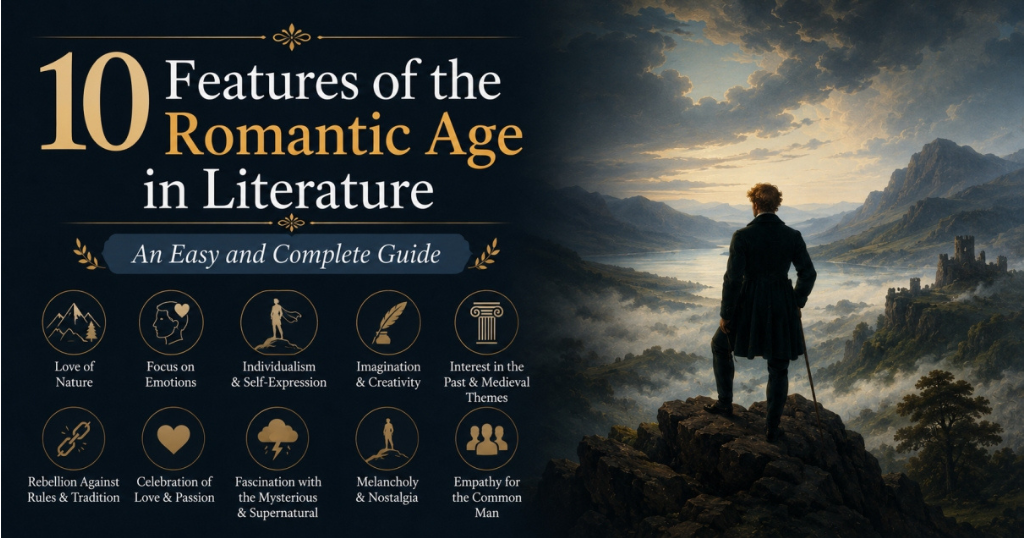
The Romantic Age changed English literature forever. Between roughly 1798 and 1837, writers of Romantic Age turned away from cold logic and strict rules. Instead, they chased feeling, nature, and the power of the individual mind. If you’ve ever wondered why Wordsworth wrote about daffodils or why Keats obsessed over a Grecian urn, the answer lies in the core features of Romanticism itself.
This guide breaks down every major feature of the Romantic Age in literature, with clear examples from the poets who defined it.
What Was the Romantic Age in Literature?
The Romantic Age began with the publication of Lyrical Ballads by William Wordsworth and Samuel Taylor Coleridge in 1798. It lasted until around 1837, when the Victorian era took over. Poets led this movement far more than novelists or playwrights did, though writers like Mary Shelley and Jane Austen also shaped the period in their own ways.
Romanticism rose as a reaction against the Neoclassical Age, which prized order, reason, and rigid poetic structure. The Romantics rejected those rules. They believed poetry should flow from genuine emotion, not from formulas borrowed from Greek and Roman writers.

1. Imagination Over Reason
The Neoclassical writers trusted logic and reason above all else. The Romantics flipped that hierarchy. They treated imagination as the highest human faculty — a tool that let poets see truths that pure logic could never reach.
Coleridge captured this idea perfectly in Kubla Khan, a poem built almost entirely from dream-like, imaginative vision rather than observed reality. For the Romantics, imagination didn’t just decorate a poem; it created new ways of understanding the world.
2. Deep Love for Nature
Nature sits at the heart of almost every major Romantic work. But these poets didn’t just describe pretty landscapes. They saw nature as a living, spiritual force — a teacher, healer, and even a divine presence.
Wordsworth called nature his “anchor” and “guide” in Tintern Abbey. He believed it shaped human morality and offered comfort that cities and crowds never could. This connection between nature and the human soul became the single most recognizable feature of Romantic poetry.
3. Emotion and Personal Feeling
Where Neoclassical writers valued restraint, Romantic writers embraced raw emotion. Joy, grief, longing, and wonder all became valid subjects for serious poetry. Wordsworth famously defined poetry as “the spontaneous overflow of powerful feelings.”
This shift meant poets no longer needed to hide behind formal, impersonal language. They wrote in the first person, shared their private thoughts, and invited readers into their inner emotional world.
4. Celebration of the Common Man
The Romantics believed every person, regardless of class or background, deserved poetic attention. Wordsworth wrote about shepherds, farmers, and beggars, treating their lives as worthy subjects for serious literature.
This focus connected directly to the political climate of the time. The French Revolution had stirred ideas of liberty, equality, and individual worth across Europe, and many Romantic poets carried those same values into their writing.
5. Simplicity of Language
Neoclassical poetry often used elevated, formal diction modeled on classical Latin and Greek styles. The Romantics rejected this. Wordsworth insisted poetry should use, as he put it, “the real language of men” — plain, direct speech rather than ornate phrasing.
This shift made poetry more accessible. Readers no longer needed a classical education to understand and connect with a poem.
6. Subjectivity and the Poet’s Personal Vision
Romantic poets placed themselves at the center of their work. They didn’t aim for objective, universal truths the way Neoclassical writers did. Instead, they explored their own thoughts, memories, and moods, treating personal experience as a legitimate and powerful subject.
This is why so much Romantic poetry reads like a private confession. Keats’s odes, Byron’s Childe Harold, and Shelley’s Ode to the West Wind all center on the poet’s individual emotional journey.
7. Fascination with the Supernatural and the Exotic
Mystery, magic, and the unknown fascinated Romantic writers. Coleridge’s The Rime of the Ancient Mariner blends ghostly curses and supernatural punishment into a haunting sea tale. This same fascination pushed writers toward exotic, faraway settings — deserts, ancient ruins, and distant lands that felt untouched by industrial modern life.
8. Idealization of Childhood
The Romantics viewed childhood as a state of purity and closeness to nature that adults gradually lose. Wordsworth explored this idea in Ode: Intimations of Immortality, suggesting that children possess a spiritual clarity adults spend their lives trying to recover.
9. Medievalism and Nostalgia for the Past
Many Romantic writers looked backward toward the medieval world, drawn to its castles, chivalry, and folklore. This nostalgia offered an escape from the growing industrialization of Britain, which many Romantics saw as a threat to natural beauty and human spirit alike.
10. Individualism and the Spirit of Freedom
At its core, Romanticism celebrated the individual over the institution. Poets championed personal freedom, rebellion against social convention, and the right to think and feel independently. Byron’s brooding, rebellious heroes — often called “Byronic heroes” — embody this spirit perfectly.
Major Writers of the Romantic Age
| Writer | Known For |
|---|---|
| William Wordsworth | Lyrical Ballads, Tintern Abbey |
| S.T. Coleridge | Kubla Khan, The Rime of the Ancient Mariner |
| Lord Byron | Childe Harold’s Pilgrimage, the Byronic hero |
| Percy Bysshe Shelley | Ode to the West Wind, Prometheus Unbound |
| John Keats | Ode to a Nightingale, Ode on a Grecian Urn |
| William Blake | Songs of Innocence and of Experience |
| Mary Shelley | Frankenstein |
Frequently Asked Questions
What is the main feature of the Romantic Age in literature?
The strongest feature is the priority given to imagination and emotion over reason and rigid structure, paired with a deep reverence for nature.
When did the Romantic Age begin and end?
Most scholars date it from 1798, the year Lyrical Ballads was published, to around 1837, when Queen Victoria’s reign began.
How is Romanticism different from Neoclassicism?
Neoclassicism valued order, reason, and classical form. Romanticism valued imagination, emotion, individual experience, and a close bond with nature.
Who are the major Romantic poets?
Wordsworth, Coleridge, Byron, Shelley, and Keats are considered the five major Romantic poets in English literature.
Final Thoughts
The Romantic Age didn’t just change poetic style. It changed what literature was allowed to feel like. By centering imagination, nature, and personal emotion, the Romantics created a body of work that still feels alive and deeply human today, more than two centuries later.
Also read: 12 Elements of the Renaissance Period