
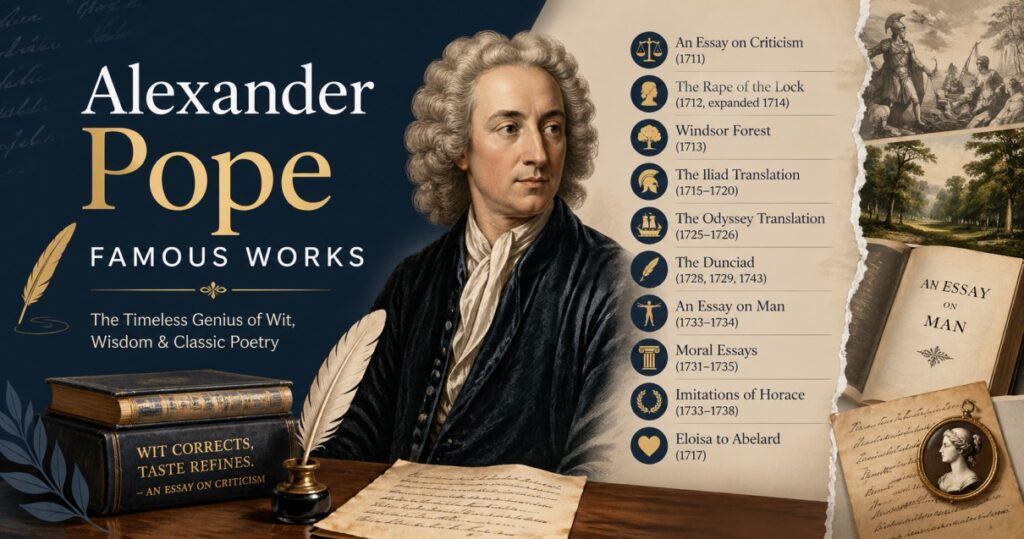
Alexander Pope stands as one of the most celebrated poets in the English language. Born in London in 1688, Pope mastered the heroic couplet, shaped the Augustan Age of English literature, and produced works that readers, scholars, and students still study today. This comprehensive guide covers Alexander Pope famous works, explains what makes each one significant, and shows you why his literary legacy endures over three centuries after his birth.
Who Was Alexander Pope?
Alexander Pope was an 18th-century English poet who lived from 1688 to 1744. Despite facing severe physical disabilities — a spinal deformity caused by tuberculosis that left him permanently hunched and in constant pain — Pope produced some of the most technically brilliant poetry in the English canon.
Pope grew up as a Roman Catholic at a time when English law actively excluded Catholics from public life. He could not attend university, vote, or hold public office. Yet he turned those limitations into fuel for his literary ambitions. Pope largely taught himself by reading voraciously in his father’s library at Binfield, Berkshire.
He rose to fame in his twenties and became wealthy enough through his translations of Homer to purchase a villa at Twickenham, which he transformed into one of the most celebrated gardens in England. From that estate, he wrote, entertained, and waged literary warfare on his enemies through satire. His life and his works were inseparable from his sharp intellect, his Catholic outsider status, and his relentless perfectionism.
The Defining Features of Alexander Pope’s Writing Style
Before exploring Pope’s famous works individually, you need to understand the stylistic tools he used across all of them.
Pope wrote almost exclusively in heroic couplets — pairs of rhyming lines in iambic pentameter. He perfected this form to a degree no other poet matched. His couplets feel inevitable, as though the English language itself chose that particular rhyme and that particular rhythm. He combined formal elegance with devastating wit, which made his satires particularly lethal.
Pope also believed in the classical ideals of order, reason, and decorum. He admired ancient Greek and Roman writers and modeled much of his work on Virgil, Horace, and Homer. He valued clarity, correctness, and polish above all else. This placed him in direct opposition to the looser, more emotionally expressive Romantic poets who came after him.
Pope’s writing is dense with meaning. A single couplet can carry layers of irony, social commentary, philosophical argument, and personal attack simultaneously. That compression is what makes him so quotable — and so frequently cited.
Alexander Pope Famous Works: A Complete Overview
1. An Essay on Criticism (1711)
Pope published An Essay on Criticism when he was only twenty-three years old. This poem established him as a major literary voice almost immediately.
An Essay on Criticism is a didactic poem — a poem that teaches. Pope uses it to lay out his views on what makes good poetry and good literary criticism. He draws heavily on Horace’s Ars Poetica and Boileau’s L’Art poétique, but he transforms those classical sources into something distinctly his own.
The poem contains some of Pope’s most famous lines, including “A little learning is a dangerous thing,” “To err is human, to forgive, divine,” and “Fools rush in where angels fear to tread.” These phrases have passed so thoroughly into everyday English that most people who use them have no idea they come from Pope.
The central argument of the poem is that good critics must understand the rules of poetry, follow nature as their guide, and subordinate personal taste to universal principles. Pope argues that the best poets and the best critics aim for the same thing: truth expressed with beauty and precision.
The poem runs to 744 lines and divides into three parts. The first part establishes the principles of good criticism. The second identifies the sources of faulty judgment. The third describes the ideal critic.
An Essay on Criticism matters because it announced Pope as not just a skilled versifier but a serious thinker about literature. It established the critical framework that governed English literary taste for most of the 18th century.
2. The Rape of the Lock (1712, expanded 1714)
The Rape of the Lock is widely considered Alexander Pope’s comic masterpiece and one of the greatest mock-heroic poems ever written in any language.
Pope wrote the poem at the request of his friend John Caryll, who wanted him to defuse a real social conflict. A young aristocrat named Lord Petre had snipped a lock of hair from the head of Arabella Fermor without her permission. The incident caused a genuine quarrel between two Catholic families. Caryll hoped that Pope’s poem would make both sides laugh and put the quarrel behind them.
Pope responded by treating this trivial event as if it were an epic battle. He deployed all the grand machinery of classical epic poetry — invocations to the muse, divine intervention by supernatural beings, councils among the gods, and heroic battle scenes — and applied them to a game of cards, a cup of coffee, and the theft of a lock of hair.
He created a set of tiny supernatural creatures called sylphs, modeled on the spirits in Rosicrucian philosophy, who guard Belinda (his version of Arabella Fermor) from harm. The Baron (his version of Lord Petre) eventually cuts the lock with a pair of scissors despite the sylphs’ efforts. Belinda rages. Her friend Thalestris demands revenge. A mock battle breaks out. The poem ends with the lock ascending to the heavens as a new star.
The genius of The Rape of the Lock lies in how precisely Pope calibrates his satire. He is mocking the self-importance and vanity of fashionable society, but he is also celebrating the beauty and vitality of that same society. The poem simultaneously ridicules Belinda for treating the loss of her hair as a catastrophe and sympathizes with her genuine distress. Pope skewers the triviality of aristocratic life while rendering it dazzlingly attractive.
The 1712 version ran to two cantos. Pope expanded it to five cantos in 1714, adding the sylphs and the machinery of the classical epic. The expanded version is the one readers know today. It runs to 794 lines and represents Pope at his most playful, most technically accomplished, and most socially perceptive.
The Rape of the Lock remains essential reading for anyone who wants to understand 18th-century English society, the mock-heroic tradition, and the range of which Pope was capable.
3. Windsor Forest (1713)
Windsor Forest is a topographical poem — a poem that celebrates a specific landscape — and also a political poem celebrating the Peace of Utrecht, which ended the War of the Spanish Succession in 1713.
Pope draws on the landscape of Windsor Forest, where he spent much of his childhood, to meditate on England’s history, its natural abundance, and its political destiny. The poem praises Queen Anne and the Tory government’s decision to pursue peace with France and Spain.
Pope models the poem on Virgil’s Georgics, the great Roman poem celebrating the Italian countryside and agricultural life. Like Virgil, Pope uses the pastoral landscape as a vehicle for larger political and philosophical arguments.
Windsor Forest is less celebrated today than Pope’s satirical and philosophical works, but it demonstrates his versatility. The poem shows that Pope could write with genuine lyrical warmth about the natural world, not just with the cool precision of argument and wit.
4. The Iliad Translation (1715–1720)
Between 1715 and 1720, Pope published his translation of Homer’s Iliad in six volumes. This project transformed his financial situation completely. The translation sold by subscription, and Pope earned enough money to buy his villa at Twickenham and achieve genuine financial independence — a remarkable achievement for a Catholic who faced legal discrimination.
Pope’s translation is not a literal rendering of Homer’s Greek. He renders Homer in the polished heroic couplets of the Augustan age. His Iliad sounds like Augustan English poetry at its most elevated, not like ancient Greek verse. For this reason, later classical scholars criticized it as unfaithful.
However, Pope’s Iliad succeeded brilliantly as an English poem. The critic Samuel Johnson called it “a performance which no age or nation could hope to equal.” Readers who could not read Greek encountered Homer through Pope for the first time and found a work of tremendous energy, grandeur, and emotional power.
The translation established Pope as the greatest English poet of his generation in the public mind. It also freed him to pursue whatever projects he chose for the rest of his life, since he no longer needed patrons or publishers’ advances to survive.
5. The Odyssey Translation (1725–1726)
Pope followed his Iliad with a translation of Homer’s Odyssey, published in 1725 and 1726. He translated the first twelve books himself and engaged two collaborators, Elijah Fenton and William Broome, to translate the remaining twelve.
The collaboration created problems. Pope did not fully disclose his collaborators’ contributions in the published work, which led to accusations of deception. The translation is generally considered less accomplished than his Iliad, partly because the collaborative work lacks perfect consistency and partly because Pope’s creative energy was directed elsewhere by this point.
Nevertheless, the Odyssey completed Pope’s Homeric project and cemented his status as the English Homer for his generation. Both translations remained widely read and influential throughout the 18th century.
6. The Dunciad (1728, 1729, 1743)
The Dunciad is Pope’s great satirical epic and one of the most unusual poems in English literature. It is a mock-heroic attack on dullness, bad writing, and the cultural forces Pope believed were degrading English literary life.
Pope published the first version of The Dunciad in 1728. He modeled it on Milton’s Paradise Lost and Virgil’s Aeneid, giving it the structure of a heroic epic while filling it with the names of the hack writers, booksellers, critics, and literary enemies he despised.
The poem’s central figure is the Goddess Dulness, who reigns over a kingdom of stupidity and bad taste. She crowns a new king of dunces — originally the poet Lewis Theobald, who had criticized Pope’s edition of Shakespeare — and watches as her followers compete in contests of bad writing, sleep-inducing poetry reading, and general incompetence.
Pope published a revised and expanded version in 1729, adding extensive mock-scholarly footnotes that satirized the pedantry of commentators. In 1743, he published The Dunciad in Four Books, which replaced Theobald with the poet laureate Colley Cibber as the king of dunces and expanded the poem’s scope. This final version ends with the goddess Dulness triumphing completely, extinguishing all learning and culture as “Universal Darkness buries All” — one of the most devastating closing lines in English literature.
The Dunciad demonstrates Pope’s willingness to deploy his gifts in genuinely aggressive literary warfare. It is vindictive, scurrilous, and brilliantly funny. It also makes a serious argument about the dangers of commercialism and declining standards in literary culture — an argument that feels remarkably contemporary.
7. An Essay on Man (1733–1734)
An Essay on Man is Pope’s most ambitious philosophical work. He published it in four epistles between 1733 and 1734, addressing them to his friend Henry St. John, Viscount Bolingbroke, who influenced the poem’s philosophical framework.
Pope designed An Essay on Man as part of a larger project he called the Opus Magnum — a comprehensive account of human nature, society, and morality written in verse. He completed only portions of this project, but An Essay on Man stands as its most significant surviving piece.
The poem addresses four major topics across its four epistles. The first epistle examines humanity’s place in the universal order. The second examines the nature of human individuals, their passions and their reason. The third examines human society and government. The fourth examines happiness and virtue.
Pope’s philosophical position in the poem is broadly Deist and optimistic. He argues that the universe operates according to a rational divine plan that humans can only partially understand. Because we see only a fragment of the whole, we mistake apparent imperfections for genuine flaws. “Whatever is, is right,” Pope argues — meaning that the total scheme of the universe is good and rational, even when individual parts seem chaotic or painful.
The poem contains Pope’s most famous philosophical lines, including “Hope springs eternal in the human breast,” “The proper study of Mankind is Man,” and “Know then thyself, presume not God to scan; The proper study of mankind is man.”
An Essay on Man was enormously influential throughout the 18th century. Voltaire admired it. Rousseau discussed it. The poem raised difficult questions about optimism, theodicy, and the relationship between reason and faith that writers and philosophers debated for decades.
8. Moral Essays (1731–1735)
The Moral Essays consist of four epistles Pope addressed to friends: Epistle to Burlington (1731), Epistle to Bathurst (1733), Epistle to Cobham (1733), and Epistle to a Lady (1735).
Each epistle explores a different aspect of human character or social behavior. Epistle to Burlington argues for the importance of taste in architecture and landscape gardening, using the example of Burlington’s neo-Palladian villa as a model of proper aesthetic values and attacking the vulgarity of ostentatious wealth. Also, Epistle to Bathurst examines the moral effects of wealth and the corrupting power of money. Epistle to Cobham addresses the question of how one can know a person’s true character. And Epistle to a Lady characterizes different types of women, arguing that inconsistency defines the female character — a view that modern readers find problematic but that reflects 18th-century assumptions Pope shared with most of his contemporaries.
The Moral Essays connect Pope’s philosophical interests with his social observation. They are less systematically philosophical than An Essay on Man but more immediately engaged with specific people, places, and social types.
9. Imitations of Horace (1733–1738)
Between 1733 and 1738, Pope published a series of poems that he called Imitations of Horace. He modeled these on the Satires and Epistles of the Roman poet Horace, updating their social critique for 18th-century England.
The most celebrated is the Epistle to Dr. Arbuthnot (1735), which Pope addresses to his physician friend John Arbuthnot. The poem is partly autobiographical — Pope defends his own career and character against his literary enemies — and partly satirical. It contains the devastating portrait of the critic Joseph Addison under the name “Atticus” and the portrait of the courtier John Hervey under the name “Sporus.”
The description of Sporus as “this Bug with gilded wings, / This painted Child of Dirt that stinks and stings” is one of the most vicious pieces of personal satire in English literature. It also shows Pope’s technical mastery — the contempt is perfectly calibrated and the language is kinetically alive.
The Imitations of Horace represent Pope’s mature satirical voice. He uses Horace’s framework to comment on corruption under the government of Robert Walpole, the decline of literary standards, the venality of court life, and his own position as an outsider who nonetheless commands the English literary world.
10. Eloisa to Abelard (1717)
Eloisa to Abelard stands apart from most of Pope’s work because it is an emotional, romantic poem rather than a satirical or philosophical one.
Pope bases the poem on the famous correspondence between the medieval philosopher Peter Abelard and his student and lover Héloïse. After their secret marriage and Abelard’s castration by Héloïse’s uncle, both of them entered religious life. Their letters, which survive and were widely read in the 18th century, express their continued passionate attachment despite their separation.
Pope writes the poem in the voice of Eloisa (his version of Héloïse), who is torn between her religious vocation and her enduring love for Abelard. The poem is a dramatic monologue of remarkable emotional intensity. Pope renders her inner conflict with a psychological depth and erotic charge that surprises readers who know him only through his satires.
Eloisa to Abelard demonstrates that Pope was capable of genuine emotional range. It influenced the development of the sentimental and Romantic traditions in English literature and was one of his most widely admired works during his lifetime.

Alexander Pope’s Shorter Famous Poems
In addition to his major works, Pope wrote several shorter poems that remain famous today.
His Elegy to the Memory of an Unfortunate Lady (1717) is a tender, emotionally powerful poem about a young woman who died by suicide after her guardian refused to let her marry the man she loved.
Ode for Music on St. Cecilia’s Day (1713) celebrates the patron saint of music with a formally ambitious lyric that shows his range beyond the heroic couplet.
His Epistle to Miss Blount, on her Leaving the Town, after the Coronation (1717) is a delightful, teasing poem addressed to Teresa Blount, one of the women Pope was closest to throughout his life.
Why Alexander Pope’s Famous Works Still Matter
Alexander Pope’s works matter for several interconnected reasons.
First, Pope mastered the heroic couplet to a degree that no other English poet matched. Reading Pope trains your ear to hear the possibilities of formal verse. His couplets demonstrate how constraint can generate creativity rather than limiting it.
Second, Pope’s satires engage with questions about power, culture, taste, money, and literary standards that remain urgently contemporary. The world he satirized in The Dunciad — one in which commercial forces overwhelm cultural standards, in which celebrity replaces merit, in which bad writing drives out good — sounds remarkably familiar in the twenty-first century.
Third, Pope packed more genuinely memorable phrases into his poems than almost any other English writer. Dozens of everyday phrases trace back to his work, often without speakers knowing it.
Fourth, Pope’s philosophical poems — especially An Essay on Man — engage with perennial questions about human nature, the limits of knowledge, the problem of evil, and the possibility of happiness. These questions do not age.
Fifth, Pope’s life itself is instructive. He overcame severe physical disability, religious discrimination, and social exclusion to become the dominant literary figure of his age entirely through the force of his writing. His career demonstrates what a gifted, disciplined mind can achieve against significant obstacles.
Frequently Asked Questions About Alexander Pope’s Famous Works
What is Alexander Pope’s most famous work? The Rape of the Lock is generally considered Pope’s most famous and technically brilliant individual poem. However, An Essay on Man and An Essay on Criticism are equally significant in terms of philosophical and literary influence.
What is Alexander Pope best known for? Pope is best known for perfecting the heroic couplet, for his mock-heroic satires, for his translations of Homer, and for his philosophical poems. He is also famous for coining dozens of phrases that have passed into everyday English.
What are some famous quotes from Alexander Pope? “To err is human, to forgive, divine.” “A little learning is a dangerous thing.” “Hope springs eternal in the human breast.” “The proper study of Mankind is Man.” “Fools rush in where angels fear to tread.” All of these come from Pope’s poetry.
What themes appear in Alexander Pope’s famous works? Reason, nature, order, wit, satire, vanity, the proper use of wealth, the relationship between art and morality, the problem of evil, and the limits of human knowledge all recur throughout Pope’s work.
What is the mock-heroic genre, and how did Pope use it? The mock-heroic genre applies the elevated language, structure, and conventions of classical epic poetry to trivial subjects, creating comic contrast. Pope used it most effectively in The Rape of the Lock and The Dunciad.
What was Alexander Pope’s last major work? The Dunciad in Four Books (1743) was Pope’s last major work. He published it just one year before his death in 1744.
Conclusion: The Enduring Greatness of Alexander Pope
Alexander Pope’s famous works span comedy, philosophy, satire, romance, criticism, and translation. He excelled in every mode he attempted. His heroic couplets set the standard for formal English verse. Also, his satires established a template for literary attack and social critique that writers still follow. His philosophical poems engaged questions that human beings have asked in every century and will continue to ask.
Pope produced work of extraordinary range and consistent quality across more than four decades of writing. He did so while managing debilitating chronic pain, navigating legal discrimination as a Catholic, and fighting literary enemies who attacked both his work and his body.
The correct response to Alexander Pope’s famous works is not merely admiration. It is engagement. Read The Rape of the Lock and notice how precisely Pope calibrates tone. Also read An Essay on Man and argue with his optimism. Read The Dunciad and ask yourself whether his fears about cultural decline were justified. And An Essay on Criticism and test his principles against your own reading experience.
Pope’s poetry rewards that kind of active, skeptical engagement. It was designed for it. The wit is there to make you think, not just to entertain you. The satire is there to challenge you, not just to make you laugh.
Three centuries after his birth, Alexander Pope continues to do exactly what he intended — he makes you see the world more clearly, with more precision, and with a sharper sense of the gap between what human beings are and what they pretend to be.
Alexander Pope lived from May 21, 1688, to May 30, 1744. His complete works appear in numerous scholarly editions. The Twickenham Edition, edited by John Butt and published by Methuen, remains the standard scholarly text.
Also read: Songs of Innocence and of Experience Summary