Introduction — Why This Poem Still Matters
Few poems in English literature combine elegance, wit, satire, mythology, social commentary, and shimmering poetic brilliance the way Alexander Pope does in The Rape of the Lock. It is often described as:
- the finest mock-epic ever written,
- a miniature masterpiece of satire,
- and a text that captures the absurdity of aristocratic society in 18th-century England.
But beyond its humor, this poem teaches us about human vanity, class culture, reputation, desire, and the theatre of social life. It is a poem that looks light—but carries depth, irony, moral reflection, and artistic precision.
In this blog, we break down:
- The story of the poem
- The characters and what they symbolize
- Pope’s purpose, techniques, and poetic genius
- Important themes, literary devices, and historical context
- Why this poem remains so central in exams and literature discussions
By the end, you will not just understand The Rape of the Lock—you will remember it effortlessly.
About the Poet: Alexander Pope (1688–1744)
To understand The Rape of the Lock, you must understand Pope himself, because the poem is inseparable from his personality, talent, and the society he observed.
1. Born into a Catholic Family
Pope lived in a time when Catholics were restricted from:
- attending universities
- holding government positions
- living within the city of London
This outsider status shaped his voice: precise, critical, witty, observant, and restrained.
2. Suffered from Ill Health
At the age of 12, Pope developed a spinal disease (Pott’s disease) that stunted his growth and left him physically fragile for life. He often described himself as:
“A little crooked thing that asks for nothing.”
This physical limitation sharpened his intellectual power—he poured his energy into reading, writing, and mastering poetic form.
3. Known for His Mastery of the Heroic Couplets
Pope is the undisputed master of:
- heroic couplets
- balanced lines
- epigrammatic wit
- precise structure
His lines are sharp enough to quote as arguments:
“To err is human; to forgive, divine.”
“Fools rush in where angels fear to tread.”
4. His Other Major Works
Pope’s contributions include:
- Essay on Criticism — commentary on poetic rules and taste
- The Dunciad — satire of dullness in literary society
- Essay on Man — philosophical poem about human nature
- Translation of Homer’s Iliad and Odyssey
Understanding these works helps us see that The Rape of the Lock is not merely playful—it is masterfully controlled satire written by a deeply intellectual mind.
Background of The Rape of the Lock — A Real Incident!
The poem is based on a real social scandal: Lord Petre secretly cut a lock of hair from Arabella Fermor, causing a rift between two aristocratic Catholic families.
A mutual friend suggested that Pope write a humorous poem to calm things down. Pope took the suggestion seriously—and transformed a petty quarrel into a grand mock-epic.
This context is vital because:
- The poem is not an attack—it is a healing satire.
- Pope wanted to show how trivial issues are inflated into social wars.
- The aristocratic society he mocks is also the society he depends on.
Summary of The Rape of the Lock — Explained in Simple Terms
Below is an easy-to-remember chapter-wise summary:
Canto I — Belinda’s Dream and Morning Routine
We meet:
- Belinda, the beautiful heroine
- Her guardian Sylph, named Ariel
Belinda wakes, dresses, and prepares for the day. Her entire morning routine is described like a religious ritual, which mocks the vanity of aristocratic women.
“On her white breast a sparkling cross she wore…”
Irony: Pope shows religious symbols worn for fashion, not faith.
Ariel warns Belinda in a dream that a disaster is coming. The nature of this disaster is trivial, but the poem treats it like fate deciding the course of kingdoms.
Canto II — The Boat Ride and Baron’s Desire
Belinda travels to Hampton Court by boat.
Her beauty shines like a goddess.
The Baron, impressed by her charm, plots to take a lock of her hair. He builds an altar of romantic love tokens and prays for success.
The humor lies in the exaggerated seriousness.
Canto III — The Cutting of the Lock
This is the central event—the “rape” (seizing) of Belinda’s hair.
The action is described in epic style:
- Clarissa hands the Baron a pair of scissors
- The Sylphs try to stop him
- The scissors “open and close like fate”
- The lock is cut—victory for the Baron, disaster for Belinda
Pope contrasts trivial act with grand epic language for satire.
Canto IV — Belinda’s Meltdown
Belinda reacts as if a kingdom has fallen.
Her emotional response mocks the aristocratic culture where:
- reputation
- appearance
- fashion
were treated as matters of life and death.
This canto also shows the Gnomes, spirits of gloom, who encourage tears, jealousy, and anger.
Canto V — The Final Battle and Apotheosis
Belinda confronts the Baron. A mock battle follows, where:
- fans
- snuff
- petticoats
- glances
become weapons.
Finally, the poet declares that the stolen lock has risen to the heavens as a star, immortalizing Belinda’s beauty.
A perfect satirical ending.
Detailed Analysis — The Poem’s Meaning and Importance
Now that we know the story, let’s examine why the poem matters.
1. Mock-Epic Style
Pope imitates the style of ancient epics like:
- Homer’s Iliad
- Virgil’s Aeneid
- Milton’s Paradise Lost
…but applies it to a trivial event.
This creates high humor.
Example of epic imitation:
- Use of supernatural beings (Sylphs)
- Invocation of the Muse
- Ceremonial description of dressing like “arming for battle”
- Describing scissors as deadly weapons
This technique exposes the gap between real heroism and social vanity.
2. Satire of High Society
The poem criticizes:
- materialism
- obsession with beauty
- fashionable religion
- artificial behavior
- gossip culture
- fragile honor
Pope shows how aristocrats treat:
- a stolen lock of hair as a tragedy
- personal pride as national crisis
- flirtations as battles
- trivial quarrels as moral wars
This helps students understand the social structure of 18th-century England.
3. The Role of Women and Gender Politics
Women like Belinda live in a world where:
- appearance defines worth
- marriage is their destiny
- beauty is both power and prison
Clarissa’s speech in Canto V is crucial:
“Charms strike the sight, but merit wins the soul.”
This line represents Pope’s deeper message:
beauty fades, virtue stays.
4. The Symbolism of the Lock of Hair
The lock symbolizes:
- vanity
- desire
- social reputation
- objectification
- fragile honor
Its theft symbolizes the theft of public image, not morality.
In an era when a woman’s “reputation” mattered more than her happiness, Pope exposes society’s distorted values.
5. Supernatural Machinery — Sylphs and Gnomes
Inspired by Rosicrucian beliefs, Pope includes spirits:
Sylphs → Protect vanity
- airy
- light
- guardians of beauty and fashion
Gnomes → Cause jealousy and gloom
- heavy
- earthy
- guardians of negative emotions
This imaginative layer gives the poem:
- richness
- fantasy
- allegory
And it dramatizes internal emotions as external forces.
6. Pope’s Poetic Genius
Students must understand Pope’s technique:
Heroic Couplets
Every two lines rhyme:
aa
bb
cc
dd
Example:
“Not louder shrieks to pitying Heaven are cast,
When husbands or when lap-dogs breathe their last.”
This introduces rhythm, clarity, and biting humor.
Balance and Antithesis
Pope’s lines often mirror each other:
- beauty vs virtue
- appearance vs reality
- love vs vanity
Epigrams
Short, memorable lines:
“But when to mischief mortals bend their will,
How soon they find fit instruments of ill!”
7. Themes
Major themes include:
✔ Vanity
✔ Reputation
✔ Society’s superficiality
✔ Losing innocence
✔ The emptiness of aristocratic life
✔ Transformation of trivial into epic
Students should memorize that Pope uses trivial events to expose serious moral truths.
Why This Poem Still Feels Modern
The poem speaks to today’s world:
- Social media obsession
- Image-based validation
- Overreaction to small issues
- Public drama over private life
- Idolizing appearance over character
Belinda’s world is the Instagram era in powdered wigs.
How to Remember This Poem for Exams — Quick Revision Sheet
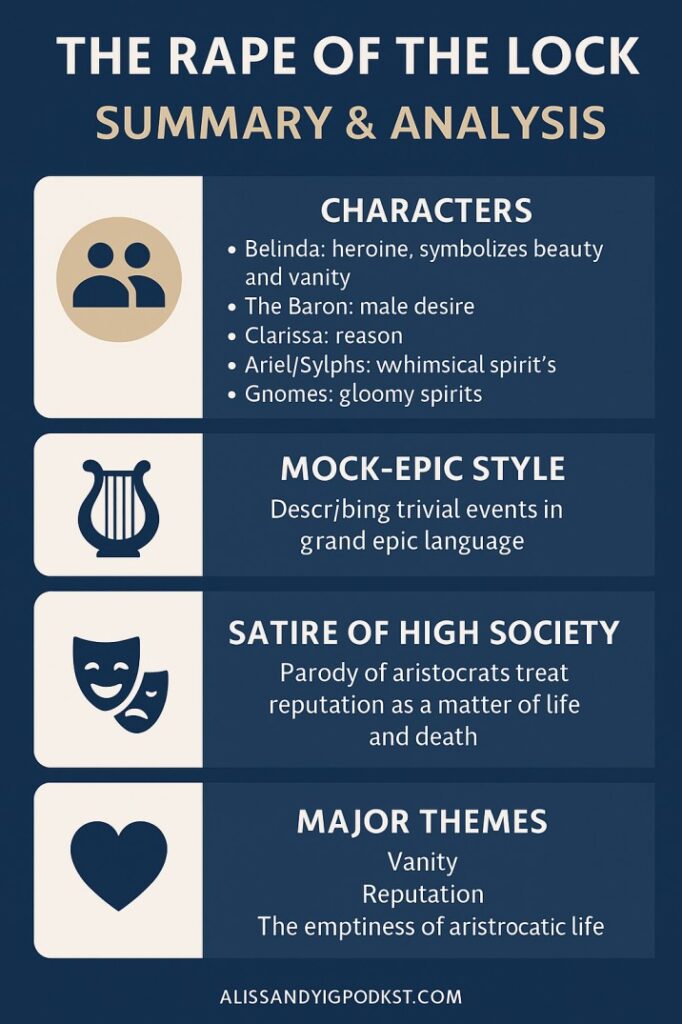
Characters
- Belinda → symbol of beauty and vanity
- Baron → symbolizes male desire and conquest
- Clarissa → voice of reason
- Ariel/Sylphs → protectors of vanity
- Gnomes → agents of gloom
Key Idea
Trivial event → described in epic style = satire.
Major Lines
- “Charms strike the sight…”
- “What mighty contests rise from trivial things!”
Conclusion — Why The Rape of the Lock Is Pope’s Masterpiece
Pope created a work that is:
- humorous yet profound
- playful yet moral
- miniature in story yet epic in execution
- specific to 18th-century society yet universal in message
It teaches that human vanity—whether in Belinda’s salon or today’s digital world—is timeless.
And through its wit, charm, and delicate satire, the poem remains one of the most brilliant examples of English poetry.
This blog was crafted to help students understand, analyze, and remember everything essential about the poem — ensuring top exam performance and deep appreciation.