
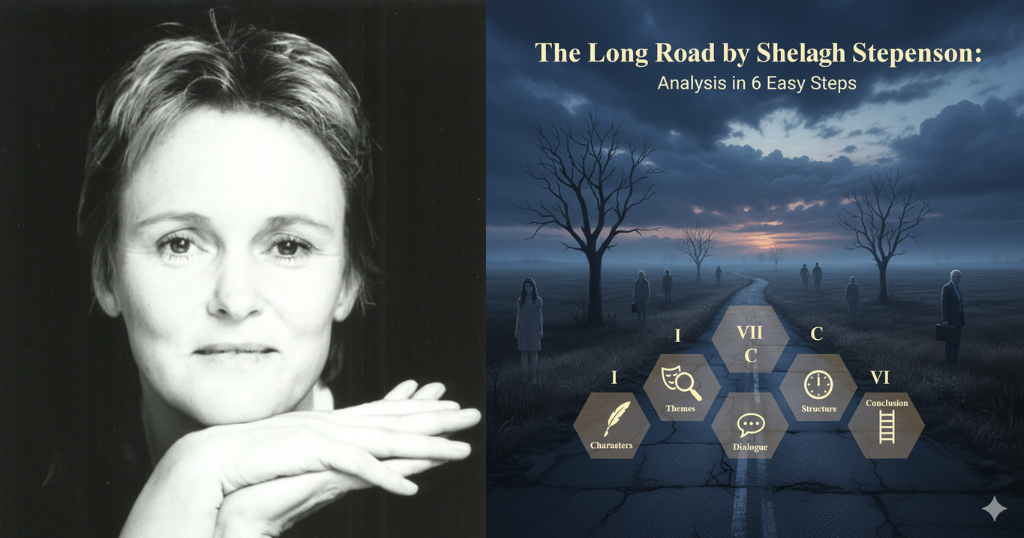
Understanding The Long Road by Shelagh Stephenson is like walking through a deeply emotional maze — one that explores grief, forgiveness, and the human cost of violence. It’s a play that doesn’t lecture but reveals. Written with raw empathy and psychological insight, this modern masterpiece helps us understand not just crime, but what happens after it — to the families, the offenders, and even to society.
Whether you’re preparing for an exam, interview, or literature discussion, this 6-step guide will help you understand the play in a way that stays with you long after reading it.
Step 1: Understanding the Writer — Shelagh Stephenson’s Psychological Lens
Shelagh Stephenson is one of Britain’s most acclaimed contemporary playwrights, known for weaving psychology, memory, and emotion into her narratives. Born in Northumberland in 1955, she studied drama at Manchester University and rose to prominence with plays like The Memory of Water (1996) and An Experiment with an Air Pump (1998).
Her writing style reflects a deep understanding of the human mind, often influenced by her background in psychology. Like Harold Pinter, she uses silence and subtext to communicate emotional tension. But unlike Pinter’s absurdist ambiguity, Stephenson focuses on clarity of emotion — she doesn’t confuse the audience; she confronts them.
The Long Road (2007) was commissioned by the Synergy Theatre Project, which works with prisoners and ex-offenders. It was inspired by true accounts of families affected by violent crime. Through this play, Stephenson explores what happens when two people on opposite sides of a tragedy — a mother who lost her son and the young man who killed him — are forced to meet.
Step 2: Plot Summary — A Journey from Rage to Redemption
At its heart, The Long Road is not about the crime itself but about the aftershock it leaves behind.
The play begins with Elizabeth, a mother whose teenage son, Danny, was stabbed to death in a random act of violence. The family — Elizabeth, her husband Mike, and sons Joe and Dan — struggle to cope with the void left by the tragedy. Their grief manifests in different ways: Elizabeth becomes obsessed with the idea of confronting her son’s killer, Mike retreats into silence, and Joe turns inward, trying to hold the fragments together.
The turning point comes when Elizabeth decides to meet Emma, the young woman responsible for Danny’s death. Instead of hatred, she finds confusion, remorse, and vulnerability. The encounter forces Elizabeth to confront her own assumptions about justice, forgiveness, and humanity.
By the end, the “long road” is not one of revenge, but of healing — an acknowledgment that pain can transform, and forgiveness, while difficult, is the only true escape from perpetual suffering.
Step 3: Themes and Motifs — The Human Core of the Play
Stephenson’s brilliance lies in her ability to make a social issue feel personal. Each theme in The Long Road interlocks with another, creating a multidimensional view of grief and moral struggle.
1. Grief and Healing
Elizabeth’s grief is raw and consuming. Like a modern Niobe from Greek mythology, she is frozen in sorrow. The play explores how grief doesn’t disappear but changes shape — from rage to understanding. In many ways, her journey mirrors that of King Lear, who learns humanity through suffering.
2. Justice vs. Forgiveness
Stephenson questions the idea of justice as punishment. Is true justice achieved when someone is jailed, or when both sides begin to heal? The meeting between Elizabeth and Emma is symbolic — echoing real-life restorative justice programs in Britain. This idea contrasts starkly with older revenge-based literature, such as Hamlet, where vengeance is glorified. Here, forgiveness becomes the higher moral victory.
3. Family and Emotional Distance
Grief affects everyone differently. Mike, Elizabeth’s husband, becomes emotionally unavailable. Their surviving sons are lost between anger and numbness. This mirrors the post-war disconnection often found in T.S. Eliot’s works, where people share space but not emotions. Stephenson’s domestic setting becomes a microcosm for how trauma fractures communication.
4. Memory and Guilt
Elizabeth’s memories of Danny haunt her. She replays moments like scenes in a broken film reel. Stephenson often uses fragmented dialogues to show how memory interferes with the present. This is similar to Virginia Woolf’s narrative style in Mrs. Dalloway, where consciousness itself becomes a battlefield between memory and time.
5. Hope and Redemption
Despite its darkness, the play ends on a note of hope. The title itself — The Long Road — implies that healing isn’t instant. It’s a journey. Like in Seamus Heaney’s poetry, where wounds become metaphors for rebirth, Stephenson suggests that pain, when faced bravely, can become a bridge to empathy.
Step 4: Character Analysis — Layers of Emotion
Elizabeth
The emotional nucleus of the play. She is torn between wanting to destroy Emma and wanting to understand her. Her confrontation scene with Emma is a masterclass in emotional writing — the silence, the hesitation, the breakdown. Elizabeth embodies both anger and compassion, a paradox that makes her human.
Mike
Represents stoic suffering. His silence contrasts Elizabeth’s emotional volatility. Stephenson subtly criticizes how society expects men to be emotionally distant, a theme also explored by Arthur Miller in Death of a Salesman. Mike’s detachment is not strength; it’s paralysis.
Emma
The most complex figure in the play. She’s not portrayed as a villain but as a flawed, frightened human being who made a devastating mistake. Stephenson’s choice to humanize Emma rather than demonize her is what makes this play revolutionary. It reflects her deep psychological insight and moral courage as a writer.
Joe
The surviving son serves as the emotional glue. He tries to mediate, to bring everyone back from the edge. In many ways, he represents the future — the possibility of breaking cycles of trauma.
Step 5: Symbolism and Language — The Subtle Craft of Stephenson
Stephenson’s dialogue is deceptively simple — yet loaded with meaning. Every pause, repetition, and unfinished sentence reflects the characters’ inability to articulate grief.
Symbolism:
- The Road: The “long road” is a metaphor for emotional recovery — it’s not straight, it’s winding and painful.
- Silence: Represents both avoidance and reflection. In moments of silence, the characters say the most without words.
- Letters and Memories: When Elizabeth recalls Danny’s childhood, those flashbacks serve as both comfort and torment — much like how Emily Dickinson used letters to preserve memory and emotion simultaneously.
Language:
Stephenson balances realism with poetic rhythm. Her use of short, fractured lines mimics real conversation. Unlike Shakespeare’s heightened verse or Tennyson’s lyrical flow, Stephenson’s language feels authentic and immediate, capturing how real people speak when they’re broken.
Step 6: Context and Comparison — From Ancient Tragedy to Modern Realism
To truly appreciate The Long Road, one must see it as part of a larger literary conversation about crime, guilt, and redemption.
- In Greek tragedies like Oedipus Rex, justice is divine and unavoidable. The gods decide fate.
- In Shakespeare’s tragedies, justice becomes personal — characters like Hamlet or Macbeth take it into their own hands.
- In modern literature, as seen in Stephenson’s work, justice becomes psychological. It’s about understanding, not punishing.
Stephenson’s humane approach aligns her with modern playwrights such as David Hare and Caryl Churchill, who also explore moral complexity in contemporary settings. Yet, her emotional intimacy and family-centered lens make her style uniquely powerful.
Conclusion: Why The Long Road Still Matters
The Long Road isn’t just a play — it’s a moral experiment. It asks, “What if we could talk instead of hate? What if forgiveness was justice?”
In a world obsessed with revenge and punishment, Stephenson’s work feels radical and deeply necessary.
By dissecting grief without sensationalism, she reminds us that even the darkest roads can lead to light. For students and readers, The Long Road offers not just literary brilliance but emotional wisdom. It teaches empathy — something that’s as vital in literature as it is in life.
Summary Table: 6 Steps to Remember
| Step | Focus | Key Takeaway |
|---|---|---|
| 1 | Writer Background | Stephenson blends psychology with realism. |
| 2 | Plot Summary | A mother’s journey from rage to forgiveness. |
| 3 | Themes | Grief, justice, family, hope. |
| 4 | Character Analysis | Deeply layered human portrayals. |
| 5 | Symbolism & Language | Simple words, profound emotion. |
| 6 | Context | Modern realism meets ancient moral themes. |

Final Thought
Shelagh Stephenson once said in an interview, “Forgiveness doesn’t excuse what happened, but it allows you to move on.”
That’s what The Long Road teaches — to keep walking, even when the road feels endless.
Also read: 10 Best Poems About Rain in the History of Literature