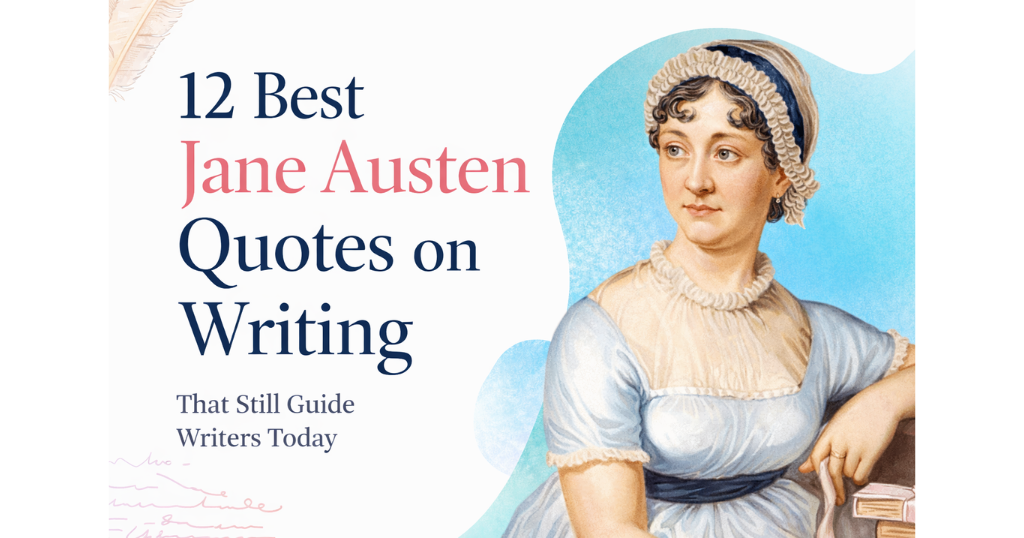
Why Jane Austen Still Teaches Writers How to Write
Jane Austen never wrote writing manuals. She never gave lectures on craft. And yet, two centuries later, writers across the world still turn to her words for guidance on voice, discipline, observation, character, and truth.
Austen wrote quietly, often anonymously, in a time when women writers were rarely taken seriously. She revised obsessively, trusted her instincts, and built entire worlds out of drawing rooms, glances, silences, and social rules. Her novels endure not because they are ornate, but because they are precise.
Scattered across her novels and personal letters are lines that reveal how she understood writing itself—its discipline, its joy, and its responsibility. This blog gathers 12 of the best Jane Austen quotes about writing (and the writer’s mind) and explains how each can sharpen your craft today.
1. “I am not at all in a humor for writing; I must write on until I am.”
Why this matters to writers
This is one of the most honest lines ever written about the writing process. Austen demolishes the myth of waiting for inspiration.
What Austen teaches here:
- Writing creates mood; mood does not create writing
- Discipline comes before motivation
- Momentum is built by starting, not waiting
For writers struggling with procrastination, this line is a quiet command: sit down and begin.
2. “I cannot determine what to do about my new novel… I have no fault to find with it.”
Why this matters to writers
This line captures a rare but important moment: learning to trust your own judgment.
What Austen teaches here:
- Self-doubt is natural, but endless self-distrust is damaging
- Revision is important, but so is knowing when to stop
- Confidence grows from craft, not praise
Great writers know when a work is finished—even if the world hasn’t seen it yet.
3. “One does not love a place the less for having suffered in it, unless all the suffering, nothing but the suffering.”
Why this matters to writing
Though not explicitly about writing, this quote is deeply about emotional truth, which is the core of great storytelling.
What Austen teaches here:
- Pain deepens attachment, not weakens it
- Characters become real through struggle
- Avoid writing suffering without meaning
Writers should not protect characters from discomfort—growth lives there.
4. “I always deserve the best treatment because I never put up with any other.”
Why this matters to writers
This is about standards, not ego.
What Austen teaches here:
- Respect your craft enough to revise properly
- Don’t settle for lazy language or vague scenes
- Good writing demands self-respect
Austen’s prose is sharp because she refused to accept mediocrity—from herself first.
5. “There is no charm equal to tenderness of heart.”
Why this matters to writing
This line explains why Austen’s characters endure.
What Austen teaches here:
- Wit without empathy becomes cruelty
- Intelligence must be balanced with compassion
- Readers connect to emotional honesty, not cleverness alone
For writers, this is a reminder that heart matters more than brilliance.
6. “Pictures of perfection make me sick and wicked.”
Why this matters to writers
Austen openly rejects idealized characters.
What Austen teaches here:
- Flaws make characters believable
- Perfection kills narrative tension
- Readers trust imperfection
Elizabeth Bennet, Emma Woodhouse, and Anne Elliot endure because they are unfinished.
7. “If a book is well written, I always find it too short.”
Why this matters to writers
This line reveals Austen’s understanding of reader engagement.
What Austen teaches here:
- Quality makes readers want more
- Pacing matters more than length
- Engagement is the true measure of success
A well-written book leaves the reader longing, not relieved.

8. “What should be done with a young woman who neither sings nor dances nor draws?”
Why this matters to writing
This satirical question exposes societal expectations, a central theme in Austen’s work.
What Austen teaches here:
- Writing should observe society critically
- Satire is most effective when subtle
- Question norms rather than preaching
Austen writes around social rules, letting irony do the work.
9. “Vanity and pride are different things, though the words are often used synonymously.”
Why this matters to writers
This is a masterclass in character psychology.
What Austen teaches here:
- Precise language creates psychological depth
- Small distinctions define great characters
- Good writing notices what others overlook
This single line explains the emotional core of Pride and Prejudice.
10. “A mind lively and at ease can do with seeing nothing, and can see nothing that does not answer.”
Why this matters to writing
This quote is about selective observation.
What Austen teaches here:
- Writers don’t record everything—they choose
- Perspective shapes reality on the page
- Character viewpoint determines meaning
Writing is not about more detail, but the right detail.
11. “Silly things do cease to be silly if they are done by sensible people in an impudent way.”
Why this matters to writing
Austen understood tone better than most writers.
What Austen teaches here:
- Voice can redeem simple material
- Confidence transforms trivial moments
- Style gives meaning to content
This is why her quiet scenes feel electric.
12. “I hate to hear you talk about all women as if they were fine ladies instead of rational creatures.”
Why this matters to writing
This line reflects Austen’s commitment to intelligent characterization.
What Austen teaches here:
- Write characters as thinkers, not types
- Respect the inner lives of your characters
- Intelligence makes dialogue sharper and truer
Austen’s women endure because they think, not because they charm.
Why Jane Austen Is Still a Writing Teacher Without Trying
Jane Austen teaches writers because she:
- Trusted discipline over inspiration
- Observed human behavior with precision
- Valued clarity over ornament
- Believed intelligence and empathy must coexist
Her guidance doesn’t come as rules—but as truths hidden in sentences.
Conclusion: Writing Advice That Ages Better Than Advice
Trends change. Platforms change. Genres shift. But the principles Jane Austen lived by—clarity, discipline, observation, emotional honesty—remain unchanged.
For writers today, these quotes are not decorative wisdom. They are practical tools, reminding us that good writing is not loud, rushed, or indulgent. It is thoughtful, exact, and deeply human.
Two hundred years later, Jane Austen still teaches us how to write—not by instruction, but by example.
Also read: Contribution of Women to Literature