
In the realm of literary criticism, few essays have been as provocative and enduring as Aldous Huxley’s “Tragedy and the Whole Truth.” Published in 1931 as part of his collection Music at Night, this piece challenges the very foundation of how we perceive “Great Literature.”
For students and researchers, understanding Huxley’s argument is like being given a new pair of glasses; suddenly, you see why a Shakespearean play feels different from a modern novel, and why some stories feel “too perfect” to be true. This blog provides a comprehensive, easy-to-digest analysis of Huxley’s masterpiece.
1. About the Author: The Polymath Aldous Huxley
To understand the essay, you must understand the man. Aldous Huxley (1894–1963) was an intellectual titan of the 20th century. Born into a family of world-renowned scientists and writers, he spent his life exploring the tension between the “scientific” view of the world and the “artistic” view.
- The Visionary: Most famous for his dystopian novel Brave New World, Huxley was obsessed with how humans perceive reality.
- The Critic: He didn’t just write fiction; he was a brilliant essayist. In “Tragedy and the Whole Truth” (1931), he acts as a “literary scientist,” dissecting why certain stories feel more “real” than others.
- His Importance: Huxley is vital because he challenged the “Gods” of literature (like Sophocles and Racine). He argued that their “Great Tragedies” were actually incomplete because they ignored the messy, physical reality of being human.
2. Wholesome Summary: The “Easy-Language” Breakdown
If you only have two minutes to understand this essay, here is the “Whole Truth” in simple terms:
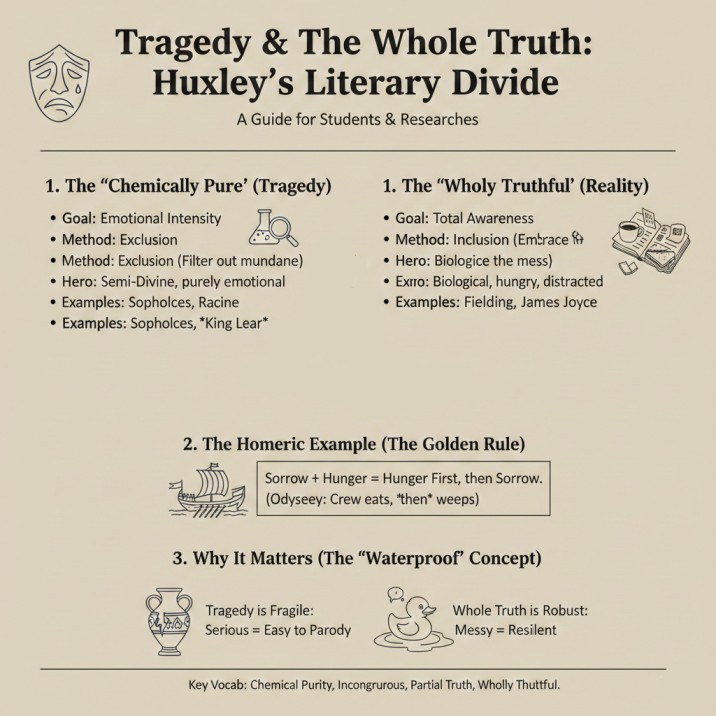
Imagine you are watching a movie where a hero is crying over a lost love. In a Tragedy, the camera stays on his face, the music is sad, and he looks perfect in his grief. Huxley calls this “Chemically Pure” art. It’s like a lab experiment where everything except the sadness has been filtered out.
However, in Real Life (The Whole Truth), while that hero is crying, he might also feel a bit hungry. He might have an itch on his nose he needs to scratch, or he might notice a fly buzzing around the room.
Huxley’s main point is that Tragedy and the Whole Truth cannot live together. If the hero scratches his nose or eats a sandwich, the “Tragic” feeling is ruined. He says that writers like Homer are “Wholly-Truthful” because they include the snacks, the naps, and the bored moments alongside the epic battles. He concludes that while Tragedy is beautiful, it is a “refined” lie—the “Whole Truth” is much bigger and more interesting.
3. The Central Premise: Chemical Purity vs. The Whole Truth
Huxley uses a fascinating scientific metaphor here. He compares literature to chemistry.
Chemical Purity
In a laboratory, scientists create pure substances by removing all “contaminants.” Huxley says Tragedy does the same. It is a “pure” representation of human suffering. To keep it pure, the author must remove:
- Physical needs (hunger, sleep).
- Irrelevant thoughts.
- Humor or “low” behavior.
The Whole Truth
This is literature that is “unrefined.” It contains all the “contaminants” of life. It acknowledges that man is not just a soul or a mind, but a body that demands attention even during a crisis.
4. The Famous “Odyssey” Analysis
This is the heart of the essay and a favorite for examiners. Huxley points to a specific scene in Homer’s Odyssey.
The Scene: Odysseus’s crew has just watched six of their friends get eaten alive by the monster Scylla. They escape to an island.
The Reaction: Do they fall to their knees and weep for hours? No. Homer writes that they cook dinner first. They eat, they drink, and then, once their stomachs are full, they begin to cry.
“Homer’s liberty to tell the Whole Truth,” Huxley writes, “is the secret of his power.”
Huxley argues that because they ate first, their grief feels more real to us. It shows they are human beings, not just “characters” in a play.
5. Why Tragedy is “Partial” (The Contrast)
Huxley contrasts Homer with “Pure Tragedians” like Sophocles (Ancient Greek) or Racine (17th Century French).
In a Racine play, if a character is grieving, they stay in that state of “pure grief” until the curtain falls. Huxley argues this is Partial Art. It only tells half the story. It ignores the “incongruous” (things that don’t fit).
The Comparison Table
| Feature | Pure Tragedy (Sophocles/Racine) | The Whole Truth (Homer/Fielding/Joyce) |
| Focus | One intense emotion. | Multiple, conflicting realities. |
| Body | Ignored (No hunger/thirst). | Acknowledged (Characters eat/sleep). |
| Tone | Solemn and “High.” | Mixed (Serious and Mundane). |
| Effect | Catharsis (Emotional release). | Realism (Deep understanding). |
6. The “Incongruous” Element
The “Incongruous” is a key term in this essay. It refers to things that are out of place. Huxley notes that in a Tragedy, the “incongruous” is the enemy. A fart, a sneeze, or a craving for a beer would destroy the nobility of King Lear. But in Wholly-Truthful literature, the incongruous is essential because life itself is incongruous.
7. Why This Matters for Students and Researchers
When you are analyzing a text, ask yourself: “Is this writer telling the Whole Truth, or are they aiming for Chemical Purity?”
- Modernism: You will notice that modern writers (like James Joyce or Virginia Woolf) almost always aim for the Whole Truth. They want to show the “stream of consciousness,” which includes everything from deep philosophy to what someone wants for breakfast.
- The Survival of Art: Huxley suggests that “Wholly-Truthful” art is more “waterproof.” Because it already includes the ridiculous and the mundane, it is harder to make fun of. Tragedy, because it is so serious, can easily become “melodrama” if it isn’t perfect.
- Humanism: This essay is a plea for us to accept our “wholeness”—to realize that our physical selves and our emotional selves are inseparable.
8. Frequently Asked Questions (FAQs)
What does Huxley mean by “Chemical Purity” in literature?
It refers to literature (like Tragedy) that focuses on one single, intense emotion and purposefully leaves out any “normal” or “mundane” details that might distract from that feeling.
Why does Huxley think we can’t have a “Whole Truth” Tragedy?
Because Tragedy requires a very specific, serious “vibe.” The moment you introduce the “Whole Truth”—like a character feeling hungry or having an itchy foot—the seriousness is broken and the “Tragic” effect disappears.
Is “The Whole Truth” better than “Tragedy”?
Huxley doesn’t say one is “better,” but he suggests that the Whole Truth is more “resilient” and honest about the human condition, whereas Tragedy is a specialized, limited form of art.
Which authors represent “The Whole Truth” for Huxley?
He primarily points to Homer, but the concept also applies to writers like Fielding, Chaucer, and James Joyce, who include the “low” and “messy” parts of life in their stories.
This essay is a fundamental tool for any literary researcher. It teaches us that while the “pure” hero is inspiring, the “hungry” hero is the one who truly reflects our existence.
Also read: Red Rose in Poetry