
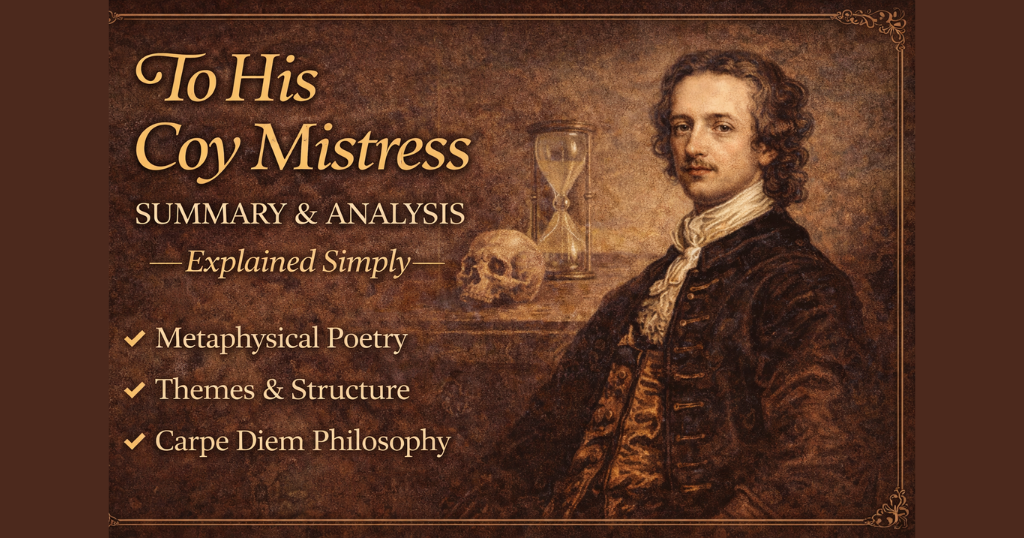
Introduction: Why To His Coy Mistress Is Still Studied Today
To His Coy Mistress is one of the most famous poems in English literature, written by Andrew Marvell, a leading Metaphysical poet of the 17th century. Though the poem is short, it carries extraordinary depth. It combines love, time, mortality, philosophy, wit, and urgency in a way that few poems manage.
At first reading, the poem may seem like a man trying to persuade a woman to love him. But beneath this surface lies a complex exploration of human life, the passage of time, death, and how people respond to their limited existence. That is why the poem is not only important for exams but also deeply relevant even today.
This blog explains To His Coy Mistress in a simple, structured, and memorable way, covering:
- The poet and his background
- The historical and literary context
- A clear summary of the poem
- Detailed analysis of each section
- Themes, imagery, and poetic devices
- Comparison with other Metaphysical poets
- Why the poem still matters
By the end, you will understand not just what the poem says, but why it says it and how it works.
About the Poet: Andrew Marvell (1621–1678)
Andrew Marvell was a Metaphysical poet, politician, and intellectual. Unlike poets who wrote purely for emotion or beauty, Marvell wrote poems that made readers think.
Marvell’s Literary Position
Marvell stands alongside:
- John Donne
- George Herbert
- Henry Vaughan
These poets are called Metaphysical because they:
- Use intellectual arguments
- Combine emotion with logic
- Employ striking metaphors (conceits)
- Explore love, religion, time, and death
Marvell’s poetry is known for its clarity, balance, and philosophical sharpness. To His Coy Mistress is his most famous poem and a perfect example of his style.
Literary and Historical Background
Metaphysical Poetry
Metaphysical poetry:
- Appeals to the mind as much as the heart
- Uses surprising comparisons
- Often sounds like a logical argument in verse
Unlike Romantic poetry (which focuses on emotion and nature), Metaphysical poetry focuses on thought, reasoning, and paradox.
Carpe Diem Tradition
The poem belongs to the Carpe Diem tradition, a Latin phrase meaning “seize the day.”
This tradition urges people to:
- Enjoy life while they can
- Act before time and death take everything away
Other poets who used this theme include:
- Robert Herrick (To the Virgins, to Make Much of Time)
- Shakespeare (several sonnets)
Marvell’s version, however, is darker, more intellectual, and more urgent.
Structure of the Poem
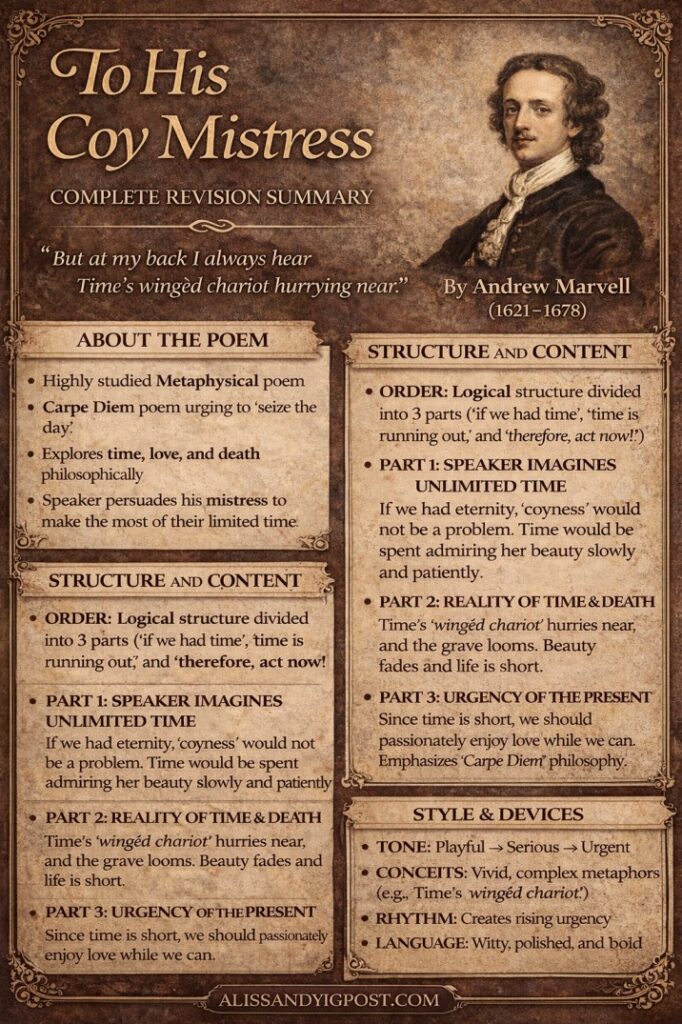
The poem is carefully structured into three logical sections, almost like a persuasive speech:
- If we had unlimited time
- But we don’t—time and death are approaching
- Therefore, we must act now
This logical progression makes the poem easy to analyze and remember.
Summary of To His Coy Mistress
(Explained Clearly)
Part 1: Imagining Unlimited Time
The speaker begins by imagining a world where time is endless. If they had infinite time, the speaker says, the woman’s shyness (coyness) would not be a problem.
He would:
- Spend centuries admiring each part of her beauty
- Wait thousands of years before expecting love
- Praise her slowly and patiently
This section sounds romantic, but it is deliberately exaggerated to show how unrealistic the idea is.
Part 2: Reality of Time and Death
Suddenly, the tone shifts. The speaker reminds the woman that time is moving fast.
He introduces frightening images:
- Time chasing them
- The grave waiting
- Worms consuming the body
- Silence after death
Love, beauty, and desire mean nothing once death arrives.
This is the most serious and philosophical part of the poem.
Part 3: Urgency of the Present Moment
In the final section, the speaker urges immediate action. Since time is short and death is certain, they should enjoy love now.
He suggests:
- Living intensely
- Embracing passion
- Making the most of the present moment
The poem ends with a powerful idea: humans cannot stop time, but they can make it meaningful.
Detailed Analysis of Each Section
Section 1: Love in an Imaginary World
This section uses:
- Hyperbole (exaggeration)
- Flattery
- Playful logic
The speaker’s argument is:
“If time were endless, your hesitation would be acceptable.”
But this world does not exist.
Marvell uses this fantasy to prepare the reader for the reality that follows.
Section 2: The Fear of Time and Death
This section is the emotional and philosophical heart of the poem.
Key ideas:
- Time is unstoppable
- Beauty fades
- The body decays
- Death brings silence
The imagery is deliberately harsh. Marvell wants to shock both the woman and the reader into awareness.
This is not just about romance—it is about human mortality.
Section 3: Choosing Life Over Delay
The final section is not gentle persuasion; it is urgent.
The speaker argues that:
- Since time cannot be stopped
- Humans must live fully while they can
This is the essence of Carpe Diem philosophy.
Themes of the Poem
1. Time
Time is portrayed as:
- Relentless
- Destructive
- Uncontrollable
The poem constantly reminds us that time governs human life.
2. Love and Desire
Love is presented not as eternal romance, but as something tied to the physical world, which is temporary.
3. Mortality
Death is unavoidable. Marvell does not soften this truth.
4. Carpe Diem (Seize the Day)
The central message: act now, because delay leads to loss.
Imagery and Poetic Devices
Metaphysical Conceits
Marvell compares abstract ideas like time and love to physical objects, making them vivid.
Alliteration and Rhythm
The poem’s rhythm creates urgency, especially in the final section.
Contrast
- Infinite time vs limited time
- Youth vs decay
- Desire vs death
Tone and Style
The tone shifts:
- Playful → Serious → Urgent
This progression mirrors the speaker’s argument and keeps the reader engaged.
Comparison with Other Poets
Marvell vs John Donne
Donne uses intense emotion and dramatic language.
Marvell is more controlled and logical.
Marvell vs Robert Herrick
Herrick’s Carpe Diem poems are gentle and celebratory.
Marvell’s are darker and philosophical.
Marvell vs Shakespeare
Shakespeare often promises poetic immortality.
Marvell offers no such comfort—only the present moment.
Why the Poem Is Important for Exams and Interviews
- It is a perfect example of Metaphysical poetry
- Shows Carpe Diem philosophy
- Rich in imagery and argument
- Easy to divide into sections
- Frequently asked in exams
Key Points for Quick Revision
- Poet: Andrew Marvell
- Genre: Metaphysical Poetry
- Theme: Time, love, death
- Structure: Logical argument in three parts
- Central idea: Make the most of the present moment
Why To His Coy Mistress Still Matters Today
Modern life is still shaped by:
- Deadlines
- Aging
- Regret
- Missed opportunities
Marvell’s poem speaks to anyone who has ever delayed living.
It reminds us that while we cannot defeat time, we can choose how we live within it.
Conclusion
To His Coy Mistress is not just a love poem—it is a philosophical reflection on human existence. Andrew Marvell blends wit, logic, emotion, and fear to create a poem that feels urgent even centuries later.
For students, understanding this poem means understanding:
- Metaphysical poetry
- Carpe Diem philosophy
- The human response to time and death
This blog is designed to give you that understanding clearly, deeply, and confidently—so whether it’s an exam, interview, or personal reading, the poem will stay with you.
FAQs on To His Coy Mistress
Q1. What is the main theme of To His Coy Mistress?
The main theme is time and mortality, emphasizing the urgency of love before life ends.
Q2. What is the message of the poem To His Coy Mistress?
The poem conveys the idea that since life is short, one should seize the present moment and live fully.
Q3. What is the symbolism in To His Coy Mistress?
Time symbolizes the inevitable passage toward death, while love represents temporary human pleasure.
Q4. What are the two rivers in To His Coy Mistress?
The two rivers are the Ganges and the Humber, symbolizing vast time and distance.
Q5. What is the irony in To His Coy Mistress?
The irony lies in presenting romantic persuasion through logical and even grim arguments about death.
Q6. What is the meaning of “carpe diem” in the poem?
“Carpe diem” means seize the day, urging immediate action before time and death intervene.
Also read: The Way of the World Summary and Analysis