Introduction: Why The Language of Paradox Is a Turning Point in Literary Criticism
The Language of Paradox is a landmark critical essay written by Cleanth Brooks, one of the most influential figures of New Criticism. The essay reshaped how poetry is read by challenging the belief that poems communicate meaning through clear, logical statements or moral lessons.
Brooks argues that poetry speaks through paradox, irony, and tension, and that attempting to simplify or paraphrase a poem destroys its meaning. This essay is essential for students because it explains how poetry works internally, not what it “says” externally.
This blog explains the essay in six clear steps, each focusing on a different layer of understanding, supported by key excerpts, examples, and critical perspectives.
About the Author: Cleanth Brooks (1906–1994)
Cleanth Brooks was an American literary critic, educator, and a founding figure of New Criticism, a movement that dominated literary studies in the mid-20th century.
He believed that:
- A poem is a self-contained structure
- Meaning lies in language and form
- External contexts like biography or history should not dominate interpretation
Major Works:
- The Well Wrought Urn
- Understanding Poetry (with Robert Penn Warren)
- Modern Poetry and the Tradition
Among these, The Language of Paradox stands as the theoretical core of his critical philosophy.
STEP 1: The Central Idea of The Language of Paradox
What Does Brooks Mean by “Paradox”?
Brooks opens the essay with his central claim:
“The language of poetry is the language of paradox.”
By paradox, Brooks means the ability of poetry to hold opposing ideas together without resolving them. He argues that reality itself is complex and contradictory, and poetry mirrors this complexity more truthfully than logical discourse.
📌 Key Point:
Poetry does not avoid contradiction—it depends on it.
STEP 2: Why Logical and Scientific Language Fails in Poetry
Brooks explains that different forms of language serve different purposes. Logical or scientific language seeks clarity and precision, while poetic language seeks experience and depth.
He writes that poetry resists “the temptation to simplify” because simplification distorts truth.
“Poetry is not the language of science or philosophy, but a language which cannot be translated without loss.”
📌 Key Point:
Poetry requires paradox because human emotions, values, and experiences are not logically neat.
STEP 3: How Paradox Creates Meaning in Poetry
In this step, Brooks shows that paradox is not decorative but structural. It is how meaning is formed.
Poems achieve unity by balancing opposing forces:
- Love and death
- Time and eternity
- Flesh and spirit
Brooks argues that tension, not harmony, creates poetic unity.
“The poem is a pattern of resolved stresses.”
📌 Key Point:
Meaning emerges from tension, not from resolution.
STEP 4: Use of Poetic Examples (Brooks’ Method of Close Reading)
Brooks supports his theory by closely analyzing poetry, especially metaphysical poets like John Donne.
In Donne’s poetry:
- Physical love becomes spiritual
- Sin coexists with faith
- Desire leads to transcendence
Brooks shows that Donne’s meaning collapses if paradox is removed.
“The poet attempts to unify experience which is itself discordant.”
📌 Key Point:
Paradox is deliberately crafted through imagery, metaphor, and structure.
STEP 5: The Heresy of Paraphrase
One of Brooks’ most famous ideas appears here: The Heresy of Paraphrase.
He argues that reducing a poem to a prose summary is a critical error because:
- Form and meaning are inseparable
- Language itself is the meaning
“The poem resists paraphrase because it is not a statement but a structure of meaning.”
📌 Key Point:
A poem does not contain meaning—it enacts meaning.
STEP 6: What Other Critics Say About The Language of Paradox
Support for Brooks
Supporters praise Brooks for:
- Restoring close reading
- Protecting poetry from oversimplification
- Teaching analytical discipline
Criticism of Brooks
Later critics argue that:
- Reader-response critics emphasize the reader’s role
- Marxist critics accuse Brooks of ignoring social context
- Post-structuralists question stable meaning
Despite criticism, Brooks remains foundational.
📌 Key Point:
Even critics who disagree with Brooks must engage with his ideas.
Why This Essay Is Crucial for Students
- Frequently asked in exams
- Explains New Criticism clearly
- Improves close-reading skills
- Helps answer analytical questions
- Sharpens understanding of poetic language
Quick Revision: Key Ideas to Remember
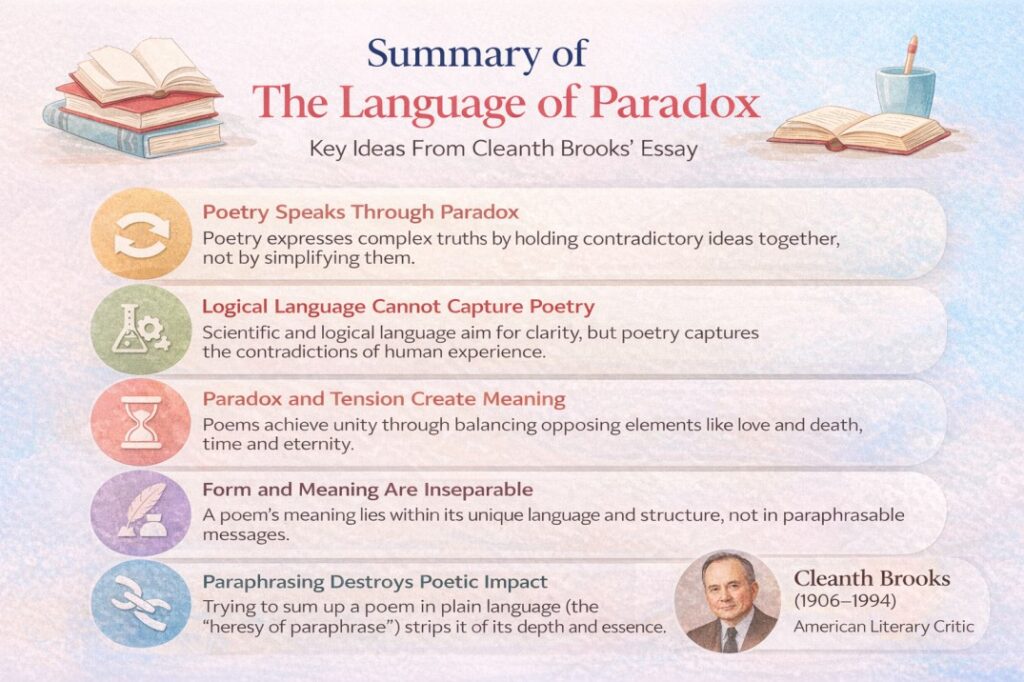
- Poetry speaks through paradox
- Logical language cannot capture human complexity
- Meaning lies within the text
- Paraphrase destroys poetic meaning
- Unity comes from tension
- Brooks is a New Critic
Conclusion: Why The Language of Paradox Still Endures
The Language of Paradox teaches us that poetry does not simplify life—it honors its contradictions. Cleanth Brooks shows that paradox is not confusion but clarity at a deeper level.
For students, understanding this essay means understanding:
- How poetry thinks
- Why language matters
- How close reading works
This step-wise structure ensures that once learned, the concept stays with you.
FAQs on The Language of Paradox
Who wrote The Language of Paradox?
Cleanth Brooks wrote the essay as part of his work on New Criticism. It later appeared in The Well Wrought Urn.
What is the main idea of the essay?
The essay argues that poetry expresses truth through paradox and tension. Logical simplification weakens poetic meaning.
Which critical movement does Brooks belong to?
Cleanth Brooks is a key figure of New Criticism. This movement focuses on close reading and textual analysis.
What is the Heresy of Paraphrase?
It is the belief that a poem’s meaning cannot be reduced to a prose summary. Meaning exists in the poem’s language and structure.
Why is paradox important in poetry?
Paradox allows poetry to express complex human experiences. It reflects emotional and moral contradictions.
Also read: To His Coy Mistress Summary and Analysis (In an Easy Way)