In the vast garden of world literature, no flower has been more heavily laden with meaning than the red rose. From the scorched sands of Persian deserts to the misty highlands of Scotland, and the imperial courts of China to the modern urban landscapes of today, the red rose has served as the ultimate shorthand for human emotion.
As a literary expert who has spent years tracing the evolution of botanical metaphors, I invite you on a journey through 20 of the most iconic poems that define the red rose. This is not just a list; it is a map of the human heart across centuries.
1. “A Red, Red Rose” – Robert Burns (1794)
The Verse:
“O my Luve’s like a red, red rose, That’s newly sprung in June: O my Luve’s like the melodie, That’s sweetly play’d in tune. As fair art thou, my bonnie lass, So deep in luve am I; And I will luve thee still, my dear, Till a’ the seas gang dry.”
– Robert Burns
Analysis: Burns uses the “newly sprung” rose to signify the peak of vitality. It isn’t just a flower; it’s a sensory experience of sight and sound. By promising to love until the seas dry up, he elevates the fragile rose to a symbol of eternal devotion.
2. “The Sick Rose” – William Blake (1794)
The Verse:
“O Rose thou art sick. The invisible worm, That flies in the night In the howling storm: Has found out thy bed Of crimson joy: And his dark secret love Does thy life destroy.”
– William Blake
Analysis: Blake’s “crimson joy” is one of the most famous descriptions of a red rose. Here, the rose is a metaphor for a soul or a relationship being eaten away by shame and hidden desires. It is a haunting look at the darker side of passion.
3. “The Rose of the World” – W.B. Yeats (1893)
The Verse:
“Who dreamed that beauty passes like a dream? For these red lips, with all their mournful pride, Mournful that no new wonder may betide, Troy passed away in one high funeral gleam, And Usna’s children died. Bow down, archangels, in your dim abode: Before you were, or any hearts to beat, Weary and kind one lingered by His seat;”
– W.B. Yeats
Analysis: Yeats connects the “red lips” of the beloved to the red rose of history. He suggests that beauty is a divine, ancient force. The red rose here is “mournful,” burdened by the weight of all the empires that have fallen in its name.
4. “Gulon Mein Rang Bhare” – Faiz Ahmed Faiz (1954)
The Verse:
“Gulon mein rang bhare baad-e-naubahaar chale, Chale bhi aao ki gulshan ka kaarobaar chale. Qafas udaas hai yaaro saba se kuch to kaho, Kaheen to bahr-e-khuda aaj zikr-e-yaar chale.” (Let the roses be filled with color, let the spring breeze blow, Come, so the business of the garden may begin. The cage is despondent, friends, say something to the breeze, For God’s sake, let the mention of the Beloved begin today.)
– Faiz Ahmed Faiz
Analysis: Written while Faiz was in prison, the “red rose” represents hope and the return of life. The “business of the garden” is a metaphor for social and emotional restoration. It is the most celebrated Urdu poem involving botanical imagery.
5. “Sonnet 54” – William Shakespeare (1609)
The Verse:
“The rose looks fair, but fairer we it deem For that sweet odour which doth in it live. The canker-blooms have full as deep a dye As the perfumed tincture of the roses, Hang on such thorns and play as wantonly When summer’s breath their masked buds discloses: But, for their virtue only is their show, They live unwoo’d and unrespected fade;”
– William Shakespeare
Analysis: The Bard distinguishes between the “canker-bloom” (wild roses with no scent) and the true Red Rose. He argues that the red rose’s “virtue” is its scent, which represents the soul’s truth, surviving even after the petals wither.
6. “One Perfect Rose” – Dorothy Parker (1926)
The Verse:
“A single flow’r he sent me, since we met. All tenderly his messenger he chose; Deep-hearted, pure, with scented dew still wet — One perfect rose. I knew the language of the floweret; ‘My fragile leaves,’ it said, ‘his heart enclose.’ Love long has taken for his amulet One perfect rose.”
– Dorothy Parker
Analysis: Parker begins with a traditional, almost reverent tone toward the rose as an “amulet” of love. She perfectly sets up the reader for her famous punchline (the limousine), making this the ultimate poem about the commercialization of romance.
7. “Go, Lovely Rose” – Edmund Waller (1645)
The Verse:
“Go, lovely Rose! Tell her that wastes her time and me, That now she knows, When I resemble her to thee, How sweet and fair she seems to be. Tell her that’s young, And shuns to have her graces spied, That hadst thou sprung In deserts where no men abide, Thou must have uncommended died.”
– Edmund Waller
Analysis:Waller uses the rose as a messenger. He warns his lady that beauty is useless if it is not seen and appreciated. The red rose here is a ticking clock, urging the beloved to “seize the day.”
8. “The Rubaiyat” – Omar Khayyam (11th Century)
The Verse:
“I sometimes think that never blows so red The Rose as where some buried Caesar bled; That every Hyacinth the Garden wears Dropt in her Lap from some once lovely Head. And this reviving Herb whose tender Green Fledges the River-Lip on which we lean — Ah, lean upon it lightly! for who knows From what once lovely Lip it springs unseen!”
– Omar Khayyam
Analysis: In Persian literature, the red rose is often the transmuted blood of kings. Khayyam uses this to show the interconnectedness of life and death. The “redness” of the rose is a reminder of the life-force that once belonged to someone else.
9. “A White Rose” – John Boyle O’Reilly (1880)
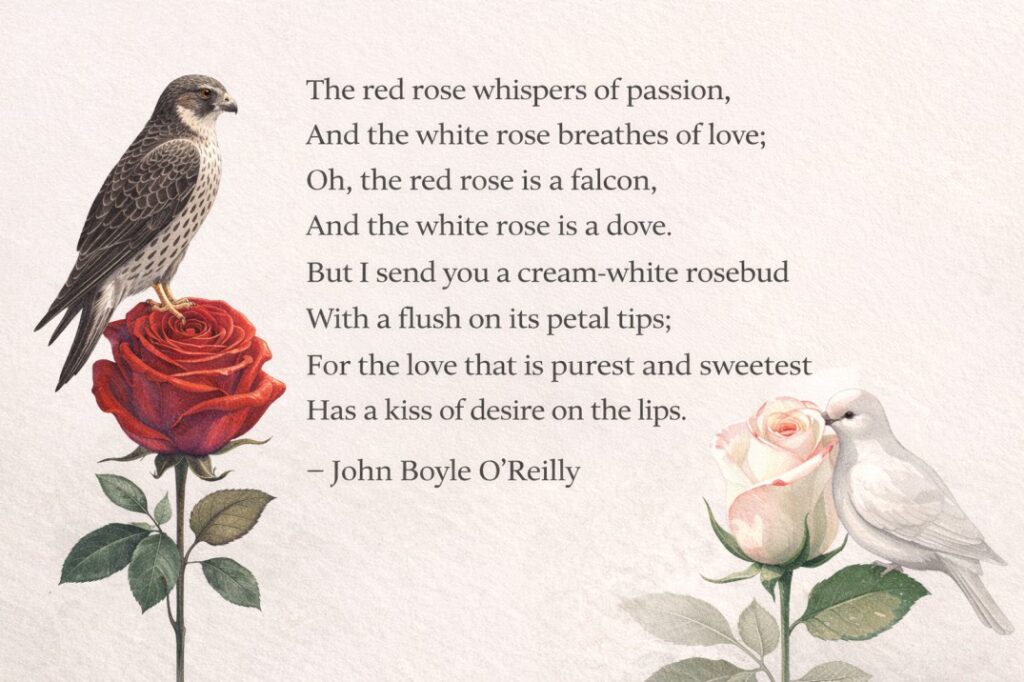
The Verse:
Analysis: O’Reilly creates a brilliant dichotomy. The red rose is a “falcon”—sharp, aggressive, and wild. This poem is a masterclass in using color to define the “temperature” of an emotion.
10. “The Nightingale and the Rose” – Oscar Wilde (1888)
The Passage (Poetic Prose):
“‘She said that she would dance with me if I brought her red roses,’ cried the young Student; ‘but in all my garden there is no red rose.’ From her nest in the holm-oak tree the Nightingale heard him… ‘Here is a weapon,’ she cried, ‘to conquer the world.’ So the Nightingale pressed closer against the thorn, and the thorn touched her heart, and a fierce pang of pain shot through her. Bitter, bitter was the pain, and wilder and wilder grew her song, for she sang of the Love that is perfected by Death, of the Love that dies not in the tomb.”
– Oscar Wilde
Analysis: While technically prose, Wilde’s language is intensely poetic. The “red rose” in this story is literally made of blood. It represents the ultimate romantic ideal—sacrificial, painful, and dangerously beautiful.
11. “Drinking Alone by Moonlight” – Li Bai (701–762)
The Verse:
“Among the flowers, a winepot, I drink alone, for no friend is near. Raising my cup, I beckon the bright moon, For he, with my shadow, will make three. The roses blush to see such a lonely guest, They spill their crimson wine upon the grass, While the moon knows nothing of drinking, And my shadow only follows my body.”
– Li Bai
Analysis: The “blush” of the roses is Li Bai’s way of animating nature. The red rose is a silent companion to the lonely poet, offering its color as a substitute for the wine of human friendship.
12. “A Rose is a Rose” – Robert Frost (1928)
The Verse:
“The rose is a rose, And was always a rose. But the theory now goes That the apple’s a rose, And the pear is, and so’s The plum, I suppose. The dear only knows What will next be a rose. You, of course, are a rose — But were always a rose.”
– Robert Frost
Analysis: Frost plays with the scientific fact that apples and plums are part of the Rosaceae family. He uses this “history of the rose” to tell his subject that they don’t need a label—they have always been beautiful.
13. “The Rose of Bakavali” – Gulzar (Modern)
The Verse:
“Surkh gulab ki patti patti, Yaad teri bikhri hai jaise. Ek naya zakhm khula hai dil mein, Phool koi khila hai jaise.” (Every petal of the red rose, Is like your scattered memories. A new wound has opened in the heart, Just as a flower has bloomed.)
– Gulzar
Analysis: Gulzar, the modern maestro, compares the blooming of a red rose to the opening of a wound. This “bittersweet” symbolism is a staple of South Asian literature, where love and pain are two sides of the same petal.
14. “The Rose of Battle” – W.B. Yeats (1892)
The Verse:
“Rose of all Roses, Rose of all the World! You, too, have come where the dim tides are hurled Upon the wharves of sorrow, and can roam With the salt ships of men and find no home. Vain for the world of passions is the rhyme Which told how once the moon of ancient time Was lulled to sleep by some old ballad’s sound.”
– W.B. Yeats
Analysis: Here, the “Rose of all Roses” is a symbol of the weary, suffering soul of humanity. It is a “Red Rose” that has seen battle and sorrow, representing resilience in the face of the “dim tides” of life.
15. “Sonnet 130” – William Shakespeare
The Verse:
“I have seen roses damasked, red and white, But no such roses see I in her cheeks; And in some perfumes is there more delight Than in the breath that from my mistress reeks. I love to hear her speak, yet well I know That music hath a far more pleasing sound; I grant I never saw a goddess go; My mistress, when she walks, treads on the ground.”
– William Shakespeare
Analysis: This is the most famous “anti-rose” poem. By rejecting the cliché of “rose-red cheeks,” Shakespeare makes a profound statement about real love. The red rose is a standard of perfection that no human can meet—and that’s okay.
16. “To the Virgins, to Make Much of Time” – Robert Herrick (1648)
The Verse:
“Gather ye rosebuds while ye may, Old Time is still a-flying; And this same flower that smiles today Tomorrow will be dying. The glorious lamp of heaven, the sun, The higher he’s a-getting, The sooner will his race be run, And nearer he’s to setting.”
– Robert Herrick
Analysis: While he says “rosebuds,” the context of the era always implied the red rose of passion. This is the ultimate “Carpe Diem” poem, using the rose’s lifecycle to represent human mortality.
17. “The Rhodora” – Ralph Waldo Emerson (1834)
The Verse:
“Rhodora! if the sages ask thee why This charm is wasted on the earth and sky, Tell them, dear, that if eyes were made for seeing, Then Beauty is its own excuse for being: Why thou wert there, O rival of the rose! I never stopped to ask, I never knew: But, in my simple ignorance, suppose The self-same Power that brought me there brought you.”
– Ralph Waldo Emerson
Analysis:Emerson introduces the Rhodora as the “rival of the rose.” In this classic of American literature, the red/purple flower serves to prove a spiritual point: beauty doesn’t need a “purpose” or a “utility” to justify its existence. It exists because the universe intended it to. It is a humble, spiritual take on the rose’s grandeur, suggesting that the same divine force that created the poet also created the bloom.
18. “A Red Rose” – Ghalib (19th Century)
The Verse:
“Poochhte hain woh ki Ghalib kaun hai, Koi batlao ki hum batlayein kya? Gul-e-surkh mein rang-e-vafaa hai, Magar is sheher mein hum saayein kya?” (They ask, “Who is Ghalib?” Someone tell them, what should I say? The red rose contains the color of loyalty, But in this city, what should I seek?)
– Ghalib
Analysis: Ghalib uses “Gul-e-surkh” (the red rose) as a symbol of loyalty (vafaa). He laments that while the rose holds this virtue, the world around him does not.
19. “Little Gidding” – T.S. Eliot (1942)
The Verse:
“All manner of thing shall be well When the tongues of flames are in-folded Into the crowned knot of fire And the fire and the rose are one.”
– T.S. Eliot
Analysis: This is the spiritual peak of rose poetry. The “Red Rose” here is the symbol of Divine Love and Paradise. The union of fire (suffering) and the rose (beauty) signifies the end of the human journey.
20. “The Lady of Shalott” – Alfred, Lord Tennyson (1832)
The Verse:
“She threw the helmet and the plume, She look’d down to Camelot. Out flew the web and floated wide; The mirror crack’d from side to side; ‘The curse is come upon me,’ cried The Lady of Shalott.” (Context: The “red-cross knight” Sir Lancelot is often associated with the Red Rose of the shield.)
– Alfred, Lord Tennyson
Analysis: While the rose is often a physical flower, in Arthurian poetry like Tennyson’s, the “Red Rose” is the emblem of the Knight. It represents the “outside world” of passion that eventually destroys the Lady’s secluded innocence.
Frequently Asked Questions (FAQs)
Which poet first used the red rose as a symbol of love? While the Greeks (Sappho) used it early on, Robert Burns is credited with making the “Red Rose” the global standard for romantic comparison in the 18th century.
What is the “invisible worm” in William Blake’s rose poem? The worm represents corruption, jealousy, or a literal parasite that destroys beauty from within, suggesting that even the most beautiful things have a hidden vulnerability.
How does Persian poetry differ in its use of the rose? In Persian (and Urdu) poetry, the rose is often paired with the Nightingale (Bulbul). The rose represents the silent, sometimes indifferent Beloved, while the Nightingale represents the yearning poet.
Why does Gertrude Stein say “Rose is a rose is a rose”? Stein wanted to break the “symbolism” of the rose. By repeating the word, she forces the reader to think about the actual flower rather than the romantic baggage the word usually carries.
Every artwork has value it can be low or high, but it deserves protection against theft. Copyrighting provides appropriate ownership to your creations as an…