
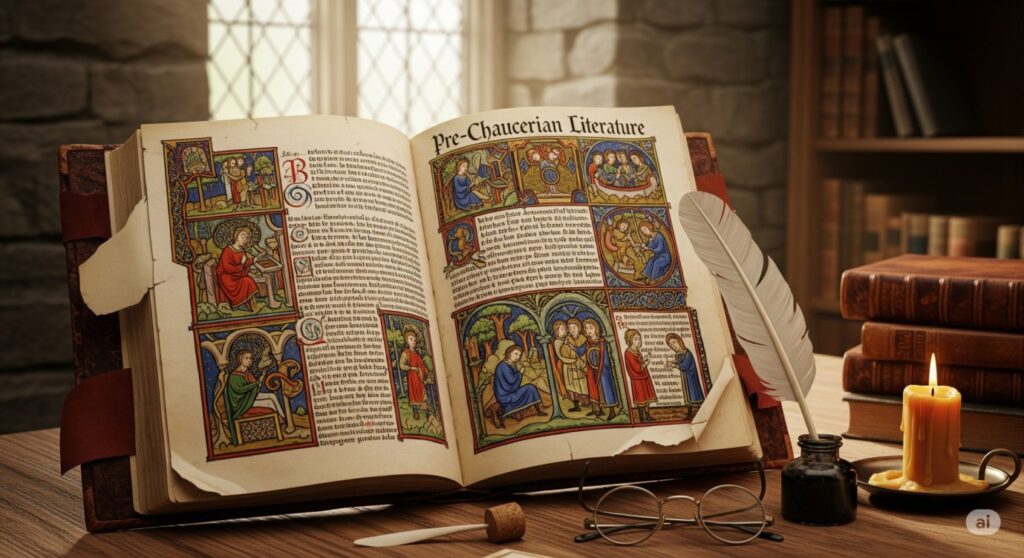
Pre-Chaucerian literature refers to the rich body of English literary works produced before the time of Geoffrey Chaucer (1343–1400), often considered the father of English poetry. This early phase of English literature spans roughly from the Anglo-Saxon period (circa 450 AD) to the early 14th century, just before Chaucer’s works revolutionized the English literary landscape.
Although much of Pre-Chaucerian literature may appear distant to the modern reader, it laid the foundation for English literary traditions, shaping themes, styles, and forms that still resonate today. In this article, we will explore eight unique features of Pre-Chaucerian literature that make it both fascinating and historically significant.
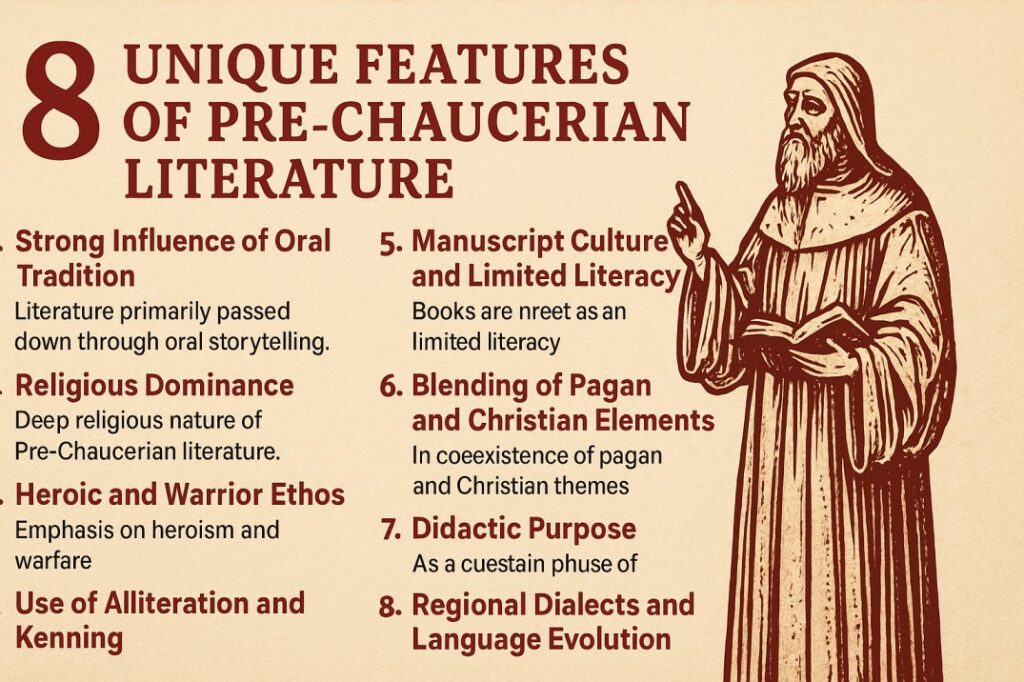
1. Strong Influence of Oral Tradition in Pre-Chaucerian Literature
Before the advent of widespread literacy, oral tradition was the primary means of preserving and transmitting literature. Poems, songs, and stories were passed down verbally by scops (Anglo-Saxon poets) and bards. Works like Beowulf (anonymous) were meant to be recited aloud in royal halls to entertain and inspire warriors.
Oral storytelling shaped the style of early English literature—repetition, alliteration, and formulaic expressions made it easier for performers to remember and audiences to follow. This oral heritage gave Pre-Chaucerian literature a rhythmic, almost musical quality, a feature that faded when written manuscripts became more common.
2. Religious Dominance in Early Medieval English Literature
One of the defining traits of Pre-Chaucerian literature is its deeply religious character. After the Christianization of England (7th century), Latin and Christian doctrine became central to literary creation. Monasteries served as cultural hubs where monks copied manuscripts and composed devotional works.
Texts such as The Dream of the Rood (anonymous) and Caedmon’s Hymn by Caedmon blend Christian themes with Anglo-Saxon poetic traditions, producing a unique mix of spiritual allegory and heroic imagery. The Church’s influence ensured that much of this literature aimed to instruct and morally guide its readers.
3. Heroic and Warrior Ethos in Anglo-Saxon Poetry
Another hallmark of Pre-Chaucerian literature is its heroic ideal, inherited from the Germanic warrior culture. Loyalty to one’s lord, bravery in battle, and the quest for eternal glory were recurring themes.
Epic poems like Beowulf (anonymous) and The Battle of Maldon (attributed to a poet known only as “The Maldon Poet”) depict larger-than-life heroes who embody strength, honor, and resilience. Even in Christian-influenced works, this warrior ethos persisted, creating a unique blend of pagan heroism and Christian morality. This feature reflects the transitional nature of the period—caught between old traditions and new beliefs.
4. Use of Alliteration and Kenning in Old English Poetry
Stylistically, Pre-Chaucerian literature is famous for its alliterative verse and use of kennings (compound metaphors). Alliteration was not just decorative—it was the backbone of poetic structure.
For example, in Beowulf, phrases like “grim and greedy” or “whale-road” (for sea) demonstrate how poets condensed imagery into memorable, imaginative phrases. Another example is The Wanderer (anonymous), where kennings such as “earth-stepper” (for wanderer) enrich the poetic imagery. These devices created a rich, symbolic language that added layers of meaning to even the simplest descriptions.
5. Manuscript Culture and Limited Literacy
In the Pre-Chaucerian period, books were rare and handmade. Scribes meticulously copied texts by hand on parchment or vellum, often decorating them with elaborate initials and illustrations. Because literacy was limited mostly to the clergy and nobility, literature was a privileged art form, accessible to few.
Major works like The Exeter Book (containing poems such as “The Seafarer” and “The Wife’s Lament”) and The Vercelli Book (containing “The Dream of the Rood”) survive only because of monastic preservation. This scarcity of written material shaped the value and preservation of literature during the period.
6. Blending of Pagan and Christian Elements
One of the most intriguing features of Pre-Chaucerian literature is its cultural duality. Even after Christianization, pagan myths, rituals, and symbolism persisted in storytelling. This fusion is evident in Beowulf, where references to God coexist with dragon-slaying adventures.
Similarly, Judith (anonymous), an Old English poem based on a biblical heroine, integrates the Christian theme of divine justice with the warrior values of courage and vengeance. Such blending gave rise to hybrid narratives—stories that celebrated heroism and fate while also emphasizing Christian virtues like humility and faith.
7. Didactic Purpose of Early English Literature
Most Pre-Chaucerian works had a didactic function—to teach moral lessons or impart religious truths. Whether it was a homily, a hymn, or an allegorical poem, the primary goal was instruction, not entertainment.
Texts like The Seafarer (anonymous) use the hardships of sea voyages as metaphors for spiritual journeys, reinforcing the belief that worldly struggles are tests of faith. Another example is Homilies of Ælfric, which were crafted specifically to guide Christian living.
8. Regional Dialects and Language Evolution
The English language during the Pre-Chaucerian period was far from standardized. Old English had several dialects—Northumbrian, Mercian, Kentish, and West Saxon—each influencing local literary production.
For instance, Bede’s Ecclesiastical History of the English People (written in Latin by the Venerable Bede, but later translated into Old English) survives in a West Saxon version, showing regional variation. This linguistic diversity means that surviving texts often differ significantly in spelling, grammar, and vocabulary. It also reflects the evolutionary stage of the English language before Chaucer helped to standardize it through the London dialect.
Final Thoughts on the Legacy of Pre-Chaucerian Literature
The unique features of Pre-Chaucerian literature—its oral tradition, religious depth, heroic ethos, stylistic devices, and linguistic variety—offer invaluable insights into early English culture. While Chaucer’s arrival marked a new literary era, the works before him remain cornerstones of English literary history.
For modern readers, studying this period is not just about tracing the origins of English literature—it’s about appreciating how deeply heritage, faith, and language shaped storytelling for centuries to come.
Also read: Modernism and Post-Modernism: Know the Difference in Easy Way