
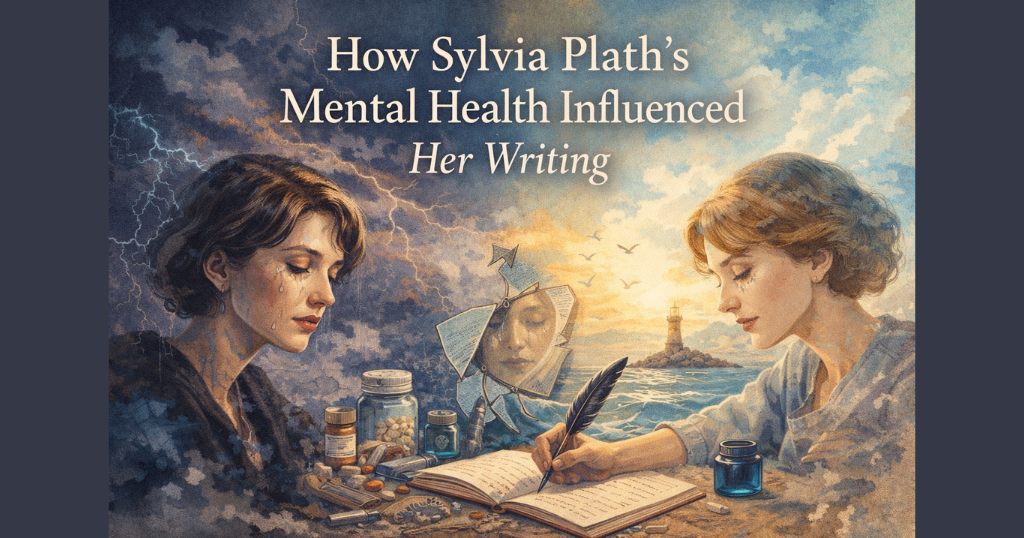
In the world of books, Sylvia Plath is a name that shines like a diamond—beautiful, sharp, and created under immense pressure. If you have never heard of her, think of her as a “super-achiever” who was fighting a silent war inside her own mind.
Plath was a genius who happened to struggle with mental health. She didn’t write because she was sad; she was a world-class artist who used her writing to build a bridge back to reality. This blog explores how she turned her deepest pain into some of the most successful literature in human history.
1. Who Was Sylvia Plath? (The Face of Perfection)
To understand her work, you first have to see the person. Born in 1932, Sylvia Plath was the definition of a “success story” on the outside. She was a straight-A student, a Fulbright scholar, and a fashion-conscious girl who attended the best colleges.
However, underneath this “perfect” exterior, Sylvia struggled with Clinical Depression (and what many modern experts believe was Bipolar Disorder). In the 1950s, people didn’t talk about mental health. There was a huge pressure to be a “perfect housewife” and a “perfect scholar” at the same time. This pressure felt like a weight she couldn’t carry, and it became the fuel for her writing.
2. The Body of Work: What Did She Create?
Plath was an incredibly disciplined artist. She often woke up at 4:00 AM to write before her children woke up. Her work is famous for its Linguistic Precision—every word was chosen like a piece of jewelry.
The “Big Three” Books:
- The Bell Jar (1963): Her only novel. It’s a “thinly veiled” autobiography about a college student who spiralled into depression during a dream internship in New York.
- The Colossus (1960): The only poetry book published while she was alive. It shows her skill and professional “mask.”
- Ariel (1965): Published after her death, this is the book that made her a legend. These poems are “fierce.” They deal with anger, motherhood, and the desire to be free.
3. The “Bell Jar” Metaphor: Explaining the Unexplainable
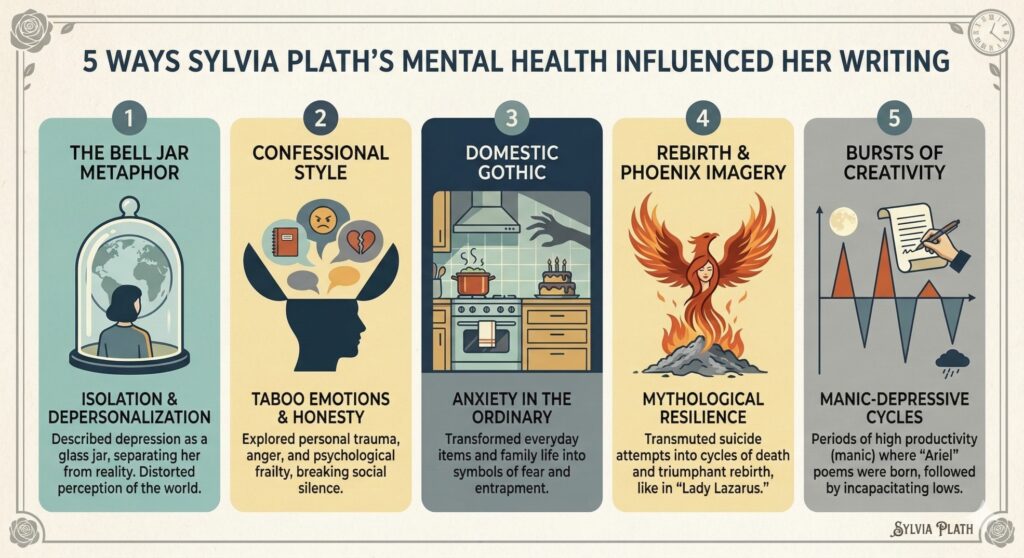
One of Plath’s greatest contributions to the world was giving us a way to describe depression. She used a simple, brilliant image: The Bell Jar.
A bell jar is a glass cover used in science labs. Plath said that when her mental health was at its worst, it felt like a giant glass bell jar had been lowered over her.
- The Isolation: Inside the jar, the air is stale. You can see everyone else living their lives, but you can’t “breathe” with them.
- The Distortion: Everything you see through the glass looks blurry or “wrong.” This accurately describes Dissociation—the feeling that you aren’t really connected to the real world.
4. Turning Pain into “Confessional” Art
Before Plath, poets usually wrote about nature or history. Plath helped start the “Confessional” movement. She decided to be honest about things people were ashamed of back then.
How her struggles influenced her themes:
- The “Colossus” (Her Father): Sylvia’s father died when she was eight. She felt abandoned. In her work, she describes him as a giant, broken statue. This represents how unprocessed grief influenced her view of men and authority.
- The “Phoenix” (Resilience): Even though she struggled, she was strong. In her poem “Lady Lazarus,” she compares herself to a Phoenix. Even after a “suicide attempt,” she rises back up.“Out of the ash / I rise with my red hair / And I eat men like air.”
- The Domestic Gothic: She would take a normal kitchen or a birthday cake and make it feel terrifying. This shows how, during anxiety, the “safe” world can feel like a minefield.
5. Global Success: Why She is a Literary Giant
Plath is a rare case where her fame exploded after she died in 1963. Today, she is a cultural icon for three main reasons:
- The First Honest Voice: She was one of the first women to say, “I am angry, I am hurting, and I am a woman.” 2. Posthumous Success: In 1982, she became the first person ever to win the Pulitzer Prize after death.
- Universal Resonance: Experts like Al Alvarez argue that Plath wasn’t just writing about “sadness”; she was exploring the very edges of human existence. By being so specific about her own pain, she became a voice for everyone’s pain.
6. Expert Insights on the Plath Mystery
Many scholars believe Plath’s struggles were worse because of the times she lived in.
- The Feminist Perspective: Experts like Sandra Gilbert argue that Plath’s “madness” was partly a rebellion against the suffocating gender roles of the 1950s.
- The Clinical Perspective: Doctors today see her “bursts” of writing as signs of the “manic” phase of Bipolar Disorder—where she would write 30 masterpieces in a single month.
7. How Sylvia Plath died?
Sylvia Plath died by suicide from carbon monoxide poisoning on February 11, 1963, at her apartment in London. She was 30 years old.
Context and Contributing Factors
Plath’s death occurred during a period of significant personal and professional difficulty. Several factors are often cited by biographers:
- Mental Health Struggles: Plath had a long history of clinical depression and had experienced previous mental health crises and suicide attempts throughout her life.
- Personal Turmoil: At the time, she was navigating a difficult separation from her husband, poet Ted Hughes.
- Environmental Stress: She was living in London during an exceptionally harsh winter, facing isolation, physical illness, and the challenges of caring for two young children on her own.
- Professional Challenges: Her novel The Bell Jar had recently been published under a pseudonym to a quiet reception, and she was awaiting further professional recognition.
Literary Legacy
Following her death, Plath’s literary reputation grew significantly. The posthumous publication of her collection Ariel is considered a landmark event in 20th-century poetry. In 1982, she became the first poet to be awarded the Pulitzer Prize posthumously for The Collected Poems.
Plath is buried in the churchyard of St Thomas the Apostle in Heptonstall, West Yorkshire.
7. Frequently Asked Questions (FAQs)
Did Sylvia Plath’s mental health make her a better writer? Not necessarily. Her talent made her a great writer. Her mental health struggles provided the “subject matter,” but it was her hard work and education that allowed her to turn that pain into successful art.
Why is The Bell Jar so important for beginners? Because it is written in very clear, modern language. It helps people who have never been depressed understand exactly what it feels like to be “trapped” in one’s own mind.
What is “Confessional Poetry”? It is poetry that uses the “I” voice to talk about private, often taboo subjects like trauma, depression, and family secrets. Plath is considered the queen of this style.
Is her work still relevant today? More than ever. As we become more open about mental health, Plath’s honesty about her “Bell Jar” feels modern, brave, and incredibly human.
Sylvia Plath’s story reminds us that even in the darkest corners of the mind, there is a way to create something beautiful. She took the “monsters” of her depression and turned them into “diamonds” of literature.
Also read: 20 Best Ocean Poetry in English