Introduction: Why Edgar Allan Poe Still Captivates Readers
Few writers have achieved the kind of timeless popularity that Edgar Allan Poe (1809–1849) enjoys. More than a century and a half after his death, Poe remains one of the most read, discussed, adapted, and reviewed authors in world literature. His stories continue to inspire films, music, graphic novels, psychological studies, and modern horror fiction.
Poe was not a novelist in the conventional sense. His work consists of approximately 70 short stories, 50 poems, and a single finished novel. During his lifetime, he published around four major collections of these works, along with specialized textbooks and essays.
Novels and Long-Form Prose
- The Narrative of Arthur Gordon Pym of Nantucket (1838): Poe’s only completed full-length novel, a sensational sea adventure.
- The Journal of Julius Rodman (1840): An unfinished novel about an expedition across the Rocky Mountains.
- Eureka: A Prose Poem (1848): A book-length non-fiction essay on the nature of the universe, which Poe considered his masterpiece.
Major Collections (Published During His Life):
- Tamerlane and Other Poems (1827): His first book, published anonymously.
- Al Aaraaf, Tamerlane, and Minor Poems (1829): A collection of early poetry.
- Tales of the Grotesque and Arabesque (1840): His first major collection of short stories, published in two volumes.
- The Raven and Other Poems (1845): The collection that brought him widespread fame as a poet.
- Tales (1845): A curated collection of his most popular short stories.
Non-Fiction and Textbooks
- The Conchologist’s First Book (1839): An illustrated textbook on shells for which Poe was paid to lend his name and provide an introduction; it was his only true “best-seller” during his lifetime.
- Maelzel’s Chess-Player (1836): A famous essay investigating a purported chess-playing automaton.
Key Summary Figures
- Short Stories: 69 to 70 total.
- Poems: Over 50 original poems.
- Essays/Critiques: Over 100 literary critiques and dozens of philosophical essays.
He is widely credited as:
- the father of modern psychological horror
- a pioneer of the detective fiction genre
- a master of gothic atmosphere
- one of the earliest theorists of the short story as an art form
Unlike many of his contemporaries, Poe wrote for emotional intensity rather than moral comfort. His work explores madness, grief, obsession, guilt, beauty, death, and the fragile structure of the human mind. Readers often describe his writing as unsettling yet irresistible—dark, musical, and unforgettable.
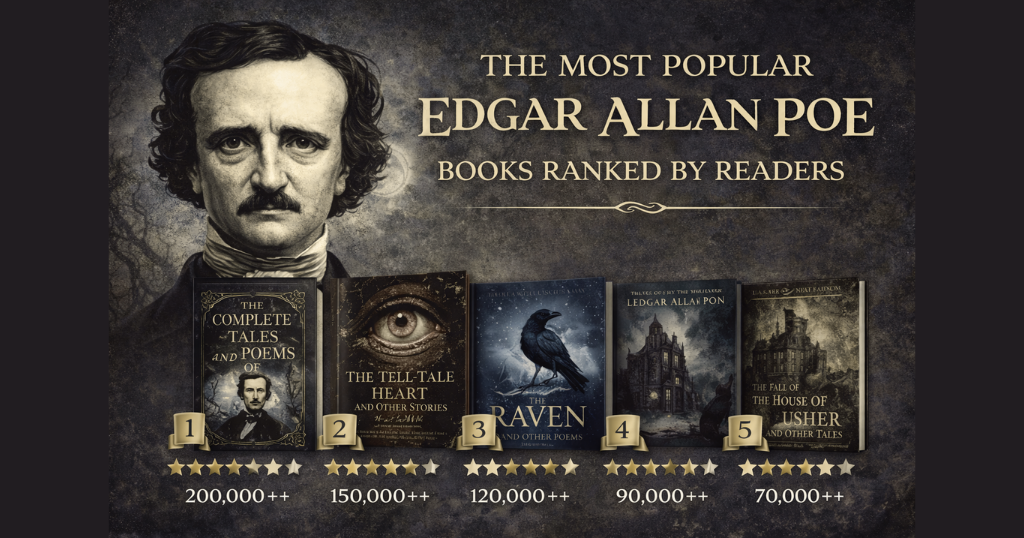
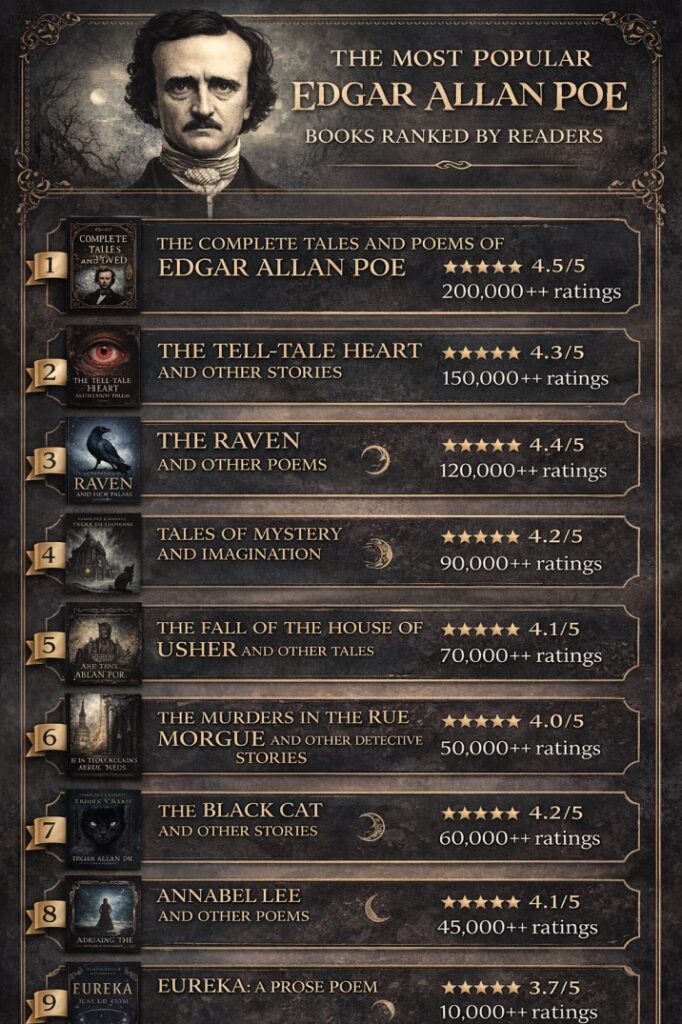
But if you want to read his work, you can buy the modern collections of his stories, which are listed in this blog. This blog ranks Edgar Allan Poe’s books and major collections according to popularity and reader reviews, beginning with the most widely loved and moving through lesser-known but still essential works. Along the way, we examine what each book contains, how readers respond to it, and why it holds a specific place in Poe’s legacy.
1. The Complete Stories and Poems of Edgar Allan Poe (Most Popular Overall)
Why it ranks first:
This is the most widely read and reviewed Poe book worldwide. For many readers, this single volume is Edgar Allan Poe.
What the book contains
- All major short stories (The Tell-Tale Heart, The Fall of the House of Usher, The Black Cat, The Murders in the Rue Morgue, etc.)
- All major poems (The Raven, Annabel Lee, The Bells, Ulalume)
- A comprehensive view of Poe’s imagination
Why readers love it
Readers appreciate having Poe’s entire literary universe in one place. It allows them to move between horror, mystery, melancholy, and lyric beauty without interruption.
For students, this edition is especially valuable because it shows Poe’s range—from detective logic to lyrical despair.
Reader response
- Frequently described as darkly beautiful, disturbing, and hypnotic
- Praised for Poe’s command of atmosphere and psychology
Goodreads sentiment (approximate):
⭐ 4.4/5 based on 294,000+ ratings across editions
2. The Tell-Tale Heart and Other Stories
Why it’s so popular:
This is often the first Poe book readers encounter, especially in schools and colleges.
What the book contains
- The Tell-Tale Heart
- The Black Cat
- The Cask of Amontillado
- The Fall of the House of Usher
- Other psychological horror classics
Why readers connect with it
These stories are short but emotionally intense. They explore:
- guilt
- paranoia
- moral decay
- unreliable narration
Readers frequently mention how Poe makes them feel inside the narrator’s mind, experiencing madness from within rather than observing it from a distance.
Critical and reader impact
This collection defines Poe as the master of psychological horror. Writers from Dostoevsky to Stephen King have acknowledged its influence.
Goodreads sentiment (approximate):
⭐ 4.3/5 based on 150,000+ ratings
3. The Raven and Other Poems
Why it remains iconic:
The Raven is arguably the most famous poem in American literature.
What the book contains
- The Raven
- Annabel Lee
- The Bells
- To Helen
- Ulalume
Why readers return to it
Poe’s poetry is musical, emotional, and haunting. Readers often describe reading his poems aloud to experience their rhythm fully.
The Raven alone has shaped popular culture’s image of poetic despair—its repetition of “Nevermore” symbolizing endless grief.
Reader reception
While some readers find the style intense or archaic, many admire its emotional power and sonic beauty.
Goodreads sentiment (approximate):
⭐ 4.4/5 based on 120,000+ ratings
4. Tales of Mystery and Imagination
Why it’s a classic title:
This was one of the earliest curated collections of Poe’s stories and helped establish his international reputation.
What the book contains
- The Fall of the House of Usher
- The Pit and the Pendulum
- The Murders in the Rue Morgue
- The Masque of the Red Death
Why readers value it
This book shows Poe’s structural mastery—his ability to design stories where every detail contributes to a single emotional effect.
Readers often note how cinematic these stories feel, even though they were written long before film existed.
Goodreads sentiment (approximate):
⭐ 4.2/5 based on 90,000+ ratings
5. The Fall of the House of Usher and Other Tales
Why it stands out:
This collection focuses on Poe’s gothic atmosphere rather than overt horror.
What the book contains
- The Fall of the House of Usher
- Ligeia
- Morella
- The Oval Portrait
Why readers appreciate it
These stories explore:
- decay (physical and mental)
- obsession
- blurred boundaries between life and death
- haunted spaces as extensions of the mind
Readers who enjoy slow-burn psychological tension often prefer this collection.
Goodreads sentiment (approximate):
⭐ 4.1/5 based on 70,000+ ratings
6. The Murders in the Rue Morgue and Other Detective Stories
Why it’s historically important:
Poe invented the detective fiction genre with this collection.
What the book contains
- The Murders in the Rue Morgue
- The Mystery of Marie Rogêt
- The Purloined Letter
Why readers respect it
Although modern crime fiction has evolved, readers admire Poe’s logical precision and intellectual clarity. His detective, C. Auguste Dupin, became the blueprint for Sherlock Holmes.
Reader response
Some readers find these stories slower than his horror tales, but many value their historical significance.
Goodreads sentiment (approximate):
⭐ 4.0/5 based on 50,000+ ratings
7. The Black Cat and Other Stories
Why readers remember it
This collection centers on moral collapse and violence driven by inner corruption.
Themes explored
- cruelty
- alcoholism
- guilt
- psychological breakdown
Readers often describe these stories as emotionally uncomfortable—but unforgettable.
Goodreads sentiment (approximate):
⭐ 4.2/5 based on 60,000+ ratings
8. Annabel Lee and Other Poems
Why it has a devoted following
This collection appeals to readers who prefer romantic melancholy over horror.
Why readers love it
- Emotional intensity
- Themes of lost love and mourning
- Musical language
Some readers consider Annabel Lee Poe’s most emotionally sincere poem.
Goodreads sentiment (approximate):
⭐ 4.1/5 based on 45,000+ ratings
9. Eureka: A Prose Poem (Most Challenging Work)
Why it’s controversial
Eureka is not fiction or poetry in the traditional sense—it is Poe’s philosophical and cosmological speculation.
Reader experience
- Admired for ambition
- Criticized for density
- Fascinating for readers interested in philosophy and science
This is the least accessible of Poe’s works, but also the most revealing of his intellectual curiosity.
Goodreads sentiment (approximate):
⭐ 3.7/5 based on 10,000+ ratings
10. Lesser-Known Collections and Essays
These include:
- Critical essays on poetry
- Reviews
- Literary theory (including The Philosophy of Composition)
These works are most appreciated by:
- literature students
- scholars
- writers interested in craft
Goodreads sentiment: varies widely, generally between 3.8–4.2
Why Poe’s Popularity Has Endured
Poe’s books remain popular because they:
- explore the human mind rather than external morality
- balance beauty with terror
- feel emotionally honest
- influence modern horror, crime fiction, and psychological storytelling
Readers do not merely read Poe—they experience him.
Conclusion: Where to Begin and Why It Matters
If you want:
- Everything Poe ever wrote → Complete Tales and Poems
- Psychological horror → The Tell-Tale Heart and Other Stories
- Poetry and emotion → The Raven and Other Poems
- Mystery and logic → Murders in the Rue Morgue
Edgar Allan Poe’s books do not age because the fears they explore—loss, guilt, obsession, and the unknown—are timeless.
This guide is designed to help readers choose wisely, understand deeply, and return to Poe with clarity rather than confusion. It is not just a ranking, but a map of one of literature’s darkest and most brilliant minds.
Also read: 10 Edgar Allan Poe Quotes