
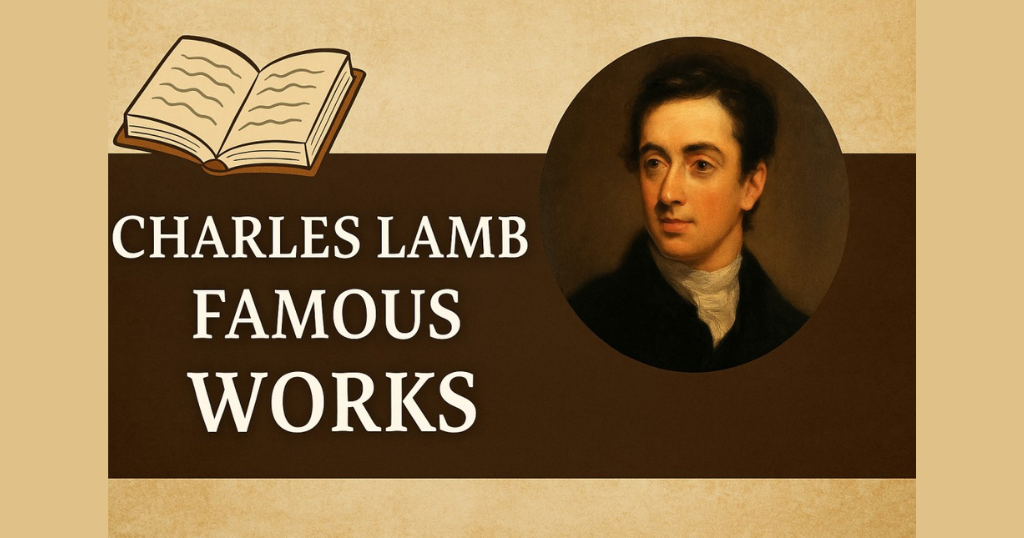
Introduction
In the grand library of English literature, few writers speak to the heart as gently and honestly as Charles Lamb. His prose does not thunder like Milton’s nor philosophize like Bacon’s — instead, it whispers. Lamb’s works feel like conversations across time: warm, companionable, deeply human.
For students, Lamb is essential because he turned the personal essay into a literary jewel. For writers, he is a lesson in emotional sincerity. And for scholars, he represents the bridge between the classical traditions of the eighteenth century and the emotional introspection of the nineteenth-century Romantics.
This guide presents a complete, exam-ready, and human-friendly analysis of Charles Lamb’s famous works, his writing style, his contributions, his books, and his unforgettable essays — all structured to help readers not just understand Lamb, but remember him.
1. About Charles Lamb
Charles Lamb (1775–1834) was born in London, lived modestly, and worked most of his life as a clerk in the East India Company. Yet his inner life was rich, delicate, and shaped by emotional depth. His childhood was spent among books, gentle relatives, and vivid memories that later found their way into his essays.
A defining event of his life occurred in 1796, when Lamb’s sister Mary Lamb, during a mental breakdown, fatally stabbed their mother. Lamb, only 21, took guardianship of Mary and remained devoted to her for life. Their relationship — marked by tenderness, sorrow, and shared creativity — shaped his personality and his art.
Lamb was a friend of Wordsworth, Coleridge, Southey, and Hazlitt, yet unlike the Romantics, he did not escape to nature for inspiration. He found his poetry in everyday life — old china, chimney sweepers, roast pig, childhood stories, books, and the bittersweet ache of memory.
His works are intimate rather than grand, personal rather than philosophical, and it is this intimacy that gives them enduring life.
Charles Lamb Pen Name
A crucial fact every student must know:
👉 Charles Lamb wrote under the pen name “Elia.”
The name belonged to a former Italian colleague at the South-Sea House. Lamb borrowed it playfully and lovingly, creating a persona that allowed him to mix autobiography with imagination. “Elia” is not merely a pseudonym — it is a character, a voice, a lens through which Lamb filters his joys, regrets, sorrows, and dreams.
This alter ego gives his essays their unique tone: half truth, half dream; half memory, half invention.
2. Charles Lamb’s Literary Style
To understand his works deeply, recognize the four pillars of Lamb’s style:
A. Deeply Personal and Intimate Tone
Lamb broke away from the impersonal formality of earlier essayists like Bacon. His essays are confessions, reflections, and private conversations with the reader.
B. Nostalgia and Memory
No writer captures the sweetness of the past like Lamb. His childhood recollections become almost sacred spaces — gentle, glowing, and tinged with loss.
C. Tender Humour
His humour never wounds. It smiles through sorrow, and even when he mocks, it is with warmth.
Lamb’s wit is emotional intelligence, not sarcasm.
D. Emotional Honesty and Pathos
Beneath the surface of comedy lies real sadness. His essays carry the weight of personal tragedy, but Lamb never dramatizes it — he transforms sorrow into wisdom.
This blend of humour + memory + emotional truth is what makes Lamb’s style immortal.
3. Overview of Charles Lamb’s Major Works
Lamb’s contribution spans:
- Essays (his greatest achievement)
- Books for children
- Literary criticism
- Fiction
- Prose retellings of classics
- Personal reflections
Below is the most authoritative breakdown of all his major works.
📘 Charles Lamb – Famous Works (Complete Table)
| Title | Year | Genre | What It Contains | Significance / Key Details | Awards / Impact |
|---|---|---|---|---|---|
| Tales from Shakespeare (with Mary Lamb) | 1807 | Prose adaptations / Children’s literature | Prose retellings of 20 Shakespeare plays for young readers | Made Shakespeare accessible worldwide; still used in schools | No awards then, but globally influential; regarded as classic children’s literature |
| The Adventures of Ulysses | 1808 | Prose adaptation of Homer | A simplified retelling of The Odyssey for young readers | Introduced Greek mythology to Victorian children; admired for clarity | Important educational text; widely used in 19th-century schools |
| Specimens of English Dramatic Poets | 1808 | Literary criticism / Anthology | Extracts from Elizabethan and Jacobean dramatists with Lamb’s commentary | Revived forgotten dramatists (Ford, Dekker, Middleton); influential in literary scholarship | Praised by Coleridge; shaped later Shakespearean studies |
| Essays of Elia | 1823 | Personal essays | Humorous, nostalgic, autobiographical essays including “Dream Children,” “Old China,” “Chimney Sweepers,” etc. | Established Lamb as the greatest English essayist; emotional depth unmatched | Recognized as a masterpiece; foundational text in essay tradition |
| Last Essays of Elia | 1833 | Personal essays | Mature, reflective essays such as “Popular Fallacies,” “Detached Thoughts on Books and Reading” | Shows Lamb’s late-life wisdom and melancholy; emotionally richer | Highly acclaimed; studied for its philosophical tone |
| Dream Children: A Reverie | 1822 (in Essays of Elia) | Personal essay | A nostalgic essay about imaginary children representing Lamb’s lost dreams | Lamb’s most emotional work; a masterpiece of pathos; reveals his inner grief | One of the most anthologized English essays ever |
| A Dissertation Upon Roast Pig | 1822 (Essays of Elia) | Humorous essay | A playful story of how roast pig was discovered accidentally | Shows Lamb’s comic genius; loved for imaginative exaggeration | Among most reprinted humorous essays |
| New Year’s Eve | 1821 (Essays of Elia) | Reflective essay | Meditations on time, mortality, memories | Beautiful philosophical depth; cited often for literary reflection | Classic of English reflective prose |
| Rosamund Gray | 1798 | Novella / Sentimental fiction | A tragic love story exploring innocence, suffering, and human fragility | Early Romantic work; showcases Lamb’s compassion and emotional tone | Admired by Coleridge and Wordsworth |
| Album Verses | 1830 | Poetry collection | Light, personal poems written for friends, often humorous | Reveals Lamb’s playful, gentle poetic side | Not major awards but culturally significant |
| John Woodvil | 1802 | Drama | A blank-verse tragedy in Elizabethan style | Shows Lamb’s admiration for old drama; not commercially successful | Appreciated later by scholars |
| Poetry for Children (with Mary Lamb) | 1809 | Children’s poetry | Simple poems for young readers | Part of Lambs’ contribution to children’s literature | Used in early 19th-century education |
| The Pawnbroker’s Daughter | 1800s (approx.) | Short story | A light narrative exploring lower-class London life | Shows Lamb’s interest in ordinary people | Not widely known but studied in Lamb scholarship |
| Confessions of a Drunkard | 1813 | Prose essay | A dark and introspective confession about alcoholism | Reveals Lamb’s personal struggles; rare emotional honesty | Considered bold for its time |
| The Housekeeper | 1819 | Essay / Sketch | Humorous depiction of domestic life | Classic example of Lamb’s intimate humour | Frequently anthologized |
| Mrs. Battle’s Opinions on Whist | 1821 | Humorous essay | Portrait of a woman obsessed with card games | Shows Lamb’s character-portrait talent; comic yet warm | Very well-known in essay collections |
4. Detailed Analysis of Each Work
A. Charles Lamb Books
This section covers all major books by Lamb — including their themes, style, and significance.
1. Tales from Shakespeare (1807)
Co-authored with Mary Lamb, this is one of the most influential works in English children’s literature.
Purpose
To retell Shakespeare’s plays in simple prose so that young readers could understand the stories before reading the originals.
Why It Matters
- Introduced Shakespeare to generations worldwide
- Preserves the emotional essence of each play
- Balances clarity with literary elegance
- A cultural bridge between Elizabethan drama and modern readers
Notable Retellings
The Tempest, Macbeth, King Lear, A Midsummer Night’s Dream, Romeo and Juliet, Hamlet
Lamb’s versions maintain dignity and emotional truth, proving his artistic sensitivity.
2. The Adventures of Ulysses (1808)
A graceful prose adaptation of Homer’s Odyssey, written for young audiences.
Features
- Faithful to the epic structure
- Accessible language
- Strong storytelling
- Brings Greek mythology to common readers
His admiration for classical literature shines through every chapter.
3. Rosamund Gray (1798)
A brief but emotionally resonant novella.
Themes
- Innocence
- Love
- Human suffering
- Emotional fragility
Significance
Though early in his career, it reveals Lamb’s Romantic sensibility and gentle empathy.
4. Specimens of English Dramatic Poets (1808)
One of Lamb’s most important scholarly contributions.
What It Contains
Selected extracts from forgotten or overlooked Elizabethan and Jacobean dramatists like:
- Thomas Dekker
- John Ford
- George Chapman
- Thomas Middleton
Importance
- Revived interest in pre-Shakespearean drama
- Demonstrated Lamb’s deep literary scholarship
- Influenced later critics
This work showcases Lamb not as an essayist, but as a serious literary historian.
5. Album Verses (1830)
A collection of Lamb’s poems — lighthearted, musical, and intimate.
Though not a major poet, these verses show the warmth and playfulness of his mind.
B. Charles Lamb Essays
Here lies the heart of Lamb’s genius.
His essays — reflective, humorous, touching — appear mainly in two collections:
- Essays of Elia (1823)
- Last Essays of Elia (1833)
Below are his greatest essays, analyzed for depth and understanding.
Charles Lamb Dream Children: A Reverie
One of the most moving essays in English literature.
Summary
Lamb narrates stories to two children, John and Alice, about family memories. Toward the end, the children slowly fade away — they were only dreams.
Why It Is Heartbreaking
Because Lamb never married and had no children.
The children represent a life he longed for but never lived.
Themes
- Pain of lost possibilities
- Emotional sacrifice
- The duality of dream and reality
- Sorrow carried with quiet dignity
The final lines, describing the children’s disappearance, are among the most poignant in English prose.
Other Famous Charles Lamb Essays
1. A Dissertation Upon Roast Pig
A humorous tale of how roast pig was discovered by accident.
Shows Lamb’s playful imagination.
2. New Year’s Eve
One of his most profound essays.
Explores time, mortality, and Lamb’s love for life:
“I am in love with this green earth.”
3. The Praise of Chimney-Sweepers
A gentle tribute to young chimney sweeps.
Illustrates his empathy for the poor and innocent.
4. Old China
A beautiful nostalgic essay.
Shows Lamb at his best: tender, reflective, playful.
5. Poor Relations
A humorous yet emotionally complex portrait of family dynamics.
Rich in observation and satire.
5. Comparison with Other Writers
Understanding Lamb becomes easier when contrasted with other great writers.
Charles Lamb vs. Francis Bacon
- Bacon: cold, logical, formal
- Lamb: warm, emotional, intimate
Lamb vs. Addison & Steele
- Addison writes about society
- Lamb writes about the inner life
Charles Lamb vs. Wordsworth
- Wordsworth finds truth in nature
- Lamb finds truth in memory
Lamb vs. Dickens
- Dickens fights social injustice
- Lamb explores personal sorrow
These contrasts show Lamb’s uniqueness:
He writes not from the world around him, but from the world within him.
6. Why Charles Lamb Matters Today
For Students
- Essays appear regularly in exams
- Easy to remember because they are personal
- Full of quotable lines and memorable imagery
For Writers
- Teaches emotional honesty
- Demonstrates how to write with warmth and subtlety
- Shows the power of personal narrative
And For Scholars
- Bridges classical and Romantic traditions
- Revived Elizabethan drama
- Influenced modern creative nonfiction
Lamb remains relevant because he writes about universal human experience — memory, love, sorrow, humour, and hope.
7. Conclusion
Charles Lamb’s famous works are more than literary texts — they are emotional experiences. Through Elia, Lamb shared not just his thoughts but his soul. His essays remain unmatched in tenderness, humour, and emotional truth. These books introduced generations to Shakespeare and Homer. His criticism revived forgotten dramatists.
To study Lamb is to study human nature — fragile, nostalgic, humorous, and beautifully imperfect.
For students, Lamb’s works are easy to remember because they are sincere.
Writers find them a masterclass in gentle prose.
For readers, they are lifelong companions.
This is why Charles Lamb lives on — not just as an essayist, but as a beloved voice whispering truth across centuries.

Also read: An Apology for Poetry Summary and Analysis