
Introduction: The Myth of the Outsider
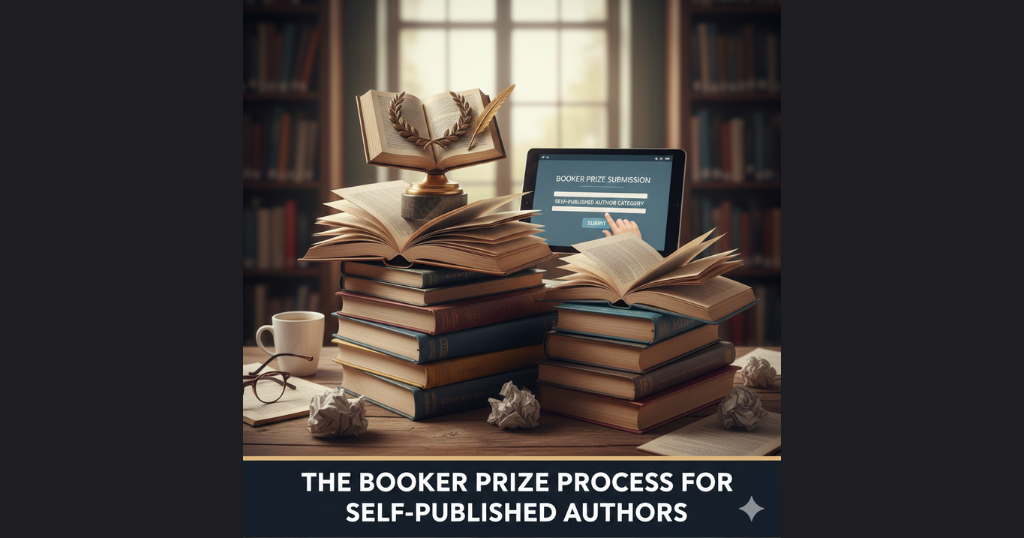
The Booker Prize has long stood as one of the most prestigious literary honours a fiction writer can dream of. But for authors outside major publishing circles, especially those coming from the world of self-publishing, the prize can look guarded by invisible gatekeepers. Booker Prize Process for self-published authors is complicated but doable.
The official rules clearly state that if you (the author) are the publisher, pay to publish, or control a company created mainly to publish your book, the book becomes ineligible. This means pure self-publishing routes are blocked, but independent publishers who do not charge authors can still submit on your behalf.
So this blog does not promise shortcuts — it gives clarity, honesty, and the exact paths that are 100% allowed, ethical, and realistic.
Here’s what we will answer in this blog:
- What truly makes a Booker-winning book
- Who has won before (with real examples only)
- How outsiders without big publishers can legally enter
- What hurdles exist for self-published authors
- How to convert a self-published author identity into Booker-eligible submission
- And finally, how to compete for a win
Let’s walk through the Booker gates responsibly.
What Makes a Booker-Winning Book — The Benchmark of Literary Excellence
Before talking about eligibility or submission, it is vital to internalize one truth:
📌 The Booker isn’t won during submission. It’s won during impact. Submission only allows you to compete — impact makes you trophy-worthy.
Judges reward books that carry:
1. The Voice That Doesn’t Sound Like Anyone Else
The novel must have a signature tone — instantly identifiable, emotionally credible, and deeply immersive.
Example: Salman Rushdie turned South Asian politics and memory into allegory through magical realism in Midnight’s Children, proving that judges admire crafted stylistic risk when rooted in emotional truth.
2. Character Contradictions That Mirror the Human Mind
Judges gravitate toward morally layered protagonists who are psychologically real, even when flawed.
Example: J. M. Coetzee wrote Disgrace in 1999, led by David Lurie, a professor wrestling with moral downfall, guilt, cultural fracture, and personal redemption. Judges rewarded this moral complexity, not social heroism.
3. Themes Bigger Than Timezones
The novel must hold cultural, historical, political, or philosophical resonance that transcends geography.
Example: Arundhati Roy won for The God of Small Things, a fiction that balanced memory, injustice, love, trauma, caste, and political observation — personal in scale, epic in impact.
4. Emotional Power That Doesn’t Manipulate but Moves
Booker novels often pierce the reader without melodrama — they let scenes carry emotional propulsion rather than explicit emotional explanation.
Example: Kiran Desai won for The Inheritance of Loss, where characters grapple with migration, colonial hangover, cultural disillusionment, mullined identities, and personal exile. Her setting in Kalimpong felt small, but the impact was global.
5. Mastery in Structure and Language
A Booker-level book does not ramble. It unfolds deliberately. Its lines read like cinematic prose — vivid, pictorial, and unforgettable.
Exam Memory Hook:
Voice ✅ Character psychology ✅ Universal themes ✅ Emotional power ✅ Mastery in language + structure ✅ UK or IE publication ✅ = Booker Pattern
Has Any Self-Published Author Ever Come Near Booker Glory?
While not a Booker entry, the example students and writers study in award discussions is publishers who launched unknown voices without charging fees.
And here’s where we make the correct historical connections:
📚 Small or independent publishers have submitted Booker-winning novels many times. The judges celebrate the book, not the banner behind it.
Let’s look at 7 real Booker-winning masterpieces from history (not self-published):
| Book Title | Winner Year | Author | Theme IImpact | Booker Submitting Publisher |
|---|---|---|---|---|
| Midnight’s Children | 1981 | Salman Rushdie | National identity crisis, allegory, political shard | Jonathan Cape |
| The God of Small Things | 1997 | Arundhati Roy | Memory, injustice, love, sorrow, caste, childhood trauma | Random House |
| The Inheritance of Loss | 2006 | Kiran Desai | Migration, class divide, identity exile, colonial scars | Faber & Faber |
| Life & Times of Michael K | 1983 | J. M. Coetzee | Existential suffering, survival, moral crisis, social distance | Ravan Press |
| Hotel du Lac | 1984 | Anita Brookner | Emotional loneliness, romantic crisis, sadness of choice | Jonathan Cape |
| Offshore | 1979 | Penelope Fitzgerald | Fragile living, societal observation, quiet emotional sagacity | Duckworth |
| Possession | 1990 | A. S. Byatt | Love and art across time, metafiction, literary inheritance | Chatto & Windus |
📌 Important: Each of these was publisher-submitted, and no fee was paid by the author to publish. This distinction is core to maintaining eligibility truth.
Can Self-Published Authors apply for The Booker Prize Process?
No. Self-published authors can not start the Booker Prize process by themselves. They first need to find an agent or publisher.
❗ A book is INELIGIBLE if:
- The author is the publisher
- Publishing happened through payment by the author
- The author controls a publishing company created only for that book
✅ A book is ELIGIBLE if:
- A legitimate publisher, literary press, or distributor published it in the UK or Ireland
- The publisher was not paid by the author
- The publisher exists outside the author’s ownership
- The book is distributed publicly and nationally in the UK or Ireland
- It is fiction, not memoir, not poetry
📘 Memory Tip:
Self-published is only a problem for Booker when you publish your own book at your own expense or ownership. It is NOT a problem when a money-free publication contract exists and a UK/IE publisher submits the book.
The 3 Biggest Paths a Self-Published Author Can Take to Compete for Booker Eligibility
Here are non-misleading, rule-safe, real paths you can take:
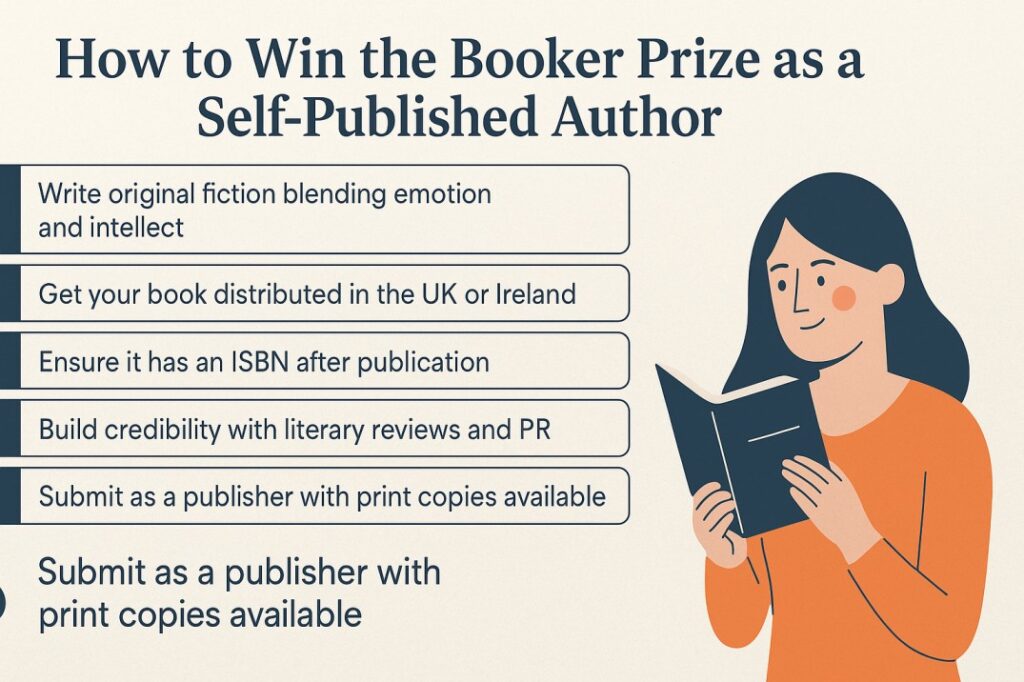
1. Publish Traditionally First via a UK/IE Independent Press That Doesn’t Charge Fees
This is the cleanest route for self-published writers wanting to enter Booker:
- You pitch your fiction manuscript to a UK/IE existing press
- They choose you with a contract (no author fees)
- They publish your book in print or digital (national availability in UK/IE)
- The publisher applies for Booker submission under their imprint
2. Get Published Through a UK/IE Distributor Without Paying Publishing Fees
Some distribution companies or literary presses allow:
- Public national listing
- Fiction in English
- No publishing fee to author
- Publisher submission rights
So you self-publish your author journey on blogs for credibility, but you don’t self-publish your Booker entry book.
3. Sign with a Literary Agency Who Places You Into a UK Fiction Publisher
Many independent writers reached Booker level by:
- Writing strong fiction
- Getting placed through literary agencies into iK or IE eligible publishers
- Publisher submits
Real Difficulties a Self-Published Author Faces (But Can Overcome)
Here are the real hurdles without exaggeration:
Hurdle 1: You Need UK/IE Publication
This is the biggest test. But not a literary test — a technical one.
Hurdle 2: Judges Expect Fiction That Doesn’t Sound Amateur
Your writing must carry depth, emotional layering, deliberate structure, and linguistic personality.
Hurdle 3: You Don’t Have a Huge Network
But networks can be built organically:
✔ publish essays and analysis on your website
✔ build reviews
✔ collaborations
✔ academic discussions
Hurdle 4: Editing Must Be Exceptional
Booker winners pass through multiple drafts with editorial precision.
Hurdle 5: You Must Compete Against Publisher-Published Authors
You join at submission, you defeat at impact.
How to Pitch Your Book to a UK/IE Independent Press for Booker Entry — The Blueprint
Here is a publishing-ready pitch template you can use (not money paid, not imprint owned):
Dear [Publisher],
I am an independent fiction writer. I’ve published previously on global platforms and literary communities, but for this novel, I am seeking a traditional publisher submission via UK/IE national availability.My manuscript is a novel of ~85,000+ words, written in English, fiction, and holds layered themes of culture, identity, tragedy, and human psychology.
I am submitting for AD publication because I believe it aligns with your existing press catalogue, not a personal publishing imprint. I am not offering payment, editorial fees, or publishing charges.
If selected, I request that the book:
✔ receive a publication contract
✔ be distributed publicly across the UK/IE
✔ be submitted by the publisher to the Booker Prize submission form
✔ send 6-10 print copies if requested by judgesI would be grateful if you could review the manuscript for possible selection.
Warmly,
[Your Name]
📌 Remember these points:
- The book must be fiction
- Must be UK/IE published
- And must be submitted by a real publisher who charged no fees to publish
How Do You Win It Then? The Real Pattern of Victory
You win by following these literary principles observed in real winners:
| Literary Trait | Winner Who Used It | Example |
|---|---|---|
| National identity allegory | Salman Rushdie | Midnight’s Children |
| Small emotional truths with cultural pain | Arundhati Roy | The God of Small Things |
| Colonial hangover and migration ache | Kiran Desai | The Inheritance of Loss |
| Existential survival and moral conflict | J. M. Coetzee | Disgrace & Michael K |
| Quiet brilliance and societal observation | Penelope Fitzgerald | Offshore |
📌 Memory Tip:
Judges love:
- emotional truth
- philosophical questions
- human contradictions
- culturally significant narratives
- structural boldness
- moderate publisher presence
- but no fee to publish
Conclusion: The Real Truth That Gives Hope Instead of Illusion
You cannot win the prize with self-publishing because the judges don’t want to award the publisher who paid the fees. They want to award the publisher who submitted the fiction due to belief in its literary merit.
Self-publishing is not the problem.
Being your own paid publisher is the problem.
The solution? A real UK/IE traditional press submission, national distribution, no fees, fiction in English, and publisher-submitted entry.
This is how you walk in.
This is how you compete.
And this is how you become unforgettable — which is where victory eventually falls.
Also read: Top 25 Motivational Quotes for Writers in 2025