Rain has always been more than water falling from the sky. It symbolizes renewal, melancholy, love, nature’s rhythm, and even the divine. Across centuries, poets have been captivated by the rain, crafting verses that remain etched in human memory. In this blog, we explore 10 of the greatest poems about rain ever written, looking closely at their language, context, and why they resonate so powerfully.
1. “Rain” by Edward Thomas (1916)
Edward Thomas, the British war poet, wrote “Rain” during World War I, shortly before his death in battle. This poem captures the solitude of a soldier listening to the rain, reflecting on mortality.
Excerpt:
“Rain, midnight rain, nothing but the wild rain
On this bleak hut, and solitude, and me
Remembering again that I shall die
And neither hear the rain nor give it thanks…”
Why it matters: Thomas connects rain with mortality and human fragility, reminding us that natural cycles continue even in war. Unlike Romantic poets who glorified nature, Thomas confronts its indifference.
2. “The Rainy Day” by Henry Wadsworth Longfellow (1842)
Longfellow, one of America’s most beloved poets, used rain as a metaphor for life’s hardships.
Excerpt:
“The day is cold, and dark, and dreary;
It rains, and the wind is never weary;
The vine still clings to the mouldering wall,
But at every gust the dead leaves fall.”
Why it matters: Unlike Thomas, Longfellow turns the gloom of rain into philosophical hope: though sorrow exists, “Behind the clouds is the sun still shining.”
3. “Summer Shower” by Emily Dickinson (1860s)
Emily Dickinson often turned natural images into metaphysical wonders. In this poem, she captures the suddenness of rain in summer.
Excerpt:
“A drop fell on the apple tree,
Another on the roof;
A half a dozen kissed the eaves,
And made the gables laugh.”
Why it matters: Dickinson transforms raindrops into living beings, showing her unique vision: rain is not just water, but playful music, life, and mystery.
4. “Song for the Rainy Season” by Elizabeth Bishop (1955)
Elizabeth Bishop, known for her detailed observations, wrote this poem about living in Brazil, where tropical rains defined daily life.
Excerpt:
“Hidden, oh hidden,
in the high fog,
the house we live in,
beneath the magnetic rock…”
Why it matters: Bishop’s rain is not melancholic but nurturing and protective. It creates a sense of shelter, intimacy, and quiet joy.
5. “The Rain” by William Henry Davies (1910)
Davies, the Welsh poet famous for “Leisure”, uses rain as a symbol of fairness and social equality.
Excerpt:
“I hear leaves drinking rain;
I hear rich leaves on top
Giving the poor beneath
Drop after drop.”
Why it matters: Davies brilliantly uses rain as a metaphor for justice and generosity—how the abundance of nature is shared among all, echoing human social ideals.
6. “It Rains” by Guillaume Apollinaire (1916)
This French poet experimented with calligrammes—visual poetry where the poem’s shape mirrors its subject. “Il Pleut” (It Rains) is arranged like falling raindrops.
Excerpt (translated):
“It’s raining women’s voices as if they were dead
even in memory it rains you as well
marvelous encounters of my life…”
Why it matters: Apollinaire connects rain to memory and desire, blending surrealism with innovative form. The poem itself looks like rain—a perfect marriage of form and meaning.
7. “Rain” by Rainer Maria Rilke (early 1900s)
The Austrian poet Rilke, famous for Duino Elegies, wrote often of rain as a universal rhythm.
Excerpt (translated):
“Suddenly the rain falls,
And you sense the weight of time,
As if each drop were an age
Falling silently to earth.”
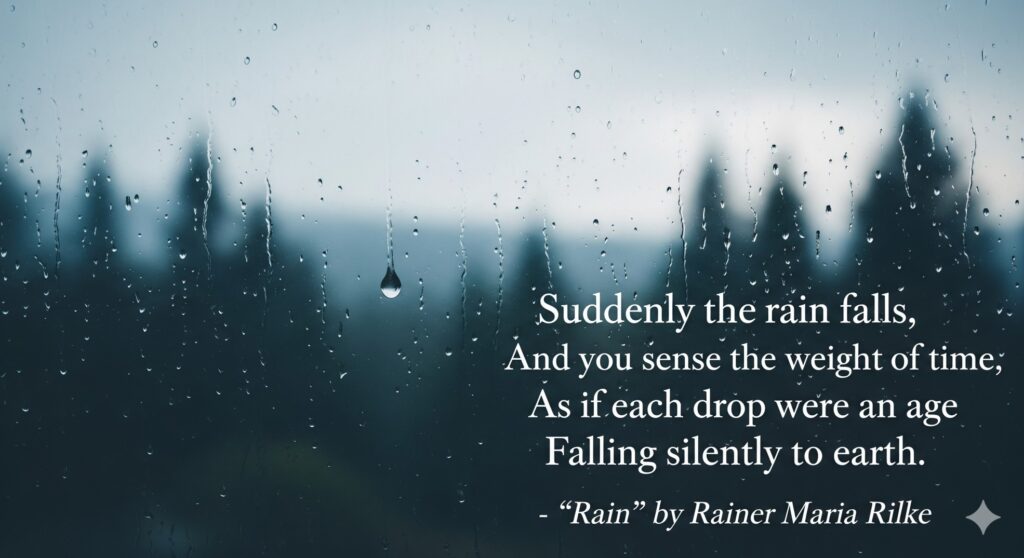
Why it matters: Rilke’s rain is spiritual and timeless. Unlike Dickinson’s playful drops, Rilke’s rain holds the gravity of existence itself.
8. “The Rain Stick” by Seamus Heaney (1996)
Irish Nobel laureate Seamus Heaney uses a rain stick, a traditional instrument, as a metaphor for rain’s music.
Excerpt:
“Up-end the rain stick and what happens next
Is a music that you never would have known
To listen for. In a cactus stalk
Downpour, sluice-rush, spillage and backwash…”
Why it matters: Heaney emphasizes listening to the ordinary, teaching us to find poetry in unexpected places. Rain here is transformed into art and memory.
9. “Rain on the Roof” by Coates Kinney (1849)
This American poet captured the nostalgic sound of rain on rooftops, one of the most comforting experiences of human life.
Excerpt:
“When the humid shadows hover
Over all the starry spheres,
And the melancholy darkness
Gently weeps in rainy tears…”
Why it matters: Kinney shows how rain awakens childhood memories and nostalgia, linking the external world with inner emotions.
10. “A Line-Storm Song” by Robert Frost (1913)
Frost, America’s great pastoral poet, compares stormy weather with troubled love.
Excerpt:
“The line-storm clouds fly tattered and swift,
The road is forlorn all day,
Where a myriad snowy quartz stones lift,
And the hoof-prints vanish away.”
Why it matters: Frost’s rain is turbulent, mirroring emotional storms in relationships. Unlike Bishop’s sheltering rain, Frost’s rain tests resilience and commitment.
🌧️ Comparisons & Contrasts
- Rain as Death vs. Life: Edward Thomas sees rain as a reminder of death, while Elizabeth Bishop celebrates it as nurturing life.
- Rain as Social Justice: Davies uses rain to symbolize fairness, unlike Frost, who uses it for romantic turmoil.
- Rain as Art Form: Apollinaire makes rain look like rain on the page, while Heaney turns it into sound.
- Rain and Memory: Kinney connects it with nostalgia, Rilke with eternity, Dickinson with playful imagery.
Thus, rain is never just weather—it is a mirror of human thought, emotion, and imagination.
🌧️ Conclusion
From Thomas’s wartime solitude to Dickinson’s lively raindrops, from Apollinaire’s visual rain to Heaney’s musical rain stick, these poems about rain prove one thing: Rain is timeless poetry.
It cleanses, comforts, terrifies, and inspires. That’s why across cultures and centuries, the best poems about rain continue to resonate with us.
Next time you hear rain tapping on your window, remember—it may just be the universe whispering poetry.
Also read: 10 Ways the Moon in Poetry Has Inspired Generations