
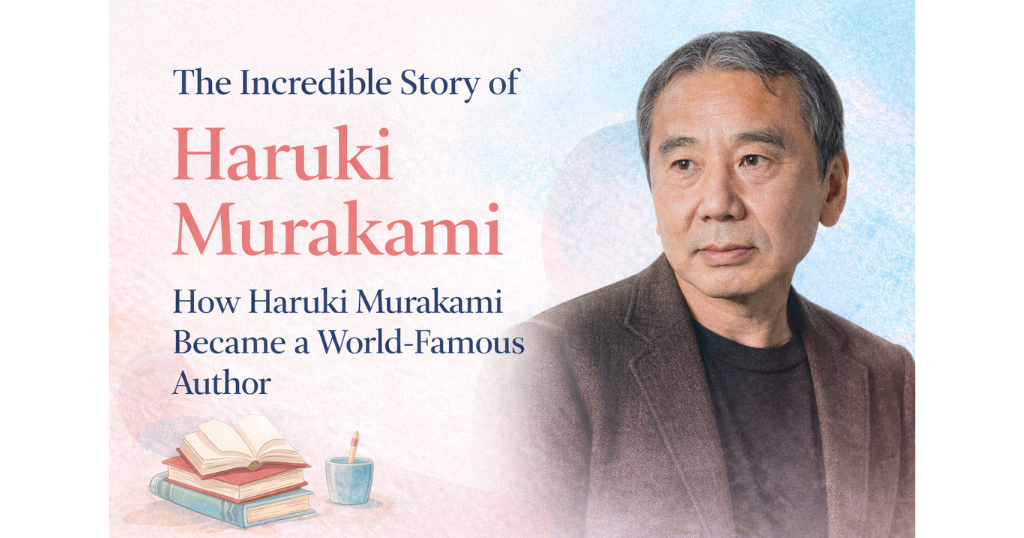
Why Haruki Murakami’s Life Reads Like One of His Novels
Haruki Murakami is not just a bestselling novelist; he is a literary phenomenon. His stories blend loneliness, surrealism, music, memory, and metaphysical mystery in ways that feel deeply personal to readers across cultures. What makes his journey extraordinary is that he did not plan to become a writer at all—and yet he became one of the most influential authors of the modern era.
Murakami’s life reads like a quiet, strange novel: a jazz bar owner who suddenly decides to write fiction during a baseball game; a man who runs marathons to sharpen his sentences; a Japanese writer whose imagination feels global rather than national. His rise was not fast, but it was inevitable in hindsight.
This blog tells the complete story of Haruki Murakami—his childhood, influences, turning point, writing philosophy, global reception, and literary legacy. You will understand why he became one of the top Japanese authors. It also includes a chronological list of all his books and ends with the most searched FAQs about him, answered simply.
Early Life: A Childhood Between Words and Silence (1949–1970)
Haruki Murakami was born in 1949 in Kyoto, Japan, and raised in Kobe, a port city exposed to Western culture. Both of his parents were teachers of Japanese literature, which meant Murakami grew up surrounded by classical texts—but interestingly, he felt detached from traditional Japanese literary styles.
Instead, he gravitated toward:
- Western novels
- American short stories
- Jazz music
- Cinema
This early cultural duality would later define his writing style: Japanese in setting, global in voice.
Murakami has often described himself as a quiet, solitary child, someone more comfortable observing than participating. This emotional distance—between the self and the world—would later become a central theme in his fiction.
University Years and Rebellion Against Expectations
Murakami studied drama at Waseda University in Tokyo, but he was not an enthusiastic student. He spent more time reading foreign literature than attending lectures.
During this time, he met Yoko Takahashi, who would later become his wife and lifelong partner. Their relationship remains one of the most stable aspects of Murakami’s life.
Japan in the late 1960s was politically charged, but Murakami deliberately stayed away from ideological movements. This quiet refusal to conform—to politics, trends, or expectations—later shaped his independent literary identity.
The Jazz Bar Years: Life Before Writing (1974–1978)
After university, Murakami and Yoko opened a jazz bar called “Peter Cat” in Tokyo.
This phase of his life is crucial because:
- He learned discipline through daily work
- He developed a deep relationship with music
- He lived outside literary ambition
Murakami has often said that running the bar taught him rhythm, something that later translated directly into his prose style.
At this point, writing was not even a dream.
The Baseball Game That Changed Everything
In 1978, during a baseball game at Jingu Stadium, Murakami experienced what he later described as a sudden, inexplicable clarity. Watching a batter hit the ball, he thought:
“I think I can write a novel.”
There was no preparation, no training, no workshop. That same night, he went home and began writing.
This moment has become legendary because it captures Murakami’s belief that creativity arrives quietly, without warning.
First Novel and the Birth of a Writer (1979–1982)
Murakami wrote his first novel at night, after closing the jazz bar. He wrote in simple Japanese, partly because his energy was limited and partly because he wanted clarity.
His First Novel
- Hear the Wind Sing (1979)
It won a literary prize for new writers and instantly marked Murakami as different. His prose felt light, detached, and Western-influenced—unusual in Japanese literature at the time.
Soon followed:
- Pinball, 1973 (1980)
- A Wild Sheep Chase (1982)
Together, these formed The Trilogy of the Rat, establishing Murakami’s recurring themes: loneliness, search for meaning, and surreal disruption.
Leaving Japan: Distance as Creative Fuel
Despite early success, Murakami felt uncomfortable with literary fame in Japan. Critics accused him of being “too Western,” while readers either adored or rejected him completely.
In response, he left Japan, living in:
- Greece
- Italy
- The United States
This physical distance helped him:
- Reconnect with Japanese identity on his own terms
- Write without cultural pressure
- Develop his mature voice
Breakthrough Novel: Norwegian Wood (1987)
Everything changed with Norwegian Wood.
Unlike his earlier surreal works, this novel was:
- Realistic
- Emotional
- Deeply nostalgic
It became a massive bestseller in Japan, turning Murakami into a celebrity—something he deeply disliked.
Ironically, the book’s success pushed him further away from mainstream attention and deeper into psychological and surreal fiction.
Mature Works and Global Recognition
After Norwegian Wood, Murakami returned to the style he loved—but now with greater emotional depth.
Major novels followed:
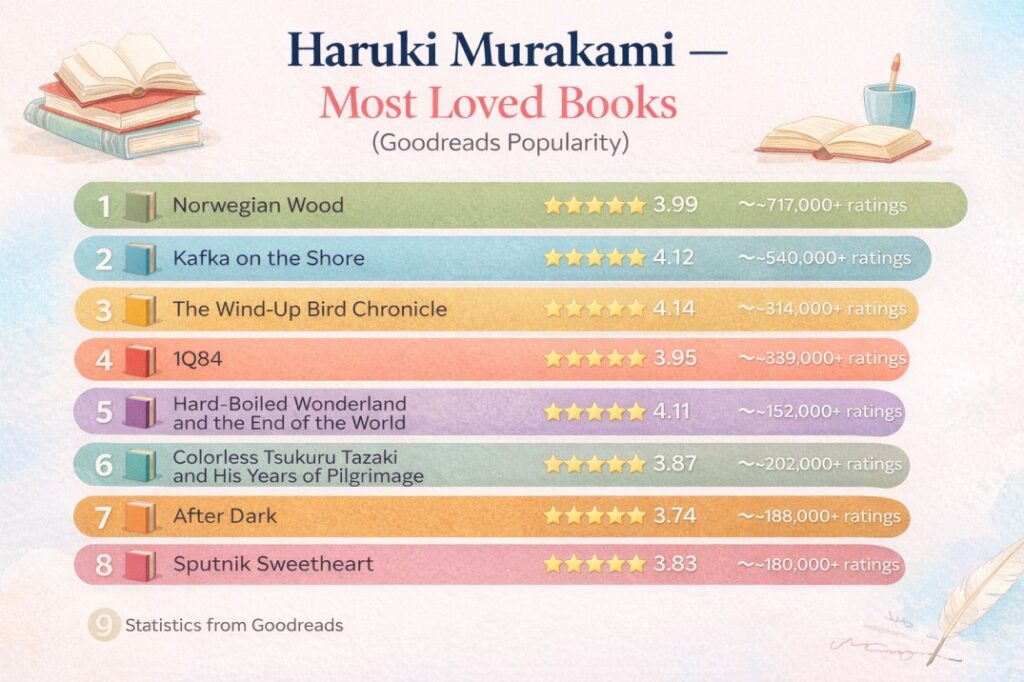
- Hard-Boiled Wonderland and the End of the World
- The Wind-Up Bird Chronicle
- Kafka on the Shore
- 1Q84
These works established him as:
- A master of surreal realism
- A global voice on alienation and identity
- A literary bridge between East and West
Murakami’s Writing Philosophy
Murakami’s discipline is legendary:
- Writes every morning
- Runs long distances
- Avoids social distractions
He believes:
- Writing is a physical act
- Stamina matters more than talent
- Style emerges from consistency
This routine reflects in his prose—calm on the surface, profound underneath.
Why Readers Across the World Connect With Him
Murakami’s characters are often:
- Isolated
- Emotionally restrained
- Searching for meaning
These qualities resonate globally because modern life feels increasingly solitary.
His work does not explain everything. It allows ambiguity—and readers trust him for that.
Complete List of Haruki Murakami Books (Chronological Order)
Novels
- Hear the Wind Sing (1979)
- Pinball, 1973 (1980)
- A Wild Sheep Chase (1982)
- Hard-Boiled Wonderland and the End of the World (1985)
- Norwegian Wood (1987)
- Dance Dance Dance (1988)
- South of the Border, West of the Sun (1992)
- The Wind-Up Bird Chronicle (1994–95)
- Sputnik Sweetheart (1999)
- Kafka on the Shore (2002)
- After Dark (2004)
- 1Q84 (2009–10)
- Colorless Tsukuru Tazaki and His Years of Pilgrimage (2013)
- Killing Commendatore (2017)
- The City and Its Uncertain Walls (2023)
Short Story Collections
- The Elephant Vanishes (1993)
- After the Quake (2000)
- Blind Willow, Sleeping Woman (2006)
- Men Without Women (2014)
- First Person Singular (2020)
Non-Fiction
- Underground (1997)
- What I Talk About When I Talk About Running (2007)
- Absolutely on Music (2011)
- Novelist as a Vocation (2015)
Literary Awards and Recognition
Murakami has won:
- Franz Kafka Prize
- Jerusalem Prize
- World Fantasy Award
Despite repeated speculation, he has not won the Nobel Prize, though he remains one of the most discussed candidates.
FAQs About Haruki Murakami
Is Haruki Murakami a magical realist?
He is often associated with magical realism, but his work fits better under surreal and metaphysical fiction.
Why does Murakami include cats, wells, and music?
They function as symbolic gateways to inner worlds and memory.
Is Murakami influenced by Western writers?
Yes—especially Kafka, Raymond Chandler, and F. Scott Fitzgerald.
Which Murakami book should beginners read first?
Norwegian Wood or Kafka on the Shore are the most accessible.
Why is Murakami popular worldwide?
Because his themes—loneliness, identity, desire—are universal.
Conclusion: A Writer Who Found His Voice by Trusting Silence
Haruki Murakami’s story proves that literature does not always begin with ambition. Sometimes, it begins with listening—to silence, to rhythm, to the quiet pull of imagination.
He became a writer not by chasing trends, but by walking his own strange, steady path. That is why his books feel intimate even when they are surreal, and personal even when they are global.
For readers and writers alike, Murakami’s life offers a powerful lesson:
the most incredible journeys often begin when you least expect them.
Also read: Top 10 Japanese Books of all time