
Introduction: Why Abdul Kalam’s Books Belong to Every Age
Dr. A. P. J. Abdul Kalam (1931–2015) was not only India’s 11th President or its most beloved scientist; he was also a writer who understood human growth better than most educators. Over his lifetime, Kalam wrote and co-wrote more than 15 books, spanning autobiographies, student-focused inspiration, national vision documents, leadership reflections, and spiritual explorations.
What sets Kalam apart as an author is his moral credibility. He never wrote from a place of privilege or detachment. Born into a modest family in Rameswaram, he experienced financial struggle, academic pressure, professional failure, and public responsibility long before fame reached him. Every book he wrote emerged from lived experience—scientific laboratories, classrooms, policy rooms, and quiet moments of self-reflection.
Students admired him because he spoke without condescension. Teachers trusted him because he respected learning as a discipline, not a shortcut. Adults respected him because his personal life matched his public philosophy. Kalam did not preach success; he explained growth.
One remarkable feature of his writing is that each book naturally aligns with a particular stage of life. Some are gentle enough for children discovering curiosity. Others speak directly to teenagers battling exams and self-doubt. Still others address adults seeking meaning beyond career success.
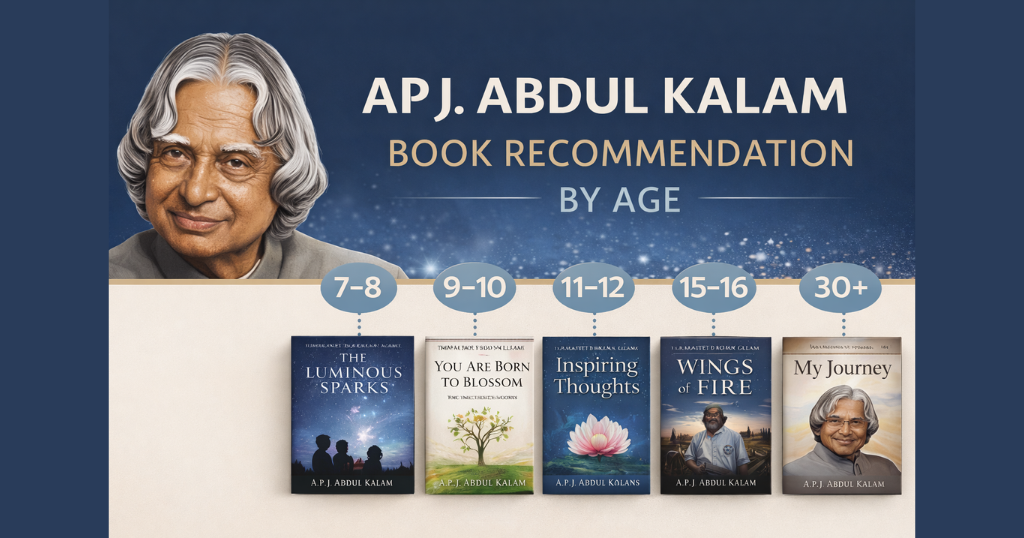
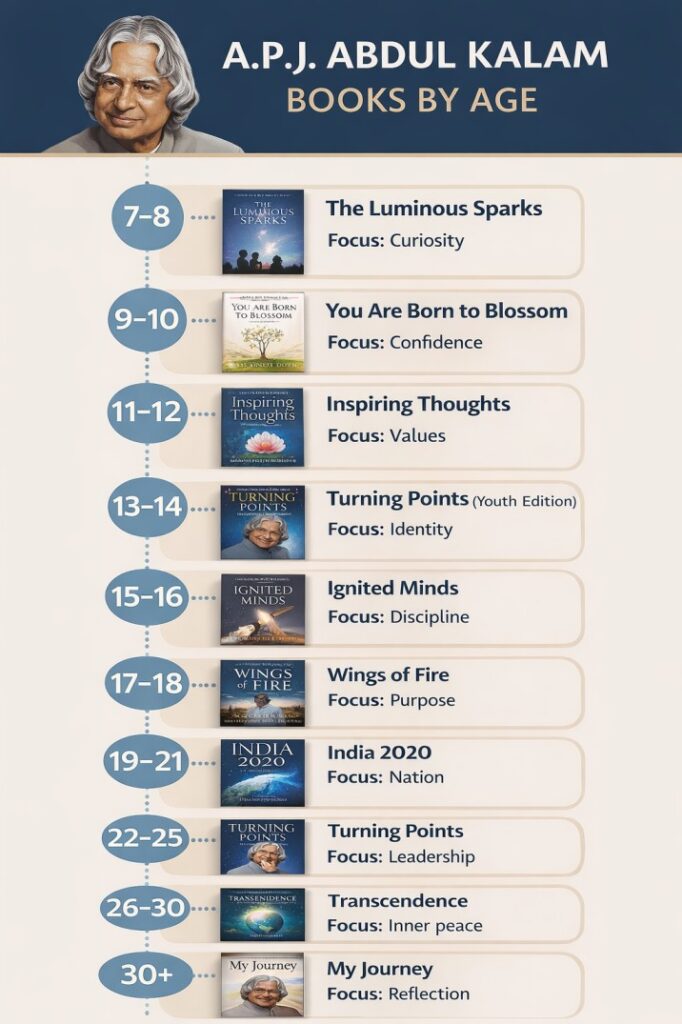
This blog presents an age-wise guide to A. P. J. Abdul Kalam’s books, starting from early childhood and progressing through adolescence, young adulthood, leadership, and reflection—so readers can choose the right book at the right moment in life.
Age 7–8 Years: 📘 The Luminous Sparks (Children’s Adaptation)
Awakening Curiosity and Wonder
At seven or eight, children are not searching for ambition; they are discovering the joy of curiosity. The Luminous Sparks works beautifully at this stage because it does not overwhelm young readers with stories of achievement. Instead, it offers short thoughts and reflections that encourage observation, honesty, effort, and kindness.
The language is simple, and the ideas are gentle. Kalam introduces values indirectly—through reflections rather than instructions. Children encounter concepts like curiosity, discipline, and dreaming without pressure or fear.
For parents and teachers, this book often becomes a conversation starter rather than a lesson plan. A single page can lead to discussions about nature, learning, or helping others.
Why it fits this age:
Children at this stage absorb ideas emotionally. Kalam’s calm, reassuring tone allows curiosity to grow naturally.
Reader sentiment (Goodreads, approximate):
⭐ 4.4/5 — appreciated for simplicity and positivity.
Age 9–10 Years: 📘 You Are Born to Blossom
Building Confidence and Self-Belief
As children approach ten, comparison begins. They notice grades, competitions, and expectations. You Are Born to Blossom speaks directly to this moment, reminding young readers that growth is personal and gradual.
Kalam emphasizes education as a journey rather than a race. He reassures students that ability develops through effort, discipline, and patience—not instant results.
The book is written almost like a caring teacher addressing a classroom. There is encouragement without flattery and discipline without fear.
Why it fits this age:
It addresses insecurity gently, reinforcing self-belief before self-doubt becomes dominant.
Reader sentiment:
⭐ 4.3/5 — widely used by parents and schools.
Age 11–12 Years: 📘 Inspiring Thoughts
Understanding Values and Responsibility
At eleven or twelve, children begin questioning authority and forming independent opinions. Inspiring Thoughts offers short, thoughtful messages drawn from Kalam’s interactions with students across the country.
Instead of telling children what to think, the book invites them to reflect—on effort, honesty, respect for knowledge, and social responsibility.
This is often the age when children start asking deeper questions: Why should I study? Why should I care? Kalam responds without moral pressure, offering perspective rather than commands.
Why it fits this age:
The short-format reflections suit developing attention spans while introducing ethical thinking.
Reader sentiment:
⭐ 4.2/5 — valued for clarity and accessibility.
Age 13–14 Years: 📘 Turning Points (Youth-Friendly Edition)
Identity, Failure, and Choice
Early adolescence is marked by emotional shifts and self-questioning. In Turning Points, Kalam shares moments when his life direction changed—through rejection, mentorship, and difficult decisions.
Rather than presenting a smooth success story, he highlights uncertainty and learning. Failure is treated not as a setback but as information.
For teenagers beginning to face academic pressure, this book offers reassurance that growth is uneven and personal.
Why it fits this age:
It normalizes confusion and presents choice as a process rather than a single defining moment.
Reader sentiment:
⭐ 4.4/5 — often praised for honesty.
Age 15–16 Years: 📘 Ignited Minds
Discipline, Effort, and Direction
Mid-teen years bring exams, expectations, and comparison. Ignited Minds is more direct in tone than Kalam’s earlier books, urging young readers to rise above complacency and passive thinking.
He addresses the youth of the nation collectively, emphasizing responsibility, discipline, and excellence. The book does not glamorize success; it stresses sustained effort.
This stage is when readers begin to connect personal growth with larger social contribution.
Why it fits this age:
It channels teenage energy into purposeful discipline without harshness.
Reader sentiment:
⭐ 4.5/5 — especially popular among students preparing for competitive exams.
Age 17–18 Years: 📘 Wings of Fire
Dreams, Career, and Self-Discovery
Kalam’s autobiography is best read when students stand at the edge of adulthood. Wings of Fire traces his journey from a modest childhood in Rameswaram to leading India’s space and missile programs.
The book is not a celebration of achievement alone; it highlights teamwork, mentorship, failure, and perseverance. Teachers, scientists, and colleagues receive as much credit as Kalam himself.
For students choosing careers, this book offers reassurance that beginnings do not define limits.
Why it fits this age:
It provides direction without prescribing a single path.
Reader sentiment:
⭐ 4.3/5 — one of the most loved Indian autobiographies.
Age 19–21 Years: 📘 India 2020: A Vision for the New Millennium
Thinking Beyond the Self
As young adults begin to engage with society and politics, India 2020 shifts focus from individual ambition to collective progress.
Kalam outlines how education, technology, healthcare, and governance shape a nation’s future. The book encourages readers to see themselves as contributors, not spectators.
Why it fits this age:
It expands perspective from personal success to national responsibility.
Reader sentiment:
⭐ 4.1/5 — widely discussed in academic circles.
Age 22–25 Years: 📘 Turning Points (Complete Edition)
Leadership and Ethical Decision-Making
This edition focuses on Kalam’s presidential years and leadership challenges. It explores ethical dilemmas, decision-making under pressure, and the balance between authority and humility.
For young professionals entering workplaces or leadership roles, the book offers real-world insight into responsibility.
Why it fits this age:
It prepares readers for leadership grounded in ethics.
Reader sentiment:
⭐ 4.3/5 — respected for maturity and clarity.
Age 26–30 Years: 📘 Transcendence: My Spiritual Experiences
Inner Balance and Meaning
As career milestones accumulate, many readers begin seeking emotional and spiritual balance. Transcendence explores Kalam’s inner life, mentors, and reflections on faith and purpose.
The book bridges science and spirituality without dogma, offering calm introspection rather than instruction.
Why it fits this age:
It supports reflection during periods of transition.
Reader sentiment:
⭐ 4.0/5 — appreciated for depth and calm tone.
Age 30+ Years: 📘 My Journey: Transforming Dreams into Actions
Reflection and Wisdom
This reflective work gathers Kalam’s life lessons into a mature narrative. It revisits dreams, failures, mentors, and values with the perspective of a life lived fully.
Readers at this stage often find resonance rather than motivation.
Why it fits this age:
It encourages perspective, gratitude, and quiet purpose.
Reader sentiment:
⭐ 4.2/5 — valued for reflective insight.
Why Kalam’s Books Continue to Matter
Kalam’s books endure because they:
- Respect intelligence at every age
- Avoid exaggeration and shortcuts
- Balance ambition with ethics
- Encourage growth without comparison
They are not manuals for success but companions for growth.
Conclusion: A Reading Journey That Grows With Life
Dr. A. P. J. Abdul Kalam did not write for one generation or one phase of life. His books form a continuous learning path, offering guidance at every turning point.
Read at the right time, each book feels personal—almost as if written specifically for that stage of life. That is why Kalam remains admired not just as a leader or scientist, but as a teacher whose voice continues long after his lifetime.
This guide aims to help readers choose wisely, grow steadily, and return to Kalam whenever clarity is needed.
Also read: Motivational Quotes by Dr. APJ Abdul Kalam