
William Blake’s The Lamb is one of the most celebrated poems in English literature. Written in 1789 as part of his collection Songs of Innocence, this short yet profound poem explores themes of innocence, creation, spirituality, and the divine connection between humanity and nature. For students preparing for exams, understanding The Lamb means going beyond its simple words and discovering the deeper layers that make it one of the most powerful poems of the Romantic era.
In this blog, we will break down Analysis and Summary of The Lamb into 6 easy steps so that you can analyze and remember it clearly. We’ll also provide comparisons with other poets, highlight important literary devices, and connect Blake’s vision with broader literary traditions.
Step 1: Understand the Poet – Who Was William Blake?
Before analyzing The Lamb, it is important to know about William Blake (1757–1827), the poet and visionary artist behind the work. Blake was a poet, painter, and engraver who lived during the Romantic era but was far ahead of his time. While poets like Wordsworth and Coleridge focused on nature and human emotions, Blake combined spirituality, mysticism, and social criticism in his poetry.
Blake’s Songs of Innocence and Experience (1789–1794) is his most famous work, designed to show two contrasting states of the human soul:
- Innocence → purity, childhood, faith, and uncorrupted vision (The Lamb belongs here).
- Experience → suffering, corruption, and the harsh realities of life (The Tyger belongs here).
Think of Blake as a poet who painted with words. Unlike Alexander Pope, who used satire and wit, or John Milton, who used grand epic style, Blake’s strength lay in simplicity and symbolism.
📌 Exam Tip: Always mention that Blake was a Romantic poet but also a visionary mystic, which makes him stand out from contemporaries like Wordsworth, Byron, or Shelley.
Step 2: Read and Summarize The Lamb
Here is the poem (shortened for clarity):
Little Lamb, who made thee?
Dost thou know who made thee?
Gave thee life, and bid thee feed
By the stream and o’er the mead…
Little Lamb, I’ll tell thee,
Little Lamb, I’ll tell thee!
He is called by thy name,
For He calls Himself a Lamb.
Summary in Simple Words:
The poem is a dialogue where the speaker (often read as a child) addresses a lamb and asks: “Who created you?” After listing the gifts of life, food, and wool, the speaker answers his own question: the Lamb was created by God, who is also symbolized as a Lamb (Christ).
Thus, The Lamb celebrates innocence, purity, and the divine connection between creator and creation.
Step 3: Break Down the Structure and Form
One reason The Lamb is easy to remember is its simple structure:
- Form: Lyric poem, divided into two stanzas of 10 lines each.
- Rhyme Scheme: AABB – giving it a nursery-rhyme quality.
- Tone: Gentle, childlike, innocent, like a hymn or lullaby.
Blake intentionally chose simple language so that children could read and sing it. Yet behind its simplicity lies profound spiritual meaning.
📌 Comparison: Unlike Milton’s Paradise Lost with complex blank verse, Blake uses simple couplets. This shows the Romantic idea that even simple words can express divine truths.
Step 4: Thematic Analysis in 6 Easy Steps
Now let’s analyze The Lamb step by step.
1. Theme of Innocence
The lamb itself is a universal symbol of innocence, childhood, and purity. In Christian tradition, the lamb often represents Jesus Christ. Blake uses this image to show how children see the world with faith and simplicity.
Example: Compare this with Wordsworth’s Ode: Intimations of Immortality, where childhood is also seen as a pure, divine state.
2. The Question of Creation
The first stanza repeatedly asks: “Little Lamb, who made thee?” This is not a philosophical question like one in John Donne’s metaphysical poetry, but rather a childlike curiosity.
📌 Contrast: Compare this with Blake’s own The Tyger (from Songs of Experience), where the question “Did he who made the Lamb make thee?” is much darker and more complex. Together, these two poems show Blake’s vision of innocence versus experience.
3. God as the Creator
In the second stanza, the speaker answers: God made the Lamb. Here Blake is both simple and profound. He identifies God with Christ, “the Lamb of God” (a Biblical reference).
Unlike poets like Dryden or Pope, who often explored reason and classical order, Blake emphasizes spirituality and mystery.
4. Childlike Voice and Faith
The speaker sounds like a child, but this is Blake’s genius. For Blake, children are closest to God because of their purity. The use of repetition (“Little Lamb, I’ll tell thee”) is both tender and instructive, resembling catechism or religious teaching.
📌 Comparison: This innocence contrasts with the skeptical voice of Enlightenment poets or philosophers like Voltaire, who questioned faith and reason. Blake restores faith through simplicity.
5. Symbolism of the Lamb
The lamb has multiple symbolic layers:
- Nature: a real lamb, soft and gentle.
- Religion: Christ, “the Lamb of God.”
- Humanity: the innocence within us.
Blake believed that symbols revealed spiritual truths. This is why his poetry is sometimes called prophetic poetry.
📌 Contrast: Compare with Shelley’s Ode to the West Wind, where the wind symbolizes change and revolution. Both poets use nature as a symbol, but for different purposes.
6. Harmony Between Nature and Religion
In The Lamb, nature (the animal) and religion (God as creator) are inseparable. This reflects the Romantic idea of unity in creation. Blake suggests that the divine is not distant but present in every living thing.
📌 Example: This echoes St. Francis of Assisi’s belief in the sacredness of all creatures.
Step 5: Literary Devices in The Lamb
To score high in exams, always mention key literary devices:
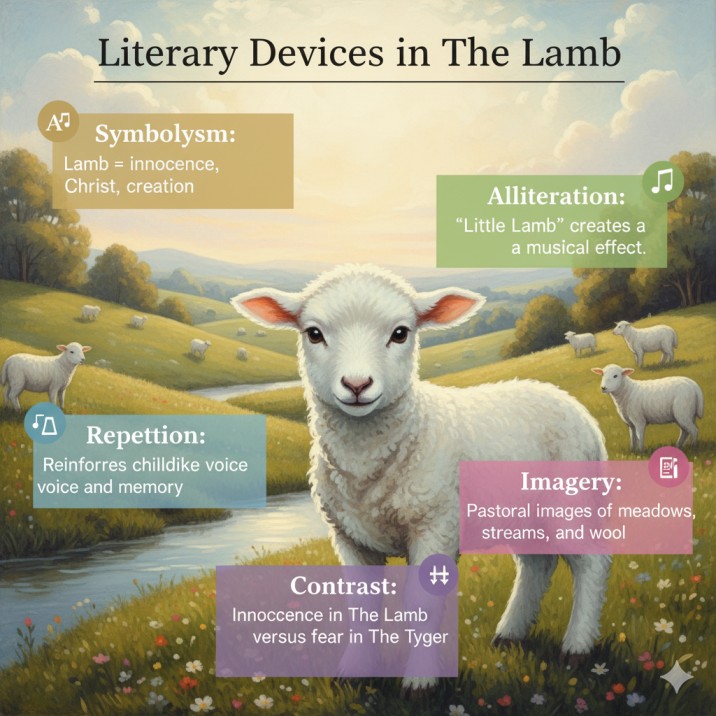
- Symbolism: Lamb = innocence, Christ, creation.
- Alliteration: “Little Lamb” creates a musical effect.
- Repetition: Reinforces childlike voice and memory.
- Imagery: Pastoral images of meadows, streams, and wool.
- Contrast: Innocence in The Lamb versus fear in The Tyger.
📌 Extra Tip: Teachers love when you mention contrasts within Blake’s own works. Always connect The Lamb to The Tyger.
Step 6: Blake in Context – Why Is The Lamb Important?
Blake was not famous during his lifetime, but today he is considered one of the greatest Romantic poets. The Lamb is important because:
- It shows Blake’s visionary spirituality.
- It represents the Romantic idea that nature and God are linked.
- It demonstrates that simplicity can be profound.
- It forms part of Blake’s “Innocence and Experience” duality, making it central to his philosophy.
📌 Comparison with Other Poets:
- Blake vs. Wordsworth: Both see children as pure, but Blake focuses on spiritual innocence while Wordsworth focuses on natural innocence.
- Blake vs. Donne: Donne uses intellectual arguments (metaphysical conceits), while Blake uses childlike imagery.
- Blake vs. Milton: Milton writes about cosmic battles (Paradise Lost), while Blake writes about small, everyday symbols to reveal God.
Final Thoughts: Why Students Should Remember The Lamb
Students often think of Blake’s The Lamb as “too simple.” But its simplicity is its power. By asking “Who made thee?” Blake not only celebrates childhood innocence but also forces us to reflect on creation, God, and humanity itself. We have made this analysis and summary of The Lamb so that you never forget about it.
In exams, remember the following key points:
- Blake was a Romantic visionary poet.
- The Lamb belongs to Songs of Innocence.
- It symbolizes innocence, Christ, and divine creation.
- It contrasts with The Tyger from Songs of Experience.
- Blake’s style = simple yet deeply symbolic.
- The poem is important because it connects nature, religion, and humanity.
When compared to other poets like Wordsworth, Donne, and Milton, Blake’s uniqueness lies in his childlike yet profound voice. That is why The Lamb continues to be one of the most studied and remembered poems in English literature.
Also read: 10 Best Poems About Rain in the History of Literature