
The ocean has always been the ultimate mirror for the human soul. It is vast, deep, unpredictable, and rhythmic. In the history of literature, poets have turned to the sea to explain everything from the agony of exile to the heights of spiritual awakening.
Whether you are a student, a researcher, or a lover of the deep blue, this guide explores the 20 most significant ocean poems across global literature. We will dive into the verses of masters from the West and the East, analyzing how the “wine-dark sea” has evolved as a symbol of life, death, and eternity.
1. “The Rime of the Ancient Mariner” – Samuel Taylor Coleridge (England)
The Verse:
“Water, water, every where,
And all the boards did shrink;
Water, water, every where,
Nor any drop to drink.”
The Meaning: Coleridge’s 1798 masterpiece uses the ocean as a space of divine judgment and supernatural purgatory. After killing an albatross, the Mariner is stranded in a “silent sea.” Here, the ocean is a beautiful but terrifying prison that reflects the character’s guilt and isolation.
2. “Sea Fever” – John Masefield (UK)
The Verse:
“I must go down to the seas again, to the lonely sea and the sky,
And all I ask is a tall ship and a star to steer her by;
And the wheel’s kick and the wind’s song and the white sail’s shaking,
And a grey mist on the sea’s face, and a grey dawn breaking.”
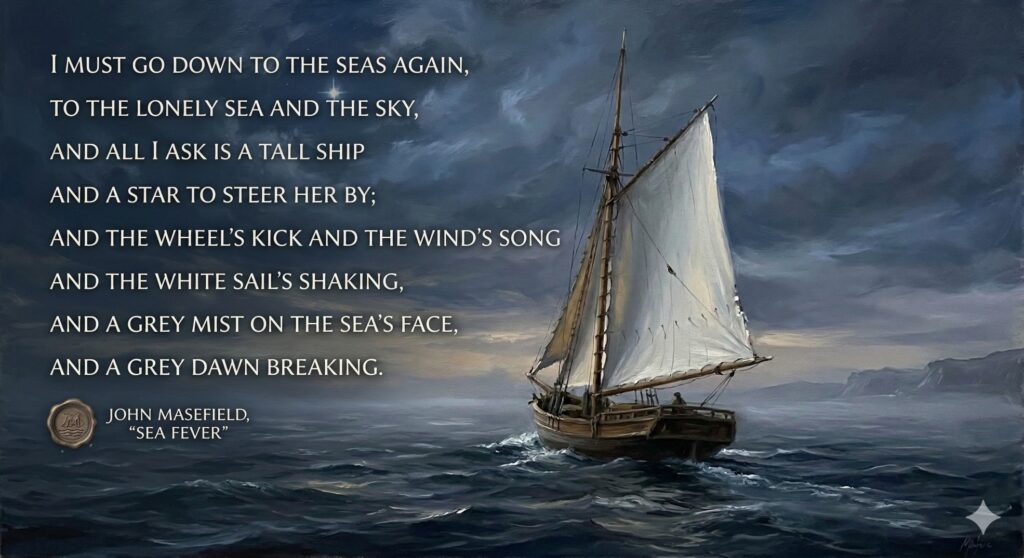
The Meaning: Masefield, who was a sailor himself, captures the irresistible “call” of the ocean. The sea here represents freedom and the restless human spirit that cannot be contained by life on land.
3. “Dover Beach” – Matthew Arnold (England)
The Verse:
“The Sea of Faith
Was once, too, at the full, and round earth’s shore
Lay like the folds of a bright girdle furl’d.
But now I only hear
Its melancholy, long, withdrawing roar,”
The Meaning: Arnold uses the ocean as a metaphor for religious faith. Just as the tide retreats from the pebbles on the beach, he argues that faith is retreating from the modern world, leaving behind a cold, uncertain reality.
4. “The Odyssey” – Homer (Ancient Greece)
The Verse:
“Then for nine days I was swept along by destructive winds
over the fish-infested sea; but on the tenth day
we reached the land of the Lotus-eaters.”
The Meaning: In the foundation of Western literature, the ocean is the ultimate obstacle. For Odysseus, the “wine-dark sea” is the domain of Poseidon—a chaotic force that tests a man’s cunning and endurance.
5. “Break, Break, Break” – Alfred, Lord Tennyson (UK)
The Verse:
“Break, break, break,
On thy cold grey stones, O Sea!
And I would that my tongue could utter
The thoughts that arise in me.”
The Meaning: Tennyson wrote this after the death of his friend Arthur Hallam. The ocean’s relentless waves represent the cold, indifferent continuation of the world while the poet is paralyzed by grief. The sea is eternal; human life is not.
6. “Song of Myself” (Section 22) – Walt Whitman (USA)
The Verse:
“You sea! I resign myself to you also—I guess what you mean,
I behold from the beach your crooked inviting fingers,
I believe you refuse to go back without feeling of me,
We must have a turn together, I undress, hurry me out of sight of the land,”
The Meaning: Unlike the fearful Europeans, Whitman views the ocean as a lover. He seeks a sensual, physical union with the water, representing the American Transcendentalist idea of merging one’s identity with nature.
7. “Ghazal: Samundar Ki Khamoshi” – Parveen Shakir (Urdu/Pakistan)
The Verse:
“Aks-e-khushboo hoon, bikharne se na roke koi,
Aur bikhar jaaun to mujh ko na samete koi.
Main samundar hoon, meri apni ana hai apni,
Mujh mein gir kar to dikhaye na dube koi.”
(I am a reflection of fragrance, let no one stop me from scattering / I am the ocean, I have my own ego / Let someone try to fall into me and not drown.)
The Meaning: Shakir, a legendary Urdu poet, uses the ocean to represent the vast, deep, and sometimes dangerous interior world of a woman’s emotions and self-respect (ana).
8. “The Dry Salvages” – T.S. Eliot (USA/UK)
The Verse:
“The sea has many voices,
Many gods and many voices.
The salt is on the briar rose,
The fog is in the fir tree.”
The Meaning: Part of his Four Quartets, Eliot’s ocean is a symbol of time. It is an ancient, rhythmic force that contains the history of all human suffering and wreckage.
9. “Ariel’s Song” (The Tempest) – William Shakespeare
The Verse:
“Full fathom five thy father lies;
Of his bones are coral made;
Those are pearls that were his eyes:
Nothing of him that doth fade
But doth suffer a sea-change
Into something rich and strange.”
The Meaning: This is the origin of the term “sea-change.” Here, the ocean is a place of magical transformation. Death in the sea isn’t an end, but a metamorphosis into something beautiful and permanent.
10. “Facing the Ocean” – Cao Cao (China/Han Dynasty)
The Verse:
“East of Jieshi I look upon the deep,
How vast the water, how still the islands.
The trees stand thick, the grass lush,
The autumn wind sighs, great waves rise.”
The Meaning: A powerful statesman and poet, Cao Cao uses the vastness of the ocean to reflect his own political ambitions and the grandeur of the universe.
11. “Full Moon, Little Frieda” – Ted Hughes (UK)
The Verse:
“The moon has stepped back like an artist gazing amazed at a work
That points at him amazed.
Then the sea’s voice…
A staggering bay, a depth of stars.”
The Meaning: Hughes captures the raw, elemental power of the sea meeting the sky. It is a moment of pure, unmediated contact with the universe’s scale.
12. “The Sea is History” – Derek Walcott (Saint Lucia)
The Verse:
“Where are your monuments, your battles, martyrs?
Where is your tribal memory? Sirs,
in that grey vault. The sea. The sea
has locked them up. The sea is History.”
The Meaning: For Caribbean poets, the ocean is the grave of the Middle Passage. Walcott argues that for displaced people, the ocean holds the records that land-based history books have ignored.
13. “Annabel Lee” – Edgar Allan Poe (USA)
The Verse:
“And so, all the night-tide, I lie down by the side
Of my darling—my darling—my life and my bride,
In her sepulchre there by the sea—
In her tomb by the sounding sea.”
The Meaning: The ocean is the setting for eternal, gothic romance. The “sounding sea” provides a rhythmic, mournful soundtrack to a love that survives death.
14. “Mirza Ghalib’s Sea Metaphor” – Mirza Ghalib (India)
The Verse:
“Ishrat-e-qatra hai darya mein fana ho jaana,
Dard ka had se guzarna hai dava ho jaana.”
(The joy of the drop is to be lost in the ocean / When pain exceeds all limits, it becomes its own cure.)
The Meaning: In Sufi and Urdu poetry, the “Ocean” is God or the Universal Soul. The human is a “drop” whose ultimate goal is to return to the sea, losing its ego to find peace.
15. “Crossing the Bar” – Alfred, Lord Tennyson
The Verse:
“Sunset and evening star,
And one clear call for me!
And may there be no moaning of the bar,
When I put out to sea,”
The Meaning: Written at the end of his life, Tennyson uses “putting out to sea” as a metaphor for dying. The “sandbar” is the boundary between life and the vast eternity of the afterlife.
16. “Ode to the Sea” – Pablo Neruda (Chile)
The Verse:
“Here on the island
the sea
and so much sea
overflowing
out of itself”
The Meaning: Neruda treats the sea as a living, breathing creature. It is a source of life and food for the poor, but also an overwhelming force of nature that reminds humans of their smallness.
17. “The Convergence of the Twain” – Thomas Hardy (UK)
The Verse:
“In a solitude of the sea
Deep from human vanity,
And the Pride of Life that planned her, stilly couches she.”
The Meaning: Written about the sinking of the Titanic, Hardy imagines the ship resting at the bottom of the ocean. The sea represents the “Immanent Will” of nature that humbles human pride and technology.
18. “Childe Harold’s Pilgrimage” – Lord Byron (UK)
The Verse:
“Roll on, thou deep and dark blue Ocean—roll!
Ten thousand fleets sweep over thee in vain;
Man marks the earth with ruin—his control
Stops with the shore;”
The Meaning: This is the ultimate “Byronic” view of the sea. Byron loves the ocean because humans cannot ruin it. It is the only part of the world that remains unconquered and wild.
19. “The Sea-Limits” – Dante Gabriel Rossetti (UK)
The Verse:
“Consider the sea’s listless chime:
Time’s self it is, made audible,—
The murmur of the earth’s own shell.”
The Meaning: Rossetti suggests that the sound of the ocean is the sound of time itself. To listen to the sea is to listen to the heartbeat of the world.
20. “Steering the Day” – Sahir Ludhianvi (Hindi/Urdu/India)
The Verse:
“Kashti-e-maazee ko mazdhaar mein rehne do,
Naye saahil, naye toofaan talash karte hain.”
(Let the boat of the past stay in the mid-stream / Let us search for new shores and new storms.)
The Meaning: Sahir uses the ocean as a metaphor for progress. He encourages leaving the safety of the past to face the “storms” of a new, revolutionary future.
Historical Evolution of the Ocean in Literature
| Era | Symbolic Usage |
| Ancient | A chaotic, divine obstacle (The Odyssey). |
| Medieval/Sufi | The Divine Unity (The Ocean) and the Soul (The Drop). |
| Romantic | A mirror for the sublime and human emotion (Byron/Coleridge). |
| Victorian | A metaphor for fading faith and mortality (Arnold/Tennyson). |
| Modern/Post-Colonial | A vault of history and collective memory (Walcott). |
Frequently Asked Questions (FAQs)
What is the most famous line about the ocean in poetry?
Coleridge’s “Water, water, every where / Nor any drop to drink” is the most cited, representing the irony of being surrounded by what you need but cannot use.
Why do poets often compare the human soul to a drop in the ocean?
This is a central trope in Eastern and mystical poetry (Ghalib, Rumi). It represents the idea that our individual identity is small, but we are part of a vast, divine whole.
What does the “Sandbar” represent in Tennyson’s poetry?
The sandbar (the “bar”) represents the thin line between life and death. Crossing it means leaving the world of time and entering eternity.
Also read: 20 Best Red Rose Poems