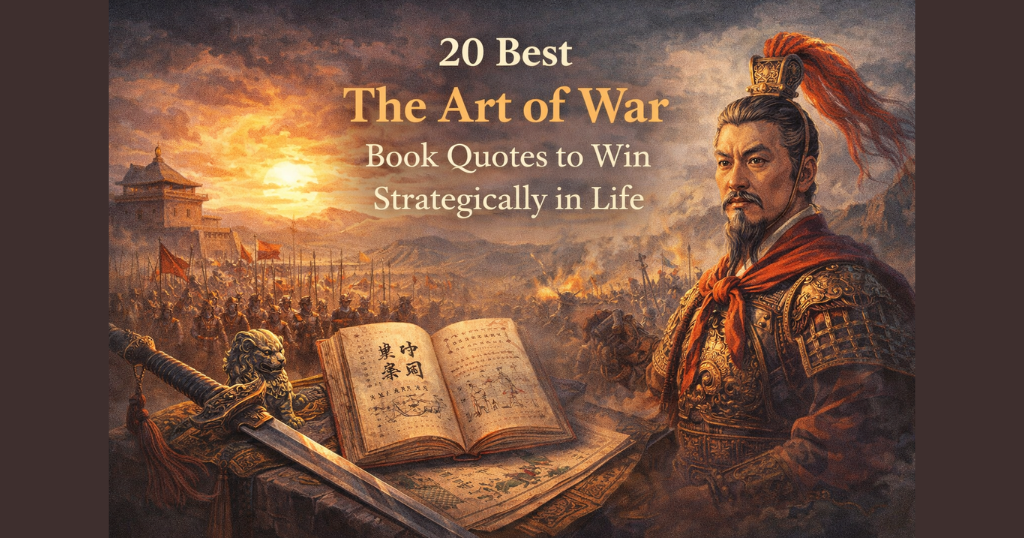
In the arena of global competition, whether on the battlefield, in the boardroom, or in personal development, one book remains the undisputed manual for victory: “The Art of War” by Sun Tzu. Written over 2,500 years ago, this ancient Chinese text is not just a military guide; it is a profound philosophical study of human nature, conflict, and strategy.
As an expert in strategic literature, I have curated 20 quotes from “The Art of War” that are more than just words—they are tactical blueprints for success. This guide provides a wholesome, deep-dive analysis of each quote, accompanied by historical examples to help you master the “Art” yourself.
1. On Preparation and Victory
“Victorious warriors win first and then go to war, while defeated warriors go to war first and then seek to win.”

The Explanation: Strategy is won in the mind and the planning stages before a single move is made. Victory is a result of calculated preparation, not luck.
Historical Example: Before the Battle of Midway (1942), the U.S. Navy had already “won” by breaking Japanese naval codes. They knew exactly where and when the attack would happen, securing victory before the first plane took off.
2. The Power of Self-Awareness
“If you know the enemy and know yourself, you need not fear the result of a hundred battles.”
The Explanation: This is the ultimate law of competition. Success requires a brutal, honest assessment of your own strengths and a meticulous study of your opponent’s vulnerabilities.
Historical Example: In the Battle of Gaugamela, Alexander the Great knew his army was outnumbered but also knew the rigid, immobile nature of the Persian lines. He exploited this specific gap to crush an empire.
3. The Art of Subtlety
“The supreme art of war is to subdue the enemy without fighting.”
The Explanation: The highest form of excellence is achieving your goals through diplomacy, psychological pressure, or strategic positioning, rather than costly physical conflict.
Historical Example: During the Cold War, the policy of “Deterrence” was based on this principle—maintaining such a strong position that the opponent chose not to fight, eventually leading to a bloodless conclusion.
4. On Deception
“All warfare is based on deception.”
The Explanation: Conflict is a game of perception. To win, you must hide your true intentions and lead your opponent to believe a false reality.
Historical Example: During Operation Overlord (D-Day), the Allies created “Operation Fortitude,” a fake army of inflatable tanks and radio chatter to convince Hitler that the invasion would happen at Pas-de-Calais instead of Normandy.
5. The Speed of Lightning
“Let your plans be dark and impenetrable as night, and when you move, fall like a thunderbolt.”
The Explanation: Stealth followed by explosive, decisive action is the key to catching an opponent off guard. Surprise is the greatest force multiplier.
Historical Example: The Blitzkrieg tactics of WWII utilized this perfectly—moving with such speed and concentrated force that defenders were paralyzed by the “thunderbolt” before they could react.
6. On Momentum
“Energy may be likened to the bending of a crossbow; decision, to the releasing of the trigger.”
The Explanation: A leader’s role is to build up resources (potential energy) and then choose the exact, perfect millisecond to release that force for maximum impact.
Historical Example: Napoleon Bonaparte was a master of this. He would maneuver his corps separately to confuse the enemy, then suddenly “release the trigger,” concentrating his entire army at one point of the enemy line.
7. Being Formless Like Water
“Water shapes its course according to the nature of the ground over which it flows; the soldier works out his victory in relation to the foe whom he is facing.”
The Explanation: Flexibility is life; rigidity is death. You must adapt your tactics to the specific environment and the specific opponent you face.
Historical Example: Guerrilla warfare throughout history (from the American Revolution to Vietnam) succeeds by “flowing” around the rigid, traditional strength of larger armies.
8. On Chaos and Opportunity
“In the midst of chaos, there is also opportunity.”
The Explanation: When things are falling apart, most people panic. A strategist looks for the gaps created by the disorder to find a new path to victory.
Historical Example: Julius Caesar famously used the chaos of the Roman Civil War to transform a crumbling republic into his own empire by seizing moments of political instability.
9. The Importance of Foreknowledge
“Foreknowledge cannot be gotten from ghosts and spirits… it must be obtained from people who know the conditions of the enemy.”
The Explanation: Never rely on “gut feelings” or luck. Real intelligence comes from gathering hard data and human insights.
Historical Example: The Enigma machine decryption by Alan Turing’s team provided the “foreknowledge” that allowed the Allies to track German U-boats, effectively winning the Battle of the Atlantic.
10. On Leadership by Example
“A leader leads by example, not by force.”
The Explanation: Authority alone doesn’t inspire loyalty. True power comes from being the first to embody the standards you set for others.
Historical Example: George Washington at Valley Forge lived in the same harsh conditions as his men, earning a loyalty that force could never have commanded.
11. Avoiding the Strong, Striking the Weak
“Avoid what is strong and strike at what is weak.”
The Explanation: Efficiency is the goal. Don’t waste energy attacking an opponent’s greatest strength; find the “soft underbelly” where a small force can do the most damage.
Historical Example: Apple’s entry into the music industry with the iPod didn’t attack Microsoft’s PC dominance; it struck the “weak” and disorganized music market, taking over before rivals could react.
12. On Seizing the Initiative
“The expert in battle moves the enemy, and is not moved by him.”
The Explanation: A strategist dictates the terms of the engagement. If you are reacting to your opponent, you have already lost the initiative. Historical Example: Hannibal Barca at the Battle of Cannae moved the Roman legions exactly where he wanted them—into a trap—forcing them to react to his movements until they were surrounded.
13. The Cost of Conflict
“There is no instance of a nation benefitting from prolonged warfare.”
The Explanation: Conflict is expensive in terms of money, time, and morale. The goal should always be a swift, decisive victory to minimize cost.
Historical Example: The Seven Years’ War left both Britain and France in such massive debt that it directly triggered the American and French Revolutions.
14. On Discipline
“Treat your men as you would your own beloved sons, and they will follow you into the deepest valley.”
The Explanation: Empathy is a strategic asset. A team that feels truly cared for will perform at levels that fear-based management can never reach.
Historical Example: Cyrus the Great of Persia was known for his benevolence and respect for conquered peoples, creating an empire held together by loyalty rather than just fear.
15. The “Golden Bridge”
“Build your opponent a golden bridge to retreat across.”
The Explanation: A cornered animal is at its most dangerous. If you give an opponent no way to save face or escape, they will fight to the death, increasing your own losses.
Historical Example: During the Cuban Missile Crisis, Kennedy provided Khrushchev with a “golden bridge” (a private deal to remove missiles from Turkey) to allow the USSR to retreat without losing global face.
16. On Calculated Risk
“Move not unless you see an advantage; use not your troops unless there is something to be gained; fight not unless the position is critical.”
The Explanation: Patience is a weapon. Every move must serve a specific purpose. If there is nothing to be gained, don’t move.
Historical Example: Fabius Maximus (The Cunctator) saved Rome from Hannibal by refusing to fight. He knew Hannibal couldn’t be beaten in open battle, so he simply waited, exhausting the invader’s resources.
17. The Five Essentials for Victory
“He will win who knows when to fight and when not to fight.”
The Explanation: Discernment is the first step to victory. Knowing which battles are “unwinnable” or “unprofitable” is as important as knowing how to fight.
Historical Example: Sun Tzu himself reportedly served King Helü, demonstrating that a small, disciplined force (properly chosen) could defeat a massive, undisciplined army.
18. On Impenetrable Plans
“Be extremely subtle even to the point of formlessness. Be extremely mysterious even to the point of soundlessness.”
The Explanation: If your opponent cannot see your “form” (your plan or structure), they cannot build a defense against it.
Historical Example: Modern Stealth Technology is the literal application of this—planes that are “formless” to radar can strike without being detected.
19. The Resilience of the Mountain
“In raiding and plundering be like fire, in immovability like a mountain.”
The Explanation: You must have the ability to switch between extreme aggression and absolute, unshakeable defense.
Historical Example: The Battle of Thermopylae saw the Spartans acting as the “mountain,” holding a narrow pass against hundreds of thousands, demonstrating that immovability can break an entire invasion.
20. On Supreme Excellence
“Breaking the enemy’s resistance without fighting is the acme of skill.”
The Explanation: This is Sun Tzu’s ultimate conclusion. The greatest “Art” is to win through superior mindsets and systems so that the physical battle becomes unnecessary.
Historical Example: The European Union was formed on this logic—integrating economies so deeply that war between member nations became practically and strategically impossible.
Frequently Asked Questions (FAQs)
What is the most famous quote from The Art of War? “If you know the enemy and know yourself, you need not fear the result of a hundred battles” is widely considered the most famous and foundational quote of the book.
Can The Art of War be used in business? Yes. Many of Sun Tzu’s principles—such as “knowing the market” (knowing the enemy) and “finding opportunity in chaos”—are taught in top-tier MBA programs worldwide to guide corporate strategy.
Who was Sun Tzu? Sun Tzu was a legendary Chinese general, strategist, and philosopher who lived during the Spring and Autumn period (approx. 544–496 BC). His teachings were compiled into the 13 chapters of The Art of War.
What does “Victory is discerned, not manufactured” mean? It means that victory is a result of seeing an existing opportunity and exploiting it through preparation, rather than trying to force a win through brute strength alone.
Read more: How Sylvia Plath’s Mental Health Influenced Her Writing