
In the history of the modern novel, few books have fundamentally shifted how we view time and the human mind as much as Virginia Woolf’s Mrs. Dalloway. Published in 1925, this masterpiece does not rely on a complex plot; instead, it invites us into the “luminous halo” of human consciousness.
For students and researchers, analyzing Mrs. Dalloway is about more than just understanding a story—it is about understanding the very texture of life itself. This blog provides a deep, easy-to-navigate analysis of the novel, its author, and its revolutionary techniques.
Table of Contents
- About the Author: Virginia Woolf and the Modernist Revolution
- Summary: A Single Day in London
- The Technique: Stream of Consciousness and Free Indirect Discourse
- Key Characters: Clarissa Dalloway vs. Septimus Smith
- Themes: Time, Mental Health, and Post-War Society
- Symbolism: Big Ben and the Flower Shop
- Literary Contrast: Woolf vs. Joyce and Austen
- Frequently Asked Questions (FAQs)
1. About the Author: Virginia Woolf
Virginia Woolf (1882–1941) was a central figure in the Bloomsbury Group and a pioneer of the Modernist movement. She believed that the traditional Victorian novel, with its focus on external events and linear plots, was no longer sufficient to describe the “flickering” reality of modern life.
- Why She is Important: Woolf gave a voice to the internal world. She was one of the first to treat the domestic life of a woman and the traumatic hallucinations of a soldier with equal weight.
- Key Works: To the Lighthouse, Orlando, A Room of One’s Own.
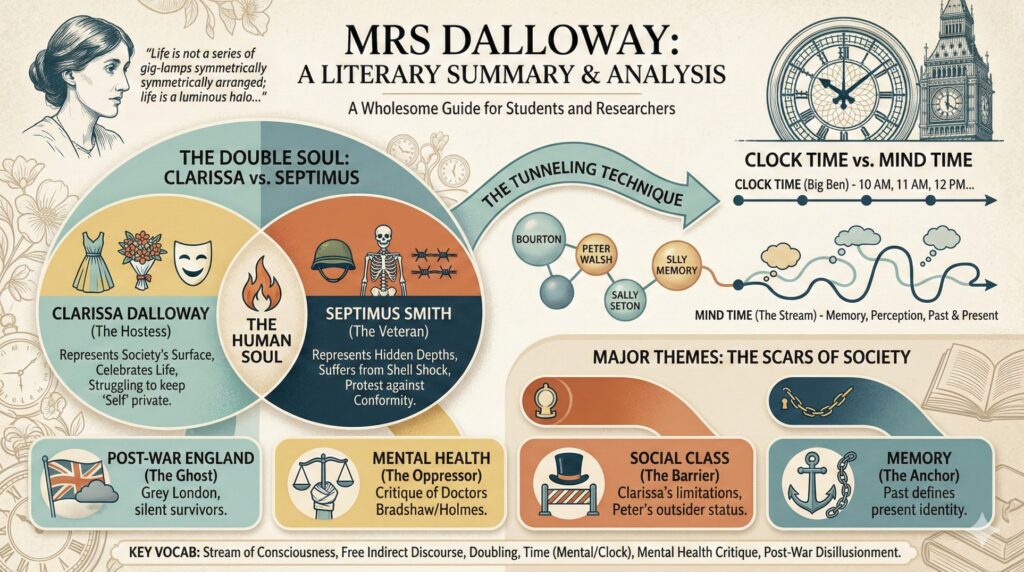
- The Woolfian Philosophy: In her essay Modern Fiction, she wrote: “Life is not a series of gig-lamps symmetrically arranged; life is a luminous halo, a semi-transparent envelope surrounding us from the beginning of consciousness to the end.”
2. Wholesome Summary: A Single Day
The plot of Mrs. Dalloway is deceptively simple: Clarissa Dalloway, a high-society woman in post-World War I London, prepares for a party she is hosting that evening.
The novel begins with one of the most famous opening lines in literature:
“Mrs. Dalloway said she would buy the flowers herself.”
As Clarissa walks through London, we hear her thoughts—her memories of her youth at Bourton, her old flame Peter Walsh, and her choice to marry the steady Richard Dalloway.
Simultaneously, we follow Septimus Warren Smith, a veteran of WWI suffering from “shell shock” (PTSD). While Clarissa prepares for life (the party), Septimus drifts toward death. He eventually commits suicide to escape the doctors who do not understand his soul. At the climax of the novel—the party—Clarissa hears of Septimus’s death. Though she never met him, she feels a profound connection to his act, seeing it as a way to preserve one’s internal freedom.
3. The Technique: How Woolf Wrote It
To analyze Mrs. Dalloway, one must understand Stream of Consciousness. Woolf uses a technique called Free Indirect Discourse, where the narrator’s voice merges with the character’s thoughts so seamlessly that you don’t realize you’ve switched perspectives.
Unlike James Joyce, who often used a “raw” stream of thoughts in Ulysses, Woolf’s style is “tunneling.” She digs tunnels behind her characters to reveal their history, making the past feel as present as the ringing of Big Ben.
4. Key Characters: The Doubling Effect
Woolf famously described Septimus as Clarissa’s “double.”
The following are the characters of the novel:
Clarissa Dalloway | The Hostess | Represents the “surface” of society, grace, and the struggle to keep life together.
Septimus Smith | The Veteran | Represents the “hidden” depths, the madness of war, and the inability to communicate.
Peter Walsh | The Old Lover | Represents the “what if” of the past and the fear of aging.
Sally Seton | The Lost Passion | Represents the wild, rebellious spirit that Clarissa had to suppress to become “Mrs. Dalloway.”
5. Themes: The Scars of Society
A. The Weight of Time
Time is the “villain” of the novel. The constant ringing of Big Ben reminds the characters that life is passing. Woolf contrasts “Clock Time” (the rigid hours of society) with “Mind Time” (the way a single second can feel like an hour if it triggers a memory).
B. Mental Health and “The Doctors”
Woolf uses Septimus to critique the medical establishment. Dr. Holmes and Sir William Bradshaw represent the “proportion” of society—they want to fix people by making them conform. Septimus’s suicide is a protest against this forced conformity.
C. The Post-War “Chill”
The war is over, but its ghost is everywhere. It is in the “grayness” of the streets and the hollowed-out hearts of the survivors.
6. Symbolism: Seeing Beyond the Petals
- Flowers: They symbolize the beauty and fragility of life. Clarissa buys flowers to “create” a world of beauty, while Septimus sees the world as too beautiful to bear.
- The Prime Minister’s Car: Represents the fading power of the British Empire and the social hierarchy that Clarissa lives within.
- The Old Woman Across the Way: Clarissa watches an old woman in the house next door. This woman symbolizes the privacy of the soul—the idea that even in a crowded city, we are ultimately alone.
7. Literary Contrast: Woolf vs. The World
To help researchers, let’s contrast Woolf’s approach with her contemporaries:
- Jane Austen: Like Austen, Woolf focuses on the domestic lives of women. However, while Austen focuses on social manners and marriage as a goal, Woolf focuses on the internal psychological state after the marriage has happened.
- James Joyce: Both used the “single day in a city” format. However, Joyce’s London is gritty and linguistic; Woolf’s London is poetic and ethereal. Joyce is interested in the “guts” of life; Woolf is interested in its “spirit.”
8. Frequently Asked Questions (FAQs)
What is the significance of the title Mrs. Dalloway? The title emphasizes Clarissa’s social identity. By referring to her by her husband’s name, Woolf highlights the tension between Clarissa’s private self and her public role as a “perfect hostess.”
Why does Septimus Smith die in the novel? Septimus commits suicide to avoid being institutionalized by Sir William Bradshaw. In Woolf’s view, this was an act of “defiance”—a way to keep his soul private and free from a society that tried to control his madness.
How does Big Ben function in the story? Big Ben is a recurring motif that symbolizes the relentless passage of time and the shared reality of Londoners. It connects the disparate thoughts of different characters, bringing them back to the present moment.
Is Mrs. Dalloway an example of feminism? Yes. It explores the “buried” lives of women, the limitations of the domestic sphere, and the way female friendship and passion (like Clarissa’s love for Sally Seton) are often sacrificed for social stability.
Also read: Tragedy and the Whole Truth Summary