
Introduction: Why The Way of the World Matters
The Way of the World (1700) is widely regarded as the greatest Restoration comedy ever written. Authored by William Congreve, the play represents the peak of wit, social satire, and dramatic craftsmanship in late 17th-century English drama.
At first glance, the play may seem like a light comedy full of clever conversations, marriage intrigues, and humorous misunderstandings. But beneath its polished dialogue lies a sharp critique of society, particularly of marriage, money, morality, and hypocrisy in the Restoration era.
For students, this play is important because:
- It represents Restoration Comedy of Manners at its finest
- It offers deep insight into social values of late 17th-century England
- It contrasts sharply with earlier Shakespearean comedy and later sentimental drama
- It is frequently asked in university exams, interviews, and research papers
This blog explains The Way of the World in a simple, structured, and memorable manner, covering its background, plot, characters, themes, style, and significance, while also placing it in the wider literary context.
About the Author: William Congreve (1670–1729)
William Congreve was one of the most brilliant dramatists of the Restoration period. Unlike many playwrights of his time, Congreve was highly educated and deeply conscious of literary form.
Congreve’s Major Works
- Love for Love (1695)
- The Old Bachelor (1693)
- The Double Dealer (1693)
- The Way of the World (1700)
Among these, The Way of the World is considered his masterpiece—the most refined, mature, and intellectually complex.
Congreve’s Place in Restoration Drama
Congreve perfected the Comedy of Manners, a genre that:
- Focuses on the upper class
- Satirizes social behavior, marriage, and morality
- Relies heavily on witty dialogue, irony, and verbal elegance
Unlike earlier dramatists who emphasized broad humor, Congreve demanded an intelligent audience capable of appreciating subtle wit.
Historical and Literary Background
The Restoration Period (1660–1700)
The Restoration period began when Charles II was restored to the English throne in 1660 after years of Puritan rule. This era was marked by:
- Revival of theatres
- Celebration of pleasure, fashion, and social freedom
- Reaction against Puritan strictness
Drama became bold, urban, and socially focused.
Comedy of Manners
The Way of the World belongs to Comedy of Manners, characterized by:
- Upper-class settings
- Marriage plots
- Sexual politics
- Satire of hypocrisy
- Clever dialogue rather than physical action
Congreve refined this genre to its highest intellectual level.
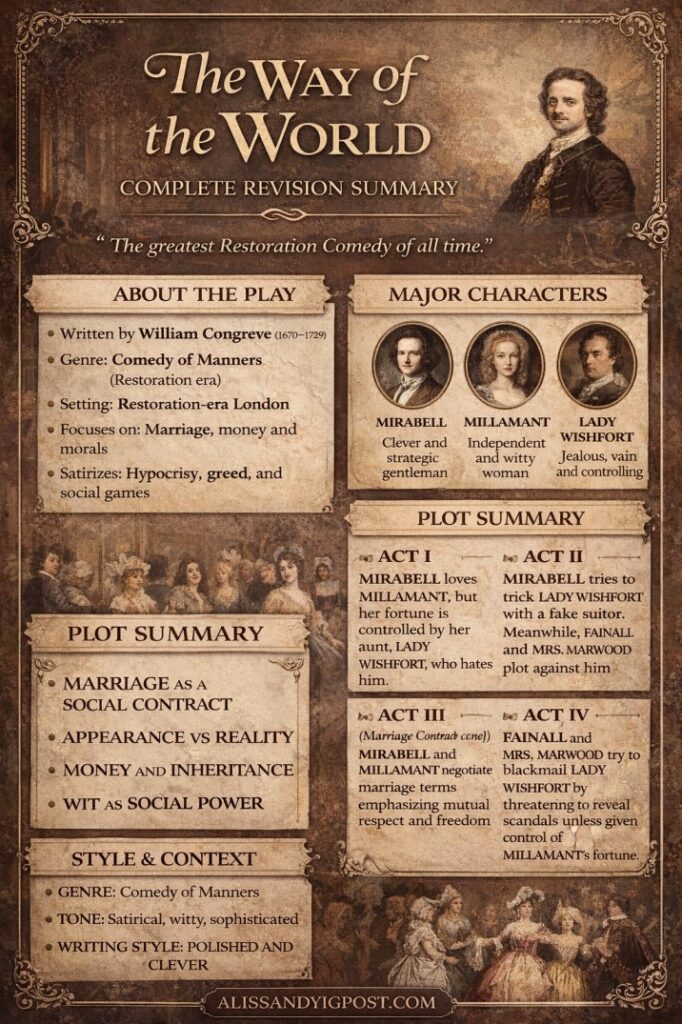
Plot Summary of The Way of the World
(Explained Act-wise for Easy Understanding)
Act I: Love, Wit, and Intrigue Begin
The play opens in a chocolate house—an elite social space. We are introduced to:
- Mirabell, a witty gentleman
- Millamant, a charming and intelligent woman
- Mrs. Fainall, Millamant’s cousin
- Mrs. Marwood, a jealous and scheming woman
Mirabell loves Millamant and wishes to marry her. However, there is a major obstacle:
Millamant’s fortune is controlled by her aunt, Lady Wishfort, who deeply hates Mirabell.
Mirabell must find a way to win Millamant without losing her inheritance.
Act II: Lady Wishfort and the Web of Deception
Lady Wishfort is obsessed with:
- Youth
- Appearance
- Marriage
She wants to remarry and is easily flattered. Mirabell plans to trick her into consenting to his marriage by arranging a fake suitor—his servant disguised as a wealthy man.
At the same time, Mrs. Marwood secretly plots against Mirabell due to jealousy.
Act III: The Marriage Contract Scene (Most Important Scene)
This act contains the famous Proviso Scene, where Mirabell and Millamant discuss the conditions of marriage.
They negotiate:
- Freedom
- Privacy
- Mutual respect
- Equality
This scene is crucial because:
- It presents marriage as a rational partnership
- It rejects blind romantic idealism
- It reflects modern ideas of marriage
Act IV: Betrayal and Exposure
Mrs. Marwood and Fainall (Mrs. Fainall’s husband) attempt to blackmail Lady Wishfort. Fainall threatens to expose his wife’s past relationship with Mirabell unless Lady Wishfort gives him control of Millamant’s fortune.
The situation becomes tense and morally complex.
Act V: Resolution and Moral Victory
Mirabell reveals that:
- Mrs. Fainall’s property is legally protected
- Fainall’s blackmail has no power
The villains are defeated through law, intelligence, and foresight, not emotional drama.
Lady Wishfort finally agrees to Mirabell and Millamant’s marriage.
The play ends with order restored, but without sentimental excess.
Major Characters Explained Simply
Mirabell
- Intelligent
- Rational
- Strategic
- Morally balanced
He represents ideal Restoration gentleman—witty but ethical.
Millamant
- Independent
- Sharp-tongued
- Intelligent
- Modern in thinking
She symbolizes the new woman—demanding respect in marriage.
Lady Wishfort
- Comic figure
- Obsessed with youth
- Symbol of vanity and hypocrisy
Fainall
- Villain of the play
- Greedy and immoral
- Represents corruption beneath polite society
Mrs. Marwood
- Jealous
- Manipulative
- Highlights emotional resentment in social games
Themes of The Way of the World
1. Marriage as a Social Contract
Unlike romantic comedies, Congreve shows marriage as:
- Practical
- Negotiated
- Based on equality
This contrasts with Shakespeare’s idealized love.
2. Appearance vs Reality
Characters appear polite and refined, but:
- Greed
- Jealousy
- Hypocrisy
operate beneath the surface.
3. Money and Inheritance
Marriage is deeply tied to wealth, showing how:
- Love and economics are intertwined
- Women’s independence depends on legal protection
4. Wit as Social Power
Those who control language (Mirabell, Millamant) succeed.
Those driven by greed (Fainall) fail.
Style and Language
Congreve’s language is:
- Polished
- Epigrammatic
- Dense with meaning
Example:
“I hate a lover that can dare to think he draws a moment’s air independent on the bounty of his mistress.”
This requires close reading, which is why students must practice understanding tone and implication.
Comparison with Other Writers
Congreve vs Wycherley
Wycherley (The Country Wife) uses cruder humor.
Congreve refines wit into elegance.
Congreve vs Shakespeare
Shakespeare celebrates romantic idealism.
Congreve emphasizes rational realism.
Congreve vs Sheridan
Sheridan (The School for Scandal) inherits Congreve’s wit but softens moral tone.
Why the Play Was Not Initially Popular
When first performed, audiences found it:
- Too intellectual
- Less emotionally engaging
But critics later recognized its brilliance.
Why Students Must Study This Play Carefully
- Essential example of Restoration Comedy
- Frequently examined
- Offers insight into social history
- Demonstrates evolution of English drama
Key Points for Exams and Interviews
- Genre: Comedy of Manners
- Theme: Marriage, money, morality
- Style: Polished wit
- Central idea: Reason over passion
Conclusion: Why The Way of the World Still Matters
The Way of the World is not just a comedy—it is a mirror of society, showing how intelligence, law, and ethical foresight can overcome greed and deception.
William Congreve created a world where:
- Wit replaces violence
- Reason triumphs over emotion
- Marriage becomes a thoughtful partnership
For students, mastering this play means understanding how society works beneath its polite surface—a lesson that remains relevant even today.