
Introduction: Why “An Apology for Poetry” Still Matters
If literature had a courtroom, An Apology for Poetry (also known as The Defence of Poesy) would be its most powerful argument. Written by Sir Philip Sidney around 1579, this essay defends poetry against the critics of the Elizabethan era who accused poets of spreading lies, promoting immorality, and wasting time.
But Sidney’s response isn’t just a defence—it’s a celebration. He turns accusation into admiration, showing that poetry is not only moral and educational but also the highest form of human expression.
This blog will walk you through the summary and analysis in 7 easy steps, help you understand its core arguments, literary style, and historical context, and make sure you remember it for life—not just for exams.
Step 1: About the Author — Who Was Sir Philip Sidney?
Before diving into the essay, it’s crucial to understand the man behind it.
Sir Philip Sidney (1554–1586) was the ideal Renaissance man — a poet, soldier, courtier, and scholar. Born into nobility, educated at Oxford, and admired by Queen Elizabeth I’s court, he embodied the spirit of his age: intelligence, virtue, and creativity.
His Major Works
- Astrophel and Stella – one of the earliest English sonnet sequences, exploring love and art.
- Arcadia – a pastoral romance blending poetry and prose.
- An Apology for Poetry – his greatest critical work.
Sidney’s writing mirrors the Renaissance belief in human potential, moral responsibility, and the power of art. Like Dante and Chaucer before him, and Milton after him, he viewed poetry as a divine calling — something that shapes both the heart and the intellect.
📘 Quick Contrast:
While later writers like Dryden and Pope defended poetry through wit and reason, Sidney’s defence glows with emotion and faith in art’s spiritual power.
Step 2: Historical Context — Why Did Sidney Write “An Apology for Poetry”?
In Sidney’s time, poetry faced harsh criticism. The Puritans — strict religious reformers — believed that poetry was sinful, promoting imagination over reason, pleasure over virtue. The most famous of these critics was Stephen Gosson, who wrote The School of Abuse (1579), attacking poets, musicians, and dramatists.
Ironically, Gosson dedicated that book to Sidney himself.
Sidney’s Apology was written as a response — not to insult Gosson, but to uplift the value of poetry in the eyes of educated men.
📘 Context Tip for Exams:
Remember: An Apology for Poetry is the first major work of literary criticism in English and laid the foundation for later theorists like Dryden, Wordsworth, and Coleridge.
Step 3: Summary of “An Apology for Poetry” in Simple Terms
Sidney’s essay can be divided into four main parts, which we’ll later break down in seven easy steps of analysis.
1. The Dignity of Poetry
Sidney argues that poetry is the oldest and most noble form of learning. The Bible, Greek myths, and Roman legends all used poetry to teach truth and virtue. He calls poets “the first light-givers to ignorance.”
2. The Power to Teach and Delight
According to Sidney, poetry’s goal is “to teach and delight.” It’s not just entertainment — it inspires people to live better lives. Unlike philosophy (which is too abstract) and history (which is too particular), poetry blends wisdom with imagination.
He famously writes:
“Poesy therefore is an art of imitation, for so Aristotle termeth it, that is to say, a representing, counterfeiting, or figuring forth — to speak metaphorically, a speaking picture.”
3. Rebutting the Critics
Sidney answers three main accusations:
- Poets are liars — No, he says, poets never claim to state facts; they create possibilities.
- Poetry is immoral — On the contrary, it promotes virtue by showing good rewarded and evil punished.
- Poetry is a waste of time — Poetry sharpens the imagination and moves people toward noble action.
4. The Praise of Poets
Sidney concludes that poets are “makers,” creators who imitate the divine act of creation. Poetry, he says, leads the soul toward perfection and truth — making poets almost godlike.
Step 4: Analysis Part 1 — Sidney’s Vision of the Poet
Sidney’s view of the poet is revolutionary. He calls poets “makers” (from the Greek word poiein), meaning creators.
Just as God created the world, poets create worlds of imagination. They don’t merely copy reality; they reimagine it.
“Nature never set forth the earth in so rich tapestry as divers poets have done.”
📘 Interpretation:
Sidney means that poets improve upon nature by revealing its inner beauty and moral truth. For instance, Homer doesn’t just describe battles — he reveals courage, honor, and fate.
📘 Modern Connection:
Think of how Shakespeare, a few years after Sidney, created more real human beings in fiction than most historians did in fact. Hamlet and Lear feel alive because Shakespeare (like Sidney’s ideal poet) reshaped nature through imagination.
Step 5: Analysis Part 2 — Poetry as Moral Education
Sidney’s famous idea that poetry’s goal is “to teach and delight” comes directly from Horace’s Ars Poetica.
But Sidney goes further — he insists that the power of poetry lies in its ability to move us emotionally. Philosophy teaches us what is right, but poetry makes us want to do what is right.
“For nothing can so move a man to love goodness as the discovering of goodness’ beauty.”
📘 Example:
A philosopher might say, “Be brave.”
But a poet like Homer shows us Achilles in battle.
We don’t just understand courage; we feel it.
This is Sidney’s central argument — poetry doesn’t lecture; it awakens.
📘 Contrast:
In the 18th century, Samuel Johnson saw poetry as “a mirror held up to nature.” Sidney saw it as a light that transforms nature.
Step 6: Analysis Part 3 — Sidney’s Rebuttal of Critics
Let’s look at how Sidney dismantles each accusation logically and elegantly.
1. “Poets are Liars.”
Sidney replies: Poets never claim to tell literal truth — they speak of “what may be.”
They create possibilities, not falsehoods.
Thus, poets are more honest than historians who may twist facts.
2. “Poetry is Immoral.”
Poetry, he argues, teaches virtue more powerfully than philosophy because it makes goodness attractive.
“The poet never affirmeth, therefore never lieth.”
He also reminds us that Plato, who famously banished poets, was himself a poet in disguise — his dialogues are filled with poetic imagination.
3. “Poetry is a Waste of Time.”
Sidney’s response: Poetry was the first form of knowledge — older than philosophy or science.
From biblical psalms to classical epics, humanity learned morality, courage, and faith through verse long before textbooks existed.
📘 Exam Tip:
Sidney transforms criticism into admiration — a rhetorical strategy that makes his essay both intellectual and inspirational.
Step 7: Analysis Part 4 — Sidney’s Literary Style
Sidney’s style is as important as his argument.
1. Classical Elegance
Sidney wrote during the Renaissance, when scholars rediscovered classical texts by Aristotle, Plato, and Horace. His essay fuses their logic with English grace.
2. Rhetorical Persuasion
Like Cicero’s orations, his writing is full of balanced phrases and rhythmic sentences.
“The poet, he nothing affirms, and therefore never lieth.”
This blend of logic and lyricism makes the essay memorable — even musical.
3. Passionate Sincerity
Sidney’s tone is not defensive but joyful. He doesn’t argue as a lawyer; he pleads as a believer.
You can feel his love for poetry in every line — and that emotional conviction gives his argument timeless power.
📘 Contrast:
Later critics like T. S. Eliot or Matthew Arnold wrote more analytically. Sidney wrote from faith, not formula — and that’s why his essay still moves readers.
Step 8: The Influence and Legacy of “An Apology for Poetry”
Sidney’s essay became the cornerstone of English literary criticism. Every major poet or critic after him — from Dryden to Coleridge, from Wordsworth to Shelley — inherited his belief in the moral and imaginative power of poetry.
- Dryden echoed Sidney when he said that poetry “delights and instructs.”
- Wordsworth’s Preface to Lyrical Ballads (1800) builds on Sidney’s idea that poetry is “emotion recollected in tranquility.”
- Shelley’s Defence of Poetry (1821) calls poets “the unacknowledged legislators of the world,” a direct descendant of Sidney’s “poets are makers.”
📘 In Short:
Sidney’s influence is universal — he gave poetry a purpose, a dignity, and a soul.
Step 9: Why “An Apology for Poetry” Matters Today
Even centuries later, Sidney’s defence feels surprisingly modern. In an age dominated by algorithms and instant entertainment, his reminder that poetry “teaches through delight” feels revolutionary.
Poetry slows us down, makes us think, makes us feel.
And in a world drowning in information, feeling — as Sidney knew — is what makes us human.
📘 For Students:
In exams, remember Sidney’s three key arguments:
- Poetry is the oldest and most noble art.
- Its purpose is to teach and delight.
- It moves the heart toward virtue through imagination.
If you write these three points with examples (like Homer, Shakespeare, or Milton), you’ll not just pass — you’ll shine.
Conclusion: The Eternal Relevance of Sidney’s Defence
Sir Philip Sidney’s An Apology for Poetry isn’t just a Renaissance essay; it’s a timeless manifesto for the human imagination.
It tells us that poetry isn’t luxury — it’s necessity. It shapes how we dream, how we feel, and how we become better versions of ourselves.
So the next time someone asks, “Why read poetry?” remember Sidney’s words:
“The poet lifts us beyond ourselves.”
That’s why this essay endures — because it reminds us that poetry, at its heart, is not about rhyme or rhythm.
It’s about rescuing humanity from dullness, through beauty and truth.
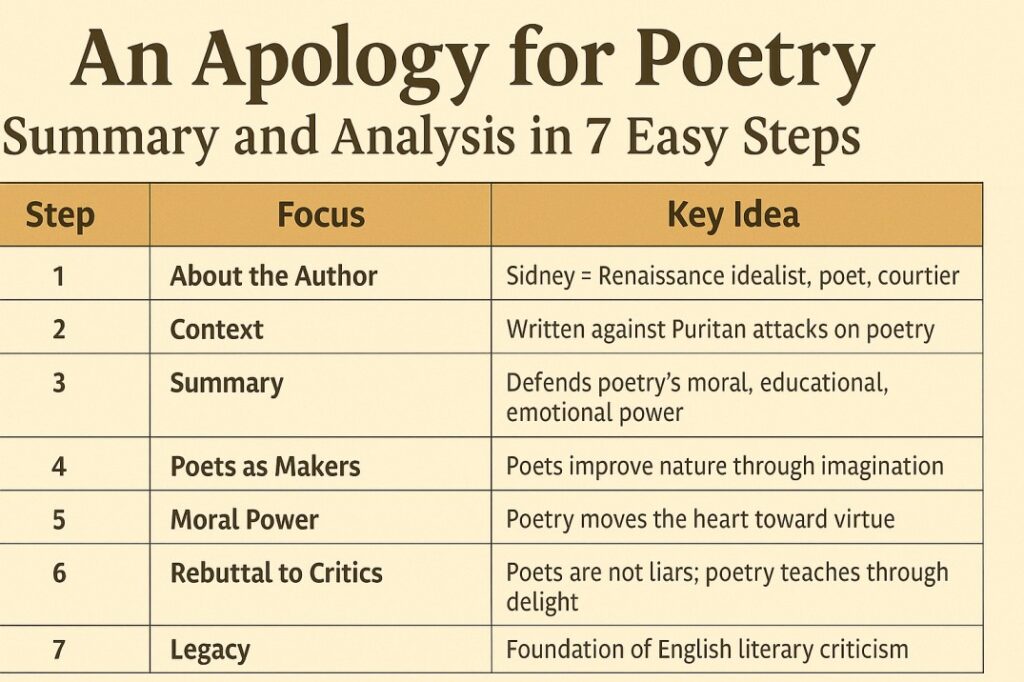
✅ 7 Easy Steps to Remember for Exams
| Step | Focus | Key Idea |
|---|---|---|
| 1 | About the Author | Sidney = Renaissance idealist, poet, courtier |
| 2 | Context | Written against Puritan attacks on poetry |
| 3 | Summary | Defends poetry’s moral, educational, emotional power |
| 4 | Poets as Makers | Poets improve nature through imagination |
| 5 | Moral Power | Poetry moves the heart toward virtue |
| 6 | Rebuttal to Critics | Poets are not liars; poetry teaches through delight |
| 7 | Legacy | Foundation of English literary criticism |
Also read: Analysis and Summary of The Lamb
If you are looking for a great novel to read, you can check our Vikram Suryawanshi’s A Man with A White Shadow.