

John Donne, often called the father of metaphysical poetry, remains one of the most fascinating figures in English literature. To call him just a poet would be like calling Leonardo da Vinci just a painter. Both created works that broke rules, questioned traditions, and pulled audiences into a new way of seeing the world. Donne’s poems are not simple melodies of love or praise; they are intellectual puzzles, emotional paradoxes, and spiritual adventures.
But what does it really mean to say John Donne is a metaphysical poet? And how does he differ from poets before and after him? Let’s break it down step by step — with comparisons, contrasts, and memorable examples.
1. What “Metaphysical Poetry” Really Means
The word metaphysical often confuses readers. It sounds abstract, almost like philosophy rather than poetry. In simple terms, metaphysical poetry is about exploring life’s deepest questions — love, death, God, the soul — with intellectual wit and imaginative comparisons.
Think of it this way: where a Romantic poet like Wordsworth might describe a daffodil field with heartfelt simplicity, a metaphysical poet like Donne would compare the daffodil to something unexpected — maybe a mathematical compass or even a theological truth — forcing the reader to think harder.
So, metaphysical doesn’t mean “cold” or “dry.” Instead, it blends intellect with passion. It’s like mixing fire with geometry, or combining philosophy with a love letter.
2. Donne’s Use of Conceits: The Heart of His Style
A hallmark of metaphysical poetry is the conceit — an extended metaphor that links two seemingly unrelated things. Donne mastered this.
Take his poem A Valediction: Forbidding Mourning. Instead of simply saying “our love will survive distance,” Donne compares lovers to the two legs of a compass. One leg stays fixed in the center (the beloved), while the other draws a wide circle (the poet, traveling). No one before him dared compare human intimacy to a geometric instrument, and yet it works brilliantly.
In contrast, think of Shakespeare’s sonnets. Shakespeare might compare his beloved to a summer’s day, a natural and beautiful but obvious metaphor. Donne, instead, goes out of his way to surprise, almost shock, the reader into a new vision. That is metaphysical.
3. The Marriage of Body and Soul
Another distinctive feature of Donne’s metaphysical style is the way he refuses to separate the physical from the spiritual. For him, the body and soul are intertwined, just as much as reason and emotion are.
Consider his famous poem The Flea. At first glance, it sounds humorous, even absurd: he argues that since a flea has bitten both him and his beloved, their blood is already mingled inside it — so why should she deny him physical union? It’s witty, mischievous, and almost comic. Yet beneath the playfulness lies a serious point: Donne is showing how physical love can be argued in spiritual or intellectual terms.
In contrast, poets before Donne (like the medieval troubadours or even Chaucer) often kept spiritual love and physical love in separate categories. Donne collapses the wall between them, suggesting that both can coexist.
4. Love Poetry Turned into Philosophy
Donne’s love poems are never just about love. They become philosophical investigations. For instance, in The Good-Morrow, he declares that two lovers create their own entire world. He even imagines their eyes as “hemispheres,” forming a complete globe when joined together.
Compare this with later Romantic poets. Shelley, for example, speaks of love as something ethereal, almost untouchable. Donne, by contrast, grounds it in real, intellectual, and sometimes shocking metaphors. Where Shelley floats, Donne argues. Where Wordsworth sings, Donne debates.
This argumentative, almost logical structure is why many critics call his poems “intellectual love lyrics.”
5. The Theme of Death and Immortality
No discussion of Donne would be complete without his obsession with death. But he doesn’t treat death like other poets.
In Death, be not proud (Holy Sonnet X), he mocks death, calling it a mere “slave to fate, chance, kings, and desperate men.” He even concludes that death itself shall one day die. Compare this with the medieval tradition, where poets often feared death or treated it with solemnity. Donne treats death like an enemy he can outwit in debate.
It’s almost like comparing two chess players: medieval poets resign at checkmate, but Donne flips the board and declares victory anyway. His faith in eternal life allows him to transform fear into triumph.
6. Religious Intensity: From Sin to Salvation
Donne’s later poems, especially his Holy Sonnets, show a man wrestling with sin, redemption, and divine love. Here too, metaphysical wit is present.
In Batter my heart, three-person’d God, Donne doesn’t ask gently for God’s grace. He uses violent imagery: he wants God to “batter” his heart, to break, blow, and burn it, so that he can be remade. Imagine asking for divine love in terms of a military siege — only Donne could think of that.
Contrast this with a poet like George Herbert, another metaphysical poet but gentler in tone. Herbert would speak of God as a loving master or a gentle guide. Donne speaks of God as a conqueror who must invade his soul. Both are spiritual, but Donne’s boldness makes his voice unforgettable.
7. Wit, Paradox, and Complexity
What makes Donne memorable is not just his themes but his style of thinking. He thrives on paradox — the idea that two contradictory things can be true at the same time.
For example, in The Canonization, he defends love by claiming that lovers become saints. On the surface, it seems ridiculous: how can earthly lovers be canonized? Yet his witty argument makes us pause. Love, he insists, is holy in its own right.
This is where Donne differs sharply from poets like Spenser, whose Faerie Queene is full of moral allegories but with straightforward lessons. Donne doesn’t hand us lessons; he forces us to wrestle with contradictions. That intellectual struggle is the essence of metaphysical poetry.
8. Why Donne Still Matters Today
Some readers wonder: why should we still read Donne in the 21st century? The answer lies in his timelessness.
- In an age where love is often reduced to clichés, Donne’s metaphors remind us that love can be both intellectual and passionate.
- In a world that fears death, Donne’s bold mockery of mortality gives courage.
- In a culture where spirituality is often sentimental, Donne’s wrestling with God feels raw, honest, and human.
If Shakespeare gives us beauty of language, Donne gives us a mindset — a way of seeing the world where even the smallest flea can carry cosmic meaning.
9. Comparisons Beyond Poetry
To make Donne’s uniqueness even clearer, let’s step outside poetry. Reading Donne is like watching a courtroom lawyer argue a case with dazzling logic, while still pulling at your heartstrings. It’s also like listening to jazz: unexpected shifts, surprising improvisations, but always in rhythm.
Other poets may be like painters, creating beautiful landscapes for us to admire. Donne, however, is like an architect, forcing us to walk through his structures, noticing how each strange angle supports the whole.
Conclusion: Donne’s Metaphysical Brilliance
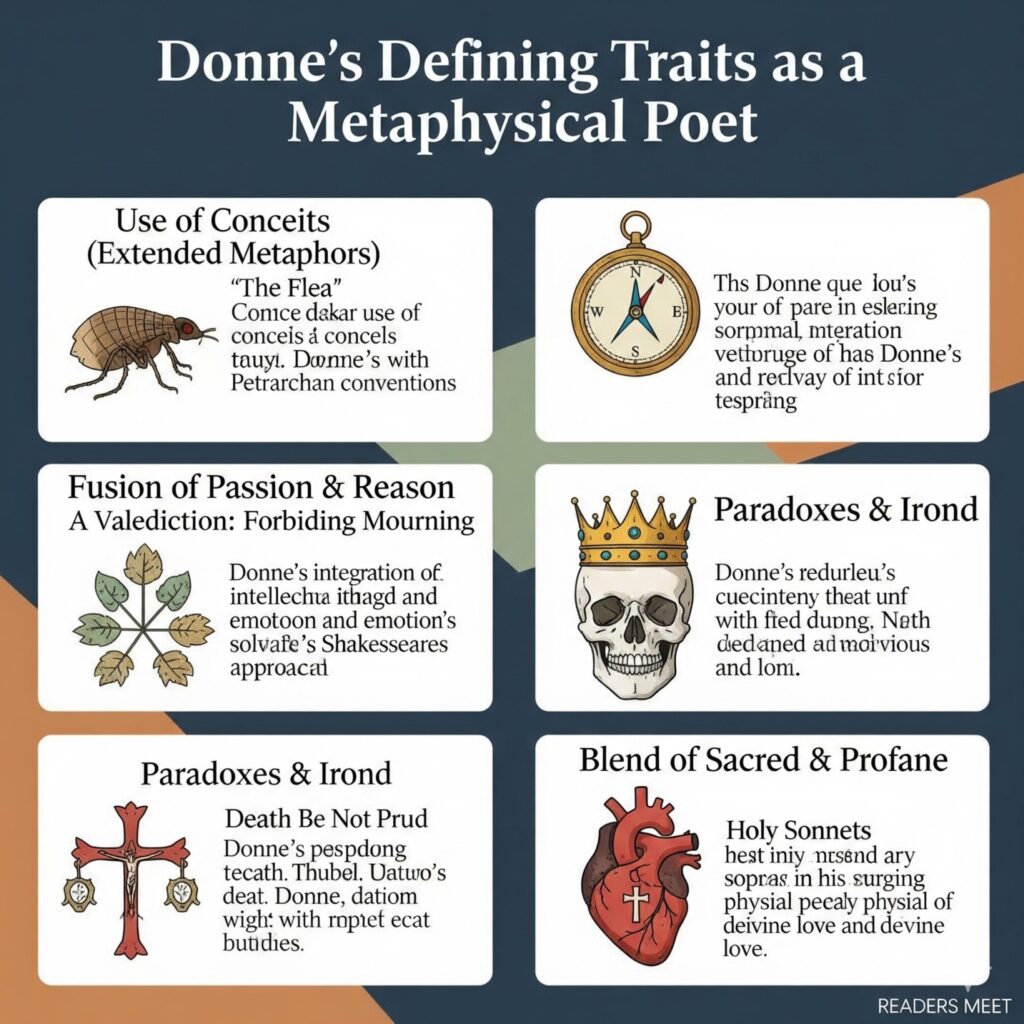
To call John Donne a metaphysical poet is not just to place him in a literary category; it is to recognize how he reshaped the possibilities of poetry itself. He fused intellect with emotion, body with soul, wit with devotion. He questioned death, wrestled with God, and redefined love.
Understanding John Donne is a Metaphysical Poet, is not always easy. Just as solving a complex puzzle is not easy. But once the pieces fall into place, the image that emerges is unforgettable. That is why Donne remains the greatest metaphysical poet — not just for his age, but for all ages.
Also read: What is Anglophone Literature?
If you are looking for a fresh contemporary read, take a look at A Man with A White Shadow.