
Introduction: Why Tennessee Williams Matters
If literature were a theatre, Tennessee Williams would be the playwright who left the lights on long after the actors left the stage. His words don’t just tell stories — they bleed emotion. Williams’ writing style is known for its lyrical intensity, psychological depth, and brutal honesty about human vulnerability.
For both writers seeking to refine their craft and students studying 20th-century American drama, understanding Tennessee Williams’ writing style is like discovering the anatomy of emotion itself.
In this blog, we’ll explore:
- How his personal life shaped his artistic choices.
- The defining traits of his writing style, with examples.
- Comparisons with other playwrights like Arthur Miller, Eugene O’Neill, and even Anton Chekhov.
- And most importantly — what modern writers can learn from his art of emotional storytelling.
Step 1: Understanding the Man Behind the Words
Thomas Lanier “Tennessee” Williams (1911–1983) grew up in the American South — a landscape of contradictions: genteel manners, deep repression, and cultural decay. His father was an alcoholic; his mother was delicate and emotionally volatile; and his beloved sister, Rose, suffered from mental illness and underwent a lobotomy — an event that scarred him for life.
This fragile family structure echoes through his plays. His protagonists are often broken dreamers, trapped in decaying homes or fading illusions. In many ways, Williams’ work is the poetic autobiography of a wounded soul.
He famously said:
“If writing is honest, it cannot be separated from the man who wrote it.”
So to understand Williams’ writing style, we must see it as the mirror of his own psyche — filled with tenderness, truth, and torment.
Step 2: The Core of His Style — Poetry in Prose, Drama in Emotion
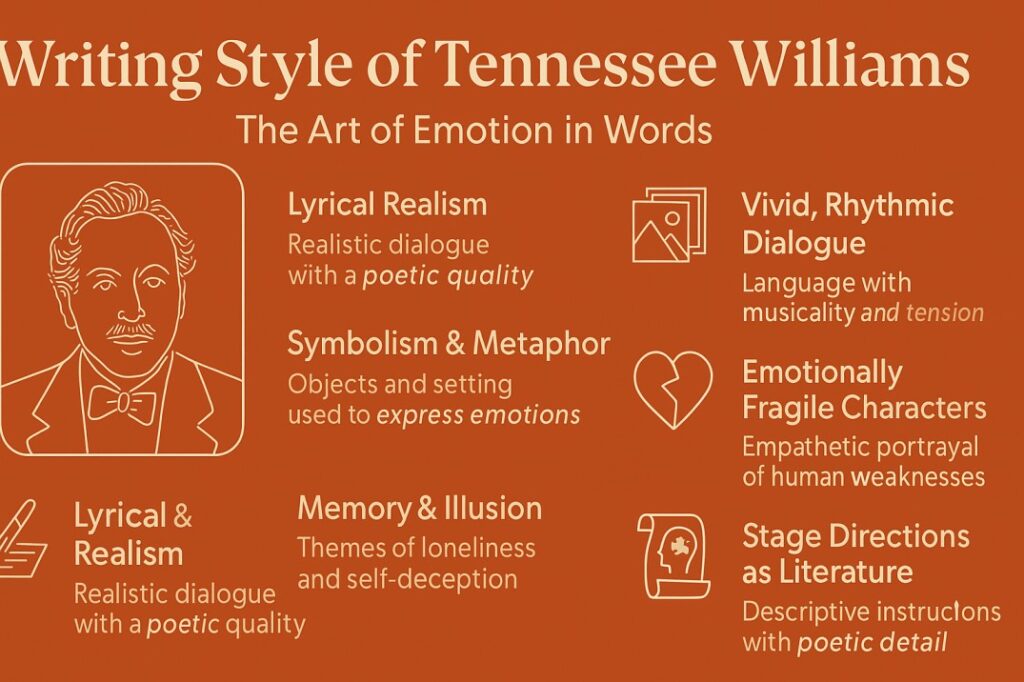
1. Lyrical Realism: Where Poetry Meets the Stage
Williams’ plays are realistic in setting but poetic in tone. He called this style “lyrical realism” — realism that bleeds poetry.
Take his masterpiece A Streetcar Named Desire (1947). The dialogue is rooted in ordinary life — a working-class New Orleans apartment — yet it flows like music. Blanche DuBois says:
“I don’t want realism. I want magic!”
This line defines Williams’ craft. His realism doesn’t just show what life is — it shows what life feels like.
📘 Comparison:
While Arthur Miller focused on moral realism (Death of a Salesman), Williams pursued emotional realism. Miller dissected social systems; Williams dissected hearts.
2. Symbolism and Metaphor — Layers Beneath Dialogue
Every Williams play carries a second language — the language of symbols. His characters rarely say what they mean. Instead, the setting, objects, and even lighting communicate subtext.
Examples:
- In The Glass Menagerie (1944), Laura’s collection of glass animals symbolizes her fragile inner world.
- The broken unicorn in that same play mirrors Laura’s shattered innocence after her encounter with Jim.
- In A Streetcar Named Desire, the recurring image of light and shadow represents Blanche’s fading beauty and illusion.
Williams’ use of symbols rivals that of F. Scott Fitzgerald in The Great Gatsby. Both use tangible objects to express intangible pain.
📘 For Writers:
Symbolism should never feel forced. Williams teaches that symbols work best when they emerge naturally from character psychology.
3. The Language of Desire and Desperation
Desire is the heartbeat of all Williams’ plays — romantic, sexual, or spiritual. His characters are consumed by longing, often destructive and misunderstood.
In A Streetcar Named Desire, Blanche’s descent begins because she cannot reconcile her yearning for affection with the reality of her faded youth.
In Cat on a Hot Tin Roof (1955), Brick numbs his repressed desires with alcohol, while Maggie burns with unfulfilled passion.
Desire, for Williams, is both salvation and damnation — “the opposite of death,” as Blanche declares.
📘 Comparison:
While Eugene O’Neill portrayed existential despair (Long Day’s Journey Into Night), Williams portrayed emotional hunger — a subtler, more sensual tragedy.
4. Characterization Through Fragility
Williams’ characters are rarely heroes; they are human wounds walking on stage. He writes them with empathy, not judgment.
Examples:
- Blanche DuBois (Streetcar) — living between fantasy and decay.
- Amanda Wingfield (The Glass Menagerie) — clinging to the past to survive the present.
- Brick and Maggie (Cat on a Hot Tin Roof) — imprisoned by silence and longing.
His fragile characters challenge the traditional masculine narratives of strength and stoicism found in earlier writers like Hemingway. Williams replaced bravado with vulnerability — and in doing so, revolutionized American theatre.
📘 For Writers:
The secret to Williams’ characters lies in psychological layering — their contradictions make them real. To create unforgettable characters, write their inner conflicts, not just their outer actions.
Step 3: Structural and Dramatic Style — The Music of Conflict
1. Nonlinear Memory Structure
Williams often structured his plays like memory itself — fragmented, nostalgic, and emotional rather than chronological.
In The Glass Menagerie, Tom narrates the story years later, telling us it’s a “memory play.” This structure allows Williams to infuse scenes with dreamlike exaggeration and poetic melancholy.
📘 Contrast:
This technique echoes Marcel Proust’s In Search of Lost Time, where the act of remembering transforms the story itself. Both writers treat memory as art, not just recollection.
2. Stage Directions as Literature
Few playwrights write stage directions as beautifully as Williams. His descriptions are almost cinematic: filled with mood, sound, and color.
For instance, the opening of The Glass Menagerie doesn’t just describe a setting — it establishes tone:
“A memory play… dimly lighted, sentimental, not realistic.”
Through such directions, Williams turns stagecraft into prose poetry — a guide not just for directors, but for readers’ imaginations.
📘 For Writers:
Even your descriptions can have rhythm. Williams’ stage directions remind us that tone begins before dialogue.
3. Musicality in Dialogue
Williams believed language should sound like jazz — emotional, rhythmic, unpredictable. His dialogue rises and falls like human breath.
In Streetcar, Blanche’s voice lilts with musical delicacy, while Stanley’s speech is rough, blunt, percussive. Their verbal clash creates both rhythm and tension — the music of conflict.
📘 Comparison:
This musical tension can be compared to Shakespeare’s blend of prose and verse in Hamlet. Both writers used contrasting voices to reveal class, power, and psychology.
Step 4: Themes — Loneliness, Illusion, and the Search for Meaning
1. Loneliness as Human Condition
Williams once said,
“We are all sentenced to solitary confinement inside our own skins.”
Loneliness runs through his entire body of work — not as a tragedy, but as an unavoidable truth of being human.
Tom, Blanche, Amanda, Brick — all live surrounded by people yet starved of understanding. Williams’ portrayal of loneliness feels timeless, much like Franz Kafka’s existential alienation or T.S. Eliot’s “The Love Song of J. Alfred Prufrock.”
2. Illusion vs. Reality
In Williams’ world, people survive by lying to themselves. Illusion becomes protection against pain.
Blanche hides behind fantasies of refinement; Amanda clings to old Southern gentility; Big Daddy hides his fear of death behind bravado.
Yet, illusion is double-edged: it saves and destroys. Williams’ fascination with self-deception mirrors Flaubert’s Emma Bovary, who also mistakes fantasy for salvation.
📘 For Writers:
Williams’ treatment of illusion teaches that characters should believe their own lies. That’s where drama lives.
3. Compassion for the “Outcasts”
Williams gave voice to the marginalized — the mentally ill, the queer, the poor, the dreamers.
His semi-autobiographical play The Two-Character Play (1967) and Suddenly Last Summer (1958) explored taboo subjects like homosexuality long before they were openly discussed.
📘 Contrast:
While contemporaries like Miller or O’Neill wrote about social struggle, Williams wrote about inner exile. His compassion turned brokenness into beauty.
Step 5: Writing Lessons from Tennessee Williams
Williams isn’t just a playwright to study — he’s a mentor in disguise. Here are lessons every writer or student can take from his craft:
- Write from emotion, not observation.
He wrote what he felt, not what he saw. - Let symbolism arise naturally.
A symbol that feels forced loses power. - Make language rhythmic.
Even simple lines can sing if they have cadence. - Love your broken characters.
Empathy turns flaws into poetry. - Don’t fear vulnerability.
Williams’ genius came from exposing what others hide.
📘 Practical Exercise:
Rewrite a plain scene — a fight, a memory, a goodbye — using Williams’ three tools: rhythm, imagery, and emotional honesty.
You’ll notice how the scene becomes alive — not just told, but felt.
Step 6: Legacy and Comparison — The Playwright Who Wrote the Human Heart
Williams’ legacy rests on his ability to merge theatrical structure with poetic introspection.
- Compared to Arthur Miller:
Miller examined society; Williams examined the soul. - Compared to Eugene O’Neill:
O’Neill’s despair was cosmic; Williams’ was personal. - Compared to Harold Pinter:
Pinter hid meaning behind silence; Williams let meaning overflow. - Compared to Chekhov:
Both mastered emotional subtlety, but Williams’ dialogue burns hotter with Southern intensity.
Even decades after his death, his plays remain relevant because they speak to what never changes — the ache of being human.
Modern playwrights like Tony Kushner (Angels in America) and Tracy Letts (August: Osage County) owe much to Williams’ blend of realism and lyricism.
Conclusion: The Signature of Tennessee Williams
Tennessee Williams’ writing style is not just about how he wrote — it’s about why.
He wrote to survive. To turn chaos into beauty. To make pain articulate.
Every sentence he crafted reveals one truth: art is empathy written down.
For students, Williams teaches analysis through emotion.
For writers, he teaches craft through vulnerability.
And for every reader, he reminds us that stories are the only bridges strong enough to carry our brokenness.
So if you want to write like Tennessee Williams, don’t imitate his language — imitate his courage.
Write what hurts, sing what trembles, and, above all, make it true.
Also Read: Decode the Universe with Carl Sagan
20 Best Tennessee Williams Quotes
And if you are looking for a fresh read that give you new perspectives on life, try A Man with A White Shadow